Medizinonline Medizinonline
  • News
    • News
    • Market & Medicine
  • Patients
    • Disease patterns
    • Diagnostics
    • Therapy
  • Partner Content
    • Diabetes
      • Dia-Month Club – Type 2 Diabetes
      • Diabetes in Motion
      • Diabetes Podcasts
    • Gastroenterology
      • IBD matters
    • Oncology
      • Swiss Oncology in motion
    • Orthopedics
      • Osteoporosis in motion
  • Departments
    • Allergology and clinical immunology
    • General Internal Medicine
    • Anesthesiology
    • Angiology
    • Surgery
    • Dermatology and venereology
    • Endocrinology and Diabetology
    • Nutrition
    • Gastroenterology and Hepatology
    • Genetics
    • Geriatrics
    • Gynecology
    • Hematology
    • Infectiology
    • Cardiology
    • Nephrology
    • Neurology
    • Emergency and intensive care medicine
    • Nuclear Medicine
    • Oncology
    • Ophthalmology
    • ORL
    • Orthopedics
    • Pediatrics
    • Pharmacology and toxicology
    • Pharmaceutical medicine
    • Phlebology
    • Physical medicine and rehabilitation
    • Pneumology
    • Prevention and health care
    • Psychiatry and psychotherapy
    • Radiology
    • Forensic Medicine
    • Rheumatology
    • Sports Medicine
    • Traumatology and trauma surgery
    • Tropical and travel medicine
    • Urology
    • Dentistry
  • CME & Congresses
    • CME continuing education
    • Congress Reports
    • Congress calendar
  • Practice
    • Noctimed
    • Practice Management
    • Jobs
    • Interviews
  • Log In
  • Register
  • My account
  • Contact
  • Publications
  • Contact
  • Deutsch
  • English
  • Français
  • Italiano
  • Português
  • Español
Subscribe
Medizinonline Medizinonline
  • News
    • News
    • Market & Medicine
  • Patienten
    • Krankheitsbilder
    • Diagnostik
    • Therapie
  • Partner Content
    • Diabetes
      • Dia-Month Club – Type 2 Diabetes
      • Diabetes in Motion
      • Diabetes Podcasts
    • Gastroenterology
      • IBD matters
    • Oncology
      • Swiss Oncology in motion
    • Orthopedics
      • Osteoporosis in motion
    • Phytotherapie
    • Rheumatology
  • Departments
    • Fachbereiche 1-13
      • Allergology and clinical immunology
      • General Internal Medicine
      • Anesthesiology
      • Angiology
      • Surgery
      • Dermatology and venereology
      • Endocrinology and Diabetology
      • Nutrition
      • Gastroenterology and Hepatology
      • Genetics
      • Geriatrics
      • Gynecology
      • Hematology
    • Fachbereiche 14-26
      • Infectiology
      • Cardiology
      • Nephrology
      • Neurology
      • Emergency and intensive care medicine
      • Nuclear Medicine
      • Oncology
      • Ophthalmology
      • ORL
      • Orthopedics
      • Pediatrics
      • Pharmacology and toxicology
      • Pharmaceutical medicine
    • Fachbereiche 26-38
      • Phlebology
      • Physical medicine and rehabilitation
      • Phytotherapy
      • Pneumology
      • Prevention and health care
      • Psychiatry and psychotherapy
      • Radiology
      • Forensic Medicine
      • Rheumatology
      • Sports Medicine
      • Traumatology and trauma surgery
      • Tropical and travel medicine
      • Urology
      • Dentistry
  • CME & Congresses
    • CME continuing education
    • Congress Reports
    • Congress calendar
  • Practice
    • Noctimed
    • Practice Management
    • Jobs
    • Interviews
Login

Sie haben noch keinen Account? Registrieren

  • 18th Annual Meeting of the Swiss Cerebrovascular Society

Transfer of evidence into practice

    • Congress Reports
    • Neurology
    • RX
  • 3 minute read

At the SHG Congress in Geneva, a satellite symposium discussed the current study situation in the field of non-valvular atrial fibrillation. How can stroke be effectively prevented and what is the benefit-risk profile of each agent? In particular, the focus was on practical reality. Apparently, there is still a need to catch up with regard to the implementation of study findings in everyday clinical practice – this despite the fact that the evidence leaves hardly any questions unanswered.

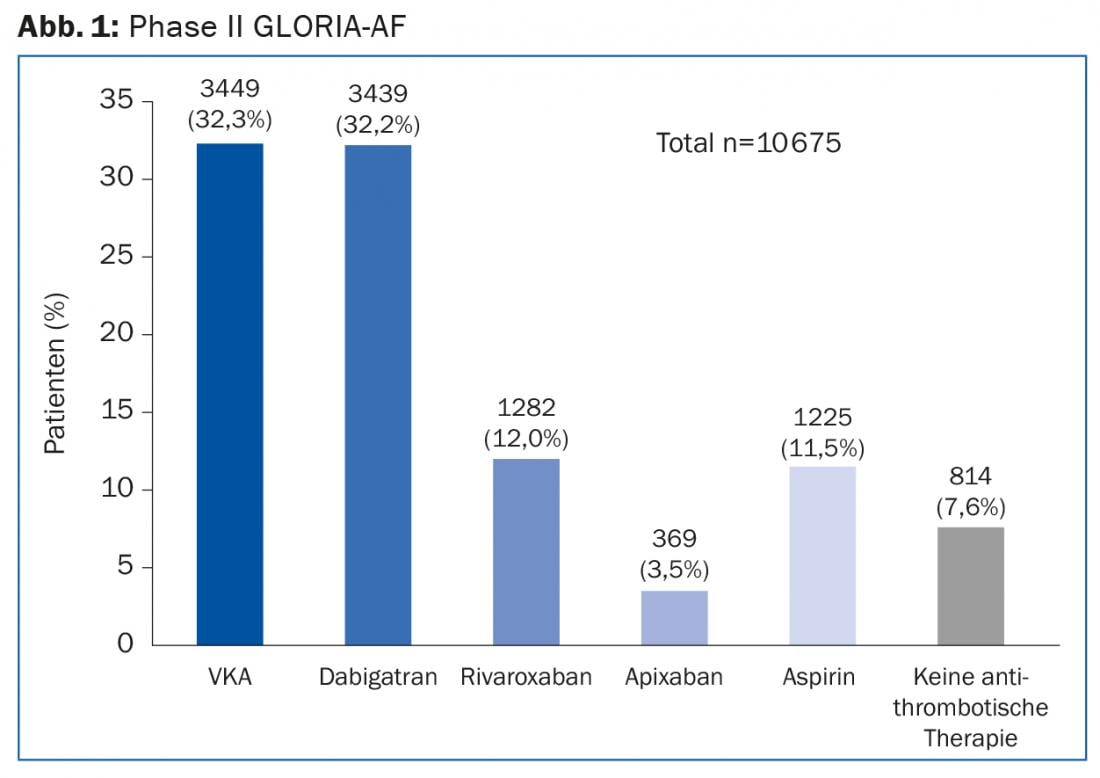
Discussion sometimes centered on which patient characteristics influence the choice of antithrombotic therapy. In addition, we again reviewed the collected safety and efficacy outcomes of each agent and discussed regional differences in their prescribing. The first topic was the large international registry study GLORIA-AF. This is a program that was launched in May 2011 and includes patients with newly diagnosed non-valvular atrial fibrillation (AF). The goal is to collect data from clinical practice – this will provide approximately 56,000 patients from nearly 50 countries (and over 2200 centers). All are at risk for stroke (CHA2DS2-VASc score ≥1). The cross-sectional data [1] presented at the 2014 ESC Congress in Barcelona covered a recruitment period from November 2011 to February 2014 and were based on 10,675 patient cases (85.5% of whom had a CHA2DS2-VASc score ≥2). They originate from the second phase of the GLORIA AF program. This started shortly after the approval of dabigatran, the first NOAK for stroke prevention in VHF.

Data from 39 countries show that although an increasing shift toward NOAKs is evident in clinical practice (Fig. 1), the process is slow and the rate of undertreated patients remains high. In addition, for newly diagnosed VCF, vitamin K antagonists (VKA) continue to be used most frequently, and aspirin still accounts for a significant proportion.
Acting against the evidence?

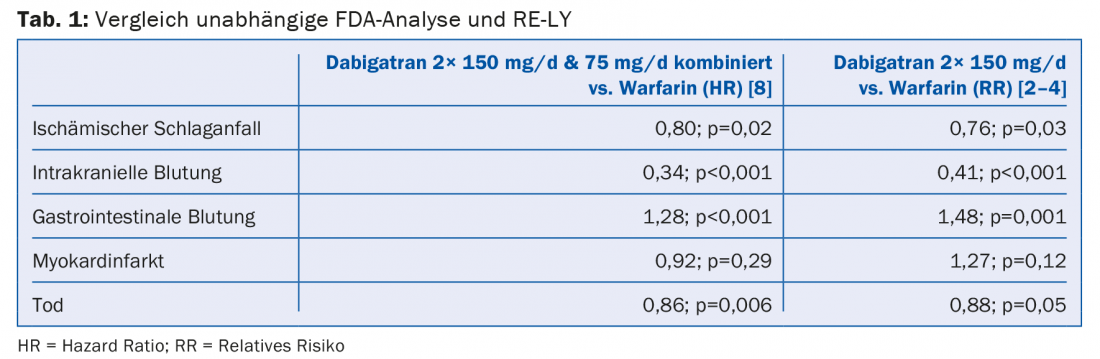
This is surprising, because the evidence speaks for itself: the NOAKs can be considered standard therapy for VHF. A review of the studies (RE-LY [2–4], ROCKET-AF [5], ARISTOTLE [6], ENGAGE-AF [7]) shows that NOAKs are superior to VKAs in the benefit-risk profile. To illustrate, according to a recent review of the RE-LY trial [4], dabigatran at the dose of 2× 150 mg/d showed a relative risk of stroke or systemic embolism of 0.65 (95%CI 0.52-0.81; p<0.001), a risk reduction of 35% compared with warfarin. For ischemic or nonspecific strokes, the value was 0.76 (95%CI 0.59-0.97; p=0.03).

According to GLORIA-AF, implementation of the findings into practice is going best in North America and Europe, where NOAKs are slowly overtaking VKAs. In Asia in particular (but also in North America in some cases), many patients – although at high risk of stroke – remain untreated or are treated exclusively with aspirin.

This approach contradicts the current state of studies. Concerns that the effects of NOAKs present differently in the randomized trial setting than in clinical reality have recently been refuted again by an independent FDA analysis [8]. It confirmed the good benefit-risk profile of dabigatran in the everyday practice setting with astonishing consistency: the data collected from 134 414 elderly patients were largely consistent with those from RE-LY (Table 1) .
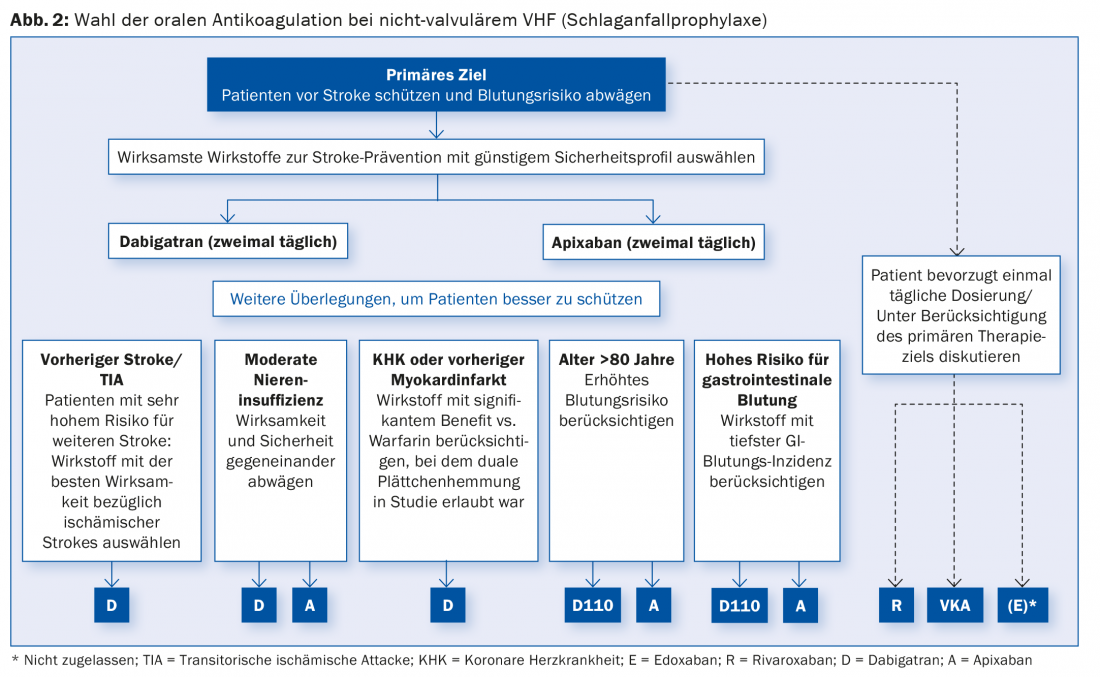
It is therefore important to now increasingly translate the evidence into clinical action. Using patient characteristics, Prof. Hans-Christoph Diener, Essen, MD, showed how this could be done. The algorithm is shown in Figure 2 .
Source: “Sheltering patients from stroke: optimizing protection,” Satellite Symposium at SHG Congress, January 29-30, 2015, Geneva.

Literature:

  1. Huisman MV, et al: Global registry on long-term oral antithrombotic treatment in patients with atrial fibrillation: baseline characteristics of the first 10,000 patients in GLORIA-AF Phase II. Session “Registry Hot Line: Atrial fibrillation and myocardial infarction”. ESC Congress 2014.
  2. Connolly SJ, et al: Dabigatran versus warfarin in patients with atrial fibrillation. N Engl J Med 2009 Sep 17; 361(12): 1139-1151.
  3. Connolly SJ, et al: Newly identified events in the RE-LY trial. N Engl J Med 2010 Nov 4; 363(19): 1875-1876.
  4. Connolly SJ, Wallentin L, Yusuf S: Additional events in the RE-LY trial. N Engl J Med 2014 Oct 9; 371(15): 1464-1465.
  5. Patel MR, et al: Rivaroxaban versus warfarin in nonvalvular atrial fibrillation. N Engl J Med 2011 Sep 8; 365(10): 883-891.
  6. Granger CB, et al: Apixaban versus warfarin in patients with atrial fibrillation. N Engl J Med 2011 Sep 15; 365(11): 981-992.
  7. Giugliano RP, et al: Edoxaban versus warfarin in patients with atrial fibrillation. N Engl J Med 2013 Nov 28; 369(22): 2093-2104.
  8. Graham DJ, et al: Cardiovascular, bleeding, and mortality risks in elderly medicare patients treated with dabigatran or warfarin for nonvalvular atrial fibrillation. Circulation 2015 Jan 13; 131(2): 157-164.

HAUSARZT PRAXIS 2015; 10(4): 33-35
Autoren
  • Andreas Grossmann
Publikation
  • HAUSARZT PRAXIS
Previous Article
  • Unclear skin lesion in three and a half year old boy

Inflammatory lump on the cheek – infectious?

  • Allergology and clinical immunology
  • Cases
  • Dermatology and venereology
  • Pediatrics
  • RX
View Post
Next Article
  • Patient Competency

“There is an increased need for micronutrients under chemotherapy”.

  • Interviews
  • Nutrition
  • Oncology
  • RX
View Post
You May Also Like
View Post
  • 5 min
  • Sarcoidosis

New options from JAKi to mTOR

    • RX
    • Congress Reports
    • General Internal Medicine
    • Pneumology
    • Studies
View Post
  • 6 min
  • Head and neck squamous cell carcinoma

Precision immunotherapy and local treatment

    • RX
    • Congress Reports
    • Dermatology and venereology
    • Oncology
    • ORL
    • Studies
View Post
  • 3 min
  • From symptom to diagnosis

Abdominal pain – Prostate cysts

    • RX
    • Cases
    • Education
    • General Internal Medicine
    • Radiology
    • Surgery
    • Urology
View Post
  • 0 min
  • Multimodal Parkinson's Treatment

Positive Effects of a Music-Based Intervention

    • RX
    • Education
    • Geriatrics
    • Neurology
    • Physical medicine and rehabilitation
    • Psychiatry and psychotherapy
View Post
  • 8 min
  • Psychooncology

Communication as the key to therapy adherence

    • RX
    • CME continuing education
    • General Internal Medicine
    • Practice Management
View Post
  • 9 min
  • Cardiology

Minimally invasive – the quiet triumph of modern heart surgery

    • RX
    • Cardiology
    • CME continuing education
    • Studies
    • Surgery
View Post
  • 6 min
  • Schizophrenia in the early-onset stage

Which antipsychotic should be used for treatment-naive patients?

    • RX
    • Education
    • Pharmacology and toxicology
    • Psychiatry and psychotherapy
    • Studies
View Post
  • 4 min
  • Diarrhea in children

The problem of parental expectations

    • RX
    • Education
    • Gastroenterology and Hepatology
    • General Internal Medicine
    • Infectiology
    • Pediatrics
    • Studies
  • IBD matters

    Zum Thema
Top CME content
  • 1
    Current State of Knowledge and New Therapeutic Approaches
  • 2
    Why is it so hard to lose weight?
  • 3
    Functional limb preservation between infection control, vascular medicine and resurfacing
  • 4
    Algorithms, avatars and the unburdened mind
  • 5
    Communication as the key to therapy adherence

Newsletter

Sign up and stay up to date

Subscribe
Medizinonline Medizinonline
  • Contact
  • General terms and conditions
  • Imprint

Input your search keywords and press Enter.