Medizinonline Medizinonline
  • News
    • News
    • Market & Medicine
  • Patients
    • Disease patterns
    • Diagnostics
    • Therapy
  • Partner Content
    • Dermatology
      • Atopic dermatitis and psoriasis news
    • Diabetes
      • Dia-Month Club – Type 2 Diabetes
      • Diabetes in Motion
      • Diabetes Podcasts
    • Gastroenterology
      • IBD matters
    • Oncology
      • Swiss Oncology in motion
    • Orthopedics
      • Osteoporosis in motion
  • Departments
    • Allergology and clinical immunology
    • General Internal Medicine
    • Anesthesiology
    • Angiology
    • Surgery
    • Dermatology and venereology
    • Endocrinology and Diabetology
    • Nutrition
    • Gastroenterology and Hepatology
    • Genetics
    • Geriatrics
    • Gynecology
    • Hematology
    • Infectiology
    • Cardiology
    • Nephrology
    • Neurology
    • Emergency and intensive care medicine
    • Nuclear Medicine
    • Oncology
    • Ophthalmology
    • ORL
    • Orthopedics
    • Pediatrics
    • Pharmacology and toxicology
    • Pharmaceutical medicine
    • Phlebology
    • Physical medicine and rehabilitation
    • Pneumology
    • Prevention and health care
    • Psychiatry and psychotherapy
    • Radiology
    • Forensic Medicine
    • Rheumatology
    • Sports Medicine
    • Traumatology and trauma surgery
    • Tropical and travel medicine
    • Urology
    • Dentistry
  • CME & Congresses
    • CME continuing education
    • Congress Reports
    • Congress calendar
  • Practice
    • Noctimed
    • Practice Management
    • Jobs
    • Interviews
  • Log In
  • Register
  • My account
  • Contact
  • Publications
  • Contact
  • Deutsch
  • English
  • Français
  • Italiano
  • Português
  • Español
Subscribe
Medizinonline Medizinonline
  • News
    • News
    • Market & Medicine
  • Patienten
    • Krankheitsbilder
    • Diagnostik
    • Therapie
  • Partner Content
    • Dermatology
      • Atopic dermatitis and psoriasis news
    • Diabetes
      • Dia-Month Club – Type 2 Diabetes
      • Diabetes in Motion
      • Diabetes Podcasts
    • Gastroenterology
      • IBD matters
    • Oncology
      • Swiss Oncology in motion
    • Orthopedics
      • Osteoporosis in motion
    • Phytotherapie
    • Rheumatology
  • Departments
    • Fachbereiche 1-13
      • Allergology and clinical immunology
      • General Internal Medicine
      • Anesthesiology
      • Angiology
      • Surgery
      • Dermatology and venereology
      • Endocrinology and Diabetology
      • Nutrition
      • Gastroenterology and Hepatology
      • Genetics
      • Geriatrics
      • Gynecology
      • Hematology
    • Fachbereiche 14-26
      • Infectiology
      • Cardiology
      • Nephrology
      • Neurology
      • Emergency and intensive care medicine
      • Nuclear Medicine
      • Oncology
      • Ophthalmology
      • ORL
      • Orthopedics
      • Pediatrics
      • Pharmacology and toxicology
      • Pharmaceutical medicine
    • Fachbereiche 26-38
      • Phlebology
      • Physical medicine and rehabilitation
      • Phytotherapy
      • Pneumology
      • Prevention and health care
      • Psychiatry and psychotherapy
      • Radiology
      • Forensic Medicine
      • Rheumatology
      • Sports Medicine
      • Traumatology and trauma surgery
      • Tropical and travel medicine
      • Urology
      • Dentistry
  • CME & Congresses
    • CME continuing education
    • Congress Reports
    • Congress calendar
  • Practice
    • Noctimed
    • Practice Management
    • Jobs
    • Interviews
Login

Sie haben noch keinen Account? Registrieren

  • Case series

Successful treatment of androgenetic alopecia with PRP

    • Cases
    • Dermatology and venereology
    • Education
    • RX
    • Studies
  • 3 minute read

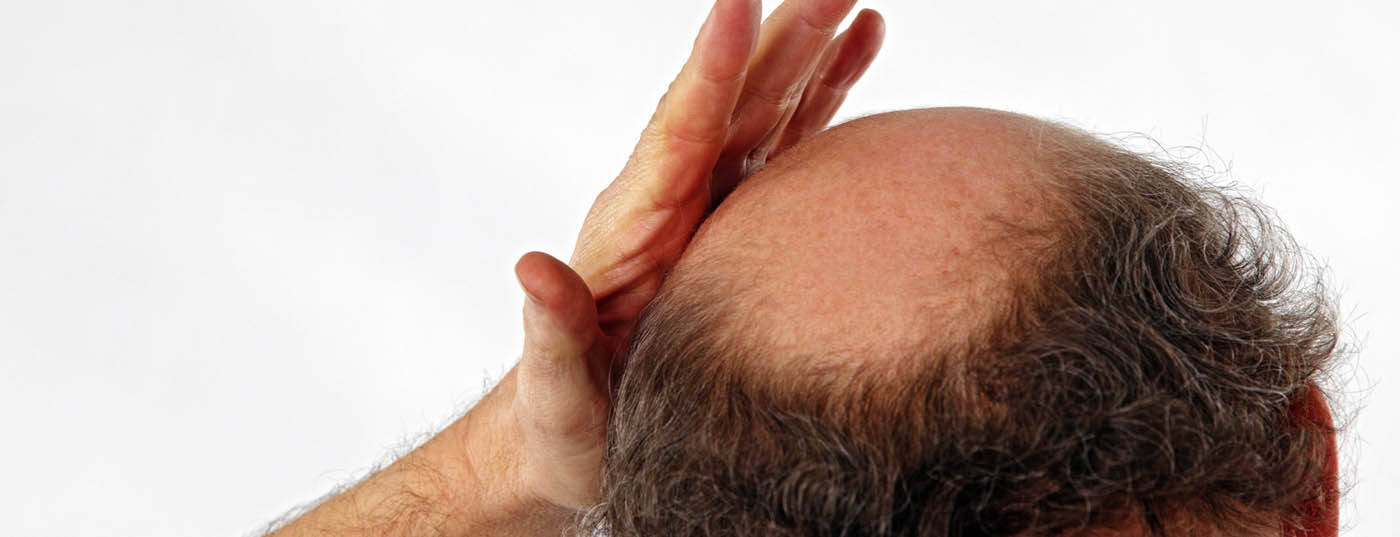
Androgenetic alopecia is the most common cause of hair loss. In a clinical trial published in 2022, PRP achieved promising results and high patient satisfaction in both women and men. Overall, this innovative treatment method was convincing both in terms of efficacy and tolerability.

Hair loss is a common disease in the Western world. Genetic hair loss (androgenetic alopecia, AGA) plays a special role, with a prevalence of up to 80% in men and 50% in women [1]. In many individuals, AGA occurs in a discrete form from late puberty and accentuates throughout life [2]. Pathogenetically, hypersensitivity to dihydrotestosterone (DHT) induces a significant shortening of the anagen phase with miniaturization of hair follicles [2]. DHT is a steroid hormone that is also found in the scalp and shortens the growth phase of the follicles. Mechanistically, AGA is a telogen effluvium [3]. Due to different androgen sensitivity of the scalp regions, AGA shows a central or frontal distribution pattern with gender differences, the back of the head is not affected [3]. In the last decade, treatment with platelet-rich plasma (PRP) has become a common method for treating hair loss. Autologous platelet-rich plasma is obtained from venous whole blood by a centrifugation process and contains a higher concentration of platelets compared with the latter [4].
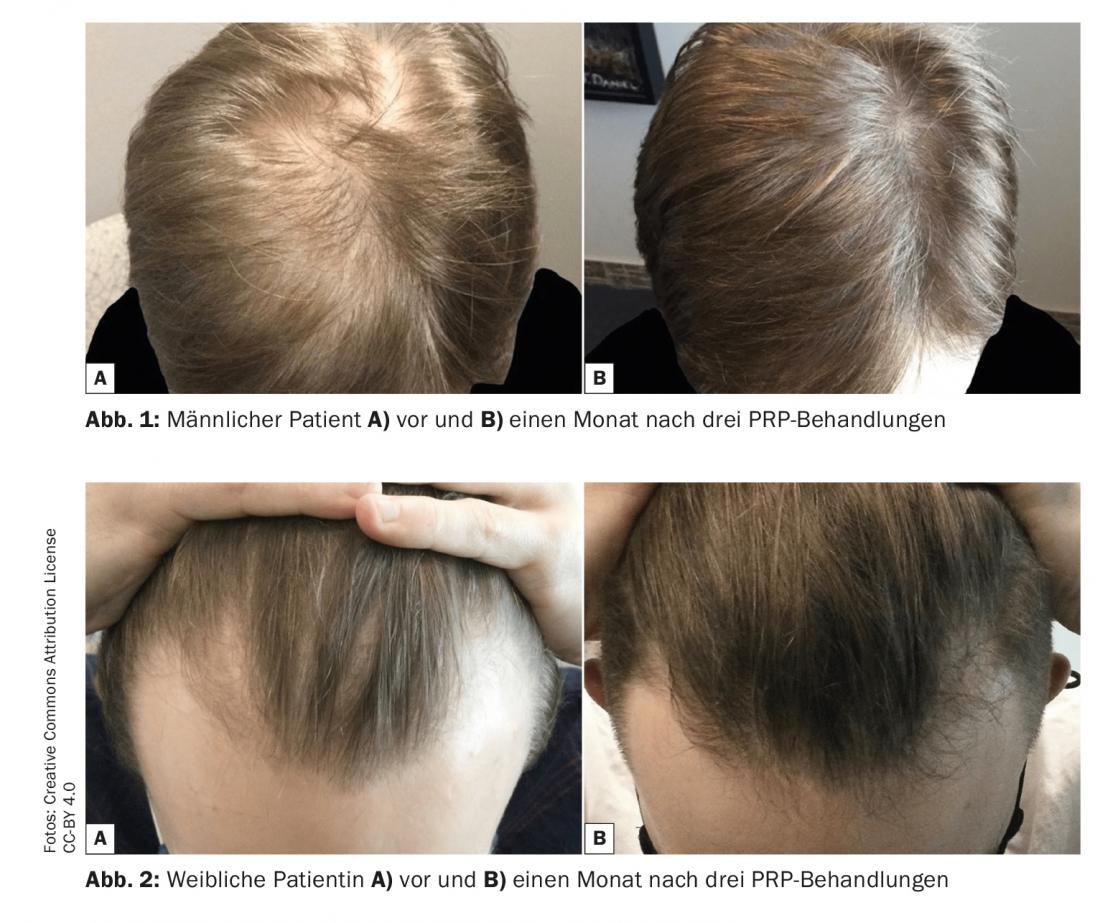


Visible clinical effects and high patient satisfaction

In alopecia treatment, PRP was first used in hair transplants to achieve a better result, but now PRP has also been established as a non-invasive therapy for alopecia. From a clinical perspective, there is increasing evidence of the beneficial effects of PRP treatments [5]. In a case series published by Dr. Samuel Hetz (Ottawa, Canada) and colleagues, a total of 56 patients with androgenetic alopecia were treated with PRP over a 12-month period [6]. The average age of the study participants was 41 years (age range 20-68 years). 57% of all patients were male and 43% female. Fifteen cc of whole blood was spun for five minutes at a time in an ACP* double syringe (Arthrex Inc., Naples, Florida)#. Subsequently, the 5-6 cm³ of PRP obtained from this procedure was injected into the scalp. Forty-nine patients were treated with a series of three injections at monthly intervals, 3 patients received four injections, and 2 were treated with five injections. One patient each was treated with a series of seven and eight injections, respectively. Follow-up examinations took place one month after the last treatment. A self-administered questionnaire was used to assess satisfaction and clinical outcomes from the patient’s and physician’s perspectives. Overall, patients were satisfied with the therapy results. On a scale of 0 to 10, the average patient rating was 7.29 and the average clinician rating was 6.46. With an average score of 8 on a scale of 0 to 10, it is also very likely that patients will recommend PRP treatments to friends.

* ACP=Autologous Conditioned Plasma
# www.arthrex.com/orthobiologics/autologous-conditioned-plasma


Literature:

  1. Piraccini BM, Alessandrini A: Androgenetic alopecia. G Ital Dermatol Venereol 2014; 149: 15-24.
  2. Beise U: Hair loss, 11/2020 update, www.medix.ch/wissen/guidelines/hautkrankheiten/haarausfall, (last accessed 10/13/2022).
  3. de Viragh PA: “Androgenetic alopecia”. Swiss Med Forum 2018; 18(44): 900-906.
  4. Reith B: Autologous platelet-rich plasma in the treatment of alopecia. Current Dermatology 2021; 47(12): 534-543.
  5. Chen JX, Justicz N, Lee LN: Platelet-rich plasma for the treatment of androgenic alopecia: a systematic review. Facial Plast Surg 2018; 34: 631-640.
  6. Hetz S P, Martin J, Pototschnig H: Patient Satisfaction and Clinical Effects of Platelet-Rich Plasma on Pattern Hair Loss in Male and Female Patients. Cureus 14(9): e28801. doi:10.7759/cureus.28801. www.cureus.com, (last accessed Oct. 13, 2022).


DERMATOLOGIE PRAXIS 2022; 32(5): 56

Autoren
  • Mirjam Peter, M.Sc.
Publikation
  • DERMATOLOGIE PRAXIS
Related Topics
  • Alopecia
  • Balding
  • Hair loss
Previous Article
  • Cardiovascular medicine

Effective treatment management for optimized outcome

  • Cardiology
  • Congress Reports
  • General Internal Medicine
  • RX
  • Studies
View Post
Next Article
  • Lower urinary tract symptoms (LUTS)

Include patient preferences when making treatment decisions

  • Education
  • General Internal Medicine
  • Infectiology
  • RX
  • Studies
  • Urology
View Post
You May Also Like
View Post
  • 6 min
  • COPD: Tailor therapy to individual characteristics

Risk of exacerbation correlates with the eosinophil count and other factors

    • Congress Reports
    • Infectiology
    • Pneumology
    • RX
    • Studies
View Post
  • 7 min
  • Focus on new therapeutic targets and senolytics

Cellular senescence

    • Education
    • General Internal Medicine
    • Genetics
    • Geriatrics
    • Prevention and health care
    • RX
    • Studies
View Post
  • 3 min
  • Development of a quintuple agonist

New strategy in the fight against obesity and T2D

    • Congress Reports
    • Endocrinology and Diabetology
    • Pharmacology and toxicology
    • RX
    • Studies
View Post
  • 4 min
  • From symptom to diagnosis

Oncocytoma

    • Cases
    • Education
    • Nephrology
    • Oncology
    • Radiology
    • RX
    • Surgery
View Post
  • 7 min
  • Arterial elasticity, vascular ageing, endothelial function

Longevity and cardiovascular health 2025

    • Angiology
    • Cardiology
    • Education
    • General Internal Medicine
    • Geriatrics
    • Prevention and health care
    • RX
    • Studies
View Post
  • 5 min
  • AI-supported risk stratification for chest pain in the emergency room

Performance of a fully automated ECG model

    • Cardiology
    • Education
    • Emergency and intensive care medicine
    • Prevention and health care
    • RX
    • Studies
View Post
  • 11 min
  • Alternative to insulin and GLP1

From the β-cell to the center: the versatile role of amylin

    • CME continuing education
    • Endocrinology and Diabetology
    • RX
    • Studies
View Post
  • 6 min
  • Hormone balance and longevity

Ageing is not a substitution diagnosis

    • Education
    • Endocrinology and Diabetology
    • General Internal Medicine
    • Geriatrics
    • Gynecology
    • Pharmacology and toxicology
    • Prevention and health care
    • RX
    • Studies
  • IBD matters

    Zum Thema
Top CME content
  • 1
    Control instead of a flood of data: AI makes big data and wearables usable
  • 2
    Causes and prevention at work
  • 3
    Yellow nail and Swyer-James syndrome
  • 4
    Recommendations for action in practice
  • 5
    From the β-cell to the center: the versatile role of amylin

Newsletter

Sign up and stay up to date

Subscribe
Medizinonline Medizinonline
  • Contact
  • General terms and conditions
  • Imprint

Input your search keywords and press Enter.