Medizinonline Medizinonline
  • News
    • News
    • Market & Medicine
  • Patients
    • Disease patterns
    • Diagnostics
    • Therapy
  • Partner Content
    • Dermatology
      • Atopic dermatitis and psoriasis news
    • Diabetes
      • Dia-Month Club – Type 2 Diabetes
      • Diabetes in Motion
      • Diabetes Podcasts
    • Gastroenterology
      • IBD matters
    • Oncology
      • Swiss Oncology in motion
    • Orthopedics
      • Osteoporosis in motion
  • Departments
    • Allergology and clinical immunology
    • General Internal Medicine
    • Anesthesiology
    • Angiology
    • Surgery
    • Dermatology and venereology
    • Endocrinology and Diabetology
    • Nutrition
    • Gastroenterology and Hepatology
    • Genetics
    • Geriatrics
    • Gynecology
    • Hematology
    • Infectiology
    • Cardiology
    • Nephrology
    • Neurology
    • Emergency and intensive care medicine
    • Nuclear Medicine
    • Oncology
    • Ophthalmology
    • ORL
    • Orthopedics
    • Pediatrics
    • Pharmacology and toxicology
    • Pharmaceutical medicine
    • Phlebology
    • Physical medicine and rehabilitation
    • Pneumology
    • Prevention and health care
    • Psychiatry and psychotherapy
    • Radiology
    • Forensic Medicine
    • Rheumatology
    • Sports Medicine
    • Traumatology and trauma surgery
    • Tropical and travel medicine
    • Urology
    • Dentistry
  • CME & Congresses
    • CME continuing education
    • Congress Reports
    • Congress calendar
  • Practice
    • Noctimed
    • Practice Management
    • Jobs
    • Interviews
  • Log In
  • Register
  • My account
  • Contact
  • Publications
  • Contact
  • Deutsch
  • English
  • Français
  • Italiano
  • Português
  • Español
Subscribe
Medizinonline Medizinonline
  • News
    • News
    • Market & Medicine
  • Patienten
    • Krankheitsbilder
    • Diagnostik
    • Therapie
  • Partner Content
    • Dermatology
      • Atopic dermatitis and psoriasis news
    • Diabetes
      • Dia-Month Club – Type 2 Diabetes
      • Diabetes in Motion
      • Diabetes Podcasts
    • Gastroenterology
      • IBD matters
    • Oncology
      • Swiss Oncology in motion
    • Orthopedics
      • Osteoporosis in motion
    • Phytotherapie
    • Rheumatology
  • Departments
    • Fachbereiche 1-13
      • Allergology and clinical immunology
      • General Internal Medicine
      • Anesthesiology
      • Angiology
      • Surgery
      • Dermatology and venereology
      • Endocrinology and Diabetology
      • Nutrition
      • Gastroenterology and Hepatology
      • Genetics
      • Geriatrics
      • Gynecology
      • Hematology
    • Fachbereiche 14-26
      • Infectiology
      • Cardiology
      • Nephrology
      • Neurology
      • Emergency and intensive care medicine
      • Nuclear Medicine
      • Oncology
      • Ophthalmology
      • ORL
      • Orthopedics
      • Pediatrics
      • Pharmacology and toxicology
      • Pharmaceutical medicine
    • Fachbereiche 26-38
      • Phlebology
      • Physical medicine and rehabilitation
      • Phytotherapy
      • Pneumology
      • Prevention and health care
      • Psychiatry and psychotherapy
      • Radiology
      • Forensic Medicine
      • Rheumatology
      • Sports Medicine
      • Traumatology and trauma surgery
      • Tropical and travel medicine
      • Urology
      • Dentistry
  • CME & Congresses
    • CME continuing education
    • Congress Reports
    • Congress calendar
  • Practice
    • Noctimed
    • Practice Management
    • Jobs
    • Interviews
Login

Sie haben noch keinen Account? Registrieren

  • Long-COVID

“The first two months are still considered a grace period”.

    • Cardiology
    • Congress Reports
    • General Internal Medicine
    • Infectiology
    • Neurology
    • Physical medicine and rehabilitation
    • Pneumology
    • Prevention and health care
    • RX
    • Studies
  • 4 minute read

Many patients complain of persistent symptoms after they have recovered from SARS-CoV-2 infection. In such cases, the first path usually leads to the family doctor, but the armamentarium available to the general practitioner does not always lead to a clear diagnosis. Which patients should receive further pulmonary diagnostics – and especially when?

The first 8 weeks after infection can still be counted as the acute phase without any problems; during this period, apart from the possibility of thromboembolic events, there is no need to worry much about complications, said Prof. Dr. Thomas Bahmer, a pulmonologist at the Schleswig-Holstein University Hospital, Kiel Campus (D). If symptoms persist after 2-3 months, performance is impaired, and the primary care physician’s examination with laboratory and ECG does not provide clarity, then diffusion capacity and body plethysmography are the next step. Thereafter, a review should be performed to determine what type of imaging and further diagnostics are indicated.

The most important markers that can be used to assess the severity of illness and progression of SARS-CoV-2 infection are, first, of course, the number, type, and severity of symptoms, the need for hospitalization, oxygen therapy, and the type of treatment. But also the question of existing pre-existing conditions and medication must be considered. “What helps and I definitely recommend is the use of structured questionnaires to elicit symptomatology,” explained Prof. Dr. Bahmer (Tab. 1). In addition, from a pneumological point of view, the findings of other practitioners should always be taken into account if the patient has previously been seen by a general practitioner, cardiologist or ENT specialist, and in rarer cases also by a neurologist or psychiatrist.


One year tracking

The physician presented a Chinese study that included 83 patients (57% male, 43% female) aged 52-66 years from a hospital in Wuhan. The proportion of nasal oxygen vs. HFNC or NIV was 45% vs. 55%, and none received steroid therapy in the acute phase. They all underwent severe acute illness with respiratory rate >30/min,SpO2 <94% at rest, pO2/FiO2 <300 mmHg, and image morphologically a 50% progression within 24-48 hours.

Concomitant or complicating risk factors were excluded, that is, patients were hospitalized and received oxygen administration but had not been ventilated and had no preexisting conditions such as arterial hypertension, diabetes, cancer, or chronic lung disease. They were also exclusively non-smokers.

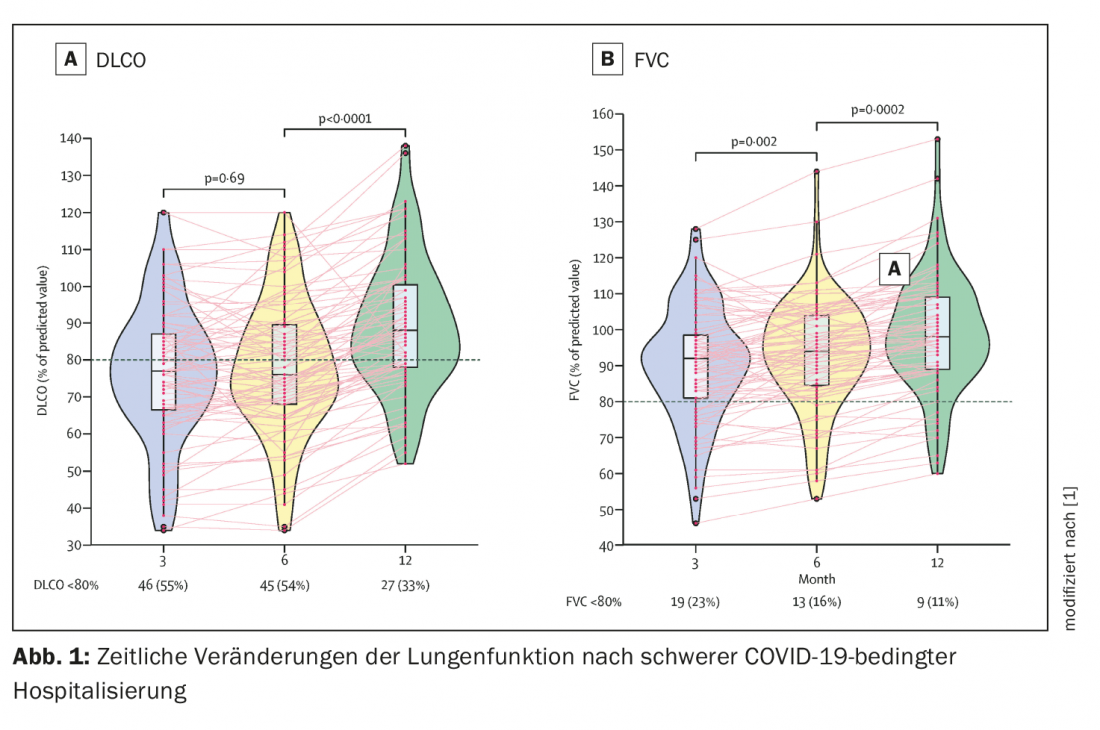
For one year, this population was followed up with both CT and pulmonary function and questionnaires. Evaluation of lung function showed that it can take up to one year for diffusion capacity to return to the normal range. One-third of patients still had a DLCO of less than 80% at 12 months. “The first 6 months remained relatively unchanged, only then was there a leap toward normalization,” said Prof. Bahmer (Fig. 1). In the case of forced vital capacity (FVC), 11% were also still suffering from limitations after one year. The 6-minute walk test and mMRC also show similar patterns.
 

After 9-12 months mostly improvement

Among patients who still have diffusion gas restriction at 12 months, women are more likely to be affected, but this appears to be the only risk factor for persistent restriction. Most patients also show improvement in CT findings after 9-12 months. Residual symptoms are mainly milk glass changes (24%), rarely septal thickening (5%), reticular drawing proliferation (4%) or subpleural compaction (1%). After a year, even more of those patients and the after-effects who had already shown a more severe course of the disease in the acute phase generally suffered, the expert said.

The Hamburg City Health Study [2] also considered patients with mild courses, more than 90% of whom had a non-hospitalized course. Here, although the data 9-10 months after SARS-CoV-2 infection show minimal changes in functional values (total lung capacity somewhat reduced, airway resistance somewhat increased), the results, although statistically significantly different, were for the most part within the normal range.


Procedure for post-COVID

  • Individual but structured step-by-step diagnostics
  • Medical history
  • Laboratory
  • Lung function
  • Imaging
  • Relevant differential diagnoses
  • rule out thoroughly
  • Appreciate pre-existing conditions and concomitant circumstances (comorbidities, age, functional status prior to infection).
  • Progress assessment/re-evaluation


Treatment Pathways

The S1 guideline Post-COVID/Long-COVID [3] recommends pneumologic care for dyspnea, thoracic symptoms, and persistent cough. In any case, diffusion gas measurement should be performed, as well as forced spirometry and body plethysmography at rest. Under stress, the 6-minute walk test and spiroergometry should be used. In imaging, whether chest X-ray is sufficient or CT needs to be done depends on the diffusion gas measurement or D-dimers. In addition, a screening polygraph is suggested. Nonspecific provocation testing, if needed, can address the question of whether one is dealing with post-infectious hyperresponsiveness.

Post-infectious cough is known to often respond well to inhaled corticosteroids. High FeNO levels are considered indicators of a good response to ICS. No hyperresponsiveness and low FeNO conversely indicate that ICS are not effective.
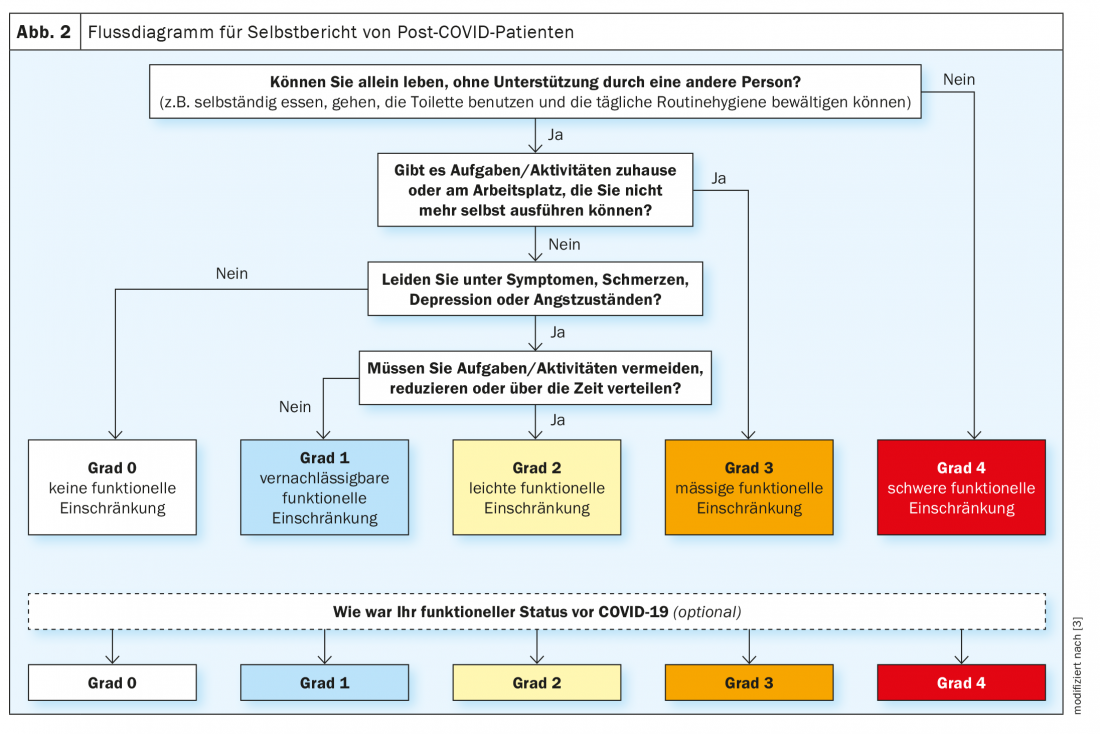


For the management of patients, he said, it is important to work together to develop a plan to get them out of their performance limitations and to give them an awareness that, on the one hand, it will get better over time, but on the other hand, it may take some time. Scoring systems such as those presented in the guideline (Fig. 2) are therefore important and can be given to patients to help them determine progress, Prof. Bahmer said.

Source: 128. Congress of the German Society for Internal Medicine (DGIM)


Literature:

  1. Wu X, Liu X, Zhou Y, et al: 3-month, 6-month, 9-month, and 12-month respiratory outcomes in patients following COVID-19-related hospitalization: a prospective study. Lancet Respir Med 2021; 9: 747-754; doi: 10.1016/S2213-2600(21)00174-0.
  2. Petersen EL, Goßling A, Adam G, et al: Multi-organ assessment in mainly non-hospitalized individuals after SARS-CoV-2 infection: The Hamburg City Health Study COVID programme. European Heart Journal 2022; 43 (11): 1124-1137; doi: 10.1093/eurheartj/ehab914.
  3. Koczulla AR, Ankermann T, Behrends U, et al: S1 guideline post-COVID/long-COVID 2021; AWMF registry number 020-027.


InFo PNEUMOLOGY & ALLERGOLOGY 2022; 2(4): 17-18. 

Autoren
  • Jens Dehn
Publikation
  • InFo PNEUMOLOGIE & ALLERGOLOGIE
Related Topics
  • CORONA
  • covid
  • FeNO
  • ICS
  • long covid
  • post covid
Previous Article
  • Earnings

Work as an independent doctor in Switzerland

  • Education
  • General Internal Medicine
  • News
  • Prevention and health care
  • RX
View Post
Next Article
  • Wound care

Antimicrobial wound dressings in the context of “Antibiotic Stewardship”.

  • Dermatology and venereology
  • Education
  • Infectiology
  • RX
  • Studies
View Post
You May Also Like
View Post
  • 5 min
  • Consequences for pathophysiology, clinic and therapy

The inflammatory subgroup of major depression

    • Education
    • Pharmacology and toxicology
    • Psychiatry and psychotherapy
    • RX
    • Studies
View Post
  • 3 min
  • Adherence of GLP1-RA

Half of patients discontinue treatment within a year

    • Congress Reports
    • Endocrinology and Diabetology
    • General Internal Medicine
    • RX
    • Studies
View Post
  • 6 min
  • RSV infection in adult patients at risk

Vaccination as a simple and sensible prophylaxis

    • Education
    • General Internal Medicine
    • Infectiology
    • Pneumology
    • Prevention and health care
    • RX
View Post
  • 7 min
  • A case-based, practical overview from Canada

Vaccinations for heart patients

    • Cardiology
    • Cases
    • General Internal Medicine
    • Infectiology
    • Prevention and health care
    • RX
View Post
  • 4 min
  • Acne treatment: current trends

What role do dermocosmetics play?

    • Allergology and clinical immunology
    • Congress Reports
    • Dermatology and venereology
    • Pharmacology and toxicology
    • RX
    • Studies
View Post
  • 6 min
  • COPD: Tailor therapy to individual characteristics

Risk of exacerbation correlates with the eosinophil count and other factors

    • Congress Reports
    • Infectiology
    • Pneumology
    • RX
    • Studies
View Post
  • 7 min
  • Focus on new therapeutic targets and senolytics

Cellular senescence

    • Education
    • General Internal Medicine
    • Genetics
    • Geriatrics
    • Prevention and health care
    • RX
    • Studies
View Post
  • 3 min
  • Development of a quintuple agonist

New strategy in the fight against obesity and T2D

    • Congress Reports
    • Endocrinology and Diabetology
    • Pharmacology and toxicology
    • RX
    • Studies
  • IBD matters

    Zum Thema
Top CME content
  • 1
    Control instead of a flood of data: AI makes big data and wearables usable
  • 2
    Causes and prevention at work
  • 3
    Yellow nail and Swyer-James syndrome
  • 4
    Recommendations for action in practice
  • 5
    From the β-cell to the center: the versatile role of amylin

Newsletter

Sign up and stay up to date

Subscribe
Medizinonline Medizinonline
  • Contact
  • General terms and conditions
  • Imprint

Input your search keywords and press Enter.