Medizinonline Medizinonline
  • News
    • News
    • Market & Medicine
  • Patients
    • Disease patterns
    • Diagnostics
    • Therapy
  • Partner Content
    • Dermatology
      • Atopic dermatitis and psoriasis news
    • Diabetes
      • Dia-Month Club – Type 2 Diabetes
      • Diabetes in Motion
      • Diabetes Podcasts
    • Gastroenterology
      • IBD matters
    • Oncology
      • Swiss Oncology in motion
    • Orthopedics
      • Osteoporosis in motion
  • Departments
    • Allergology and clinical immunology
    • General Internal Medicine
    • Anesthesiology
    • Angiology
    • Surgery
    • Dermatology and venereology
    • Endocrinology and Diabetology
    • Nutrition
    • Gastroenterology and Hepatology
    • Genetics
    • Geriatrics
    • Gynecology
    • Hematology
    • Infectiology
    • Cardiology
    • Nephrology
    • Neurology
    • Emergency and intensive care medicine
    • Nuclear Medicine
    • Oncology
    • Ophthalmology
    • ORL
    • Orthopedics
    • Pediatrics
    • Pharmacology and toxicology
    • Pharmaceutical medicine
    • Phlebology
    • Physical medicine and rehabilitation
    • Pneumology
    • Prevention and health care
    • Psychiatry and psychotherapy
    • Radiology
    • Forensic Medicine
    • Rheumatology
    • Sports Medicine
    • Traumatology and trauma surgery
    • Tropical and travel medicine
    • Urology
    • Dentistry
  • CME & Congresses
    • CME continuing education
    • Congress Reports
    • Congress calendar
  • Practice
    • Noctimed
    • Practice Management
    • Jobs
    • Interviews
  • Log In
  • Register
  • My account
  • Contact
  • Publications
  • Contact
  • Deutsch
  • English
  • Français
  • Italiano
  • Português
  • Español
Subscribe
Medizinonline Medizinonline
  • News
    • News
    • Market & Medicine
  • Patienten
    • Krankheitsbilder
    • Diagnostik
    • Therapie
  • Partner Content
    • Dermatology
      • Atopic dermatitis and psoriasis news
    • Diabetes
      • Dia-Month Club – Type 2 Diabetes
      • Diabetes in Motion
      • Diabetes Podcasts
    • Gastroenterology
      • IBD matters
    • Oncology
      • Swiss Oncology in motion
    • Orthopedics
      • Osteoporosis in motion
    • Phytotherapie
    • Rheumatology
  • Departments
    • Fachbereiche 1-13
      • Allergology and clinical immunology
      • General Internal Medicine
      • Anesthesiology
      • Angiology
      • Surgery
      • Dermatology and venereology
      • Endocrinology and Diabetology
      • Nutrition
      • Gastroenterology and Hepatology
      • Genetics
      • Geriatrics
      • Gynecology
      • Hematology
    • Fachbereiche 14-26
      • Infectiology
      • Cardiology
      • Nephrology
      • Neurology
      • Emergency and intensive care medicine
      • Nuclear Medicine
      • Oncology
      • Ophthalmology
      • ORL
      • Orthopedics
      • Pediatrics
      • Pharmacology and toxicology
      • Pharmaceutical medicine
    • Fachbereiche 26-38
      • Phlebology
      • Physical medicine and rehabilitation
      • Phytotherapy
      • Pneumology
      • Prevention and health care
      • Psychiatry and psychotherapy
      • Radiology
      • Forensic Medicine
      • Rheumatology
      • Sports Medicine
      • Traumatology and trauma surgery
      • Tropical and travel medicine
      • Urology
      • Dentistry
  • CME & Congresses
    • CME continuing education
    • Congress Reports
    • Congress calendar
  • Practice
    • Noctimed
    • Practice Management
    • Jobs
    • Interviews
Login

Sie haben noch keinen Account? Registrieren

  • Non-resolving pneumonia

When the inflammation does not want to heal

    • Congress Reports
    • General Internal Medicine
    • Infectiology
    • Pneumology
    • RX
  • 3 minute read

Pneumonia remains a common and deadly infectious disease. Nearly 40,000 patients are hospitalized in Switzerland each year for pneumonia, and a good 1,000 people die each year as a result of this disease. Most of the time, the diagnosis can be made easily with the help of clinic, X-ray and laboratory and the pneumonia heals with antibiotics administration. In some cases, however, the clinic and course are atypical, and response with antibiotic therapy is delayed or absent.

The diagnosis of pneumonia is challenging. Different aspects such as clinical, laboratory and radiology can be highlighted. Community-acquired pneumonia is best diagnosed when several factors come together, explained Dr. Irène Laube, Head of the Department of Pneumology at the Stadtspital Triemli in Zurich [1]: It is an acute illness with cough and ≥1 finding:

  • new focal lung lesions
  • Fever >4 days
  • Dyspnea and tachypnea (WITHOUT other cause)
  • new filtrate in X-ray

In a usual course of pneumonia, with adequate antibiotic choice, there should be a marked improvement in the laboratory (especially CRP) in the first 48 hours, and after 4-5 days there is an immune response with clinical improvement after about a week. However, radiological improvement with decrease of infiltrates may take 4-6 weeks (Table 1) . However, a longer course may still be normal: If pneumonia does not resolve on radiography until about 5-8 weeks, this is not nonhealing pneumonia. Instead, inadequate antibiotic therapy, multilobular localization, high CURB-65 score, comorbidities, or older age of the patient, for example, may explain slower healing.
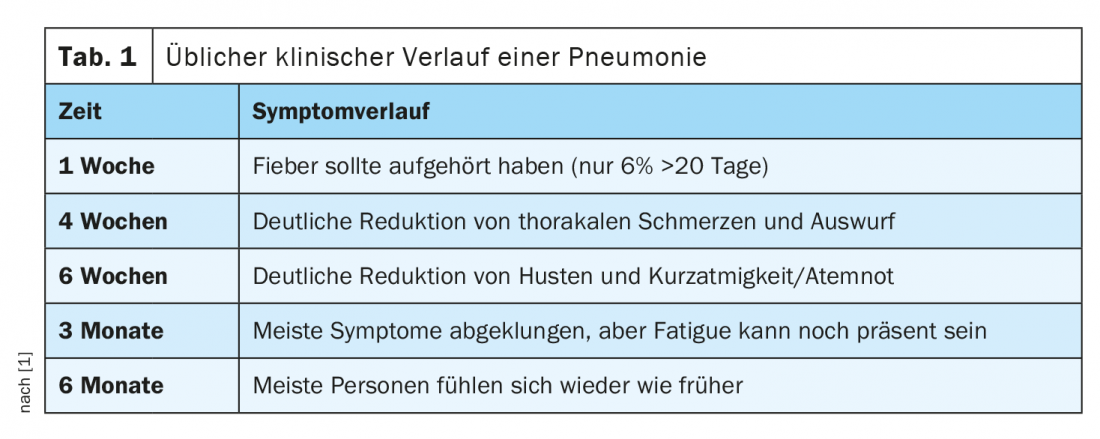


After 3 months, most symptoms of pneumonia should have resolved. If this does not occur, the pneumonia may be progressive or protracted. Primary or secondary treatment failure may also be present. – Or non-healing pneumonia may be present, but will not become apparent for several weeks.

What does non-resolving mean?

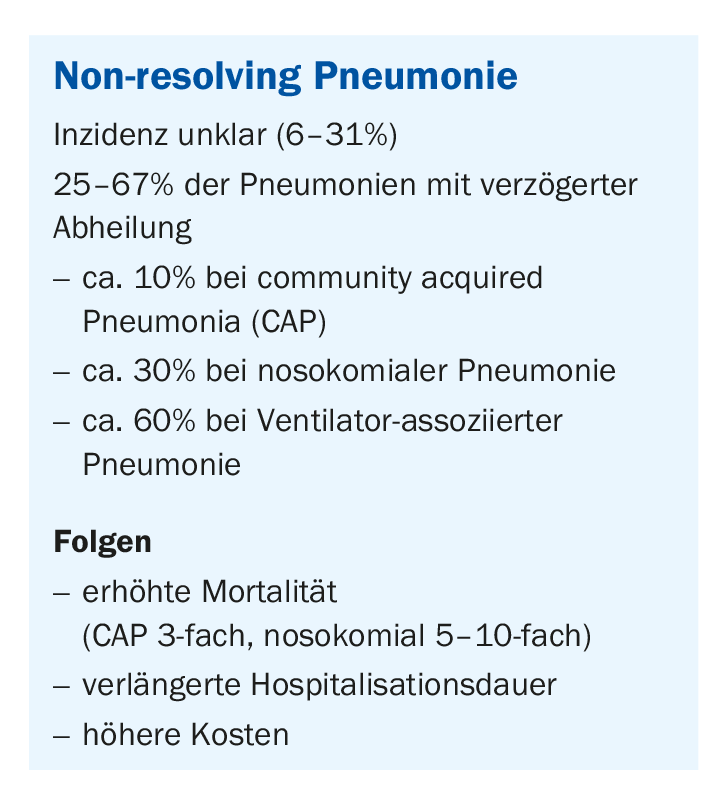
Non-resolving, or non-healing, pneumonia is usually a radiologic definition, but this is not uniformly defined. The time factor is important in such cases: after 4 weeks, at least two-thirds of the infiltrates should have receded so that one can speak of a delayed but still normal course. Such a situation does not occur so rarely, Dr. Laube reported. Commonly (15-25%) found in hospitalized patients who have had nosocomial pneumonia. In patients with ventilators who were mechanically ventilated, it is found in as many as 60% of cases (box) .

Non-healing can also mean persistent symptomatology, as is increasingly seen in COVID-19 patients. The symptoms decrease significantly in intensity after 2 weeks, but then continue for several months. Patients complain of symptoms, but the laboratory is inconclusive and nothing can be found on X-ray. The risk factors in slow healing can have a mortality increase of 17.74% after one month and a 60-day mortality up to even 25.81%, the expert warned. Therefore, slow healing implies an independent risk factor for 60-day mortality.

Procedure for non-resolving pneumonia

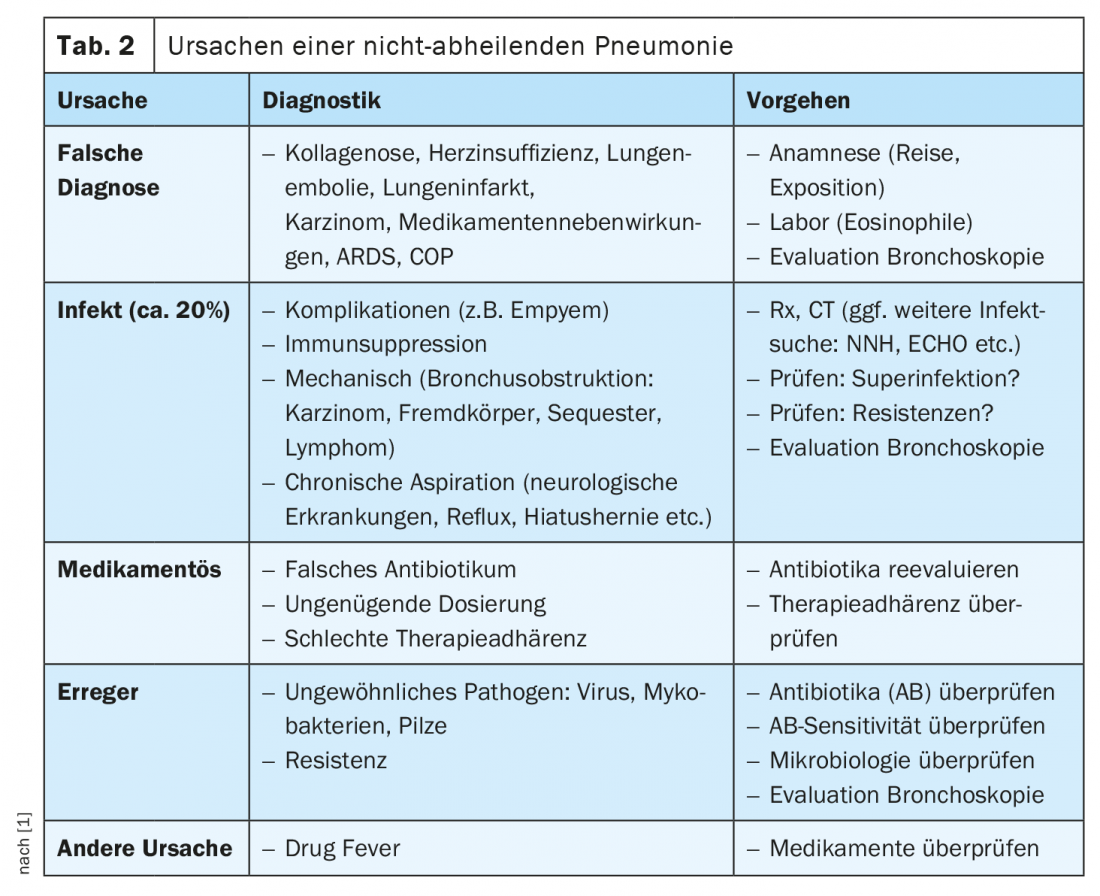
Diagnosis is initially based on the patient’s medical history, which highlights various aspects such as medication and antibiotic use, dosage or stay abroad (tab. 2) . According to Dr. Laube, if the patient can provide sputum, it is worthwhile to examine it for microbiology. At the onset of pneumonia, this usually does not happen. Blood cultures are recommended if fever is present, and urine should be tested for Legionella antigen if Legionella pneumonia is suspected. However, it should be noted here that false-negative results may occur. In most cases, bronchoscopy and bronchoalveolar lavage (BAL) for further diagnosis are not feasible to search for rare pathogens such as mycobacteria, viruses, Legionella, Nocardia, fungi, cell differentiation and other causes.


Early pleural ultrasonography is very important to avoid missing an empyema, he said. In particular, patients with pneumococcal pneumonia may develop early empyema, which may be septated and then inaccessible to simple drainage. Should this occur, the thoracic surgeon must be consulted. A pleural effusion that is caught early can be drained or punctured.

A CT thorax can also help in the diagnosis. If an enlarged heart is apparent in a chest radiograph, pneumococcal pneumonia must also be thought of as pericardial empyema. Echocardiography is then the next step. In addition, immunosuppression should be excluded.


CT thorax, Dr. Laube concluded, thus forms an add-on aid before bronchoscopy when abscess formation or fungal infection is present or a tumor is suspected. However, in the case of bronchoscopy, current data are unclear as to whether it has an impact on patient mortality, he said.

Congress: 60th Medical Congress Davos – Online event


Source:

  1. Workshop “The non-healing pneumonia”; 60th Medical Congress Davos – Online event, 11. February 2021.


InFo PNEUMOLOGY & ALLERGOLOGY 2021; 3(3): 22-23.
Autoren
  • Jens Dehn
Publikation
  • InFo PNEUMOLOGIE & ALLERGOLOGIE
Related Topics
  • Antibiotics
  • cough
  • Infectious disease
  • Non-resolving pneumonia
  • Pneumonia
  • Pneumonia
  • Thoracic pain
Previous Article
  • Skin diseases

Update acne and rosacea

  • CME continuing education
  • Dermatology and venereology
  • Education
  • RX
  • Studies
View Post
Next Article
  • COVID-19

Tariff shortfall is compensated by the Zurich government council

  • Infectiology
  • News
  • Prevention and health care
  • RX
View Post
You May Also Like
asthma_winter_istock-887318372
View Post
  • 4 min
  • Symptom-free despite asthma?

Asthma treatment requirements have increased

    • Congress Reports
    • General Internal Medicine
    • Pharmacology and toxicology
    • Pneumology
    • RX
View Post
  • 9 min
  • Phytotherapy for rhinosinusitis

Evidence, active substances and clinical classification for medical practice

    • Education
    • General Internal Medicine
    • Infectiology
    • ORL
    • Pharmaceutical medicine
    • Phytotherapy
    • RX
    • Studies
View Post
  • 15 min
  • Pulmonary hypertension

PH and lung diseases

    • Cardiology
    • CME continuing education
    • Pneumology
    • RX
    • Studies
View Post
  • 10 min
  • Contact eczema

Causes and prevention at work

    • Allergology and clinical immunology
    • CME continuing education
    • Dermatology and venereology
    • Prevention and health care
    • RX
View Post
  • 6 min
  • Respiratory infections: viral bronchitis or bacterial pneumonia?

Old crucial question in the light of current findings

    • Congress Reports
    • General Internal Medicine
    • Infectiology
    • Pharmaceutical medicine
    • Pharmacology and toxicology
    • Phytotherapy
    • Pneumology
    • RX
View Post
  • 6 min
  • What biomarkers reveal about "biological youth" - and what not (yet)

Epigenetic ageing

    • Education
    • Genetics
    • Geriatrics
    • Prevention and health care
    • RX
    • Studies
View Post
  • 4 min
  • Amyotrophic lateral sclerosis and nutrition

Calorie optimization in ALS through digital intervention

    • Education
    • Neurology
    • Nutrition
    • RX
    • Studies
View Post
  • 14 min
  • "Forgotten axis" between plant substances, gut and systemic health

Microbiome and phytotherapy

    • Education
    • Endocrinology and Diabetology
    • Gastroenterology and Hepatology
    • General Internal Medicine
    • Infectiology
    • Neurology
    • Nutrition
    • Pharmaceutical medicine
    • Phytotherapy
    • RX
    • Studies
  • IBD matters

    Zum Thema
Top CME content
  • 1
    Can you swallow intelligence? Relevant substance classes times for healthy people
  • 2
    PH and lung diseases
  • 3
    Causes and prevention at work
  • 4
    Clinical care from birth to adulthood
  • 5
    Aligning care with the patient

Newsletter

Sign up and stay up to date

Subscribe
Medizinonline Medizinonline
  • Contact
  • General terms and conditions
  • Imprint

Input your search keywords and press Enter.