Medizinonline Medizinonline
  • News
    • News
    • Market & Medicine
  • Patients
    • Disease patterns
    • Diagnostics
    • Therapy
  • Partner Content
    • Dermatology
      • Atopic dermatitis and psoriasis news
    • Diabetes
      • Dia-Month Club – Type 2 Diabetes
      • Diabetes in Motion
      • Diabetes Podcasts
    • Gastroenterology
      • IBD matters
    • Oncology
      • Swiss Oncology in motion
    • Orthopedics
      • Osteoporosis in motion
  • Departments
    • Allergology and clinical immunology
    • General Internal Medicine
    • Anesthesiology
    • Angiology
    • Surgery
    • Dermatology and venereology
    • Endocrinology and Diabetology
    • Nutrition
    • Gastroenterology and Hepatology
    • Genetics
    • Geriatrics
    • Gynecology
    • Hematology
    • Infectiology
    • Cardiology
    • Nephrology
    • Neurology
    • Emergency and intensive care medicine
    • Nuclear Medicine
    • Oncology
    • Ophthalmology
    • ORL
    • Orthopedics
    • Pediatrics
    • Pharmacology and toxicology
    • Pharmaceutical medicine
    • Phlebology
    • Physical medicine and rehabilitation
    • Pneumology
    • Prevention and health care
    • Psychiatry and psychotherapy
    • Radiology
    • Forensic Medicine
    • Rheumatology
    • Sports Medicine
    • Traumatology and trauma surgery
    • Tropical and travel medicine
    • Urology
    • Dentistry
  • CME & Congresses
    • CME continuing education
    • Congress Reports
    • Congress calendar
  • Practice
    • Noctimed
    • Practice Management
    • Jobs
    • Interviews
  • Log In
  • Register
  • My account
  • Contact
  • Publications
  • Contact
  • Deutsch
  • English
  • Français
  • Italiano
  • Português
  • Español
Subscribe
Medizinonline Medizinonline
  • News
    • News
    • Market & Medicine
  • Patienten
    • Krankheitsbilder
    • Diagnostik
    • Therapie
  • Partner Content
    • Dermatology
      • Atopic dermatitis and psoriasis news
    • Diabetes
      • Dia-Month Club – Type 2 Diabetes
      • Diabetes in Motion
      • Diabetes Podcasts
    • Gastroenterology
      • IBD matters
    • Oncology
      • Swiss Oncology in motion
    • Orthopedics
      • Osteoporosis in motion
    • Phytotherapie
    • Rheumatology
  • Departments
    • Fachbereiche 1-13
      • Allergology and clinical immunology
      • General Internal Medicine
      • Anesthesiology
      • Angiology
      • Surgery
      • Dermatology and venereology
      • Endocrinology and Diabetology
      • Nutrition
      • Gastroenterology and Hepatology
      • Genetics
      • Geriatrics
      • Gynecology
      • Hematology
    • Fachbereiche 14-26
      • Infectiology
      • Cardiology
      • Nephrology
      • Neurology
      • Emergency and intensive care medicine
      • Nuclear Medicine
      • Oncology
      • Ophthalmology
      • ORL
      • Orthopedics
      • Pediatrics
      • Pharmacology and toxicology
      • Pharmaceutical medicine
    • Fachbereiche 26-38
      • Phlebology
      • Physical medicine and rehabilitation
      • Phytotherapy
      • Pneumology
      • Prevention and health care
      • Psychiatry and psychotherapy
      • Radiology
      • Forensic Medicine
      • Rheumatology
      • Sports Medicine
      • Traumatology and trauma surgery
      • Tropical and travel medicine
      • Urology
      • Dentistry
  • CME & Congresses
    • CME continuing education
    • Congress Reports
    • Congress calendar
  • Practice
    • Noctimed
    • Practice Management
    • Jobs
    • Interviews
Login

Sie haben noch keinen Account? Registrieren

  • Mycoses

Genital candidiasis: diagnosis and management

    • Congress Reports
    • Dermatology and venereology
    • Gynecology
    • Infectiology
    • News
    • Oncology
    • RX
    • Urology
  • 3 minute read

Dermatoses in the genital area are very distressing for those affected. What risk factors are known and what is the current state of knowledge regarding therapy?

“Candida albicans remains the most important pathogen, causing over 70% of all infections,” explained Isabella Terrani, MD, Cantonal Hospital of Bellinzona. Candida are commensals in the lower tract of the female genitalia (vagina, vulva). In addition to newborns and immunocompromised individuals, those with elevated estrogen levels (e.g., due to pregnancy or contraceptives), smokers, diabetics, psoriasis sufferers, atopics, and patients treated with immunosuppressants or antibiotics have an increased risk of infection (candidiasis), the speaker explained. Among the non-Candida bacterial (NCA) strains, C. parapsilosis and C. glabrata are the most common in the etiology of candidiasis [1].

The most important infections and their treatment at a glance

Candida vulvovaginitis (CVV): This is a common infection, with a lifetime prevalence of 75% for women and 5-8% for recurrent CVV, the speaker said. The most common pathogens are Candida albicans (in >85% of cases). In about 5%, the disease is caused by non-Candida bacterial strains, with C. glabrata being the most common pathogen, followed by C. tropicalis and C. parapsilosis.

Typical symptoms of CVV include pruritus, burning sensation at the vaginal outlet and vulva, and possibly inflammatory changes. In the presence of vaginal discharge, the following differential diagnoses should be considered: bacterial vaginosis (Amsel criteria: pH >4.5; gray-white fluor vaginalis; clue cells; fishy odor); aerobic vaginitis (elevated pH); trichomoniasis; STI [2]. Only about one-third of women who thought they had Candida vaginitis had this diagnosis confirmed [3]. Differential diagnostic indications can also be provided by different morphological features that are characteristic of Candida [4]. Symptomatology also depends on age (estrogen levels); premenopausal there is often involvement of the vagina, postmenopausal more of the vulva and intertrigo.

Immunocompetent asymptomatic and partners of patients with vulvovaginitis do not need to be treated, the speaker said [2].
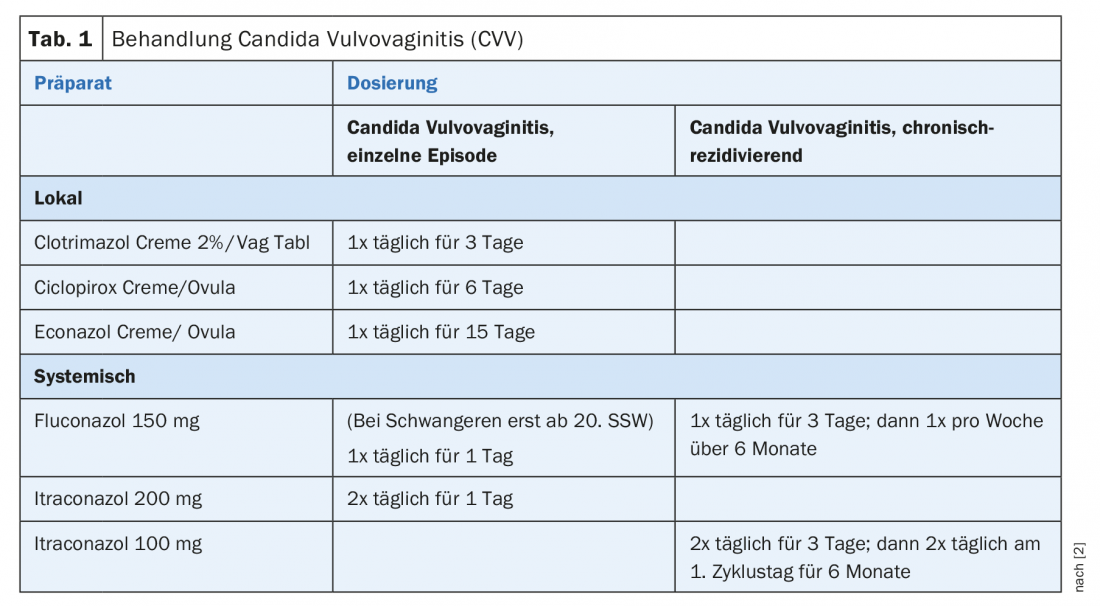


The following criteria are indicative of chronic recurrent Candida vulvovaginitis: at least 4 episodes per year and symptoms for more than 6 weeks, or at least 12 episodes per year and symptoms for at least 100 days per year. Therapy (Table 1) should be given over a longer period than for normal Candida vulvovaginitis. The following interactions are known regarding CVV therapeutics: Oral and anal sex result in poorer response with fluconazole continuous therapy  [5]; For RCVV that does not respond to fluconazole, a smear test should be performed  [2]; Probiotics as an additional medication may reduce the recurrence rate of CVV [6].

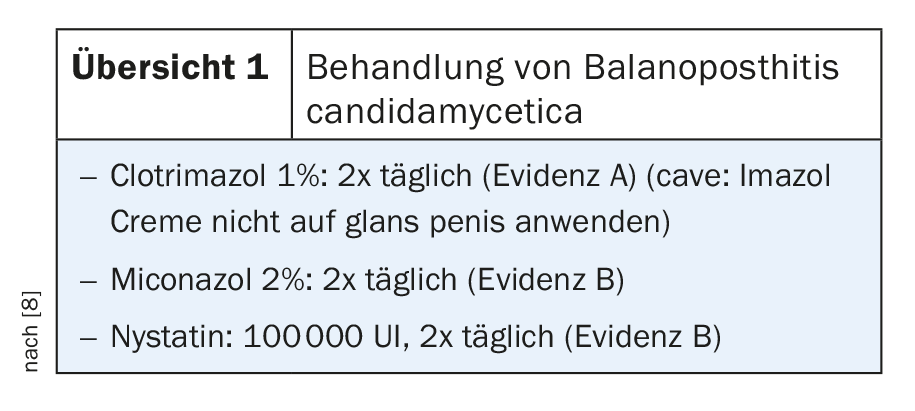
Balanoposthitis candidamycetica: Candida is the causative agent in 20% of all infectious balanitis [7]. The classic symptoms are itching, erythema with a moist shiny surface and white stipple-like coatings. Regarding treatment, clotrimazole 1% has the best evidence (caveat: do not use Imazol cream on glans penis), followed by miconazole 2% and nystatin (review 1).


Intertrigo candidamycetica: This is the most common complication of intertrigo. Typical pathologic changes include satellite lesions and collarettes.  The following clinical pictures should be differentiated: Contact dermatitis, psoriasis inversa, Hailey’s disease, tinea inguinalis (scrotum not affected). Risk factors for intertrigo candidamycetica include tight clothing, sweating, and poor hygiene.   
 

Source: Swiss Derma Day, January 16, 2019, Lucerne


Literature:

  1. Sadeghi G, et al: Emergence of non-Candida albicans species: epidemiology, phylogeny and fluconazole susceptibility profile. Journal de Mycologie Médical 2018; 28(1): 51-58.
  2. Sherrad J, et al: 2018 European (IUSTI/WHO) International Union against sexually transmitted infections (IUSTI) World Health Organization (WHO) guideline on the management of vaginal discharge. International Journal of STD & AIDS 2018; 29: 1258-1272.
  3. Ferris GD, et al: Over-the-counter antifungal drug misuse associated with patient-diagnosed vulvovaginal candidiasis. Obstetrics Gynecology 2002; 99(3): 419-425.
  4. Cassone A: Vulvovaginal Candida albicans infections: pathogenesis, immunity and vaccine prospects. BJOG. Journal of Obstetrics and Gynecology 2015; 122(6): 785-794.
  5. Grinceviciene S, et al: Sexual behavior and extra-genital colonization in women treated for recurrent Candida vulvo-vaginitis. Mycoses 2018; 61(11): 857-860.
  6. Xie HY, et al: Probiotics for vulvovaginal candidiasis in non-pregnant women. Cochrane Database of Systematic Reviews. Cochrane Database of Systematic Reviews 2017, Issue 11. CD010496. DOI: 10.1002/14651858.CD010496.pub2
  7. Borelli S, Lautenschlager S: Differential diagnosis and management of balanitis. Dermatologist 2015; 66(1): 6-11.
  8. Edwards SK, et al: 2013 European guideline for the management of balanoposthitis. International Journal of STD and Aids 2014; 25(9): 615-626.


DERMATOLOGY PRACTICE 2019; 29(1): 38-39

Autoren
  • Mirjam Peter, M.Sc.
Publikation
  • DERMATOLOGIE PRAXIS
Related Topics
  • detection rate
  • Melanoma
  • Skin cancer
Previous Article
  • New laser systems

Low side effects thanks to optimized precision?

  • Congress Reports
  • Dermatology and venereology
  • RX
View Post
Next Article
  • Mental illness in pregnancy

Mother and child in view

  • Education
  • Gynecology
  • Psychiatry and psychotherapy
  • RX
View Post
You May Also Like
View Post
  • 25 min
  • Neuroenhancement

Can you swallow intelligence? Relevant substance classes times for healthy people

    • CME continuing education
    • Neurology
    • Pharmacology and toxicology
    • Psychiatry and psychotherapy
    • RX
    • Studies
View Post
  • 9 min
  • Microbiome, inflammaging and affective/cognitive health

Gut-brain axis in old age

    • Education
    • Gastroenterology and Hepatology
    • General Internal Medicine
    • Geriatrics
    • Neurology
    • Nutrition
    • Prevention and health care
    • RX
    • Studies
View Post
  • 6 min
  • Vitiligo - the level of suffering should not be underestimated

A lot can be achieved therapeutically nowadays

    • Congress Reports
    • Dermatology and venereology
    • RX
    • Studies
View Post
  • 12 min
  • Patient-centered rounds in medicine

Aligning care with the patient

    • CME continuing education
    • Education
    • General Internal Medicine
    • Prevention and health care
    • RX
    • Studies
View Post
  • 14 min
  • Adrenogenital syndrome

Clinical care from birth to adulthood

    • CME continuing education
    • Endocrinology and Diabetology
    • Nephrology
    • Pediatrics
    • RX
    • Studies
View Post
  • 4 min
  • Communication between hospitals and outpatient care

How does a digital clinical information system prove itself in everyday practice?

    • Education
    • General Internal Medicine
    • Practice Management
    • Prevention and health care
    • RX
View Post
  • 5 min
  • Chronic and hard-to-heal wounds

Benefit from the advantages of outpatient negative pressure wound therapy

    • Congress Reports
    • Dermatology and venereology
    • Endocrinology and Diabetology
    • General Internal Medicine
    • Geriatrics
    • Physical medicine and rehabilitation
    • RX
    • Studies
View Post
  • 13 min
  • Acute myeloid leukemia

Treatment decisions between MRD monitoring, transplantation and CAR-T cells

    • Congress Reports
    • Hematology
    • Oncology
    • RX
    • Studies
  • IBD matters

    Zum Thema
Top CME content
  • 1
    Can you swallow intelligence? Relevant substance classes times for healthy people
  • 2
    Clinical care from birth to adulthood
  • 3
    Aligning care with the patient
  • 4
    Control instead of a flood of data: AI makes big data and wearables usable
  • 5
    Causes and prevention at work

Newsletter

Sign up and stay up to date

Subscribe
Medizinonline Medizinonline
  • Contact
  • General terms and conditions
  • Imprint

Input your search keywords and press Enter.