Medizinonline Medizinonline
  • News
    • News
    • Market & Medicine
  • Patients
    • Disease patterns
    • Diagnostics
    • Therapy
  • Partner Content
    • Dermatology
      • Atopic dermatitis and psoriasis news
    • Diabetes
      • Dia-Month Club – Type 2 Diabetes
      • Diabetes in Motion
      • Diabetes Podcasts
    • Gastroenterology
      • IBD matters
    • Oncology
      • Swiss Oncology in motion
    • Orthopedics
      • Osteoporosis in motion
  • Departments
    • Allergology and clinical immunology
    • General Internal Medicine
    • Anesthesiology
    • Angiology
    • Surgery
    • Dermatology and venereology
    • Endocrinology and Diabetology
    • Nutrition
    • Gastroenterology and Hepatology
    • Genetics
    • Geriatrics
    • Gynecology
    • Hematology
    • Infectiology
    • Cardiology
    • Nephrology
    • Neurology
    • Emergency and intensive care medicine
    • Nuclear Medicine
    • Oncology
    • Ophthalmology
    • ORL
    • Orthopedics
    • Pediatrics
    • Pharmacology and toxicology
    • Pharmaceutical medicine
    • Phlebology
    • Physical medicine and rehabilitation
    • Pneumology
    • Prevention and health care
    • Psychiatry and psychotherapy
    • Radiology
    • Forensic Medicine
    • Rheumatology
    • Sports Medicine
    • Traumatology and trauma surgery
    • Tropical and travel medicine
    • Urology
    • Dentistry
  • CME & Congresses
    • CME continuing education
    • Congress Reports
    • Congress calendar
  • Practice
    • Noctimed
    • Practice Management
    • Jobs
    • Interviews
  • Log In
  • Register
  • My account
  • Contact
  • Publications
  • Contact
  • Deutsch
  • English
  • Français
  • Italiano
  • Português
  • Español
Subscribe
Medizinonline Medizinonline
  • News
    • News
    • Market & Medicine
  • Patienten
    • Krankheitsbilder
    • Diagnostik
    • Therapie
  • Partner Content
    • Dermatology
      • Atopic dermatitis and psoriasis news
    • Diabetes
      • Dia-Month Club – Type 2 Diabetes
      • Diabetes in Motion
      • Diabetes Podcasts
    • Gastroenterology
      • IBD matters
    • Oncology
      • Swiss Oncology in motion
    • Orthopedics
      • Osteoporosis in motion
    • Phytotherapie
    • Rheumatology
  • Departments
    • Fachbereiche 1-13
      • Allergology and clinical immunology
      • General Internal Medicine
      • Anesthesiology
      • Angiology
      • Surgery
      • Dermatology and venereology
      • Endocrinology and Diabetology
      • Nutrition
      • Gastroenterology and Hepatology
      • Genetics
      • Geriatrics
      • Gynecology
      • Hematology
    • Fachbereiche 14-26
      • Infectiology
      • Cardiology
      • Nephrology
      • Neurology
      • Emergency and intensive care medicine
      • Nuclear Medicine
      • Oncology
      • Ophthalmology
      • ORL
      • Orthopedics
      • Pediatrics
      • Pharmacology and toxicology
      • Pharmaceutical medicine
    • Fachbereiche 26-38
      • Phlebology
      • Physical medicine and rehabilitation
      • Phytotherapy
      • Pneumology
      • Prevention and health care
      • Psychiatry and psychotherapy
      • Radiology
      • Forensic Medicine
      • Rheumatology
      • Sports Medicine
      • Traumatology and trauma surgery
      • Tropical and travel medicine
      • Urology
      • Dentistry
  • CME & Congresses
    • CME continuing education
    • Congress Reports
    • Congress calendar
  • Practice
    • Noctimed
    • Practice Management
    • Jobs
    • Interviews
Login

Sie haben noch keinen Account? Registrieren

  • Rose root against stress

Amazing effect of a new adaptogenic medicinal plant from the north

    • News
    • Pharmaceutical medicine
    • Pharmacology and toxicology
    • Psychiatry and psychotherapy
    • RX
  • 4 minute read

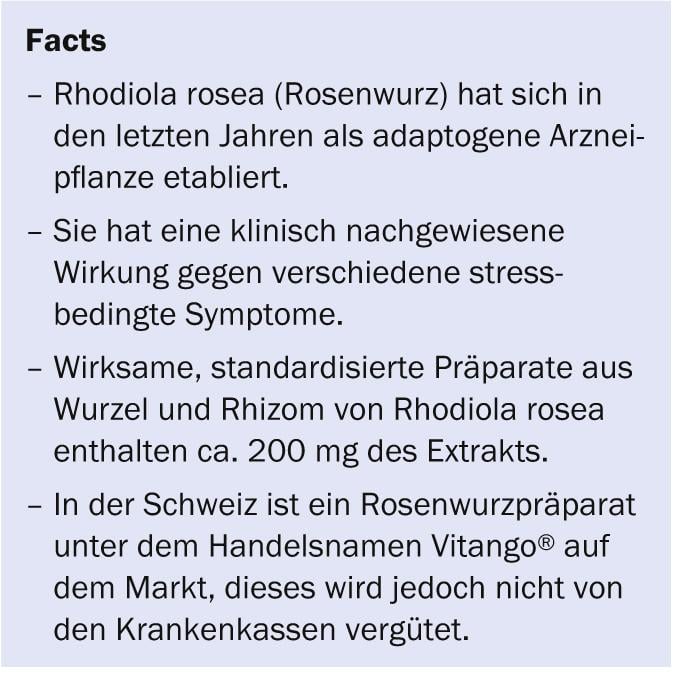
In recent years, Rhodiola rosea (rose root) has become established as a medicinal plant. Numerous studies show an adaptogenic effect of this plant growing in northern areas of Europe. It was found that the effect occurs more quickly with rose root than with other known adaptogens.

Rose root (Rhodiola rosea), a thick-leaf plant, has long been overshadowed by ginseng (Panax ginseng) and taiga root (Eleutherococcus senticosus). For years, these two medicinal plants have been considered the adaptogens (see box) par excellence. However, in recent years, various publications have appeared proving the effectiveness of rose root, so that now this medicinal plant is also rightly included among the adaptogens.


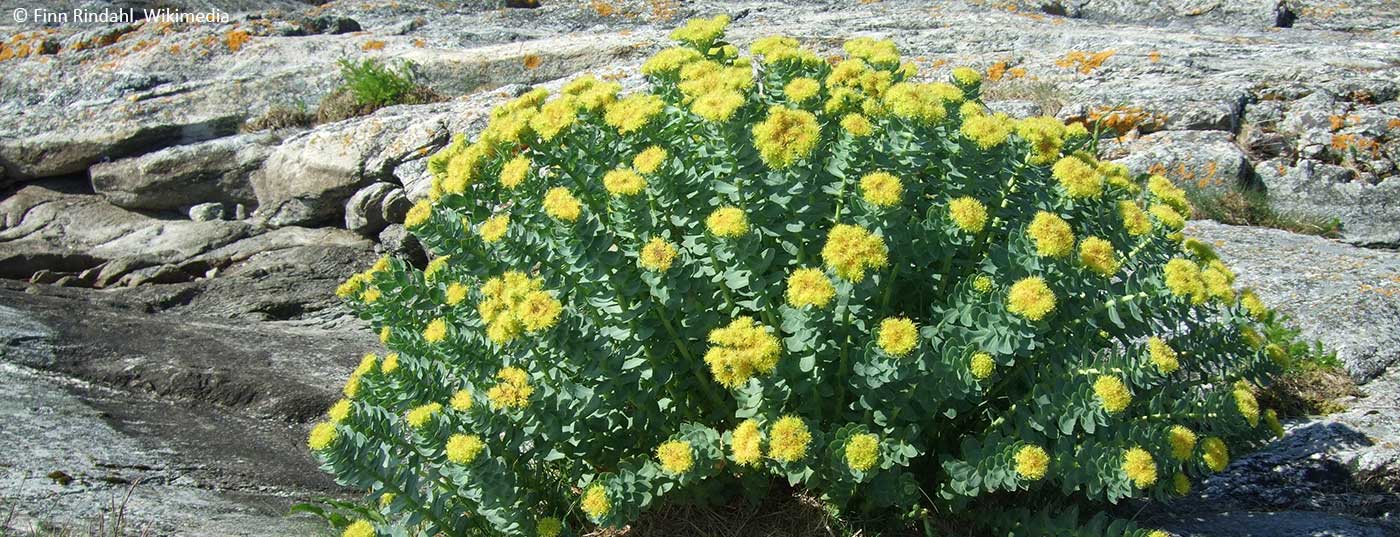
Rhodiola rosea

Rose root is a medicinal plant used in folk medicine for centuries, native to arctic areas of Scandinavia and Russia. Interestingly, it was already around 77 AD. mentioned by Dioscurides in his Materia Medica. Rose root is a perennial, succulent plant that grows from five to a maximum of 35 cm tall and forms taproots. As a survival strategy, rose root develops an underground stem that has a characteristic rose smell, giving the plant its German name. The main constituents of the plant are derivatives of phenylpropane and of phenylethanol such as rosavin, rosarin, rosin and salidroside.

In the folk medicine of Scandinavia and Russia, rose root is used to increase physical performance, against altitude complaints, fatigue, certain infectious diseases and disorders of the central nervous system. It is reported that Russian soldiers in the Afghan war used Rhodiola rosea as a tea against stress and war trauma. Likewise, the plant was used by Russian cosmonauts and athletes.

Pharmacology

Pharmacological studies have shown that extracts of rose root normalize the concentration of neurotransmitters such as serotonin, norepinephrine, dopamine, and acetylcholine in the cortex and pituitary gland by promoting their release. Furthermore, they increase the permeability of the blood-brain barrier for their precursors. With their antioxidant properties, rose root extracts can also protect the CNS from oxidative free radical damage [2]. It is also worth mentioning that the adaptogenic properties of Rhodiola rosea take effect much more quickly than is the case, for example, with ginseng (Panax ginseng) or taiga root (Eleutherococcus senticosus).
 

Clinic

In the course of scientific research on Rhodiola rosea, various clinical studies have also been published.

Concentration: In 2000, Darbinyan [3] and Spasov [4] each published a study with very similar results: Both studies documented an improvement in the ability to perform and concentrate, as well as in the ability to concentrate. Shevtson showed in a study published in 2003 [5], which he conducted with young Russian cadets aged 19 to 21, that rose root can also reduce fatigue.

Vitality disorders: Grünwald et al. reported in 2007 [6] on an observational study in which 120 elderly persons were administered a preparation consisting of vitamins, minerals and rose root over a period of twelve weeks. All treated showed physical and mental vitality disturbances, after weeks a highly significant improvement in physical and mental performance was observed (p≤0.001). However, the flaw of the observational study is that the study drug was not a pure rose root preparation. For this reason, it is not possible to make a definite statement about the effect ratio of Rhodiola rosea, but the study is still worth mentioning because the preparation was able to improve the performance of seniors. Vitamins and minerals alone can only bring about this effect to a limited extent.

Anxiety disorder: that rose root can also be effective against anxiety disorders was shown by Bystritsky er al. 2008 [7]. Ten subjects with a well-defined anxiety disorder were included in this ten-week, open-label study. They received a standardized rose root extract. This was followed by a follow-up period of 30 days. Half of all subjects (five individuals) met the conditions as treatment responders: they showed an improvement on the Hamilton Anxiety Rating Scale (HARS) of at least 50% determined.

Fatigue: Olsson et al. published a randomized, placebo-controlled, double-blind, parallel-group study in 2009 that tested the efficacy of rose root extract for stress-related fatigue [8]. Compared to Bystritsky et al, this study shows. [7] had the advantage that it was a placebo-controlled study and included many more subjects. A total of 60 individuals between the ages of 20 and 55 participated, all of whom had a diagnosis of fatigue syndrome (ICD F438a). Subjects received the study drug or placebo twice daily for a period of four weeks. The primary outcome variable was reduction in fatigue, as determined by the Pines’ Burnout Scale (PNS). There was a significant difference between verum and placebo at the end of treatment (p=0.047). Other parameters collected also showed non-significant advantages for the study drug over placebo.

Summary

The studies published so far have documented that standardized extracts from rose root have an adaptogenic effect and can therefore improve stress-related symptoms. Thus, this medicinal plant offers itself as a valid alternative to the usual synthetic treatment strategies.

Literature:

  1. Vignutelli A: Adaptogens – the science behind the concept, paper presented at the 24th Swiss Annual Conference on Phytotherapy, Baden, 19.11.2019.
  2. Hostettmann K, van Diermen D: La plante du jour – Rhodiola rosea. La Phytothérapie Européenne 2007; 3.
  3. Darbinyan V, et al: Rhodiola rosea in stress inducedfatugue – a double blind cross-over study of a standardized extract SHR-5 with a repeated low-dose regimen on the mental performance of healthy physicians during nigth duty. Phytomedicine 2000; 7: 365-371.
  4. Spasov A, et al: A double-blind, placebo-controlled pilot study of the stimulation and adaptogenic effect of Rhodiola rosea SHR-5 extract on the fatigue of students caused by stress during an examination period with a repeated low-dose regimen. Phytomedicine 2000; 7: 85-89.
  5. Shevtsov VA, et al: Antifatigue and improved mental performance with Rhodiola rosea, Phytomedicine 2003; 10: 95-105.
  6. Grünwald J, et al: Efficacy and tolerability of a combination with Rhodiola rosea extract in older adults with reduced physical and mental vitality. EHK 2007; 65: 138-142.
  7. Bystritsky A, et al: Plot study of Rhodiola rosea (Rodax®) for Generalized Anxiety Disorder (GAD). The Journal of Alternative and Complementary Medicine 2008(2); 14: 175-180.
  8. Olsson EMG, et al: A Randomised, Double-blind, Placebo-controlled, ParallelGroup Study of the Standardised Extract SHR-5 of the Roots of Rhodiola rosea in the Treatment of Subjects with Stress-Related Fatigue. Planta Med 2009; 75: 105-112.

HAUSARZT PRAXIS 2014; 9(3): 5-6

Autoren
  • Dr. pharm. Christoph Bachmann
Publikation
  • HAUSARZT PRAXIS
Related Topics
  • Adaptogen
  • Anxiety disorder
  • CNS
  • concentration
  • Fatigue
  • Metabolism
  • Rhodiola rosea
  • Rose Root
  • Vitality disorder
Previous Article
  • Infectiology

When are the antiviral drugs used?

  • Allergology and clinical immunology
  • Infectiology
  • Interviews
  • RX
View Post
Next Article
  • Health Policy

Emotions in politics – Cave!

  • News
  • Prevention and health care
  • RX
View Post
You May Also Like
View Post
  • 6 min
  • What biomarkers reveal about "biological youth" - and what not (yet)

Epigenetic ageing

    • Education
    • Genetics
    • Geriatrics
    • Prevention and health care
    • RX
    • Studies
View Post
  • 4 min
  • Amyotrophic lateral sclerosis and nutrition

Calorie optimization in ALS through digital intervention

    • Education
    • Neurology
    • Nutrition
    • RX
    • Studies
View Post
  • 14 min
  • "Forgotten axis" between plant substances, gut and systemic health

Microbiome and phytotherapy

    • Education
    • Endocrinology and Diabetology
    • Gastroenterology and Hepatology
    • General Internal Medicine
    • Infectiology
    • Neurology
    • Nutrition
    • Pharmaceutical medicine
    • Phytotherapy
    • RX
    • Studies
View Post
  • 4 min
  • HIV: updated EACS guideline

Individualized approach to sustainable prevention and care

    • Cardiology
    • Education
    • General Internal Medicine
    • Infectiology
    • Prevention and health care
    • RX
    • Studies
View Post
  • 5 min
  • Evidence-based diagnostics and treatment in the medical setting

Anxiety and depression disorders in adolescence

    • Education
    • Pediatrics
    • Pharmacology and toxicology
    • Psychiatry and psychotherapy
    • RX
    • Studies
View Post
  • 25 min
  • Neuroenhancement

Can you swallow intelligence? Relevant substance classes times for healthy people

    • CME continuing education
    • Neurology
    • Pharmacology and toxicology
    • Psychiatry and psychotherapy
    • RX
    • Studies
View Post
  • 9 min
  • Microbiome, inflammaging and affective/cognitive health

Gut-brain axis in old age

    • Education
    • Gastroenterology and Hepatology
    • General Internal Medicine
    • Geriatrics
    • Neurology
    • Nutrition
    • Prevention and health care
    • RX
    • Studies
View Post
  • 6 min
  • Vitiligo - the level of suffering should not be underestimated

A lot can be achieved therapeutically nowadays

    • Congress Reports
    • Dermatology and venereology
    • RX
    • Studies
  • IBD matters

    Zum Thema
Top CME content
  • 1
    Can you swallow intelligence? Relevant substance classes times for healthy people
  • 2
    Clinical care from birth to adulthood
  • 3
    Aligning care with the patient
  • 4
    Control instead of a flood of data: AI makes big data and wearables usable
  • 5
    Causes and prevention at work

Newsletter

Sign up and stay up to date

Subscribe
Medizinonline Medizinonline
  • Contact
  • General terms and conditions
  • Imprint

Input your search keywords and press Enter.