Medizinonline Medizinonline
  • News
    • News
    • Market & Medicine
  • Patients
    • Disease patterns
    • Diagnostics
    • Therapy
  • Partner Content
    • Diabetes
      • Dia-Month Club – Type 2 Diabetes
      • Diabetes in Motion
      • Diabetes Podcasts
    • Gastroenterology
      • IBD matters
    • Oncology
      • Swiss Oncology in motion
    • Orthopedics
      • Osteoporosis in motion
  • Departments
    • Allergology and clinical immunology
    • General Internal Medicine
    • Anesthesiology
    • Angiology
    • Surgery
    • Dermatology and venereology
    • Endocrinology and Diabetology
    • Nutrition
    • Gastroenterology and Hepatology
    • Genetics
    • Geriatrics
    • Gynecology
    • Hematology
    • Infectiology
    • Cardiology
    • Nephrology
    • Neurology
    • Emergency and intensive care medicine
    • Nuclear Medicine
    • Oncology
    • Ophthalmology
    • ORL
    • Orthopedics
    • Pediatrics
    • Pharmacology and toxicology
    • Pharmaceutical medicine
    • Phlebology
    • Physical medicine and rehabilitation
    • Pneumology
    • Prevention and health care
    • Psychiatry and psychotherapy
    • Radiology
    • Forensic Medicine
    • Rheumatology
    • Sports Medicine
    • Traumatology and trauma surgery
    • Tropical and travel medicine
    • Urology
    • Dentistry
  • CME & Congresses
    • CME continuing education
    • Congress Reports
    • Congress calendar
  • Practice
    • Noctimed
    • Practice Management
    • Jobs
    • Interviews
  • Log In
  • Register
  • My account
  • Contact
  • Publications
  • Contact
  • Deutsch
  • English
  • Français
  • Italiano
  • Português
  • Español
Subscribe
Medizinonline Medizinonline
  • News
    • News
    • Market & Medicine
  • Patienten
    • Krankheitsbilder
    • Diagnostik
    • Therapie
  • Partner Content
    • Diabetes
      • Dia-Month Club – Type 2 Diabetes
      • Diabetes in Motion
      • Diabetes Podcasts
    • Gastroenterology
      • IBD matters
    • Oncology
      • Swiss Oncology in motion
    • Orthopedics
      • Osteoporosis in motion
    • Phytotherapie
    • Rheumatology
  • Departments
    • Fachbereiche 1-13
      • Allergology and clinical immunology
      • General Internal Medicine
      • Anesthesiology
      • Angiology
      • Surgery
      • Dermatology and venereology
      • Endocrinology and Diabetology
      • Nutrition
      • Gastroenterology and Hepatology
      • Genetics
      • Geriatrics
      • Gynecology
      • Hematology
    • Fachbereiche 14-26
      • Infectiology
      • Cardiology
      • Nephrology
      • Neurology
      • Emergency and intensive care medicine
      • Nuclear Medicine
      • Oncology
      • Ophthalmology
      • ORL
      • Orthopedics
      • Pediatrics
      • Pharmacology and toxicology
      • Pharmaceutical medicine
    • Fachbereiche 26-38
      • Phlebology
      • Physical medicine and rehabilitation
      • Phytotherapy
      • Pneumology
      • Prevention and health care
      • Psychiatry and psychotherapy
      • Radiology
      • Forensic Medicine
      • Rheumatology
      • Sports Medicine
      • Traumatology and trauma surgery
      • Tropical and travel medicine
      • Urology
      • Dentistry
  • CME & Congresses
    • CME continuing education
    • Congress Reports
    • Congress calendar
  • Practice
    • Noctimed
    • Practice Management
    • Jobs
    • Interviews
Login

Sie haben noch keinen Account? Registrieren

  • Hematology

Challenges and opportunities of precision therapy

    • Education
    • Hematology
    • RX
  • 2 minute read

In recent years, the ever-improving molecular understanding of malignant diseases has opened up avenues for targeted treatment strategies. Tumor genomic analyses are becoming increasingly important in providing patients with access to individually effective agents. The potential of precision oncology is far from exhausted. But there are also challenges that need to be overcome.

The terms “personalized therapy” or “precision therapy” have been used more and more frequently recently. At the same time, no clear definitions could be established at the beginning. As a rule, this involved drugs with a molecular target structure in tumor cells. However, with increasing understanding regarding the cellular basis of hematologic diseases and the advancement of genomic analysis, precision oncology now assumes therapy based on molecular characterization of the individual tumor. The goal is a more effective and better tolerated treatment [1].

Individual therapy based on the tumor profile

On the way to precision oncology, interpretation and classification of the tumor genetic alterations found, a deduction of possible effects on tumor cell biology, and assignment of potential therapeutic targets are required, leading to the generation of a molecular pathology report [2]. Exclusively histology-based therapy planning was yesterday’s news. Meanwhile, entities are increasingly being abandoned and the individual tumor profile is coming into focus. This development was made possible in part by improvements in high-throughput sequencing. In the meantime, mutation analyses can be performed on a large number of genes with a technically high, but time and financially justifiable effort [1,2].

However, therapeutic strategies based on the results of molecular tumor analysis face particular challenges, as individual treatment approaches can never be evidence-based, nor can they be mapped in comprehensive clinical trials. Therefore, many treatment decisions are made on the basis of analogies, biological rationales, or small case series. However, the same genomic alteration may have different value as a therapeutic target in the context of different diseases – another challenge for the practitioner. Therefore, to implement precision oncology in a meaningful and successful way, careful patient selection and access to targeted drugs are required.


Targeted treatment of hematological diseases

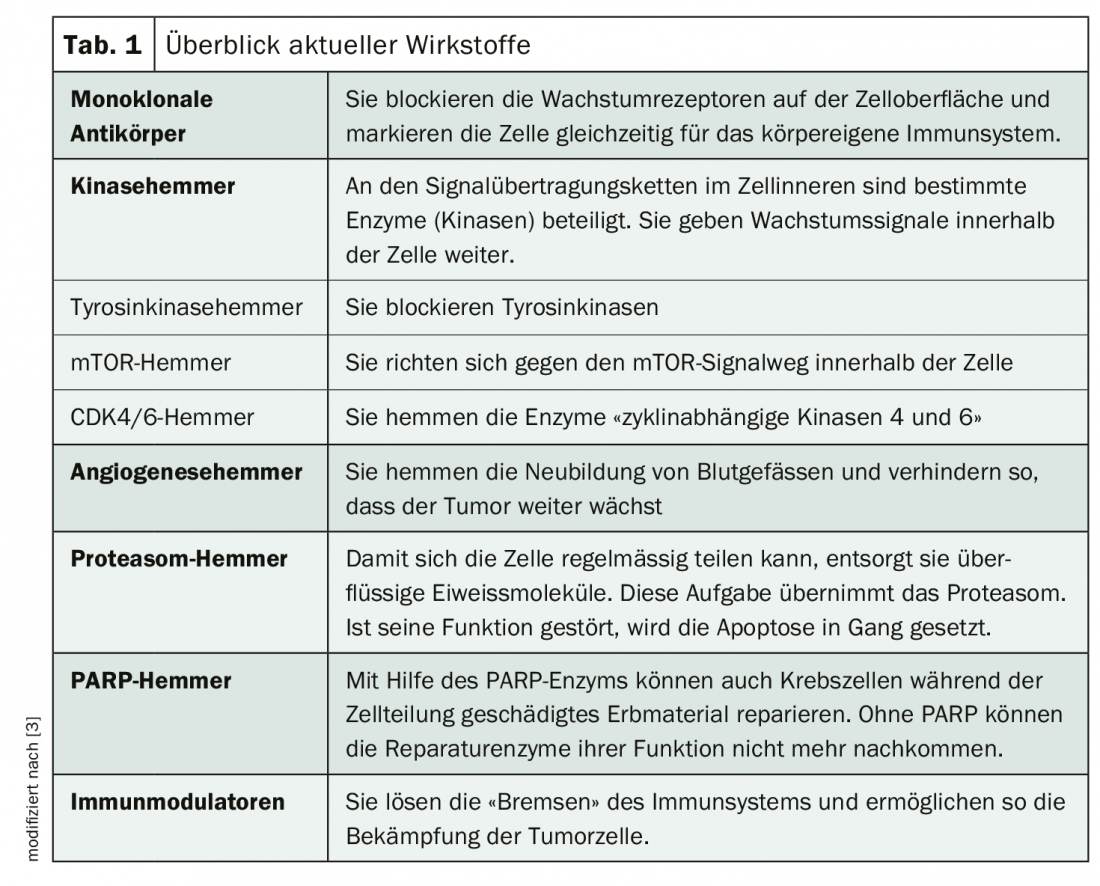
Molecular biology therapies target ligands, receptors for these messenger substances on the cell surface, or signaling pathways in the cells themselves. They influence tumor or blood vessel growth by suppressing growth signals, cutting off the tumor’s food supply, blocking the cell’s waste disposal, or inhibiting repair mechanisms of the cancer cell [3]. Immunomodulators take on a special role. They enhance the antitumor immune response and improve innate and adaptive immune function (Table 1) [4–6]. Therapeutic options can be used as monotherapy or in combination with chemotherapy or radiotherapy.


Literature:

  1. Holch JW, Westphalen CB, et al: Dtsch Med Wochenschr 2017; 142(22): 1676-1684.
  2. www.klinikum-grosshadern.de/CCCLMU-Krebszentrum-Muenchen/download/inhalt/TZM-News-MTB.pdf (last accessed 07/17/2020)
  3. www.krebsinformationsdienst.de/service/iblatt/iblatt-zielgerichtete-krebstherapien.pdf (last accessed 07/17/2020)
  4. Quach H, et al: leukemia 2010; 24(1): 22-32.
  5. Davies FE, et al: Blood 2001; 98(1): 210-216.
  6. www.therapyselect.de/de/blog/zielgerichtete-krebstherapie-targeted-therapy-das-wichtigste (last accessed 07/17/2020)


InFo ONCOLOGY & HEMATOLOGY 2020; 8(4): 19.
Autoren
  • Leoni Burggraf
Publikation
  • InFo ONKOLOGIE & HÄMATOLOGIE
Previous Article
  • Epigastric pain

Bio-psycho-social approach to the therapy of functional abdominal pain

  • Education
  • Gastroenterology and Hepatology
  • General Internal Medicine
  • Market & Medicine
  • RX
  • Studies
View Post
Next Article
  • Galenic systems

Advantages of topical pharmacotherapy

  • Allergology and clinical immunology
  • Dermatology and venereology
  • Education
  • Pharmacology and toxicology
  • RX
View Post
You May Also Like
View Post
  • 7 min
  • Obesity in Children and Adolescents

Gene-Environment Interactions: Polygenic or Monogenic Determinants?

    • RX
    • Education
    • General Internal Medicine
    • Genetics
    • Nutrition
    • Pediatrics
View Post
  • 18 min
  • From Risk Identification to Anti-Inflammatory Intervention

Inflammation as a Treatment Goal in Its Own Right

    • RX
    • Angiology
    • Cardiology
    • CME continuing education
    • Endocrinology and Diabetology
    • General Internal Medicine
    • Nutrition
    • Studies
View Post
  • 7 min
  • H. pylori infection: current study data

Fewer gastric carcinomas and peptic ulcers after eradication

    • RX
    • Gastroenterology and Hepatology
    • General Internal Medicine
    • Infectiology
    • Oncology
    • Studies
View Post
  • 4 min
  • From symptom to diagnosis

Pneumology – tracheal and bronchial calcifications

    • RX
    • Cases
    • Education
    • General Internal Medicine
    • Pneumology
    • Radiology
View Post
  • 12 min
  • Global Recommendation, Swissmedic Approval, and SL Limitation

WHO Guidelines on GLP-1 for Obesity

    • RX
    • Cardiology
    • Education
    • Endocrinology and Diabetology
    • General Internal Medicine
    • Nutrition
    • Pharmacology and toxicology
    • Prevention and health care
    • Studies
View Post
  • 3 min
  • Tinea capitis: Current Guidelines and Recommendations

What should be kept in mind when treating adult patients?

    • Dermatology and venereology
    • Education
    • Infectiology
    • Pharmacology and toxicology
    • RX
View Post
  • 7 min
  • Geriatric patients

Micronutrient Intake in Older Adults

    • RX
    • Education
    • General Internal Medicine
    • Geriatrics
    • Nutrition
View Post
  • 7 min
  • Crohn's disease: focus on long-term results

“Top-down” approach or classic step therapy?

    • RX
    • Congress Reports
    • Gastroenterology and Hepatology
    • General Internal Medicine
    • Studies
  • IBD matters

    Zum Thema
Top CME content
  • 1
    Inflammation as a Treatment Goal in Its Own Right
  • 2
    Personalized Treatment Before a Planned Pregnancy
  • 3
    Current State of Knowledge and New Therapeutic Approaches
  • 4
    Why is it so hard to lose weight?
  • 5
    Functional limb preservation between infection control, vascular medicine and resurfacing

Newsletter

Sign up and stay up to date

Subscribe
Medizinonline Medizinonline
  • Contact
  • General terms and conditions
  • Imprint

Input your search keywords and press Enter.