Medizinonline Medizinonline
  • News
    • News
    • Market & Medicine
  • Patients
    • Disease patterns
    • Diagnostics
    • Therapy
  • Partner Content
    • Diabetes
      • Dia-Month Club – Type 2 Diabetes
      • Diabetes in Motion
      • Diabetes Podcasts
    • Gastroenterology
      • IBD matters
    • Oncology
      • Swiss Oncology in motion
    • Orthopedics
      • Osteoporosis in motion
  • Departments
    • Allergology and clinical immunology
    • General Internal Medicine
    • Anesthesiology
    • Angiology
    • Surgery
    • Dermatology and venereology
    • Endocrinology and Diabetology
    • Nutrition
    • Gastroenterology and Hepatology
    • Genetics
    • Geriatrics
    • Gynecology
    • Hematology
    • Infectiology
    • Cardiology
    • Nephrology
    • Neurology
    • Emergency and intensive care medicine
    • Nuclear Medicine
    • Oncology
    • Ophthalmology
    • ORL
    • Orthopedics
    • Pediatrics
    • Pharmacology and toxicology
    • Pharmaceutical medicine
    • Phlebology
    • Physical medicine and rehabilitation
    • Pneumology
    • Prevention and health care
    • Psychiatry and psychotherapy
    • Radiology
    • Forensic Medicine
    • Rheumatology
    • Sports Medicine
    • Traumatology and trauma surgery
    • Tropical and travel medicine
    • Urology
    • Dentistry
  • CME & Congresses
    • CME continuing education
    • Congress Reports
    • Congress calendar
  • Practice
    • Noctimed
    • Practice Management
    • Jobs
    • Interviews
  • Log In
  • Register
  • My account
  • Contact
  • Publications
  • Contact
  • Deutsch
  • English
  • Français
  • Italiano
  • Português
  • Español
Subscribe
Medizinonline Medizinonline
  • News
    • News
    • Market & Medicine
  • Patienten
    • Krankheitsbilder
    • Diagnostik
    • Therapie
  • Partner Content
    • Diabetes
      • Dia-Month Club – Type 2 Diabetes
      • Diabetes in Motion
      • Diabetes Podcasts
    • Gastroenterology
      • IBD matters
    • Oncology
      • Swiss Oncology in motion
    • Orthopedics
      • Osteoporosis in motion
    • Phytotherapie
    • Rheumatology
  • Departments
    • Fachbereiche 1-13
      • Allergology and clinical immunology
      • General Internal Medicine
      • Anesthesiology
      • Angiology
      • Surgery
      • Dermatology and venereology
      • Endocrinology and Diabetology
      • Nutrition
      • Gastroenterology and Hepatology
      • Genetics
      • Geriatrics
      • Gynecology
      • Hematology
    • Fachbereiche 14-26
      • Infectiology
      • Cardiology
      • Nephrology
      • Neurology
      • Emergency and intensive care medicine
      • Nuclear Medicine
      • Oncology
      • Ophthalmology
      • ORL
      • Orthopedics
      • Pediatrics
      • Pharmacology and toxicology
      • Pharmaceutical medicine
    • Fachbereiche 26-38
      • Phlebology
      • Physical medicine and rehabilitation
      • Phytotherapy
      • Pneumology
      • Prevention and health care
      • Psychiatry and psychotherapy
      • Radiology
      • Forensic Medicine
      • Rheumatology
      • Sports Medicine
      • Traumatology and trauma surgery
      • Tropical and travel medicine
      • Urology
      • Dentistry
  • CME & Congresses
    • CME continuing education
    • Congress Reports
    • Congress calendar
  • Practice
    • Noctimed
    • Practice Management
    • Jobs
    • Interviews
Login

Sie haben noch keinen Account? Registrieren

  • Routine care for psoriasis

Update system therapy – what is important for the practice?

    • Congress Reports
    • Dermatology and venereology
    • Education
    • Rheumatology
    • RX
  • 3 minute read

The new treatment options lead to higher therapeutic goals. This is also reflected in the current psoriasis guideline, which received an update last year. The determination of the severity is an important basis for the choice of the individually appropriate therapy. Here, the “upgrade criteria” must be taken into account. The majority of first-line treatments are conventional systemic therapeutics, but some biologics now also have a “first-line” label.

The great abundance of drug innovations in the indication area of moderate to severe psoriasis has raised the therapy goals to a new level: “We want to achieve extensive healing and this is really achievable with the drugs available today,” says Prof. Matthias Augustin, MD, Director at the Institute for Health Services Research in Dermatology and Nursing Professions, University Hospital Hamburg [1]. The clinical benchmark for psoriasis treatment today is freedom from skin manifestations and restoration of quality of life. The therapeutic approach is tailored to individual preferences (“shared decision making”). A look at the data shows that the objective severity, operationalized by means of the Psoriasis Area and Severity Index (PASI), as well as the losses in quality of life have decreased in recent years, according to Prof. Augustin. The 2021 psoriasis S3 line update discusses treatment algorithms and currently available systemic agents in detail [1,2].

Consider localization of skin lesions as well as quality of life

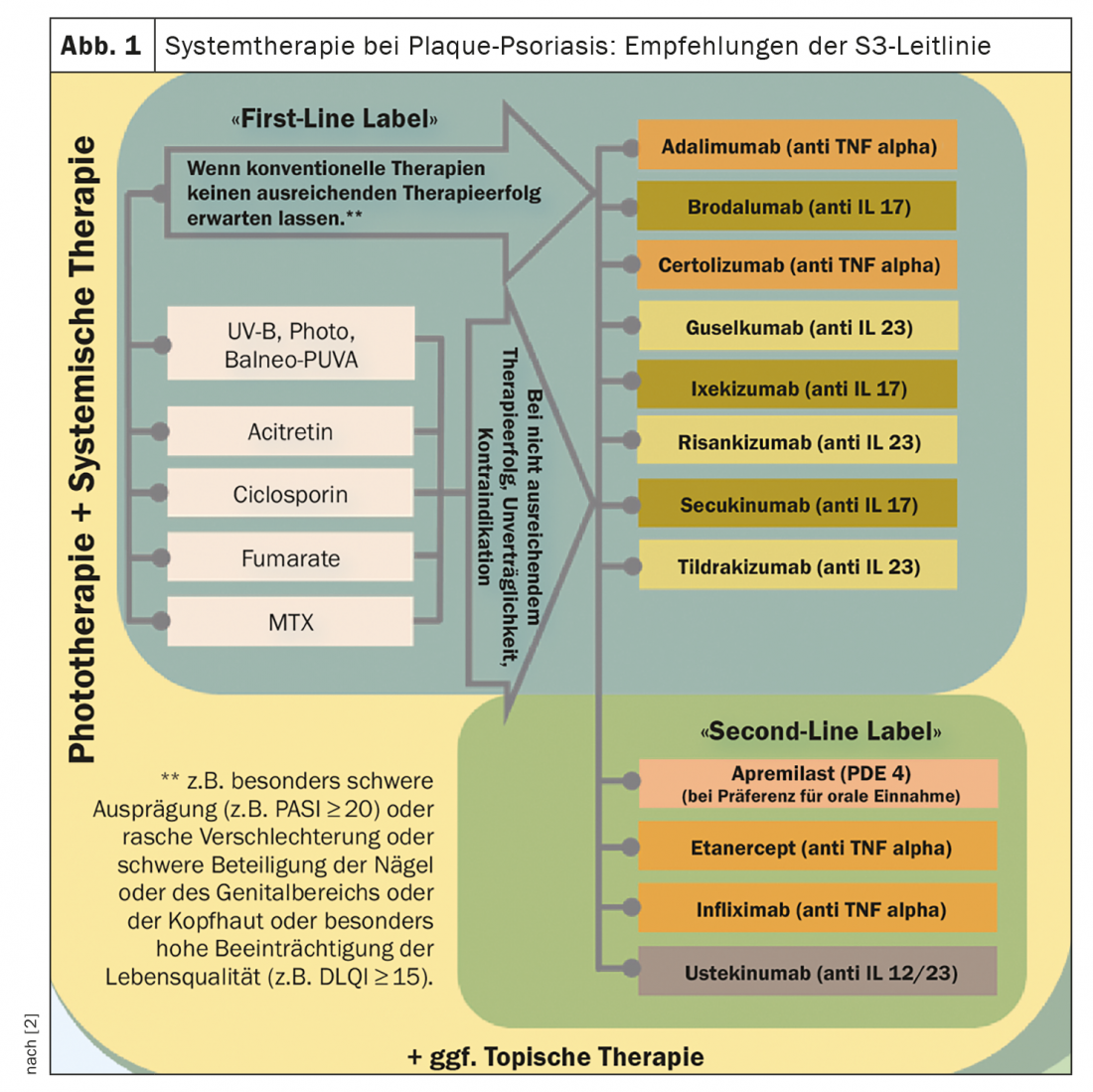
It is important that those patients who need systemic therapy have access to it, the expert stresses. In this context, the so-called “upgrade criteria” are significant: According to this, the classification as moderate to severe psoriasis is not limited to cases in which the BSA or PASI and DLQI values are above 10, but the following criteria are alternatively decisive: pronounced disease of visible areas, pronounced disease of the scalp, disease of the genital area, disease of the palms and soles, onycholysis or onychodystrophy of at least two fingernails, itching and associated scratching, presence of therapy-resistant plaques [2]. When selecting the appropriate systemic therapy, the guideline recommends considering the following factors in addition to efficacy and safety: Time to onset of action, comorbidity, and individual patient factors/preferences.


Biologics as first-line therapy – a look at registry data.

According to Prof. Augustin, an analysis of data from the PsoBest registry* shows that a biologic is used as a “first-line” treatment in about 30% of patients with moderate to severe psoriasis in Germany [1]. This share has risen noticeably since 2015. Secukinumab is the most commonly used, accounting for 29%, followed by guselkumab, which is used as a first-line systemic therapeutic in 20% of cases [1]. About two-thirds receive conventional systemic therapeutics as a “first systemic drug,” with dimethyl fumarate and methotrexate being by far the most common. The recommendations made in the guideline (Fig. 1) are based on empirical evidence as well as on the consensus-agreed clinical experience of the expert panel [2]. The selection of the appropriate systemic therapy for special clinical situations or for psoriasis patients with comorbidities is discussed and highlighted in detail in the guideline.

* The Psoriasis Registry PsoBest collects data from patients with psoriasis and psoriatic arthritis who are prescribed a biologic or other systemic therapy for the first time.


Congress: Update Inflammatory Skin Diseases


Literature:

  1. Augustin M: Update Psoriasis: What is important for the practice, Prof. Dr. med. Matthias Augustin, 5th Lübeck Update Inflammatory Skin Diseases, 05.03.2022.
  2. Nast A, et al: German S3 guideline on the therapy of psoriasis vulgaris, 2021. J Dtsch Dermatol Ges, www.awmf.org, (last accessed 24.05.2022).


DERMATOLOGIE PRAXIS 2022; 32(3): 20

Autoren
  • Mirjam Peter, M.Sc.
Publikation
  • DERMATOLOGIE PRAXIS
Related Topics
  • Biologics
  • Psoriasis
  • Psoriasis
Previous Article
  • Asthma as a risk factor

Treatment of allergies during pregnancy

  • Allergology and clinical immunology
  • Education
  • Gynecology
  • Pneumology
  • RX
  • Studies
View Post
Next Article
  • Gastrointestinal disorders in childhood and adolescence

Is it irritable bowel syndrome?

  • Education
  • Gastroenterology and Hepatology
  • General Internal Medicine
  • Pediatrics
  • RX
  • Studies
View Post
You May Also Like
View Post
  • 13 min
  • Why lipoprotein(a) is the biggest therapeutic vacuum in cardiology

Lp(a): The underestimated risk factor before the turning point

    • Cardiology
    • Education
    • Endocrinology and Diabetology
    • RX
    • Studies
View Post
  • 11 min
  • Modern system therapeutics for hidradenitis suppurativa

Immunological dysregulation in the sights of several biologics and “small molecules”

    • Allergology and clinical immunology
    • Dermatology and venereology
    • Education
    • RX
    • Studies
View Post
  • 15 min
  • Perimenopausal depression, PMDS and tokophobia

Psychosomatics and mental health in gynecology

    • Education
    • Gynecology
    • Psychiatry and psychotherapy
    • RX
    • Studies
View Post
  • 7 min
  • Plastic surgery and reconstructive microsurgery for DFS

Functional limb preservation between infection control, vascular medicine and resurfacing

    • Angiology
    • CME continuing education
    • Endocrinology and Diabetology
    • General Internal Medicine
    • Geriatrics
    • Physical medicine and rehabilitation
    • RX
    • Surgery
View Post
  • 8 min
  • Proteins in wound healing

Do special amino acids lead to success?

    • CME continuing education
    • Dermatology and venereology
    • Endocrinology and Diabetology
    • Nutrition
    • RX
    • Studies
View Post
  • 9 min
  • Polycystic ovary syndrome 2025/2026

New pathophysiology, updated diagnostics and the age of incretin mimetics

    • Education
    • Gastroenterology and Hepatology
    • General Internal Medicine
    • Gynecology
    • Pharmacology and toxicology
    • RX
    • Studies
View Post
  • 14 min
  • Heart failure and type 2 diabetes

Oral semaglutide and cardiac decompensation in type 2 diabetes

    • Cardiology
    • Education
    • Endocrinology and Diabetology
    • RX
    • Studies
View Post
  • 7 min
  • Atopic dermatitis as a door opener for an atopic cascade?

AD trajectories: Summary of current findings

    • Allergology and clinical immunology
    • Congress Reports
    • Dermatology and venereology
    • RX
    • Studies
  • IBD matters

    Zum Thema
Top CME content
  • 1
    Functional limb preservation between infection control, vascular medicine and resurfacing
  • 2
    Do special amino acids lead to success?
  • 3
    Do special amino acids lead to success?
  • 4
    Current status of PAT
  • 5
    Surgical wound complications

Newsletter

Sign up and stay up to date

Subscribe
Medizinonline Medizinonline
  • Contact
  • General terms and conditions
  • Imprint

Input your search keywords and press Enter.