Medizinonline Medizinonline
  • News
    • News
    • Market & Medicine
  • Patients
    • Disease patterns
    • Diagnostics
    • Therapy
  • Partner Content
    • Diabetes
      • Dia-Month Club – Type 2 Diabetes
      • Diabetes in Motion
    • Gastroenterology
      • IBD matters
    • Oncology
      • Swiss Oncology in motion
    • Orthopedics
      • Osteoporosis in motion
  • Departments
    • Allergology and clinical immunology
    • General Internal Medicine
    • Anesthesiology
    • Angiology
    • Surgery
    • Dermatology and venereology
    • Endocrinology and Diabetology
    • Nutrition
    • Gastroenterology and Hepatology
    • Genetics
    • Geriatrics
    • Gynecology
    • Hematology
    • Infectiology
    • Cardiology
    • Nephrology
    • Neurology
    • Emergency and intensive care medicine
    • Nuclear Medicine
    • Oncology
    • Ophthalmology
    • ORL
    • Orthopedics
    • Pediatrics
    • Pharmacology and toxicology
    • Pharmaceutical medicine
    • Phlebology
    • Physical medicine and rehabilitation
    • Pneumology
    • Prevention and health care
    • Psychiatry and psychotherapy
    • Radiology
    • Forensic Medicine
    • Rheumatology
    • Sports Medicine
    • Traumatology and trauma surgery
    • Tropical and travel medicine
    • Urology
    • Dentistry
  • CME & Congresses
    • CME continuing education
    • Congress Reports
    • Congress calendar
  • Practice
    • Noctimed
    • Practice Management
    • Jobs
    • Interviews
  • Log In
  • Register
  • My account
  • Contact
  • Publications
  • Contact
  • Deutsch
  • English
  • Français
  • Italiano
  • Português
  • Español
Subscribe
Medizinonline Medizinonline
  • News
    • News
    • Market & Medicine
  • Patienten
    • Krankheitsbilder
    • Diagnostik
    • Therapie
  • Partner Content
    • Diabetes
      • Dia-Month Club – Type 2 Diabetes
      • Diabetes in Motion
    • Gastroenterology
      • IBD matters
    • Oncology
      • Swiss Oncology in motion
    • Orthopedics
      • Osteoporosis in motion
    • Phytotherapie
    • Rheumatology
  • Departments
    • Fachbereiche 1-13
      • Allergology and clinical immunology
      • General Internal Medicine
      • Anesthesiology
      • Angiology
      • Surgery
      • Dermatology and venereology
      • Endocrinology and Diabetology
      • Nutrition
      • Gastroenterology and Hepatology
      • Genetics
      • Geriatrics
      • Gynecology
      • Hematology
    • Fachbereiche 14-26
      • Infectiology
      • Cardiology
      • Nephrology
      • Neurology
      • Emergency and intensive care medicine
      • Nuclear Medicine
      • Oncology
      • Ophthalmology
      • ORL
      • Orthopedics
      • Pediatrics
      • Pharmacology and toxicology
      • Pharmaceutical medicine
    • Fachbereiche 26-38
      • Phlebology
      • Physical medicine and rehabilitation
      • Phytotherapy
      • Pneumology
      • Prevention and health care
      • Psychiatry and psychotherapy
      • Radiology
      • Forensic Medicine
      • Rheumatology
      • Sports Medicine
      • Traumatology and trauma surgery
      • Tropical and travel medicine
      • Urology
      • Dentistry
  • CME & Congresses
    • CME continuing education
    • Congress Reports
    • Congress calendar
  • Practice
    • Noctimed
    • Practice Management
    • Jobs
    • Interviews
Login

Sie haben noch keinen Account? Registrieren

  • Benefit-risk profile

Which laser for which vascular lesion?

    • Congress Reports
    • Dermatology and venereology
    • RX
  • 2 minute read

Modern laser systems have an indispensable role in the therapy of vascular malformations. New technological developments make choosing the right device a challenge. What to look for to get the best results?

According to Dr. Antonio Campo Voegeli, Medical Director of Clinica Dermatologica Campo-Optimage in Barcelona, the following should be considered when selecting an adequate laser treatment: For superficial small lesions, either devices with short wavelengths (dye laser (PDL), potassium titanyl phosphate laser (KTP), flash lamp laser (IPL) or those with long wavelengths and small spot size (diodes, alexandrites, Nd:YAG) are suitable. For deep large lesions, diode and Nd:YAG lasers are best. The pulse duration varies depending on the type of lesion (Table 1).
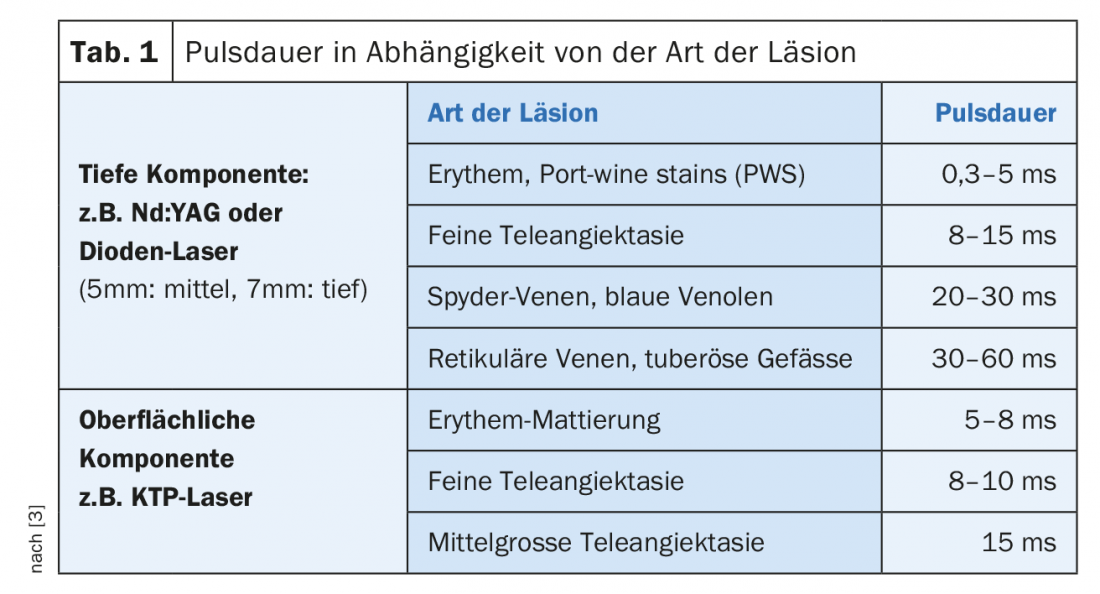


For the choice of the energy density (“fluence”, J/cm²) one can follow the following scheme:

  • low “fluence”: large, thick lesions; dark red or purple lesions, large vascular volumes
  • high “fluence”: small, thin lesions; bright red or pink lesions, small vascular volumes

Next-generation lasers (more powerful laser diodes, simultaneous application of multiple wavelengths) are already successfully applied in the field of hair removal and will be applicable to the field of vascular lesions in the future, according to the prediction in a review published in 2018 [1]. Argon lasers, on the other hand, have lost importance due to side effects (scarring, long-lasting hyperpigmentation) [1].

Side effect management

Dr. Campo Voegeli summarizes the post-treatment measures to minimize adverse effects in laser therapy of vascular lesions as follows:

  • Cooling measures (very important); following the treatment.
  • specific topical preparations; for 2-3 days
    • Aloe gel, topical steroids, plus possibly antibiotic ointment.
    • if bruise forms: topical vitamin K products
  • Sun-protective preparations; for 7-10 days (face) respectively 2-3 months (legs)
  • Follow-up visits; during 4-8 weeks (in case of leg veins 8-12 weeks).

Common transient secondary reactions include: Erythema, pain (usually lasting only a few seconds, sometimes longer), burning sensation (usually only a few seconds), and blistering/scarring and hypo/hyperpigmentation. In case of aggressive procedure and/or high vascular density, edema may occur. Risk factors for hemosiderotic pigmentation, in addition to sun exposure, are deep vessels or a very high density of superficial vessels. Small skin hemorrhages may occur if very small vessels are treated with short pulse duration and high energy density (“fluence”). In vascular lesions of leg veins, pigmentation is possible as a side effect for a period of two to four months. Consistent UV protection can reduce the risk of postinflammatory hyperpigmentation [2]. Cooling measures following treatment are essential to reduce swelling and pain.

Source: SGML Lasers&Procedures, January 17, 2019, Zurich
 

Literature:

  1. Paasch U, Grunewald S: 2018 update on dermatologic laser therapy: Part 1 – epilation, vascular lesions and pigments. Journal of the German Society of Dermatology 2018; 16(12): 1417-1423.
  2. Rümmelein B: The considered post-treatment skin care after laser therapy. Certified advanced training. Skin 2014; 6: 232-238. www.dr-ruemmelein.ch/images/dokumente
  3. Campo Voegeli A: Slide presentation: Vascular laser treatments. A. Campo Voegeli, MD. SGML Laser&Procedures, January 17, 2019, Zurich.


DERMATOLOGIE PRAXIS 2019; 29(1): 34

Autoren
  • Mirjam Peter, M.Sc.
Publikation
  • DERMATOLOGIE PRAXIS
Related Topics
  • Benefit-risk profile
  • Evidence base
  • Laser devices
  • Laser Medicine
  • vascular malformations
Previous Article
  • Aesthetic medicine

New non-invasive method for fat reduction

  • Congress Reports
  • Dermatology and venereology
  • RX
  • Studies
View Post
Next Article
  • Vaccination schedule 2019

Vaccinate according to the “magic formula

  • Congress Reports
  • General Internal Medicine
  • Pediatrics
  • Prevention and health care
  • RX
View Post
You May Also Like
View Post
  • 6 min
  • Disorders of the Gut-Brain Interaction

Rome V Criteria: What Has Changed, and What Has Remained the Same?

    • RX
    • Education
    • Gastroenterology and Hepatology
    • General Internal Medicine
View Post
  • 5 min
  • Tourette Syndrome

What can be done to treat this tic disorder?

    • RX
    • Education
    • General Internal Medicine
    • Neurology
    • Pharmacology and toxicology
    • Studies
View Post
  • 4 min
  • Chronic Hepatitis B: Is a Cure in Sight?

Phase III Trial of Temporary Treatment with Bepirovirsen Was Successful

    • RX
    • Congress Reports
    • General Internal Medicine
    • Infectiology
    • Studies
View Post
  • 14 min
  • Fibromyalgia Syndrome

Development, Diagnosis, Epidemiology, and Treatment of a Disease Entity

    • General Internal Medicine
    • CME continuing education
    • Geriatrics
    • Neurology
    • Orthopedics
    • Rheumatology
    • RX
View Post
  • 5 min
  • Clinically Suspected Arthralgias

“Watchful waiting” or intervention?

    • RX
    • Congress Reports
    • General Internal Medicine
    • Geriatrics
    • Rheumatology
    • Studies
View Post
  • 3 min
  • Tumors of the Calcaneus

Diagnostic Challenges of Rare Heel Tumors

    • RX
    • Education
    • Oncology
    • Radiology
View Post
  • 6 min
  • Upper GI Tract Bleeding: Hematemesis, Hematochezia, or Melena?

From Risk Stratification to Post-Endoscopic Management

    • RX
    • Congress Reports
    • Gastroenterology and Hepatology
    • General Internal Medicine
    • Prevention and health care
    • Studies
View Post
  • 15 min
  • Obesity, Nutrition, and Mental Health

Depression, Binge Eating, Internalized Stigma

    • RX
    • Education
    • Endocrinology and Diabetology
    • General Internal Medicine
    • Nutrition
    • Psychiatry and psychotherapy
    • Studies
  • IBD matters

    Zum Thema
Top CME content
  • 1
    Development, Diagnosis, Epidemiology, and Treatment of a Disease Entity
  • 2
    Personalized Treatment Before a Planned Pregnancy
  • 3
    Update on Anti-Rheumatic Medications
  • 4
    Psychiatry versus Neuro-Oncology: Diagnostic Pitfalls
  • 5
    Focus on preventive care options

Newsletter

Sign up and stay up to date

Subscribe
Medizinonline Medizinonline
  • Contact
  • General terms and conditions
  • Imprint

Input your search keywords and press Enter.