Medizinonline Medizinonline
  • News
    • News
    • Market & Medicine
  • Patients
    • Disease patterns
    • Diagnostics
    • Therapy
  • Partner Content
    • Diabetes
      • Dia-Month Club – Type 2 Diabetes
      • Diabetes in Motion
    • Gastroenterology
      • IBD matters
    • Oncology
      • Swiss Oncology in motion
    • Orthopedics
      • Osteoporosis in motion
  • Departments
    • Allergology and clinical immunology
    • General Internal Medicine
    • Anesthesiology
    • Angiology
    • Surgery
    • Dermatology and venereology
    • Endocrinology and Diabetology
    • Nutrition
    • Gastroenterology and Hepatology
    • Genetics
    • Geriatrics
    • Gynecology
    • Hematology
    • Infectiology
    • Cardiology
    • Nephrology
    • Neurology
    • Emergency and intensive care medicine
    • Nuclear Medicine
    • Oncology
    • Ophthalmology
    • ORL
    • Orthopedics
    • Pediatrics
    • Pharmacology and toxicology
    • Pharmaceutical medicine
    • Phlebology
    • Physical medicine and rehabilitation
    • Pneumology
    • Prevention and health care
    • Psychiatry and psychotherapy
    • Radiology
    • Forensic Medicine
    • Rheumatology
    • Sports Medicine
    • Traumatology and trauma surgery
    • Tropical and travel medicine
    • Urology
    • Dentistry
  • CME & Congresses
    • CME continuing education
    • Congress Reports
    • Congress calendar
  • Practice
    • Noctimed
    • Practice Management
    • Jobs
    • Interviews
  • Log In
  • Register
  • My account
  • Contact
  • Publications
  • Contact
  • Deutsch
  • English
  • Français
  • Italiano
  • Português
  • Español
Subscribe
Medizinonline Medizinonline
  • News
    • News
    • Market & Medicine
  • Patienten
    • Krankheitsbilder
    • Diagnostik
    • Therapie
  • Partner Content
    • Diabetes
      • Dia-Month Club – Type 2 Diabetes
      • Diabetes in Motion
    • Gastroenterology
      • IBD matters
    • Oncology
      • Swiss Oncology in motion
    • Orthopedics
      • Osteoporosis in motion
    • Phytotherapie
    • Rheumatology
  • Departments
    • Fachbereiche 1-13
      • Allergology and clinical immunology
      • General Internal Medicine
      • Anesthesiology
      • Angiology
      • Surgery
      • Dermatology and venereology
      • Endocrinology and Diabetology
      • Nutrition
      • Gastroenterology and Hepatology
      • Genetics
      • Geriatrics
      • Gynecology
      • Hematology
    • Fachbereiche 14-26
      • Infectiology
      • Cardiology
      • Nephrology
      • Neurology
      • Emergency and intensive care medicine
      • Nuclear Medicine
      • Oncology
      • Ophthalmology
      • ORL
      • Orthopedics
      • Pediatrics
      • Pharmacology and toxicology
      • Pharmaceutical medicine
    • Fachbereiche 26-38
      • Phlebology
      • Physical medicine and rehabilitation
      • Phytotherapy
      • Pneumology
      • Prevention and health care
      • Psychiatry and psychotherapy
      • Radiology
      • Forensic Medicine
      • Rheumatology
      • Sports Medicine
      • Traumatology and trauma surgery
      • Tropical and travel medicine
      • Urology
      • Dentistry
  • CME & Congresses
    • CME continuing education
    • Congress Reports
    • Congress calendar
  • Practice
    • Noctimed
    • Practice Management
    • Jobs
    • Interviews
Login

Sie haben noch keinen Account? Registrieren

  • Coronary heart disease

Cardiomyopathies – an approach to different manifestations.

    • Cardiology
    • Congress Reports
    • RX
  • 3 minute read

When one or both chambers of the heart are inappropriately thickened or dilated, the heart is no longer as efficient. Cardiomyopathies are characterized by a variety of different causes of such changes in the heart muscle tissue. However, the differentiation of each clinical manifestation has major implications for prognosis and potential treatment regimens.

Cardiomyopathies have many faces. Basically, they can be classified into four morphological phenotypes with hypertrophic cardiomyopathy (HCM), dilated cardiomyopathy (DCM), arrhythmogenic cardiomyopathy (ARVC), and restrictive cardiomyopathy (RCM). However, this rough, view-based classification has rather little in common with the actual causes, can be illustrated by the large number of subcategories. Prof. Benjamin Meder, MD, Heidelberg (D), showed that imaging alone is therefore not sufficient to detect the disease. Accordingly, the functional characteristics should still be added. This is because cardiomyopathy is ultimately the description of a morphological and functional myocardial phenotype that cannot be explained by coronary artery disease or altered filling properties due to arterial hypertension, valvular vitiation, or congenital heart disease.

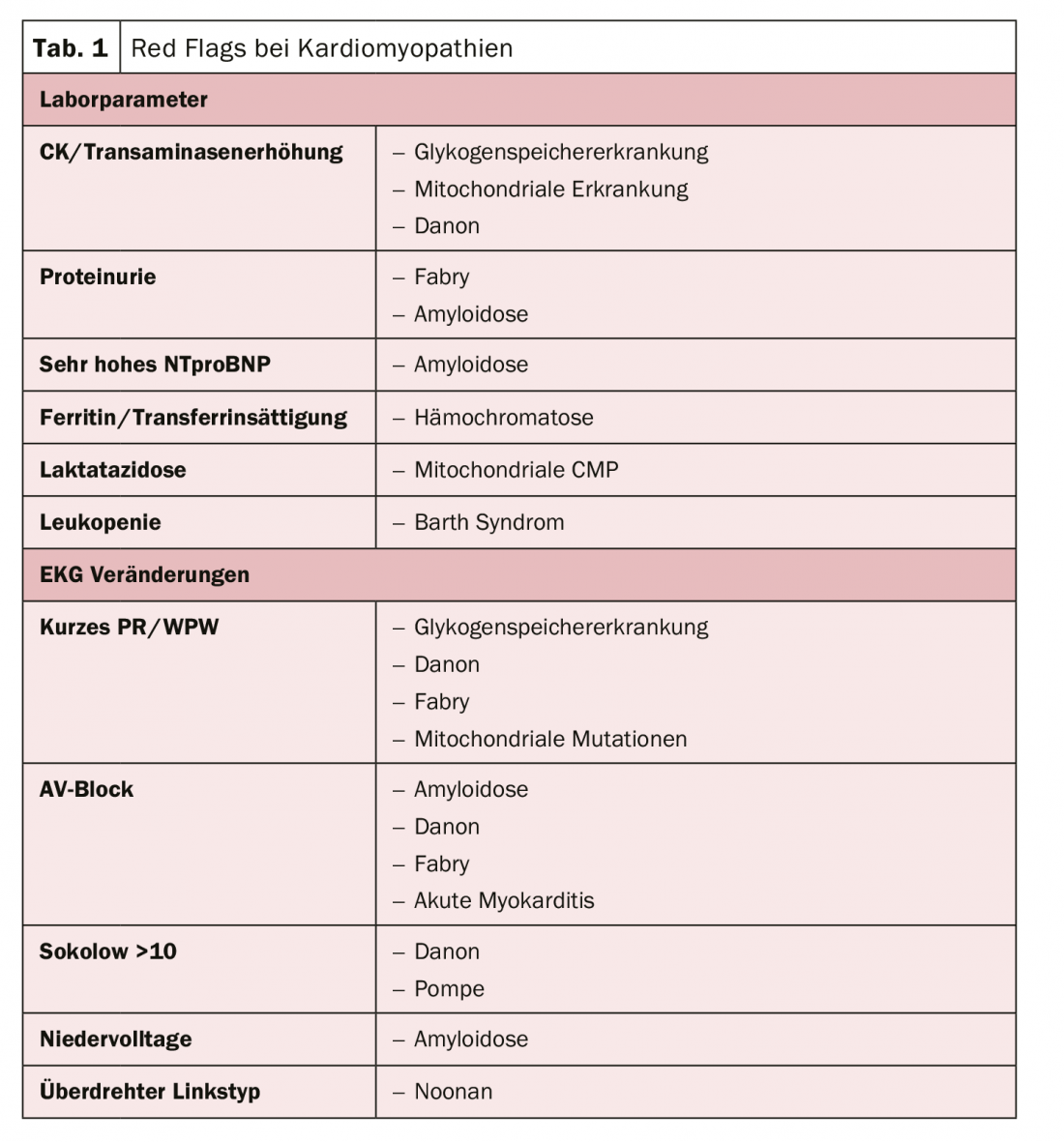
The structural approach to optimized treatment therefore approaches via etiology with the goal of avoiding sudden cardiac death, the limiting problem of all cardiomyopathies. There are typical laboratory parameters and abnormalities in the ECG that can indicate the presence of cardiomyopathy (tab. 1). Being able to make these distinctions is therefore relevant, as the prognosis is essentially determined by the cause, says the expert. In particular, patients with amyloidosis have very poor survival.


Detect and effectively treat amyloidosis

Amyloidosis can be divided into three types based on organ involvement: AL amyloidosis affecting the kidneys, heart and/or intestines, mt-ATTR amyloidosis affecting mainly the heart or nervous system, and wt-ATTR amyloidosis affecting mainly the heart. In principle, AL amyloidosis can be understood as a complication of plasma cell dyscrasia. Therefore, hematologic therapy along the lines of that used in multiple myeloma is used with the goal of eliminating the amyloidogenic, (cardio)toxic light chains as quickly as possible. In addition to high-dose chemotherapy for fit patients, a proteasome inhibitor-based regimen is primarily used. In younger patients, CyBorD (bortezomib, cyclophosphamide, dexamethasone) should be favored over BMDex (bortezomib, melphalan, dexamethasone) because of the stem cell toxicity of melphalan to preserve the option of subsequent stem cell apheresis and high-dose chemotherapy.

In amyloidosis caused by transthyretin protein deposition, drugs such as diflunisal and tafamidis can stabilize the mutant protein. Furthermore, gene therapies that reduce transthyretin production (e.g., patisiran, inotersen) may reduce nervous system effects.

For patients with symptomatic cardiac AL and ATTR amyloidosis, the same general therapy recommendations apply in principle as for heart failure patients. However, even low doses of β-blockers or ACE inhibitors can lead to symptomatic hypotension. Therefore, treatment in patients with cardiac amyloidosis is primarily based on proper dosing of diuretics.

Syndromal involvement of many organ systems – Fabry disease

Fabry disease is a genetically inherited disorder that usually manifests between the ages of 20-40. A misfolded or nonfunctional α-Gal A enzyme is formed, disrupting transport from the endoplasmic reticulum to the lysosome. This leads to an accumulation of lysosomal substrates. Besides the heart, the kidneys, the central nervous system, but also the peripheral nervous system and the skin can be involved. If not treated, renal failure is the most common cause of death in these patients, explained Prof. Ingrid Kindermann, MD, Homburg/Saar (D). Cardiac symptoms occur in more than half of all Fabry patients. Malignant arrhythmias are mainly responsible for sudden cardiac death.

For a long time, therapy was limited to the mere alleviation of symptoms. There is now a specific treatment option in which the missing enzyme is replaced by a biotechnologically produced enzyme. Laboratory-produced alpha-galactosidase A is administered to the patient by infusion and ensures that the accumulated storage material is broken down. However, since enzyme replacement therapy cannot repair organ damage that has already occurred, but only delay its progression, it should be used as early as possible. Another option is to take a pharmacological chaperone orally. This agent can be used in patients with certain mutations in the GLA gene and residual activity of the α-galactosidase A enzyme. This is because it binds to unstable forms of AGAL and stabilizes the enzyme so that it can break down the accumulated lipids in the cell.

Source: CardioMedLive 2020


CARDIOVASC 2020; 19(3): 28-29 (published 9/17/20, ahead of print).

Autoren
  • Leoni Burggraf
Publikation
  • CARDIOVASC
Related Topics
  • Cardiomyopathies
Previous Article
  • Laser Medicine

Tattoo removal – from the origins to modernity

  • Dermatology and venereology
  • Education
  • RX
View Post
Next Article
  • Burnout and depression

Effects of the pandemic exacerbate psychological strain on physicians

  • Education
  • News
  • Prevention and health care
  • Psychiatry and psychotherapy
  • RX
View Post
You May Also Like
View Post
  • 14 min
  • Fibromyalgia Syndrome

Development, Diagnosis, Epidemiology, and Treatment of a Disease Entity

    • General Internal Medicine
    • CME continuing education
    • Geriatrics
    • Neurology
    • Orthopedics
    • Rheumatology
    • RX
View Post
  • 27 min
  • Across All Types of Cancer

Four-Legged Medical Assistants – Therapy Dogs in Clinical Settings

    • RX
    • CME continuing education
    • General Internal Medicine
    • Geriatrics
    • Hematology
    • Oncology
    • Pediatrics
    • Physical medicine and rehabilitation
    • Prevention and health care
    • Studies
View Post
  • 8 min
  • Obesity: More than half of those affected have fatty liver disease

From screening to multimodal intervention with GLP-1-RA or resmetirom

    • RX
    • Education
    • Endocrinology and Diabetology
    • Gastroenterology and Hepatology
    • General Internal Medicine
    • Nutrition
    • Studies
View Post
  • 6 min
  • Innovative Oral Treatment Options for Psoriasis: Icotrokinra and Zasocitinib

First-class immunomodulation combined with convenience—the data available so far is convincing

    • RX
    • Congress Reports
    • Dermatology and venereology
    • Rheumatology
    • Studies
View Post
  • 4 min
  • Preclinical Study on a Special Ginkgo biloba Extract

What role do proanthocyanidins play?

    • RX
    • Education
    • General Internal Medicine
    • Geriatrics
    • Neurology
    • Pharmaceutical medicine
    • Pharmacology and toxicology
    • Phytotherapy
    • Studies
View Post
  • 6 min
  • Myasthenia gravis: immunomodulatory therapies for long-term treatment

Expanded Possibilities Thanks to Innovative Classes of Active Ingredients

    • RX
    • Congress Reports
    • General Internal Medicine
    • Neurology
    • Ophthalmology
    • Studies
View Post
  • 10 min
  • Interstitial Lung Diseases

Update on Idiopathic Pulmonary Fibrosis

    • RX
    • CME continuing education
    • Pneumology
    • Studies
View Post
  • 7 min
  • Plastic surgery and reconstructive microsurgery for DFS

Functional limb preservation between infection control, vascular medicine and resurfacing

    • RX
    • Angiology
    • CME continuing education
    • Dermatology and venereology
    • Endocrinology and Diabetology
    • General Internal Medicine
    • Geriatrics
    • Physical medicine and rehabilitation
    • Surgery
  • IBD matters

    Zum Thema
Top CME content
  • 1
    Four-Legged Medical Assistants – Therapy Dogs in Clinical Settings
  • 2
    Functional limb preservation between infection control, vascular medicine and resurfacing
  • 3
    Update on Idiopathic Pulmonary Fibrosis
  • 4
    Update on Idiopathic Pulmonary Fibrosis
  • 5
    Current status of PAT

Newsletter

Sign up and stay up to date

Subscribe
Medizinonline Medizinonline
  • Contact
  • General terms and conditions
  • Imprint

Input your search keywords and press Enter.