Medizinonline Medizinonline
  • News
    • News
    • Market & Medicine
  • Patients
    • Disease patterns
    • Diagnostics
    • Therapy
  • Partner Content
    • Diabetes
      • Dia-Month Club – Type 2 Diabetes
      • Diabetes in Motion
      • Diabetes Podcasts
    • Gastroenterology
      • IBD matters
    • Oncology
      • Swiss Oncology in motion
    • Orthopedics
      • Osteoporosis in motion
  • Departments
    • Allergology and clinical immunology
    • General Internal Medicine
    • Anesthesiology
    • Angiology
    • Surgery
    • Dermatology and venereology
    • Endocrinology and Diabetology
    • Nutrition
    • Gastroenterology and Hepatology
    • Genetics
    • Geriatrics
    • Gynecology
    • Hematology
    • Infectiology
    • Cardiology
    • Nephrology
    • Neurology
    • Emergency and intensive care medicine
    • Nuclear Medicine
    • Oncology
    • Ophthalmology
    • ORL
    • Orthopedics
    • Pediatrics
    • Pharmacology and toxicology
    • Pharmaceutical medicine
    • Phlebology
    • Physical medicine and rehabilitation
    • Pneumology
    • Prevention and health care
    • Psychiatry and psychotherapy
    • Radiology
    • Forensic Medicine
    • Rheumatology
    • Sports Medicine
    • Traumatology and trauma surgery
    • Tropical and travel medicine
    • Urology
    • Dentistry
  • CME & Congresses
    • CME continuing education
    • Congress Reports
    • Congress calendar
  • Practice
    • Noctimed
    • Practice Management
    • Jobs
    • Interviews
  • Log In
  • Register
  • My account
  • Contact
  • Publications
  • Contact
  • Deutsch
  • English
  • Français
  • Italiano
  • Português
  • Español
Subscribe
Medizinonline Medizinonline
  • News
    • News
    • Market & Medicine
  • Patienten
    • Krankheitsbilder
    • Diagnostik
    • Therapie
  • Partner Content
    • Diabetes
      • Dia-Month Club – Type 2 Diabetes
      • Diabetes in Motion
      • Diabetes Podcasts
    • Gastroenterology
      • IBD matters
    • Oncology
      • Swiss Oncology in motion
    • Orthopedics
      • Osteoporosis in motion
    • Phytotherapie
    • Rheumatology
  • Departments
    • Fachbereiche 1-13
      • Allergology and clinical immunology
      • General Internal Medicine
      • Anesthesiology
      • Angiology
      • Surgery
      • Dermatology and venereology
      • Endocrinology and Diabetology
      • Nutrition
      • Gastroenterology and Hepatology
      • Genetics
      • Geriatrics
      • Gynecology
      • Hematology
    • Fachbereiche 14-26
      • Infectiology
      • Cardiology
      • Nephrology
      • Neurology
      • Emergency and intensive care medicine
      • Nuclear Medicine
      • Oncology
      • Ophthalmology
      • ORL
      • Orthopedics
      • Pediatrics
      • Pharmacology and toxicology
      • Pharmaceutical medicine
    • Fachbereiche 26-38
      • Phlebology
      • Physical medicine and rehabilitation
      • Phytotherapy
      • Pneumology
      • Prevention and health care
      • Psychiatry and psychotherapy
      • Radiology
      • Forensic Medicine
      • Rheumatology
      • Sports Medicine
      • Traumatology and trauma surgery
      • Tropical and travel medicine
      • Urology
      • Dentistry
  • CME & Congresses
    • CME continuing education
    • Congress Reports
    • Congress calendar
  • Practice
    • Noctimed
    • Practice Management
    • Jobs
    • Interviews
Login

Sie haben noch keinen Account? Registrieren

  • Ankylosing spondylitis

Help from TNF inhibition?

    • Congress Reports
    • General Internal Medicine
    • Orthopedics
    • Rheumatology
    • RX
  • 3 minute read

One of the therapeutic goals in ankylosing spondylitis is to reduce spinal ankylosing progression. Data from the AxSpA cohort SCQM provide further evidence regarding the efficacy of TNF inhibitors.

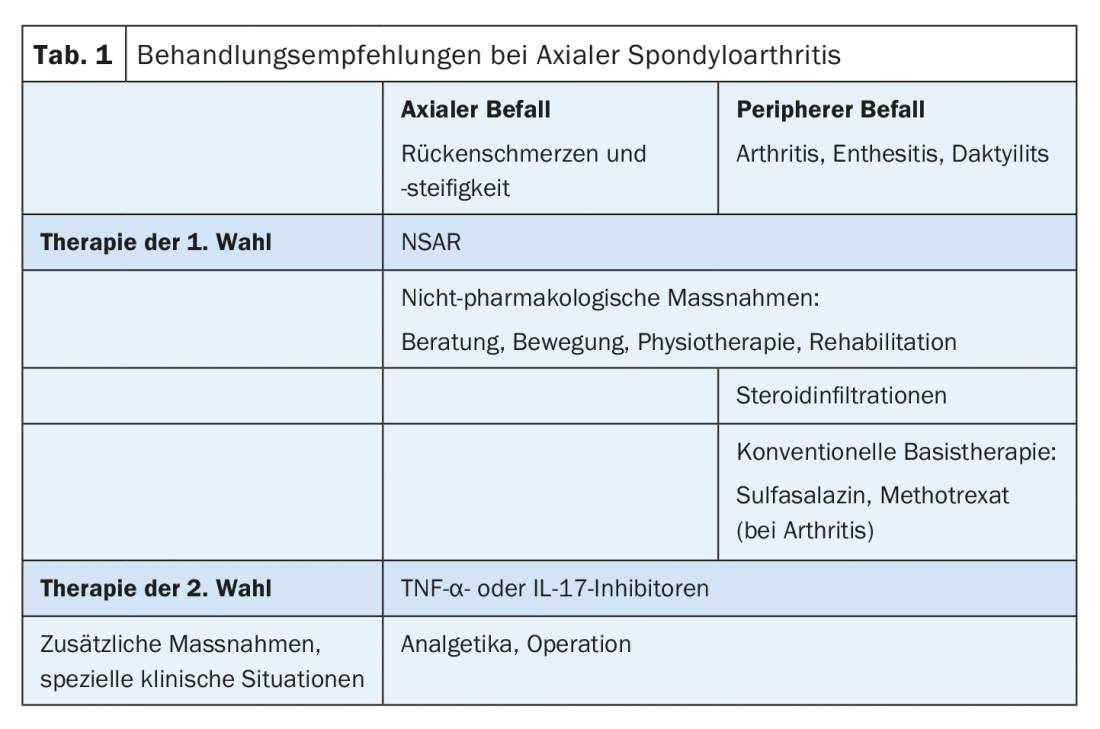
The rheumatic systemic disease ankylosing spondylitis, a form of axial spondyloarthritis (AxSpA), is characterized by chronic inflammatory, seronegative processes. The caudal spine and sacroiliac joints are mostly affected. In the case of axial involvement, which manifests as back pain and stiffness, treatment initially focuses on the administration of NSAIDs. This measure is flanked by counseling services (among others by the Swiss Bekhterev’s Disease Association, SVMB) and appropriate physical activity or physiotherapy. TNF-α or IL-17 inhibitors are used as second-line therapy (Table 1).


Can TNF blockers inhibit increasing ankylosis? “A big question in the last few years,” says PD Adrian Ciurea, MD, at the medical congress in Davos. He and his team work with data from the AxSpA cohort SCQM, the largest ankylosing spondylitis patient pool in Switzerland. For nearly two decades, TNF inhibitors have been used in ankylosing spondylitis patients with inadequate response to conventional therapies to reduce symptoms and inflammatory activity; secukinumab 150 mg was shown to be effective in two phase III RCTs [1]. In addition to inflammatory processes, spinal ankylosis also has a negative effect on the mobility and functionality of the spine. Delaying this is therefore also an important treatment goal [2].


The relationship between TNF inhibition and ankylosis was also investigated by Dr. Ciurea and his team. Their study published in 2018 [3] supported the theory that TNF blockers have a retarding effect on spinal ankylosis by reducing disease activity. Included were 432 patients from the AxSpA cohort. The follow-up of the longitudinal study was ten years with clinical and radiographic assessments every two years. Comparison between radiographic findings of patients with and without TNF inhibition showed: TNF blockers reduce the likelihood of progression in the next two years by half; progression is defined as an increase of ≥2 mSaSSS units every two years. However, to observe this effect, therapy for at least two years was required; below this time mark, no effect was seen. In addition, the longer the treatment, the greater the reduction in progression. This is – also confirmed by the study – triggered by the decrease in inflammatory activity. The authors accounted for the number of syndesmophytes, the degree of inflammation, and a male gender as predictors of progression.

The results suggest that early diagnosis and thus early initiation of therapy are important. For primary care physicians, this means working closely with rheumatologists to quickly identify patients who need biologics.

Source: 85th Medical Congress Davos, February 7-9, 2019.


Literature:

  1. Sepriano A, et al: Efficacy and safety of biological and targeted-synthetic DMARDs: a systematic literature review informing the 2016 update of the ASAS/EULAR recommendations for the management of axial spondyloarthritis. RMD Open 2017; 3(1): e000396.
  2. Poddubnyy D, Sieper J: Radiographic progression in ankylosing spondylitis/axial spondyloarthritis: how fast and how clinically meaningful? Curr Opin Rheumatol 2012; 24(4): 363-369.
  3. Molnar C, et al: TNF blockers inhibit spinal radiographic progression in ankylosing spondylitis by reducing disease activity: results from the Swiss Clinical Quality Management cohort. Ann Rheum Dis 2018; 77: 63-69.


HAUSARZT PRAXIS 2019; 14(3): 39-40

Autoren
  • Barbara Hug
Publikation
  • HAUSARZT PRAXIS
Related Topics
  • AxSpA
  • Spine
  • SPONDYLITIS
  • TNF
Previous Article
  • Mental illness in pregnancy

Mother and child in view

  • Education
  • Gynecology
  • Psychiatry and psychotherapy
  • RX
View Post
Next Article
  • Foramen ovale persistens

Closure as recurrence prophylaxis in stroke patients?

  • Cardiology
  • Congress Reports
  • Neurology
  • RX
  • Studies
View Post
You May Also Like
View Post
  • 3 min
  • Soft tissue sarcomas of the lower extremity

Diagnostics, subtypes and treatment options

    • RX
    • Education
    • Oncology
View Post
  • 38 min
  • Psychological dependence on AI assistants, smartphones and short videos

Algorithms, avatars and the unburdened mind

    • RX
    • CME continuing education
    • Neurology
    • Pediatrics
    • Prevention and health care
    • Psychiatry and psychotherapy
    • Studies
View Post
  • 8 min
  • Psychooncology

Communication as the key to therapy adherence

    • CME continuing education
    • Practice Management
    • RX
View Post
  • 12 min
  • The Brain and the Motivation to Eat

Why is it so hard to lose weight?

    • RX
    • CME continuing education
    • Endocrinology and Diabetology
    • General Internal Medicine
    • Nutrition
    • Pharmacology and toxicology
    • Prevention and health care
    • Psychiatry and psychotherapy
    • Studies
View Post
  • 5 min
  • Omaveloxolone for Friedreich's Ataxia

Efficacy and Safety Studied Over 6 Years

    • Neurology
    • Congress Reports
    • Endocrinology and Diabetology
    • RX
    • Studies
View Post
  • 6 min
  • Psoriasis: therapy with biologics and TYK-2-i

Progress assessments based on current long-term and real-world data

    • RX
    • Congress Reports
    • Dermatology and venereology
    • Pharmacology and toxicology
    • Rheumatology
    • Studies
View Post
  • 4 min
  • Hypertension: the most important facts for daily practice

Early dual antihypertensive therapy is usually indicated

    • RX
    • Cardiology
    • Congress Reports
    • General Internal Medicine
View Post
  • 4 min
  • Escitalopram for anxiety disorders

Positive effect, but no immediate improvement in symptoms

    • RX
    • Education
    • Neurology
    • Pharmacology and toxicology
    • Psychiatry and psychotherapy
    • Studies
  • IBD matters

    Zum Thema
Top CME content
  • 1
    Why is it so hard to lose weight?
  • 2
    Algorithms, avatars and the unburdened mind
  • 3
    Communication as the key to therapy adherence
  • 4
    Communication as the key to therapy adherence
  • 5
    Solutions to the malnutrition dilemma

Newsletter

Sign up and stay up to date

Subscribe
Medizinonline Medizinonline
  • Contact
  • General terms and conditions
  • Imprint

Input your search keywords and press Enter.