Medizinonline Medizinonline
  • News
    • News
    • Market & Medicine
  • Patients
    • Disease patterns
    • Diagnostics
    • Therapy
  • Partner Content
    • Diabetes
      • Dia-Month Club – Type 2 Diabetes
      • Diabetes in Motion
      • Diabetes Podcasts
    • Gastroenterology
      • IBD matters
    • Oncology
      • Swiss Oncology in motion
    • Orthopedics
      • Osteoporosis in motion
  • Departments
    • Allergology and clinical immunology
    • General Internal Medicine
    • Anesthesiology
    • Angiology
    • Surgery
    • Dermatology and venereology
    • Endocrinology and Diabetology
    • Nutrition
    • Gastroenterology and Hepatology
    • Genetics
    • Geriatrics
    • Gynecology
    • Hematology
    • Infectiology
    • Cardiology
    • Nephrology
    • Neurology
    • Emergency and intensive care medicine
    • Nuclear Medicine
    • Oncology
    • Ophthalmology
    • ORL
    • Orthopedics
    • Pediatrics
    • Pharmacology and toxicology
    • Pharmaceutical medicine
    • Phlebology
    • Physical medicine and rehabilitation
    • Pneumology
    • Prevention and health care
    • Psychiatry and psychotherapy
    • Radiology
    • Forensic Medicine
    • Rheumatology
    • Sports Medicine
    • Traumatology and trauma surgery
    • Tropical and travel medicine
    • Urology
    • Dentistry
  • CME & Congresses
    • CME continuing education
    • Congress Reports
    • Congress calendar
  • Practice
    • Noctimed
    • Practice Management
    • Jobs
    • Interviews
  • Log In
  • Register
  • My account
  • Contact
  • Publications
  • Contact
  • Deutsch
  • English
  • Français
  • Italiano
  • Português
  • Español
Subscribe
Medizinonline Medizinonline
  • News
    • News
    • Market & Medicine
  • Patienten
    • Krankheitsbilder
    • Diagnostik
    • Therapie
  • Partner Content
    • Diabetes
      • Dia-Month Club – Type 2 Diabetes
      • Diabetes in Motion
      • Diabetes Podcasts
    • Gastroenterology
      • IBD matters
    • Oncology
      • Swiss Oncology in motion
    • Orthopedics
      • Osteoporosis in motion
    • Phytotherapie
    • Rheumatology
  • Departments
    • Fachbereiche 1-13
      • Allergology and clinical immunology
      • General Internal Medicine
      • Anesthesiology
      • Angiology
      • Surgery
      • Dermatology and venereology
      • Endocrinology and Diabetology
      • Nutrition
      • Gastroenterology and Hepatology
      • Genetics
      • Geriatrics
      • Gynecology
      • Hematology
    • Fachbereiche 14-26
      • Infectiology
      • Cardiology
      • Nephrology
      • Neurology
      • Emergency and intensive care medicine
      • Nuclear Medicine
      • Oncology
      • Ophthalmology
      • ORL
      • Orthopedics
      • Pediatrics
      • Pharmacology and toxicology
      • Pharmaceutical medicine
    • Fachbereiche 26-38
      • Phlebology
      • Physical medicine and rehabilitation
      • Phytotherapy
      • Pneumology
      • Prevention and health care
      • Psychiatry and psychotherapy
      • Radiology
      • Forensic Medicine
      • Rheumatology
      • Sports Medicine
      • Traumatology and trauma surgery
      • Tropical and travel medicine
      • Urology
      • Dentistry
  • CME & Congresses
    • CME continuing education
    • Congress Reports
    • Congress calendar
  • Practice
    • Noctimed
    • Practice Management
    • Jobs
    • Interviews
Login

Sie haben noch keinen Account? Registrieren

  • From symptom to diagnosis

Abdominal pain – Pelvic congestion syndrome

    • Cases
    • Gastroenterology and Hepatology
    • General Internal Medicine
    • Gynecology
    • Radiology
    • RX
  • 3 minute read

Pelvic congestion synd rome is the second most common cause of chronic lower abdominal pain, but in many cases remains undiagnosed. Pelvic vein syndrome is caused by abnormal dilation of the ovarian and pelvic veins. If a pelvic vein syndrome is suspected, sonography and/or cross-sectional imaging using magnetic resonance imaging is performed.

Vascular malformations (VM) are congenital vascular changes with different appearances and symptoms [5,10]. They occur with an incidence of around 1.5% and are found on the skin and in internal organs and soft tissue. These can be lymphogenous, venous and arteriovenous malformations. Venous malformations represent the largest proportion of congenital vascular abnormalities [8]. They can occur ubiquitously in the body.

Pelvic congestion synd rome (PCS) is a relatively little known but very common cause of pain in the lower abdomen in women. As chronic abdominal pain is underdiagnosed, the prevalence figures in the literature are variable and range from 2.1-24%. Pelvic venous congestion syndrome is a possible cause in 10-30% of cases, with premenopausal women who are able to conceive being particularly affected. The pain in PCS has a continuity of 3 to 6 months with varying intensity, intensified during menstruation [2,4,6]. Pregnancy has no relevant influence on the intensity of the symptoms. Ultimately, the cause of these venous malformations is unclear; mechanical and hormonal influences are being discussed. An enhancing, space-occupying vascular volume of varying extent can be detected in the contrast-assisted sectional image examinations. In PCS, the venous changes in the pelvis are often not primarily part of the differential diagnostic considerations [1,3,7,9]. Dilatation of the gonadal veins and parauterine varices are frequently found, occasionally also varicosis of the vulva and venous insufficiency of the lower extremity [9].

X-rays of the pelvis have no significance for the diagnosis of PCS.

Sonographically, color-coded duplex ultrasound is a vessel-sensitive method for visualizing malformations [10].

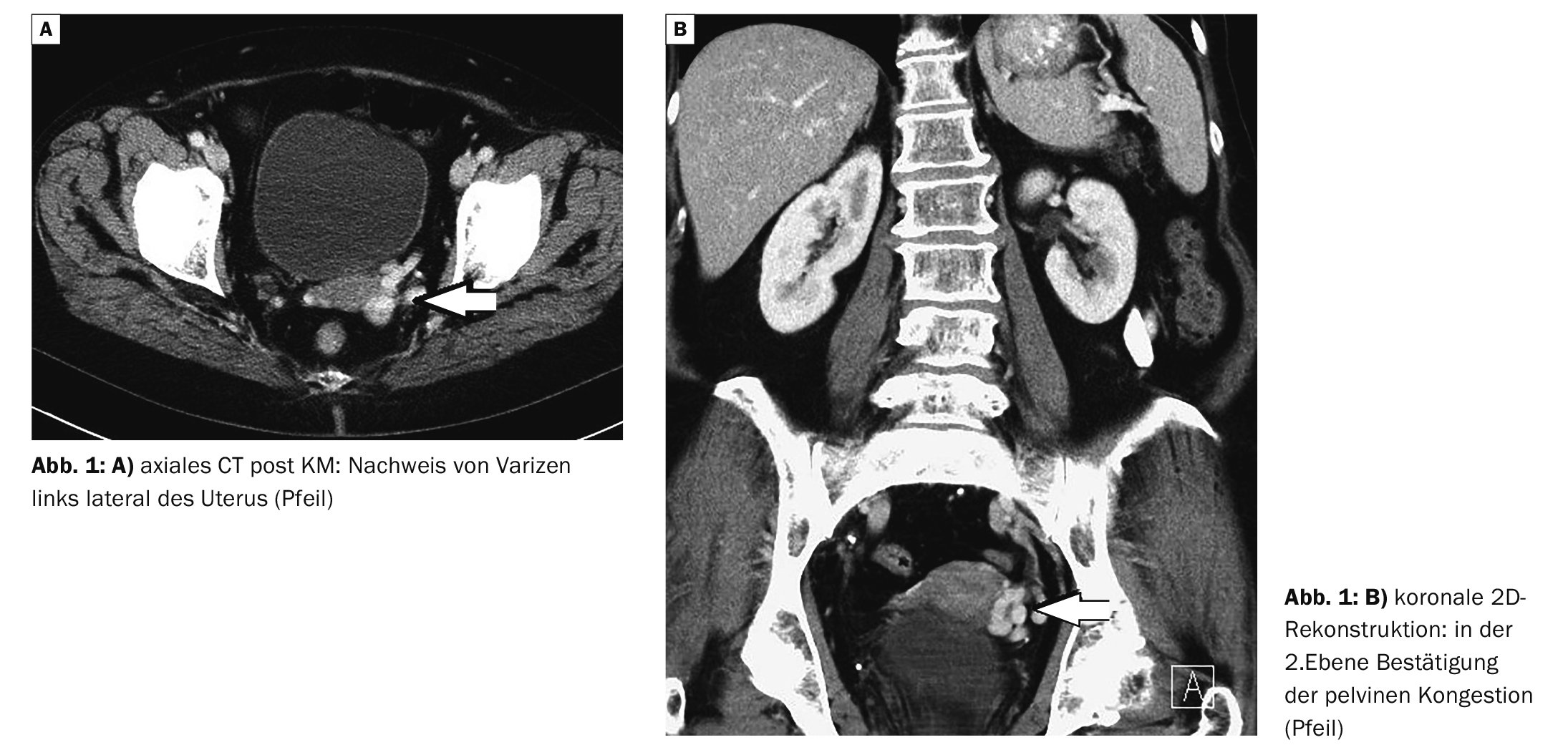
Computed tomography and magnetic resonance imaging examinations can visualize the intrapelvic varices very well, especially in contrast scans, and if necessary, can also be used for angiography. The scans can also be used to exclude tumorous or inflammatory changes, such as colitis or diverticulitis, from the differential diagnosis.
Case study

Case example 1 shows a 63-year-old female patient with recurrent unclear lower abdominal complaints on the left with unremarkable urological findings on computed tomography of a pelvic congestion on the left with parauteral varices. Asymptomatic cholecystolithiasis was known, and there was no evidence of diverticulitis on CT.
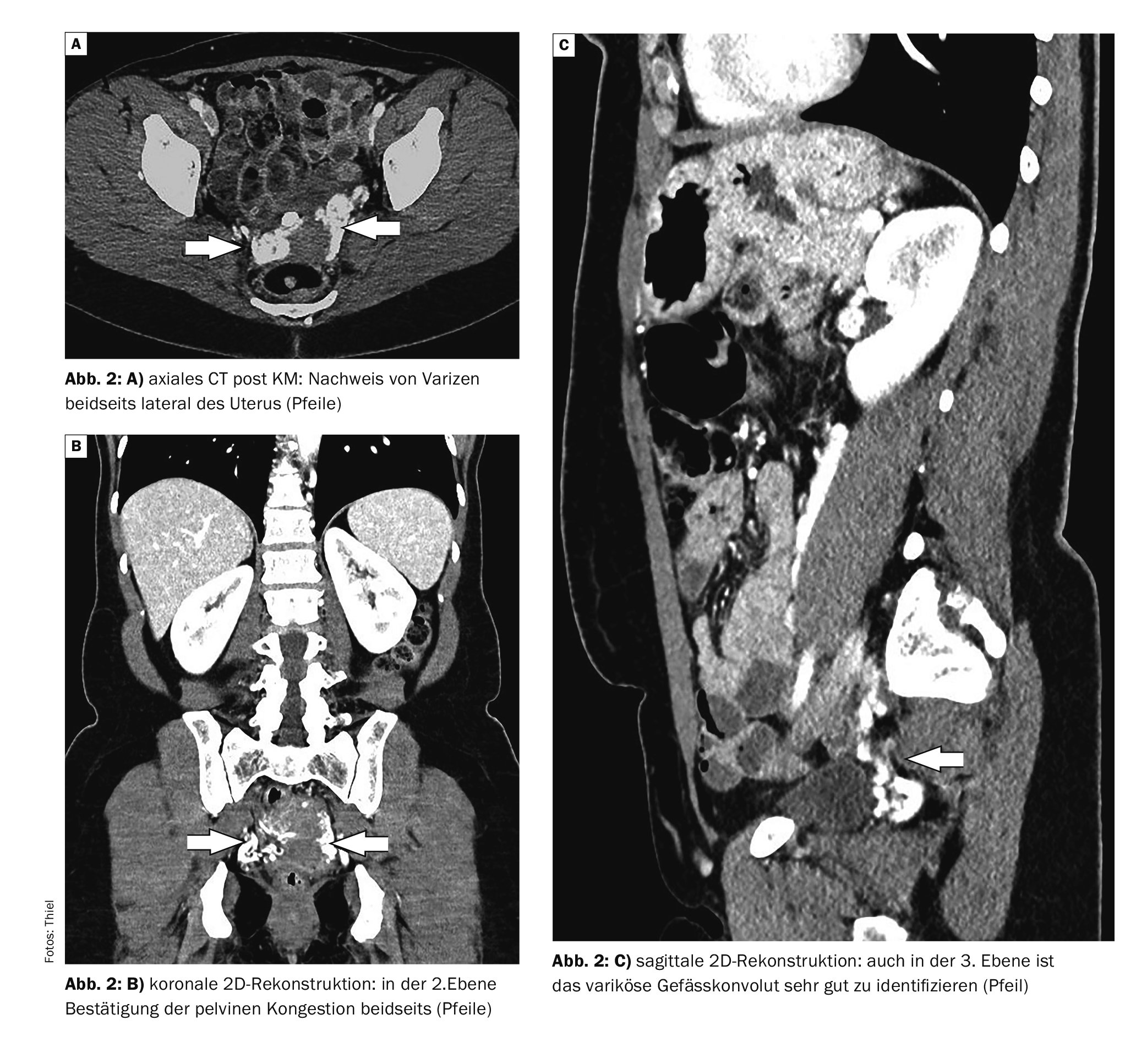
Case 2 showed evidence of pelvic congestion syndrome (PCS) in the MS-CT images of a 53-year-old female patient with unclear lower abdominal complaints (Fig. 2A to 2C) . The urine findings and standard gynecological examination were unremarkable.

Take-Home-Messages

  • Pelvic congestion syndrome primarily leads to recurrent lower abdominal pain in women of reproductive age.
  • If the intensity of the pain varies over 3 to 6 months and other inflammatory or tumorous causes have been ruled out, this clinical picture should definitely be considered.
  • Color-coded Doppler sonography, contrast-enhanced computer tomography or magnetic resonance imaging are used for diagnosis.
  • Therapeutic options include medication, endovascular or surgical measures.

Literature:

  1. Annam A: Female Pelvic Vascular Malformations. Semin Intervent Radiol 2018; 35(1): 62-68.
  2. Basile A, Failla G, Gozzo C : Pelvic congestion syndrome. Semin Ultrasound CT MR. 2021; 42(1): 3-12.
  3. Belabuszek K, Toborek M, Pietura R: Comprehensive overview of the venous disorder known as pelvic congestion syndrome. Ann Med 2022; 54(1): 22-36.
  4. Brown CL, et al: Pelvic Congestion Syndrome: Systematic review of Treatment Successes. Semin Intervent Radiol 2018; 35(1): 35-40.
  5. Carqueja IM, Sousa J, Mansilha A: Vascular malformations: classification, diagnosis and treatment. Int Angiol 2018; 37(2): 127-142.
  6. Cheema OS, Singh P: Pelvic Congestion Syndrome.
  7. Christenson BM, Gipson MG, Smith MT: Pelvic vascular malformations. Semin Intervent Radiol 2013; 30(4): 364-371.
  8. Markovic JN, Shortell CK: Venous malformations. J Cardiovasc Surg (Torino) 2021; 62(5): 456-466.
  9. Spüntrup E, et al: Pelvic venous congestion syndrome: MR diagnostics and interventional treatment options. Obstetrics Gynecology 2022; 82(03): 269-275.
  10. Stiegler H, et al: Color-coded duplex sonography. 3.3 Vascular malformations. 2015; DOI:10.1055/b-0035-124901.

GASTROENTEROLOGY 2024; 2(1): 34-35

Autoren
  • Dr. med. Hans-Joachim Thiel
Publikation
  • GASTROENTEROLOGIE PRAXIS
Related Topics
  • abdominal pain
  • Chronic lower abdominal pain
  • Ovarian veins
  • Pelvic congestion syndrome
  • Pelvic vein syndrome
  • Pelvic veins
Previous Article
  • Urology

Bladder cancer and co. – the latest findings from research

  • Congress Reports
  • Gynecology
  • Oncology
  • RX
  • Studies
  • Surgery
  • Urology
View Post
Next Article
  • Compression

Lymphoedema and chronic wounds

  • Cardiology
  • CME continuing education
  • Dermatology and venereology
  • Endocrinology and Diabetology
  • General Internal Medicine
  • Geriatrics
  • Physical medicine and rehabilitation
  • Prevention and health care
  • RX
  • Studies
View Post
You May Also Like
View Post
  • 2 min
  • Wearables: screening via smartwatch?

New study on atrial fibrillation in high-risk patients

    • RX
    • Cardiology
    • Practice Management
    • Prevention and health care
    • Studies
View Post
  • 11 min
  • Peristomal skin health

Focus on preventive care options

    • RX
    • Cases
    • CME continuing education
    • Dermatology and venereology
    • Gastroenterology and Hepatology
    • Infectiology
    • Physical medicine and rehabilitation
    • Prevention and health care
    • Surgery
View Post
  • 5 min
  • Mental Health with GLP-1 RAs

Benefits of Semaglutide and Liraglutide

    • RX
    • Education
    • Endocrinology and Diabetology
    • General Internal Medicine
    • Nutrition
    • Psychiatry and psychotherapy
    • Studies
View Post
  • 4 min
  • Bronchiolitis obliterans

Out of shape even without popcorn

    • RX
    • Education
    • General Internal Medicine
    • Infectiology
    • Pediatrics
    • Pneumology
    • Studies
View Post
  • 8 min
  • Case study

Guillain-Barré syndrome with a fulminant course

    • RX
    • Cases
    • Education
    • Infectiology
    • Neurology
    • Pharmacology and toxicology
    • Radiology
    • Studies
View Post
  • 5 min
  • Suspicion of neuroborreliosis?

Detection of borrelia-specific CSF parameters provides certainty

    • RX
    • Congress Reports
    • Infectiology
    • Neurology
    • Studies
View Post
  • 12 min
  • The Brain and the Motivation to Eat

Why is it so hard to lose weight?

    • RX
    • CME continuing education
    • Endocrinology and Diabetology
    • General Internal Medicine
    • Nutrition
    • Pharmacology and toxicology
    • Prevention and health care
    • Psychiatry and psychotherapy
    • Studies
View Post
  • 12 min
  • Global Recommendation, Swissmedic Approval, and SL Limitation

WHO Guidelines on GLP-1 for Obesity

    • RX
    • Cardiology
    • Education
    • Endocrinology and Diabetology
    • General Internal Medicine
    • Nutrition
    • Pharmacology and toxicology
    • Prevention and health care
    • Studies
  • IBD matters

    Zum Thema
Top CME content
  • 1
    Focus on preventive care options
  • 2
    Inflammation as a Treatment Goal in Its Own Right
  • 3
    Personalized Treatment Before a Planned Pregnancy
  • 4
    Current State of Knowledge and New Therapeutic Approaches
  • 5
    Why is it so hard to lose weight?

Newsletter

Sign up and stay up to date

Subscribe
Medizinonline Medizinonline
  • Contact
  • General terms and conditions
  • Imprint

Input your search keywords and press Enter.