Medizinonline Medizinonline
  • News
    • News
    • Market & Medicine
  • Patients
    • Disease patterns
    • Diagnostics
    • Therapy
  • Partner Content
    • Diabetes
      • Dia-Month Club – Type 2 Diabetes
      • Diabetes in Motion
      • Diabetes Podcasts
    • Gastroenterology
      • IBD matters
    • Oncology
      • Swiss Oncology in motion
    • Orthopedics
      • Osteoporosis in motion
  • Departments
    • Allergology and clinical immunology
    • General Internal Medicine
    • Anesthesiology
    • Angiology
    • Surgery
    • Dermatology and venereology
    • Endocrinology and Diabetology
    • Nutrition
    • Gastroenterology and Hepatology
    • Genetics
    • Geriatrics
    • Gynecology
    • Hematology
    • Infectiology
    • Cardiology
    • Nephrology
    • Neurology
    • Emergency and intensive care medicine
    • Nuclear Medicine
    • Oncology
    • Ophthalmology
    • ORL
    • Orthopedics
    • Pediatrics
    • Pharmacology and toxicology
    • Pharmaceutical medicine
    • Phlebology
    • Physical medicine and rehabilitation
    • Pneumology
    • Prevention and health care
    • Psychiatry and psychotherapy
    • Radiology
    • Forensic Medicine
    • Rheumatology
    • Sports Medicine
    • Traumatology and trauma surgery
    • Tropical and travel medicine
    • Urology
    • Dentistry
  • CME & Congresses
    • CME continuing education
    • Congress Reports
    • Congress calendar
  • Practice
    • Noctimed
    • Practice Management
    • Jobs
    • Interviews
  • Log In
  • Register
  • My account
  • Contact
  • Publications
  • Contact
  • Deutsch
  • English
  • Français
  • Italiano
  • Português
  • Español
Subscribe
Medizinonline Medizinonline
  • News
    • News
    • Market & Medicine
  • Patienten
    • Krankheitsbilder
    • Diagnostik
    • Therapie
  • Partner Content
    • Diabetes
      • Dia-Month Club – Type 2 Diabetes
      • Diabetes in Motion
      • Diabetes Podcasts
    • Gastroenterology
      • IBD matters
    • Oncology
      • Swiss Oncology in motion
    • Orthopedics
      • Osteoporosis in motion
    • Phytotherapie
    • Rheumatology
  • Departments
    • Fachbereiche 1-13
      • Allergology and clinical immunology
      • General Internal Medicine
      • Anesthesiology
      • Angiology
      • Surgery
      • Dermatology and venereology
      • Endocrinology and Diabetology
      • Nutrition
      • Gastroenterology and Hepatology
      • Genetics
      • Geriatrics
      • Gynecology
      • Hematology
    • Fachbereiche 14-26
      • Infectiology
      • Cardiology
      • Nephrology
      • Neurology
      • Emergency and intensive care medicine
      • Nuclear Medicine
      • Oncology
      • Ophthalmology
      • ORL
      • Orthopedics
      • Pediatrics
      • Pharmacology and toxicology
      • Pharmaceutical medicine
    • Fachbereiche 26-38
      • Phlebology
      • Physical medicine and rehabilitation
      • Phytotherapy
      • Pneumology
      • Prevention and health care
      • Psychiatry and psychotherapy
      • Radiology
      • Forensic Medicine
      • Rheumatology
      • Sports Medicine
      • Traumatology and trauma surgery
      • Tropical and travel medicine
      • Urology
      • Dentistry
  • CME & Congresses
    • CME continuing education
    • Congress Reports
    • Congress calendar
  • Practice
    • Noctimed
    • Practice Management
    • Jobs
    • Interviews
Login

Sie haben noch keinen Account? Registrieren

  • Hypertension Treatment

Increase Awareness, Compliance and Adherence!

    • Cardiology
    • Congress Reports
    • Nephrology
    • RX
  • 2 minute read

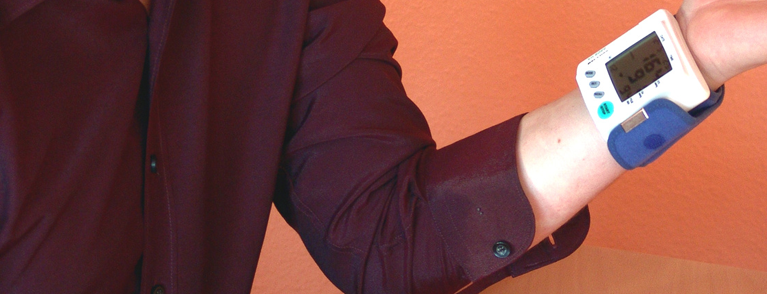
Although many hypertensive patients perform regular blood pressure measurements at home, a large proportion of these patients – 51% in the SWISSHYPE study published in 2011 [1] – are inadequately treated or have a low blood pressure. does not reach the target blood pressure values. This is due on the one hand to a lack of compliance and adherence on the part of many patients, but often also to a therapy that is not optimally developed.

A team from the Institute of Family Medicine in Zurich has shown that blood pressure can be reduced with the help of a very simple and inexpensive intervention, namely the ab-
The results of the blood pressure test are impressive (syst. -14 mmHg, diast. -8 mmHg) [2, 3]. This is achieved on the one hand by increasing compliance and adherence and on the other hand by improving awareness on the part of both patients and physicians.

In practice, 24-hour blood pressure measurement is a cost-effective and time-efficient measure for diagnosing patients with high blood pressure. NICE guidelines recommend that all patients with a blood pressure >140/90 mmHg should have one performed first [4]. If the mean blood pressure in this measurement is 135-150/85-95 mmHg, it is recommended that only lifestyle measures be taken initially in patients with no end-organ damage and no increased cardiovascular risk (this can be determined using the AGLA risk calculator, for example, www.agla.ch). If the patient already has end-organ damage and/or an increased cardiovascular risk or if the values are >150/95 mmHg, drug treatment should be started in addition to lifestyle measures [4]. At the SGIM congress in Basel, Thilo Burkhard, MD, Basel, recommended that younger patients (<55 years) should always be started primarily with an angiotensin receptor blocker (ARB) or an ACE inhibitor and older patients with a calcium antagonist(Fig. 1) [4].
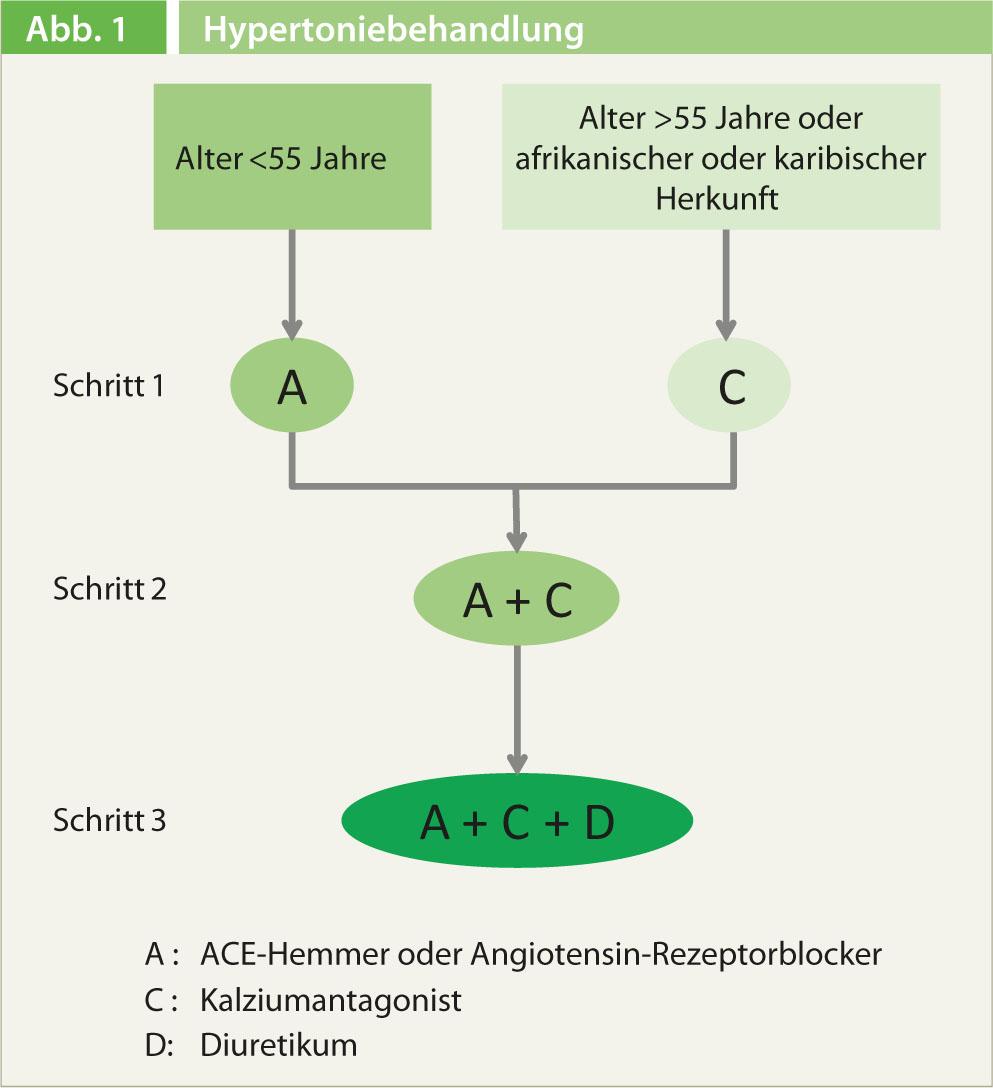
If monotherapy is not sufficient, ARB resp. ACE inhibitors and calcium antagonists are combined and only in a third step, if necessary, a diuretic is added [4]. According to Dr. Burkhard, most patients require combination therapy to achieve target blood pressure levels on a sustained basis. He therefore recommended that in patients with grade 2 hypertension or in the presence of end-organ damage – in addition to the lifestyle measures that always belong! – to consider a combination therapy already initially. Especially in patients who still need to take additional medications, fixed-dose combination preparations contribute to a significant improvement in adherence.

Source: “Hypertension Treatment in Family Practice – Good, but can it be better?” Satellite Symposium of A. Menarini AG, SGIM Congress, May 29-31, 2013, Basel.

Literature:

  1. Brenner R, et al: Swiss Med Wkly 2011; 141: w13169.
  2. Steurer-Stey C, et al: Trials 2010; 11: 38.
  3. Rosemann T: Results of the CoCo study. Paper presented at the SGIM Annual Meeting 2013.
  4. NICE: CG127, 2011. http://guidance.nice.org.uk/CG127

Autoren
  • Dr. med. Sabina M. Ludin
Publikation
  • HAUSARZT PRAXIS
Related Topics
  • Adherence
  • Blood pressure
  • Compliance
  • Diagnostics
  • Hypertension
  • Target blood glucose levels
  • Therapy
Previous Article
  • Insect venom allergy

The risk increases with the frequency of stings

  • Allergology and clinical immunology
  • Education
  • RX
View Post
Next Article
  • HIV therapy

What is State-of-the-ART 2013?

  • Education
  • Infectiology
  • RX
View Post
You May Also Like
View Post
  • 38 min
  • Psychological dependence on AI assistants, smartphones and short videos

Algorithms, avatars and the unburdened mind

    • RX
    • CME continuing education
    • Neurology
    • Pediatrics
    • Prevention and health care
    • Psychiatry and psychotherapy
    • Studies
View Post
  • 8 min
  • Psychooncology

Communication as the key to therapy adherence

    • CME continuing education
    • Practice Management
    • RX
View Post
  • 12 min
  • The Brain and the Motivation to Eat

Why is it so hard to lose weight?

    • RX
    • CME continuing education
    • Endocrinology and Diabetology
    • General Internal Medicine
    • Nutrition
    • Pharmacology and toxicology
    • Prevention and health care
    • Psychiatry and psychotherapy
    • Studies
View Post
  • 5 min
  • Omaveloxolone for Friedreich's Ataxia

Efficacy and Safety Studied Over 6 Years

    • Neurology
    • Congress Reports
    • Endocrinology and Diabetology
    • RX
    • Studies
View Post
  • 6 min
  • Psoriasis: therapy with biologics and TYK-2-i

Progress assessments based on current long-term and real-world data

    • RX
    • Congress Reports
    • Dermatology and venereology
    • Pharmacology and toxicology
    • Rheumatology
    • Studies
View Post
  • 4 min
  • Hypertension: the most important facts for daily practice

Early dual antihypertensive therapy is usually indicated

    • RX
    • Cardiology
    • Congress Reports
    • General Internal Medicine
View Post
  • 4 min
  • Escitalopram for anxiety disorders

Positive effect, but no immediate improvement in symptoms

    • RX
    • Education
    • Neurology
    • Pharmacology and toxicology
    • Psychiatry and psychotherapy
    • Studies
View Post
  • 4 min
  • Helicobacter pylori infection

Simplified dual therapy beats quadruple regimen

    • RX
    • Education
    • Gastroenterology and Hepatology
    • General Internal Medicine
    • Infectiology
    • Studies
  • IBD matters

    Zum Thema
Top CME content
  • 1
    Why is it so hard to lose weight?
  • 2
    Algorithms, avatars and the unburdened mind
  • 3
    Communication as the key to therapy adherence
  • 4
    Communication as the key to therapy adherence
  • 5
    Solutions to the malnutrition dilemma

Newsletter

Sign up and stay up to date

Subscribe
Medizinonline Medizinonline
  • Contact
  • General terms and conditions
  • Imprint

Input your search keywords and press Enter.