Medizinonline Medizinonline
  • News
    • News
    • Market & Medicine
  • Patients
    • Disease patterns
    • Diagnostics
    • Therapy
  • Partner Content
    • Diabetes
      • Dia-Month Club – Type 2 Diabetes
      • Diabetes in Motion
      • Diabetes Podcasts
    • Gastroenterology
      • IBD matters
    • Oncology
      • Swiss Oncology in motion
    • Orthopedics
      • Osteoporosis in motion
  • Departments
    • Allergology and clinical immunology
    • General Internal Medicine
    • Anesthesiology
    • Angiology
    • Surgery
    • Dermatology and venereology
    • Endocrinology and Diabetology
    • Nutrition
    • Gastroenterology and Hepatology
    • Genetics
    • Geriatrics
    • Gynecology
    • Hematology
    • Infectiology
    • Cardiology
    • Nephrology
    • Neurology
    • Emergency and intensive care medicine
    • Nuclear Medicine
    • Oncology
    • Ophthalmology
    • ORL
    • Orthopedics
    • Pediatrics
    • Pharmacology and toxicology
    • Pharmaceutical medicine
    • Phlebology
    • Physical medicine and rehabilitation
    • Pneumology
    • Prevention and health care
    • Psychiatry and psychotherapy
    • Radiology
    • Forensic Medicine
    • Rheumatology
    • Sports Medicine
    • Traumatology and trauma surgery
    • Tropical and travel medicine
    • Urology
    • Dentistry
  • CME & Congresses
    • CME continuing education
    • Congress Reports
    • Congress calendar
  • Practice
    • Noctimed
    • Practice Management
    • Jobs
    • Interviews
  • Log In
  • Register
  • My account
  • Contact
  • Publications
  • Contact
  • Deutsch
  • English
  • Français
  • Italiano
  • Português
  • Español
Subscribe
Medizinonline Medizinonline
  • News
    • News
    • Market & Medicine
  • Patienten
    • Krankheitsbilder
    • Diagnostik
    • Therapie
  • Partner Content
    • Diabetes
      • Dia-Month Club – Type 2 Diabetes
      • Diabetes in Motion
      • Diabetes Podcasts
    • Gastroenterology
      • IBD matters
    • Oncology
      • Swiss Oncology in motion
    • Orthopedics
      • Osteoporosis in motion
    • Phytotherapie
    • Rheumatology
  • Departments
    • Fachbereiche 1-13
      • Allergology and clinical immunology
      • General Internal Medicine
      • Anesthesiology
      • Angiology
      • Surgery
      • Dermatology and venereology
      • Endocrinology and Diabetology
      • Nutrition
      • Gastroenterology and Hepatology
      • Genetics
      • Geriatrics
      • Gynecology
      • Hematology
    • Fachbereiche 14-26
      • Infectiology
      • Cardiology
      • Nephrology
      • Neurology
      • Emergency and intensive care medicine
      • Nuclear Medicine
      • Oncology
      • Ophthalmology
      • ORL
      • Orthopedics
      • Pediatrics
      • Pharmacology and toxicology
      • Pharmaceutical medicine
    • Fachbereiche 26-38
      • Phlebology
      • Physical medicine and rehabilitation
      • Phytotherapy
      • Pneumology
      • Prevention and health care
      • Psychiatry and psychotherapy
      • Radiology
      • Forensic Medicine
      • Rheumatology
      • Sports Medicine
      • Traumatology and trauma surgery
      • Tropical and travel medicine
      • Urology
      • Dentistry
  • CME & Congresses
    • CME continuing education
    • Congress Reports
    • Congress calendar
  • Practice
    • Noctimed
    • Practice Management
    • Jobs
    • Interviews
Login

Sie haben noch keinen Account? Registrieren

  • Studies in focus

Interleukin-31 as a clinical target in prurigo nodularis.

    • Dermatology and venereology
    • Education
    • RX
    • Studies
  • 3 minute read

For the treatment of prurigo nodularis, there are rather few approved therapeutic options available today. There is a need for new effective and well-tolerated treatment options. The use of the IL31 inhibitor nemolizumab is currently being clinically tested in various pruriginous skin diseases, including prurigo nodularis. The balance so far is positive.

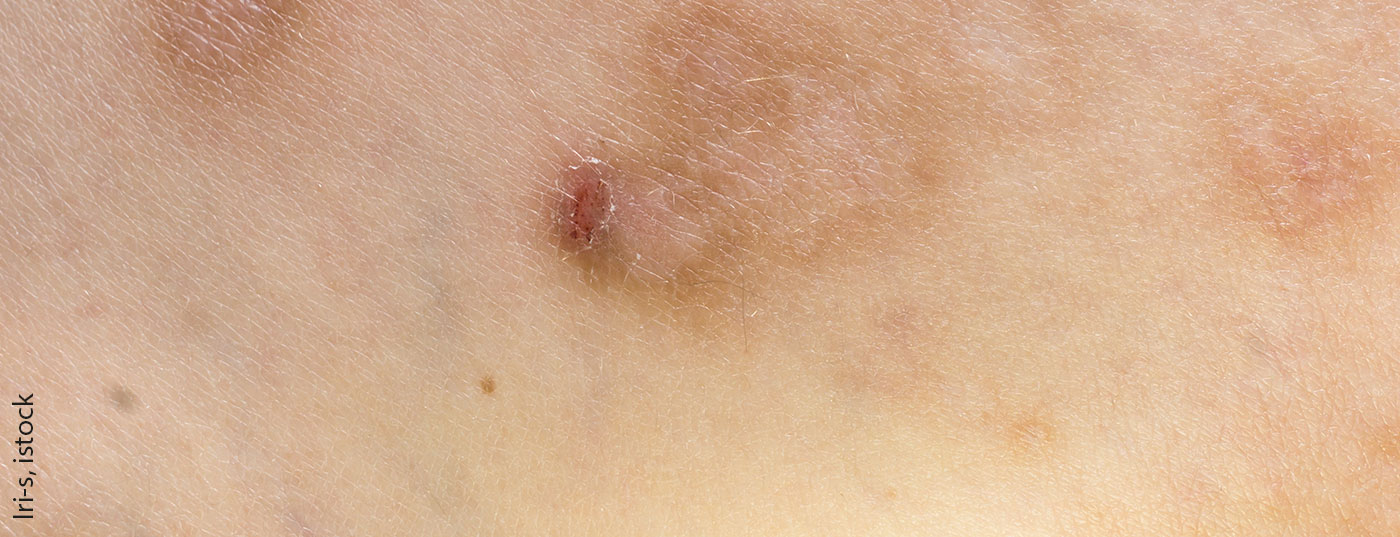
Prurigo nodularis is a rare, poorly studied chronic skin disease characterized by hyperkeratotic severely pruritic papules, often resulting in an itch-scratch cycle (review 1) . As a consequence, sleep disturbances and psychological complaints may develop [1]. Mostly people over 50 years of age are affected by this distressing skin disease. Apart from corticosteroids and topical creams, there are currently no treatment options approved for the indication prurigo nodularis, and new therapeutic options would be desirable.


Nemolizumab as a beacon of hope

In a phase II clinical trial published in the New England Journal of Medicine last year, nemolizumab was shown to be highly effective in reducing pruritus in patients with moderate to severe prurigo nodularis and severe pruritus [2]. In addition to prurigo nodularis, the use of this anti-IL31 antibody is also being investigated with respect to other skin diseases associated with pruritus, including atopic dermatitis [3]. IL31, like IL4 and IL13, is a cytokine produced by Th2 cells and plays an important pathophysiological role in various pruriginous skin diseases [4]. Nemolizumab is currently the only anti-IL31 antibody that has successfully completed large advanced clinical trials.

In a 12-week randomized double-blind placebo-controlled phase II trial, 70 study participants with moderate to severe prurigo nodularis and at least 20 or more nodules or severe prurigo nodularis, defined as an average daily pruritus score of 7/10 (10 = maximum imaginable pruritus intensity), were randomized to the two study arms, nemolizumab vs. placebo. Subjects in the verum condition received three subcutaneous injections of nemolizumab 0.5 mg/kg body weight at baseline, week 4, and week 8.


Rapid onset of symptom reduction

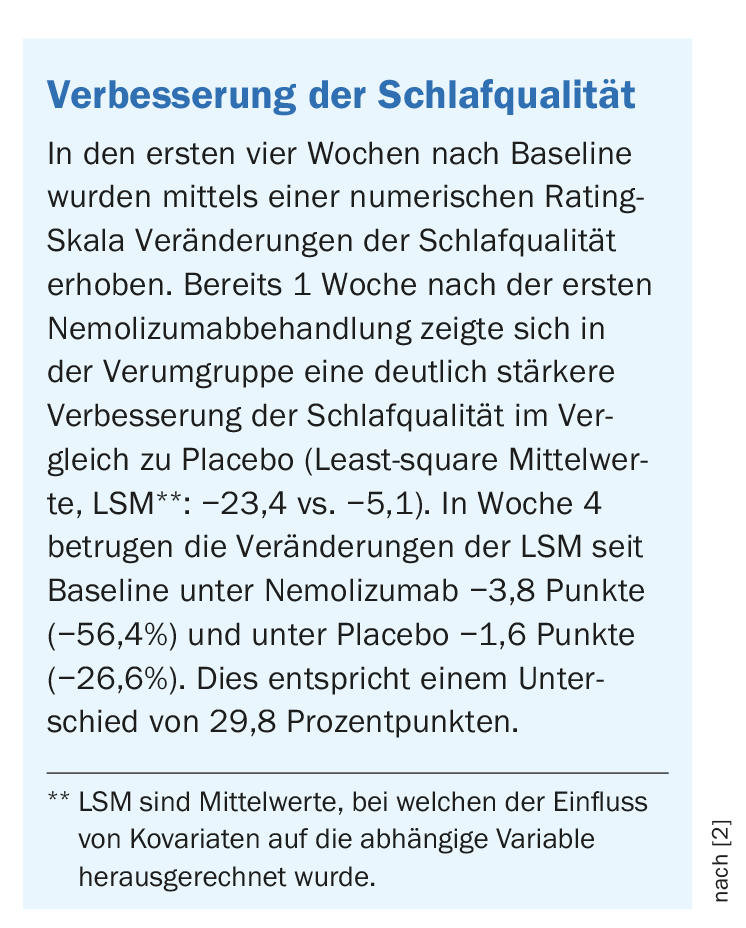
Nemolizumab-treated study participants (n=34) experienced a 53.0% reduction in itch* 4 weeks after baseline compared to a 20.2% reduction in the placebo group (n=36) (p<0.001). Thus, the study met the primary endpoint. After 12 weeks, the nemolizumab group showed a reduction in the number of lesions by an average of 12.6 versus 6.1 in the placebo group. At the last follow-up measurement at week 18 after baseline, 10 weeks after administration of the last dose of nemolizumab, the mean reduction in the number of lesions was 13.3 in the treatment arm and 7.5 in the placebo arm. In general, nemolizumab was well tolerated. Gastrointestinal symptoms, abdominal pain, and diarrhea were reported by 21% on nemolizumab and 14% on placebo, and for musculoskeletal symptoms, these proportions were 18% and 14%, respectively.

* Pruritus Numerical Rating Scale (Pruritus-NRS)


Overall, the conclusion is positive. While the study authors had expected the anti-IL31 antibody to prove effective in reducing symptoms of prurigo nodularis, they were surprised by the rapid onset of efficacy of nemolizumab. Currently, a phase III trial is ongoing to evaluate the efficacy and safety of nemolizumab in patients with prurigo nodularis ([5] ClinicalTrials.gov, NCT04501679).


Literature:

  1. Zeidler C, et al: Chronic prurigo of nodular type: a review. Acta Derm Venereol 2018; 98: 173-179.
  2. Ständer S, et al: Trial of nemolizumab in moderate-to-severe prurigo nodularis. N Engl J Med 2020; 382: 706-716.
  3. Kabashima K, Irie H: Interleukin-31 as a Clinical Target for Pruritus Treatment. Front Med (Lausanne) 2021; 8: 638325.
  4. Bieber T, et al: Novel therapies based on the pathophysiology of atopic dermatitis. JDDG 2019 17; 11: 1150-1163.
  5. ClinicalTrials.gov, NCT04501679 (last accessed 30/30/2021).
  6. Sonkoly E, et al: IL-31: a new link between T cells and pruritus in atopic skin inflammation. J Allergy Clin Immunol 2006; 117: 411-417.


DERMATOLOGY PRACTICE 2021; 31(2): 24
Autoren
  • Mirjam Peter, M.Sc.
Publikation
  • DERMATOLOGIE PRAXIS
Related Topics
  • Interleukin
  • prurigo
Previous Article
  • Type 2 diabetes

Treatment success thanks to individual therapy goals

  • Congress Reports
  • Endocrinology and Diabetology
  • General Internal Medicine
  • RX
View Post
Next Article
  • Breast Cancer

Metastatic pathways in focus

  • Education
  • Gynecology
  • Oncology
  • RX
  • Studies
View Post
You May Also Like
View Post
  • 6 min
  • Preclinical study on phytotherapeutic agent

Active ingredient combination of peppermint and caraway oil modified fecal microbiota

    • RX
    • Education
    • Gastroenterology and Hepatology
    • General Internal Medicine
    • Pharmaceutical medicine
    • Phytotherapy
    • Studies
View Post
  • 4 min
  • Casuistry

Rituximab used effectively against IgG4-RD colitis

    • RX
    • Cases
    • Education
    • Gastroenterology and Hepatology
    • General Internal Medicine
    • Radiology
    • Rheumatology
View Post
  • 5 min
  • Sarcoidosis

New options from JAKi to mTOR

    • RX
    • Congress Reports
    • General Internal Medicine
    • Pneumology
    • Studies
View Post
  • 6 min
  • Head and neck squamous cell carcinoma

Precision immunotherapy and local treatment

    • RX
    • Congress Reports
    • Dermatology and venereology
    • Oncology
    • ORL
    • Studies
View Post
  • 3 min
  • From symptom to diagnosis

Abdominal pain – Prostate cysts

    • RX
    • Cases
    • Education
    • General Internal Medicine
    • Radiology
    • Surgery
    • Urology
View Post
  • 0 min
  • Multimodal Parkinson's Treatment

Positive Effects of a Music-Based Intervention

    • RX
    • Education
    • Geriatrics
    • Neurology
    • Physical medicine and rehabilitation
    • Psychiatry and psychotherapy
View Post
  • 8 min
  • Psychooncology

Communication as the key to therapy adherence

    • RX
    • CME continuing education
    • General Internal Medicine
    • Practice Management
View Post
  • 9 min
  • Cardiology

Minimally invasive – the quiet triumph of modern heart surgery

    • RX
    • Cardiology
    • CME continuing education
    • Studies
    • Surgery
  • IBD matters

    Zum Thema
Top CME content
  • 1
    Current State of Knowledge and New Therapeutic Approaches
  • 2
    Why is it so hard to lose weight?
  • 3
    Functional limb preservation between infection control, vascular medicine and resurfacing
  • 4
    Algorithms, avatars and the unburdened mind
  • 5
    Communication as the key to therapy adherence

Newsletter

Sign up and stay up to date

Subscribe
Medizinonline Medizinonline
  • Contact
  • General terms and conditions
  • Imprint

Input your search keywords and press Enter.