Medizinonline Medizinonline
  • News
    • News
    • Market & Medicine
  • Patients
    • Disease patterns
    • Diagnostics
    • Therapy
  • Partner Content
    • Diabetes
      • Dia-Month Club – Type 2 Diabetes
      • Diabetes in Motion
      • Diabetes Podcasts
    • Gastroenterology
      • IBD matters
    • Oncology
      • Swiss Oncology in motion
    • Orthopedics
      • Osteoporosis in motion
  • Departments
    • Allergology and clinical immunology
    • General Internal Medicine
    • Anesthesiology
    • Angiology
    • Surgery
    • Dermatology and venereology
    • Endocrinology and Diabetology
    • Nutrition
    • Gastroenterology and Hepatology
    • Genetics
    • Geriatrics
    • Gynecology
    • Hematology
    • Infectiology
    • Cardiology
    • Nephrology
    • Neurology
    • Emergency and intensive care medicine
    • Nuclear Medicine
    • Oncology
    • Ophthalmology
    • ORL
    • Orthopedics
    • Pediatrics
    • Pharmacology and toxicology
    • Pharmaceutical medicine
    • Phlebology
    • Physical medicine and rehabilitation
    • Pneumology
    • Prevention and health care
    • Psychiatry and psychotherapy
    • Radiology
    • Forensic Medicine
    • Rheumatology
    • Sports Medicine
    • Traumatology and trauma surgery
    • Tropical and travel medicine
    • Urology
    • Dentistry
  • CME & Congresses
    • CME continuing education
    • Congress Reports
    • Congress calendar
  • Practice
    • Noctimed
    • Practice Management
    • Jobs
    • Interviews
  • Log In
  • Register
  • My account
  • Contact
  • Publications
  • Contact
  • Deutsch
  • English
  • Français
  • Italiano
  • Português
  • Español
Subscribe
Medizinonline Medizinonline
  • News
    • News
    • Market & Medicine
  • Patienten
    • Krankheitsbilder
    • Diagnostik
    • Therapie
  • Partner Content
    • Diabetes
      • Dia-Month Club – Type 2 Diabetes
      • Diabetes in Motion
      • Diabetes Podcasts
    • Gastroenterology
      • IBD matters
    • Oncology
      • Swiss Oncology in motion
    • Orthopedics
      • Osteoporosis in motion
    • Phytotherapie
    • Rheumatology
  • Departments
    • Fachbereiche 1-13
      • Allergology and clinical immunology
      • General Internal Medicine
      • Anesthesiology
      • Angiology
      • Surgery
      • Dermatology and venereology
      • Endocrinology and Diabetology
      • Nutrition
      • Gastroenterology and Hepatology
      • Genetics
      • Geriatrics
      • Gynecology
      • Hematology
    • Fachbereiche 14-26
      • Infectiology
      • Cardiology
      • Nephrology
      • Neurology
      • Emergency and intensive care medicine
      • Nuclear Medicine
      • Oncology
      • Ophthalmology
      • ORL
      • Orthopedics
      • Pediatrics
      • Pharmacology and toxicology
      • Pharmaceutical medicine
    • Fachbereiche 26-38
      • Phlebology
      • Physical medicine and rehabilitation
      • Phytotherapy
      • Pneumology
      • Prevention and health care
      • Psychiatry and psychotherapy
      • Radiology
      • Forensic Medicine
      • Rheumatology
      • Sports Medicine
      • Traumatology and trauma surgery
      • Tropical and travel medicine
      • Urology
      • Dentistry
  • CME & Congresses
    • CME continuing education
    • Congress Reports
    • Congress calendar
  • Practice
    • Noctimed
    • Practice Management
    • Jobs
    • Interviews
Login

Sie haben noch keinen Account? Registrieren

  • Type 2 diabetes

Treatment success thanks to individual therapy goals

    • Congress Reports
    • Endocrinology and Diabetology
    • General Internal Medicine
    • RX
  • 3 minute read

In contrast to the past, other treatment goals beyond glycemic control are sought nowadays. The current guidelines and consensus recommendations of international diabetology societies take into account the results of large outcome studies in which an additional cardiovascular benefit of GLP-1 receptor agonists and SGLT-2 inhibitors has been demonstrated. The ADA/EASD consensus report specified criteria for drug selection.

The most important points of the consensus report of ADA (“American Diabetes Association”) and EASD (“European Association for the Study of Diabetes”) were presented by Prof. Dr. med. Michael Nauck from the Ruhr University Hospital in Bochum [1]. It is important to assess patients with type 2 diabetes mellitus individually and translate this into a treatment strategy with stringent or less stringent glucose control.

Use of GLP-1-RA and SGLT-2 inhibitors independent of HbA1c level.

After diagnosis, patients should first be educated regarding lifestyle management and baseline therapy with metformin is recommended if the individual HbA1c target has not been achieved by lifestyle modification alone. In addition, SGLT-2 inhibitors and GLP-1 receptor agonists (GLP-1-RA) should be used because of the empirically demonstrated cardiovascular benefits of these classes of agents. Diabetics have an increased risk of cardiovascular sequelae such as heart attack and stroke compared to people without this metabolic disease. The cardio- and nephroprotective effects of GLP-1-RA and SGLT-2 inhibitors open new therapeutic perspectives here. If diagnosed early, they can contribute not only to the stabilization of glucose metabolism but also to cardiovascular and renal prevention.

EASD/ADA consensus recommendations: Update on new substance classes

The large cardiovascular endpoint studies of the past decade have demonstrated the particular importance of representatives from the GLP-1 RA (liraglutide, dulaglutide, semaglutide) and SGLT-2 inhibitor (empagliflozin, dapagliflozin, canagliflozin) substance classes. These results have also been incorporated into the 2020 updated consensus report of European and American diabetologists (EASD/ADA) [2]. Accordingly, GLP-1 receptor agonists or SGLT-2 inhibitors should be recommended to patients with type 2 diabetes for cardiovascular risk reduction.

In various international guidelines, SGLT-2 inhibitors and GLP-1-RA are now established as treatment options with proven additional cardiovascular and renal benefits. The German Diabetes Society has added these substance classes as one of the five pillars of diabetes therapy for type 2 diabetes (Fig. 1) [3].
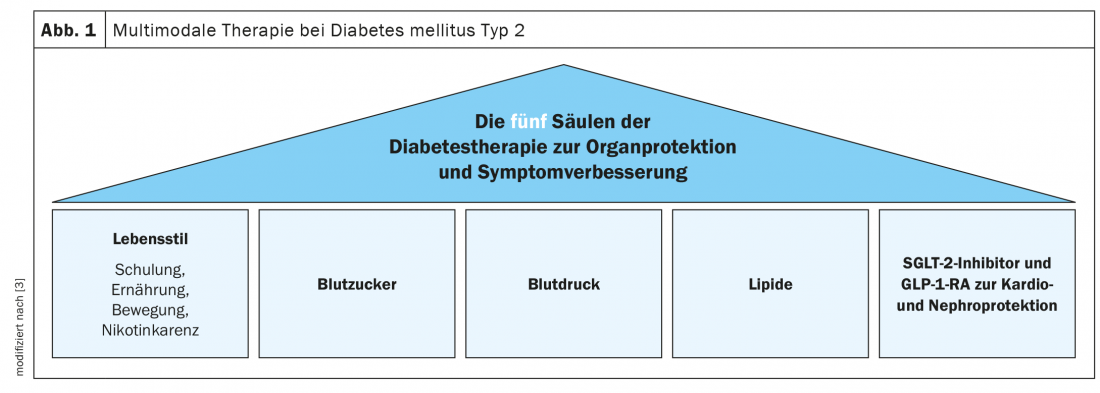


Dulaglutide for cardiovascular primary prevention.

With regard to drug selection, the ADA/EASD consensus report differentiates as follows:

GLP-1-RAs are the first choice to prevent cardiovascular events (MACE) when a diabetic patient has manifest cardiovascular disease (after myocardial infarction, stroke, revascularization) OR is at high cardiovascular risk (age ≥55 years plus left ventricular hypertrophy or arterial stenosis >50% in coronaries, carotids and/or peripheral arteries).

In diabetic patients with heart failure and reduced ejection fraction (HFrEF <45%), SGLT-2 inhibitors are primarily recommended because this class of agents has the best evidence in this regard to prevent hospitalizations for heart failure, MACE, and cardiovascular death.

In case of intolerance or contraindication to an SGLT-2 inhibitor or inadequate renal function, experts advise GLP-1 RA and vice versa. If glycemic control is inadequate, the two groups of substances can be combined.

Congress: Diabetology without borders 2021


Literature:

  • Nauck M: ADA/EASD consensus paper. Prof. Michael Nauck, MD, Diabetology without borders, Feb. 27, 2021.
  • Buse JB, et al: 2019 update to: Management of hyperglycaemia in type 2 diabetes, 2018. A consensus report by the American Diabetes Association (ADA) and the European Association for the Study of Diabetes (EASD). Diabetologia 2020; 63(2): 221-228.
  • Kellerer M: Practice guideline of the German Diabetes Society. Prof. Dr. med. Monika Kellerer, Diabetology without borders, 27.02.2021.


FAMILY DOCTOR PRACTICE 2021
Autoren
  • Mirjam Peter, M.Sc.
Publikation
  • HAUSARZT PRAXIS
Related Topics
  • Diabetes
  • diabetes type 2
Previous Article
  • Ovarian cancer and the immune system

The choice of chemotherapy is crucial

  • Education
  • Gynecology
  • Oncology
  • RX
View Post
Next Article
  • Studies in focus

Interleukin-31 as a clinical target in prurigo nodularis.

  • Dermatology and venereology
  • Education
  • RX
  • Studies
View Post
You May Also Like
View Post
  • 9 min
  • Cardiology

Minimally invasive – the quiet triumph of modern heart surgery

    • RX
    • Cardiology
    • CME continuing education
    • Studies
    • Surgery
View Post
  • 6 min
  • Schizophrenia in the early-onset stage

Which antipsychotic should be used for treatment-naive patients?

    • RX
    • Education
    • Pharmacology and toxicology
    • Psychiatry and psychotherapy
    • Studies
View Post
  • 4 min
  • Diarrhea in children

The problem of parental expectations

    • RX
    • Education
    • Gastroenterology and Hepatology
    • General Internal Medicine
    • Infectiology
    • Pediatrics
    • Studies
View Post
  • 4 min
  • From symptom to diagnosis

Multilocular cystic renal cell carcinoma (MCRCC)

    • RX
    • Cases
    • Education
    • Nephrology
    • Oncology
    • Radiology
    • Studies
    • Surgery
View Post
  • 3 min
  • Shaping the Future with LLM & Co.

AI in Everyday Clinical Practice: Friend or Foe?

    • RX
    • General Internal Medicine
    • Practice Management
    • Prevention and health care
View Post
  • 5 min
  • Ulcerative colitis: current evidence on anti-inflammatory therapies

Remission induction and maintenance with biologics and JAK-i

    • RX
    • Congress Reports
    • Gastroenterology and Hepatology
    • General Internal Medicine
    • Studies
View Post
  • 4 min
  • Bronchiectasis

New strategies against neutrophilic inflammation

    • RX
    • Congress Reports
    • General Internal Medicine
    • Infectiology
    • Pneumology
    • Studies
View Post
  • 3 min
  • IBD in childhood

Pneumococcal vaccination without negative consequences

    • RX
    • Education
    • Gastroenterology and Hepatology
    • General Internal Medicine
    • Infectiology
    • Pediatrics
    • Prevention and health care
  • IBD matters

    Zum Thema
Top CME content
  • 1
    Current State of Knowledge and New Therapeutic Approaches
  • 2
    Why is it so hard to lose weight?
  • 3
    Functional limb preservation between infection control, vascular medicine and resurfacing
  • 4
    Algorithms, avatars and the unburdened mind
  • 5
    Communication as the key to therapy adherence

Newsletter

Sign up and stay up to date

Subscribe
Medizinonline Medizinonline
  • Contact
  • General terms and conditions
  • Imprint

Input your search keywords and press Enter.