Medizinonline Medizinonline
  • News
    • News
    • Market & Medicine
  • Patients
    • Disease patterns
    • Diagnostics
    • Therapy
  • Partner Content
    • Dermatology
      • Atopic dermatitis and psoriasis news
    • Diabetes
      • Dia-Month Club – Type 2 Diabetes
      • Diabetes in Motion
      • Diabetes Podcasts
    • Gastroenterology
      • IBD matters
    • Oncology
      • Swiss Oncology in motion
    • Orthopedics
      • Osteoporosis in motion
  • Departments
    • Allergology and clinical immunology
    • General Internal Medicine
    • Anesthesiology
    • Angiology
    • Surgery
    • Dermatology and venereology
    • Endocrinology and Diabetology
    • Nutrition
    • Gastroenterology and Hepatology
    • Genetics
    • Geriatrics
    • Gynecology
    • Hematology
    • Infectiology
    • Cardiology
    • Nephrology
    • Neurology
    • Emergency and intensive care medicine
    • Nuclear Medicine
    • Oncology
    • Ophthalmology
    • ORL
    • Orthopedics
    • Pediatrics
    • Pharmacology and toxicology
    • Pharmaceutical medicine
    • Phlebology
    • Physical medicine and rehabilitation
    • Pneumology
    • Prevention and health care
    • Psychiatry and psychotherapy
    • Radiology
    • Forensic Medicine
    • Rheumatology
    • Sports Medicine
    • Traumatology and trauma surgery
    • Tropical and travel medicine
    • Urology
    • Dentistry
  • CME & Congresses
    • CME continuing education
    • Congress Reports
    • Congress calendar
  • Practice
    • Noctimed
    • Practice Management
    • Jobs
    • Interviews
  • Log In
  • Register
  • My account
  • Contact
  • Publications
  • Contact
  • Deutsch
  • English
  • Français
  • Italiano
  • Português
  • Español
Subscribe
Medizinonline Medizinonline
  • News
    • News
    • Market & Medicine
  • Patienten
    • Krankheitsbilder
    • Diagnostik
    • Therapie
  • Partner Content
    • Dermatology
      • Atopic dermatitis and psoriasis news
    • Diabetes
      • Dia-Month Club – Type 2 Diabetes
      • Diabetes in Motion
      • Diabetes Podcasts
    • Gastroenterology
      • IBD matters
    • Oncology
      • Swiss Oncology in motion
    • Orthopedics
      • Osteoporosis in motion
    • Phytotherapie
    • Rheumatology
  • Departments
    • Fachbereiche 1-13
      • Allergology and clinical immunology
      • General Internal Medicine
      • Anesthesiology
      • Angiology
      • Surgery
      • Dermatology and venereology
      • Endocrinology and Diabetology
      • Nutrition
      • Gastroenterology and Hepatology
      • Genetics
      • Geriatrics
      • Gynecology
      • Hematology
    • Fachbereiche 14-26
      • Infectiology
      • Cardiology
      • Nephrology
      • Neurology
      • Emergency and intensive care medicine
      • Nuclear Medicine
      • Oncology
      • Ophthalmology
      • ORL
      • Orthopedics
      • Pediatrics
      • Pharmacology and toxicology
      • Pharmaceutical medicine
    • Fachbereiche 26-38
      • Phlebology
      • Physical medicine and rehabilitation
      • Phytotherapy
      • Pneumology
      • Prevention and health care
      • Psychiatry and psychotherapy
      • Radiology
      • Forensic Medicine
      • Rheumatology
      • Sports Medicine
      • Traumatology and trauma surgery
      • Tropical and travel medicine
      • Urology
      • Dentistry
  • CME & Congresses
    • CME continuing education
    • Congress Reports
    • Congress calendar
  • Practice
    • Noctimed
    • Practice Management
    • Jobs
    • Interviews
Login

Sie haben noch keinen Account? Registrieren

  • Multiple sclerosis

On the pulse of time: advances in immunotherapy

    • Education
    • Neurology
    • RX
  • 3 minute read

The spectrum of immunotherapies for multiple sclerosis is constantly expanding. This is because today’s options for long-term treatment can delay the progression of the disease in many patients – but not in all. However, attention should be paid in Switzerland primarily to the approval and other limitations, which may differ from those in the EMA area.

In Switzerland, approximately 15,000 people suffer from multiple sclerosis (MS) with increasing prevalence [1]. The chronic, as yet incurable neurodegenerative disease is associated with an unpredictable course. But treatment options have expanded. In recent years, immunotherapy has steadily gained in importance. More than a dozen compounds with different mechanisms of action, modes of administration, target populations, and benefit-risk profiles are now available for disease-modifying treatment of relapsing forms of MS. However, their approval in Switzerland may differ significantly from those in neighboring countries. Limitations due to the list of specialties also have an impact on the application. Also, progression-modifying therapy is now approved for patients with primary progressive MS. The goal of individualized therapy is moving ever closer. Aspects such as current life circumstances or perspective goals such as pregnancy or the professional situation can always be better taken into account when selecting the right treatment [2].

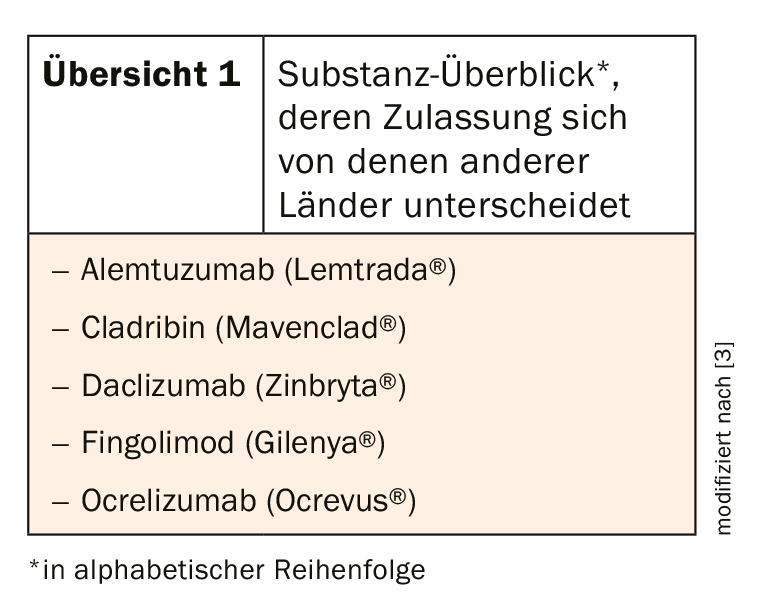
However, special regulatory conditions in Switzerland may lead to differences in the use of immunotherapeutics in clinical practice that are not reflected in European or national guidelines of other countries (overview 1) [3]. Different risk-benefit assessments, but also procedural aspects, can lead to these partially divergent approvals. This could also be due to the staggered submission to the regulatory authorities, which then access divergent data situations. This includes not only scientific results, but also other aspects such as data quality and product quality.


Possible side effects in view

The new substances are very effective, but in rare cases they can have potentially serious side effects. Therefore, regular neurological monitoring is essential. For example, cases of progressive multifocal leukoencephalopathy have been reported. Therefore, patients at high risk for developing PML should undergo cranial MRI after initiation of treatment. In addition, a lumbar puncture to determine JCV DNA prior to treatment initiation is recommended for this patient group [2].

Exceptional case: autologous hematopoietic stem cell transplantation

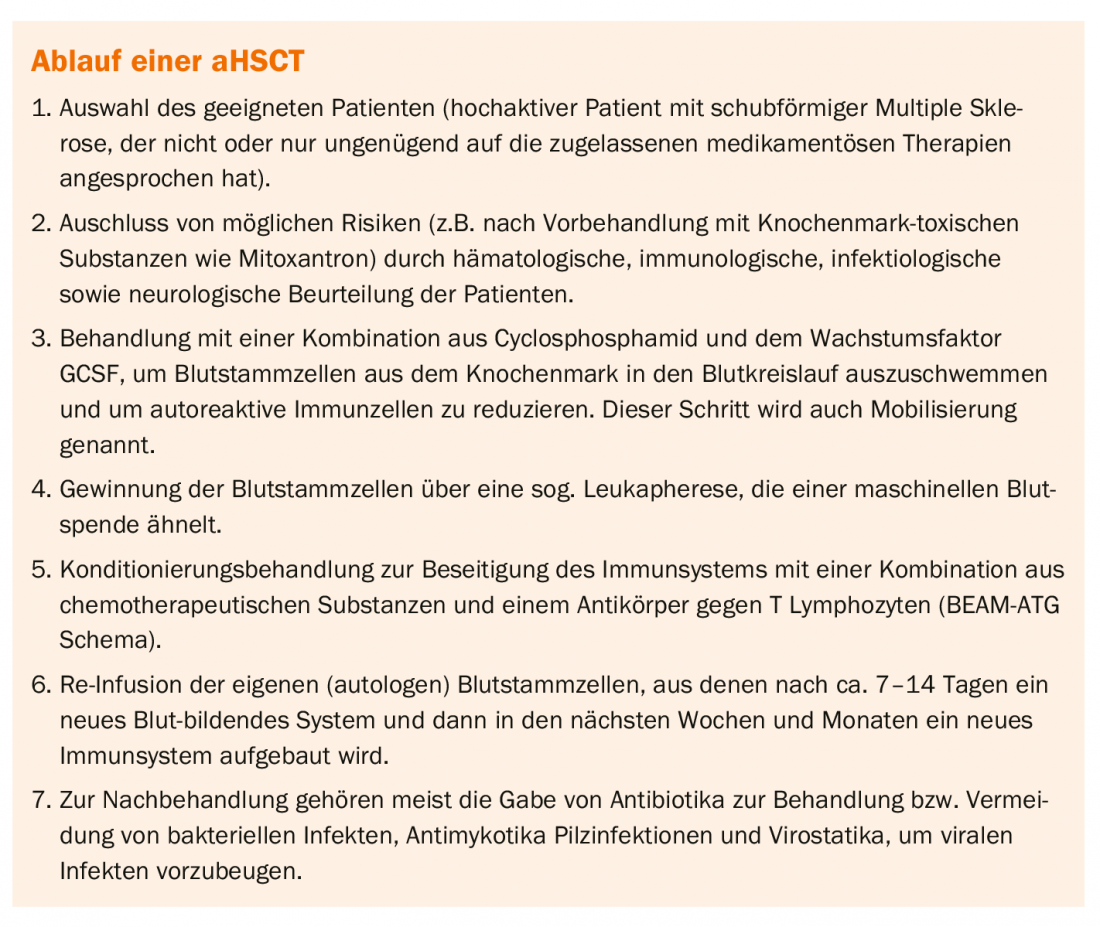
Autologous hematopoietic stem cell transplantation (aHSCT) has been shown to be effective for malignancies of the hematopoietic system (Box). Their use in MS therapy has also been researched for years. Again, it appears to be effective, but has a significant risk of side effects. Therefore, it is currently performed in Switzerland only in patients with a severe course under certain conditions [4]: the MS patients should be in the relapsing phase of the disease (in a primary/secondary chronic progressive course, inflammatory lesions in the CNS should still be present), several criteria must indicate an active/aggressive form of the course, the affected persons should preferably not be over 50 years of age and should not have severe impairments [5].


Effective treatment strategy

The NEDA status (“No Evidence of Disease Activity”) has become common to indicate the effectiveness of a treatment. This term describes the absence of clinical disease activity (relapses, disability increase) and MRI lesions. With highly effective treatment strategies such as immunotherapy, this can be achieved in up to 50% of patients over two years. However, by aHSCT, the fraction of patients with NEDA at two years is 70-92% [4]. However, cancer (<2%) and other autoimmune diseases (≤5%; especially inflammation of the thyroid gland with subsequent hypofunction) may occur as long-term side effects. In addition, the treatment may cause infertility in women, and very rarely in men.


Literature:

  1. Blozik E et al: Epidemiology and costs of multiple sclerosis in Switzerland: an analysis of health-care claims data, 2011-2015. Neuropsychiatr Dis Treat 2017; 13: 2737-2745.
  2. Chan A, Diem L. Indication and safety of course-modifying therapies for multiple sclerosis. Leading Opinions, Oct. 31, 2019. https://ch.universimed.com/fachthemen/1000001995 (last accessed 03/18/2020)
  3. Achtnichts L, Chan A, Czaplinski A, et al: Specifics of immunotherapy for multiple sclerosis in Switzerland. A structured report. SWISS MEDICAL FORUM – SWISS MEDICAL FORUM 2019; 19(41-42): 676-685.
  4. www.multiplesklerose.ch/PDF/de/News/2017/Stellungnahme_aHSCT_Wiss.Beirat_MS-Gesellschaft.pdf (last accessed 03/18/2020)
  5. www.multiplesklerose.ch/de/aktuelles/detail/stammzelltherapie-wird-von-krankenkasse-uebernommen/ (last accessed 3/18/2020).


InFo NEUROLOGY & PSYCHIATRY 2020; 18(2): 26-27.

Autoren
  • Leoni Burggraf
Publikation
  • InFo NEUROLOGIE & PSYCHIATRIE
Related Topics
  • Immunotherapy
  • MS
  • Multiple sclerosis
Previous Article
  • 2019-nCoV

Over 60 approved clinical trials in Switzerland

  • Infectiology
  • Pneumology
  • RX
View Post
Next Article
  • CORIMUNO-TOCI Study

Significant COVID-19 improvement with tocilizumab.

  • Infectiology
  • News
  • Pneumology
  • RX
  • Studies
View Post
You May Also Like
View Post
  • 4 min
  • Study report

Sphingolipid profile in early-stage primary biliary cholangitis

    • Education
    • Gastroenterology and Hepatology
    • General Internal Medicine
    • RX
    • Studies
View Post
  • 6 min
  • Angiosarcoma of the heart

A diagnostic and therapeutic “black box”

    • Cardiology
    • Education
    • Oncology
    • Radiology
    • RX
    • Studies
View Post
  • 5 min
  • Ataxias

Friedreich’s ataxia: when the energy metabolism attacks the nervous system

    • Education
    • Genetics
    • Neurology
    • RX
    • Studies
View Post
  • 3 min
  • Risk of osteoporosis in autoimmune liver diseases

Always determine bone density in PBC, PSC and AIH

    • Education
    • Gastroenterology and Hepatology
    • General Internal Medicine
    • Orthopedics
    • RX
    • Studies
View Post
  • 3 min
  • Case report: Complication after type 2 diabetes

Topical corticosteroids lead to ketoacidosis

    • Cases
    • Education
    • Endocrinology and Diabetology
    • Ophthalmology
    • RX
View Post
  • 12 min
  • NSCLC

Bispecific antibodies for rare EGFR mutations

    • Education
    • Oncology
    • Pneumology
    • RX
    • Studies
View Post
  • 6 min
  • Type 2 diabetes - glycemic control and prevention of secondary diseases

Utilizing pleiotropic cardio- and nephroprotective effects of SGLT-2-i and GLP-1-RA

    • Cardiology
    • Congress Reports
    • Endocrinology and Diabetology
    • Nephrology
    • RX
    • Studies
View Post
  • 6 min
  • Subsyndromal anxiety disorders: Family doctor as first point of contact

Practical recommendations for diagnostics and therapy

    • Education
    • General Internal Medicine
    • Pharmacology and toxicology
    • Phytotherapy
    • Psychiatry and psychotherapy
    • RX
    • Studies
Banner Landingpage Kurzfachinfo
  • IBD matters

    Zum Thema
Top CME content
  • 1
    Interplay between cancer and mental illness
  • 2
    Can you swallow intelligence? Relevant substance classes times for healthy people
  • 3
    PH and lung diseases
  • 4
    Causes and prevention at work
  • 5
    Clinical care from birth to adulthood

Newsletter

Sign up and stay up to date

Subscribe
Medizinonline Medizinonline
  • Contact
  • General terms and conditions
  • Imprint

Input your search keywords and press Enter.