Medizinonline Medizinonline
  • News
    • News
    • Market & Medicine
  • Patients
    • Disease patterns
    • Diagnostics
    • Therapy
  • Partner Content
    • Diabetes
      • Dia-Month Club – Type 2 Diabetes
      • Diabetes in Motion
    • Gastroenterology
      • IBD matters
    • Oncology
      • Swiss Oncology in motion
    • Orthopedics
      • Osteoporosis in motion
  • Departments
    • Allergology and clinical immunology
    • General Internal Medicine
    • Anesthesiology
    • Angiology
    • Surgery
    • Dermatology and venereology
    • Endocrinology and Diabetology
    • Nutrition
    • Gastroenterology and Hepatology
    • Genetics
    • Geriatrics
    • Gynecology
    • Hematology
    • Infectiology
    • Cardiology
    • Nephrology
    • Neurology
    • Emergency and intensive care medicine
    • Nuclear Medicine
    • Oncology
    • Ophthalmology
    • ORL
    • Orthopedics
    • Pediatrics
    • Pharmacology and toxicology
    • Pharmaceutical medicine
    • Phlebology
    • Physical medicine and rehabilitation
    • Pneumology
    • Prevention and health care
    • Psychiatry and psychotherapy
    • Radiology
    • Forensic Medicine
    • Rheumatology
    • Sports Medicine
    • Traumatology and trauma surgery
    • Tropical and travel medicine
    • Urology
    • Dentistry
  • CME & Congresses
    • CME continuing education
    • Congress Reports
    • Congress calendar
  • Practice
    • Noctimed
    • Practice Management
    • Jobs
    • Interviews
  • Log In
  • Register
  • My account
  • Contact
  • Publications
  • Contact
  • Deutsch
  • English
  • Français
  • Italiano
  • Português
  • Español
Subscribe
Medizinonline Medizinonline
  • News
    • News
    • Market & Medicine
  • Patienten
    • Krankheitsbilder
    • Diagnostik
    • Therapie
  • Partner Content
    • Diabetes
      • Dia-Month Club – Type 2 Diabetes
      • Diabetes in Motion
    • Gastroenterology
      • IBD matters
    • Oncology
      • Swiss Oncology in motion
    • Orthopedics
      • Osteoporosis in motion
    • Phytotherapie
    • Rheumatology
  • Departments
    • Fachbereiche 1-13
      • Allergology and clinical immunology
      • General Internal Medicine
      • Anesthesiology
      • Angiology
      • Surgery
      • Dermatology and venereology
      • Endocrinology and Diabetology
      • Nutrition
      • Gastroenterology and Hepatology
      • Genetics
      • Geriatrics
      • Gynecology
      • Hematology
    • Fachbereiche 14-26
      • Infectiology
      • Cardiology
      • Nephrology
      • Neurology
      • Emergency and intensive care medicine
      • Nuclear Medicine
      • Oncology
      • Ophthalmology
      • ORL
      • Orthopedics
      • Pediatrics
      • Pharmacology and toxicology
      • Pharmaceutical medicine
    • Fachbereiche 26-38
      • Phlebology
      • Physical medicine and rehabilitation
      • Phytotherapy
      • Pneumology
      • Prevention and health care
      • Psychiatry and psychotherapy
      • Radiology
      • Forensic Medicine
      • Rheumatology
      • Sports Medicine
      • Traumatology and trauma surgery
      • Tropical and travel medicine
      • Urology
      • Dentistry
  • CME & Congresses
    • CME continuing education
    • Congress Reports
    • Congress calendar
  • Practice
    • Noctimed
    • Practice Management
    • Jobs
    • Interviews
Login

Sie haben noch keinen Account? Registrieren

  • Atrial fibrillation

Screening procedures and interventions in pregnancy put to the test

    • Cardiology
    • Congress Reports
    • General Internal Medicine
    • Gynecology
    • RX
    • Studies
  • 2 minute read

Atrial fibrillation remains a common condition that increases with age. Nevertheless, the diagnosis is not infrequently due to chance. Guidelines therefore advocate opportunistic screening starting at age 65. Could this approach be purposeful? And what challenges must be overcome in pregnant patients with atrial fibrillation?

Atrial fibrillationis a relevant disease whose incidence increases with age. Up to 5% of the population suffer from the often symptomless disease. However, if left untreated, secondary complications may occur. Early diagnosis would therefore be desirable. Guidelines advocate opportunistic screening of all persons 65 years of age and older. In a worldwide study, this approach was shown to detect undetected AF in approximately 1.4% of cases studied. Various non-invasive methods are available for screening. These include, for example, smartwatches or other handheld devices. This means that a visit to the doctor’s office or hospital is no longer absolutely necessary. As a rule, this approach leads to good acceptance by those affected.

Sense or nonsense of systematic screening

A large-scale Swedish study assigned all people in a birth cohort to a systematic screening or control group. Over the two-week period, an ECG was written twice daily and recorded with a handheld device. In particular, in this study population, new cases of VCF were detected both in the ECG at baseline and in the first seven days of self-discharge. In these cases, anticoagulation was initiated. After an observation period of six years, the patients showed a significantly reduced risk of stroke, hemorrhage, embolism and mortality. A Danish study came to similar conclusions. Here, 32% of the subjects were diagnosed with atrial fibrillation. In the control group, only 12%. The risk of stroke was also reduced, although not significantly.

Researchers agreed that although a one-time opportunistic screening can detect persistent AF, the technology is not yet sophisticated enough to detect episodic fibrillation. In principle, systematic screening could become cost-effective after three years and save costs of about 1.8 million euros by preventing strokes and their hospitalization. Further analyses are currently underway to further elucidate the feasibility and viability of large-scale screening.


Arrhythmias during pregnancy

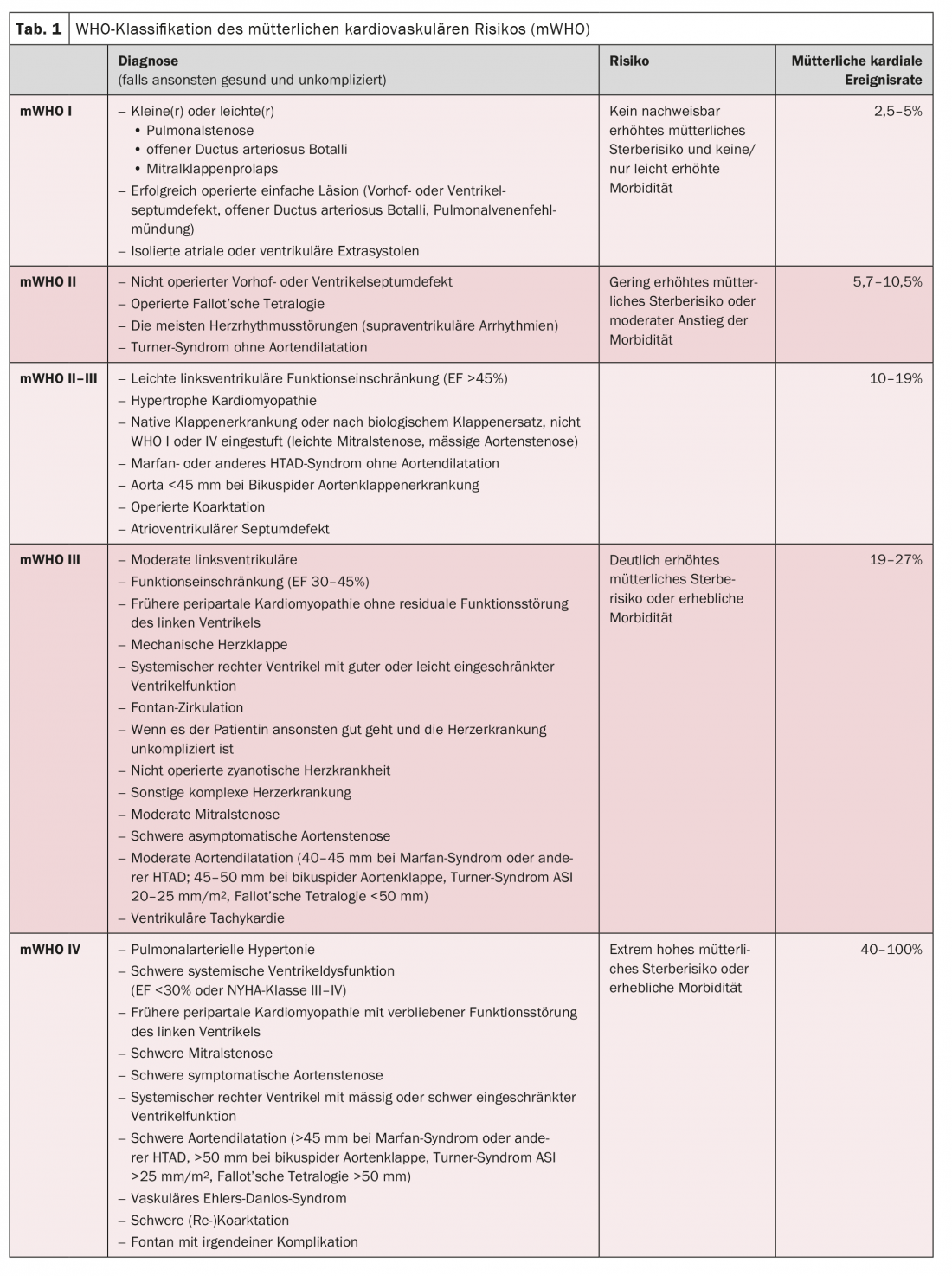
The care of patients at increased cardiovascular risk during pregnancy is becoming increasingly common. Then an interdisciplinary treatment concept involving gynecology, cardiology, pediatric cardiology, neonatology, cardiac surgery, anesthesiology and cardio-anesthesiology is required. As a rule, vaginal delivery is recommended unless premature induction of labor is indicated or the patient meets WHO maternal cardiovascular risk (mWHO) classification IV (Table 1) . In this way, the mortality of mother and child can be significantly reduced. However, care should be taken to ensure that disciplines are closely networked and maintain good communication. This is because the care of female patients with cardiovascular disease can be very complex and requires a small-scale and highly individualized approach. Fortunately, however, atrial fibrillation is a problem that occurs only sporadically in this clientele. Ventricular arrhythmias or valve diseases are much more common in practice.

Sources: Detection of atrial fibrillation with established and emerging technologies: standards 2022. and atrial fibrillation and other arrhythmias in pregnancy. 88th Annual Meeting of the DGK, Mannheim, 20-22 April 2022.


CARDIOVASC 2022; 21(2): 20-21

Autoren
  • Leoni Burggraf
Publikation
  • CARDIOVASC
Related Topics
  • Atrial fibrillation
  • Guidelines
  • Screening
Previous Article
  • S1 Guideline

The geriatric assessment

  • CME continuing education
  • Education
  • General Internal Medicine
  • Geriatrics
  • Prevention and health care
  • Psychiatry and psychotherapy
  • RX
  • Studies
View Post
Next Article
  • NMOSD

Current figures speak for early therapy management

  • Education
  • Neurology
  • RX
  • Studies
View Post
You May Also Like
View Post
  • 4 min
  • From symptom to diagnosis

Pulmonology – Lobus venae acygos

    • RX
    • Cases
    • Education
    • Oncology
    • Pneumology
    • Radiology
View Post
  • 9 min
  • Atopic Dermatitis: Precisely Targeting Immunological Targets

Interleukin blockade or OX40-(L) inhibition?

    • RX
    • Allergology and clinical immunology
    • Dermatology and venereology
    • Education
    • Studies
View Post
  • 14 min
  • Fibromyalgia Syndrome

Development, Diagnosis, Epidemiology, and Treatment of a Disease Entity

    • General Internal Medicine
    • CME continuing education
    • Geriatrics
    • Neurology
    • Orthopedics
    • Rheumatology
    • RX
View Post
  • 27 min
  • Across All Types of Cancer

Four-Legged Medical Assistants – Therapy Dogs in Clinical Settings

    • RX
    • CME continuing education
    • General Internal Medicine
    • Geriatrics
    • Hematology
    • Oncology
    • Pediatrics
    • Physical medicine and rehabilitation
    • Prevention and health care
    • Studies
View Post
  • 8 min
  • Obesity: More than half of those affected have fatty liver disease

From screening to multimodal intervention with GLP-1-RA or resmetirom

    • RX
    • Education
    • Endocrinology and Diabetology
    • Gastroenterology and Hepatology
    • General Internal Medicine
    • Nutrition
    • Studies
View Post
  • 6 min
  • Innovative Oral Treatment Options for Psoriasis: Icotrokinra and Zasocitinib

First-class immunomodulation combined with convenience—the data available so far is convincing

    • RX
    • Congress Reports
    • Dermatology and venereology
    • Rheumatology
    • Studies
View Post
  • 4 min
  • Preclinical Study on a Special Ginkgo biloba Extract

What role do proanthocyanidins play?

    • RX
    • Education
    • General Internal Medicine
    • Geriatrics
    • Neurology
    • Pharmaceutical medicine
    • Pharmacology and toxicology
    • Phytotherapy
    • Studies
View Post
  • 6 min
  • Myasthenia gravis: immunomodulatory therapies for long-term treatment

Expanded Possibilities Thanks to Innovative Classes of Active Ingredients

    • RX
    • Congress Reports
    • General Internal Medicine
    • Neurology
    • Ophthalmology
    • Studies
  • IBD matters

    Zum Thema
Top CME content
  • 1
    Four-Legged Medical Assistants – Therapy Dogs in Clinical Settings
  • 2
    Functional limb preservation between infection control, vascular medicine and resurfacing
  • 3
    Update on Idiopathic Pulmonary Fibrosis
  • 4
    Update on Idiopathic Pulmonary Fibrosis
  • 5
    Current status of PAT

Newsletter

Sign up and stay up to date

Subscribe
Medizinonline Medizinonline
  • Contact
  • General terms and conditions
  • Imprint

Input your search keywords and press Enter.