Medizinonline Medizinonline
  • News
    • News
    • Market & Medicine
  • Patients
    • Disease patterns
    • Diagnostics
    • Therapy
  • Partner Content
    • Diabetes
      • Dia-Month Club – Type 2 Diabetes
      • Diabetes in Motion
      • Diabetes Podcasts
    • Gastroenterology
      • IBD matters
    • Oncology
      • Swiss Oncology in motion
    • Orthopedics
      • Osteoporosis in motion
  • Departments
    • Allergology and clinical immunology
    • General Internal Medicine
    • Anesthesiology
    • Angiology
    • Surgery
    • Dermatology and venereology
    • Endocrinology and Diabetology
    • Nutrition
    • Gastroenterology and Hepatology
    • Genetics
    • Geriatrics
    • Gynecology
    • Hematology
    • Infectiology
    • Cardiology
    • Nephrology
    • Neurology
    • Emergency and intensive care medicine
    • Nuclear Medicine
    • Oncology
    • Ophthalmology
    • ORL
    • Orthopedics
    • Pediatrics
    • Pharmacology and toxicology
    • Pharmaceutical medicine
    • Phlebology
    • Physical medicine and rehabilitation
    • Pneumology
    • Prevention and health care
    • Psychiatry and psychotherapy
    • Radiology
    • Forensic Medicine
    • Rheumatology
    • Sports Medicine
    • Traumatology and trauma surgery
    • Tropical and travel medicine
    • Urology
    • Dentistry
  • CME & Congresses
    • CME continuing education
    • Congress Reports
    • Congress calendar
  • Practice
    • Noctimed
    • Practice Management
    • Jobs
    • Interviews
  • Log In
  • Register
  • My account
  • Contact
  • Publications
  • Contact
  • Deutsch
  • English
  • Français
  • Italiano
  • Português
  • Español
Subscribe
Medizinonline Medizinonline
  • News
    • News
    • Market & Medicine
  • Patienten
    • Krankheitsbilder
    • Diagnostik
    • Therapie
  • Partner Content
    • Diabetes
      • Dia-Month Club – Type 2 Diabetes
      • Diabetes in Motion
      • Diabetes Podcasts
    • Gastroenterology
      • IBD matters
    • Oncology
      • Swiss Oncology in motion
    • Orthopedics
      • Osteoporosis in motion
    • Phytotherapie
    • Rheumatology
  • Departments
    • Fachbereiche 1-13
      • Allergology and clinical immunology
      • General Internal Medicine
      • Anesthesiology
      • Angiology
      • Surgery
      • Dermatology and venereology
      • Endocrinology and Diabetology
      • Nutrition
      • Gastroenterology and Hepatology
      • Genetics
      • Geriatrics
      • Gynecology
      • Hematology
    • Fachbereiche 14-26
      • Infectiology
      • Cardiology
      • Nephrology
      • Neurology
      • Emergency and intensive care medicine
      • Nuclear Medicine
      • Oncology
      • Ophthalmology
      • ORL
      • Orthopedics
      • Pediatrics
      • Pharmacology and toxicology
      • Pharmaceutical medicine
    • Fachbereiche 26-38
      • Phlebology
      • Physical medicine and rehabilitation
      • Phytotherapy
      • Pneumology
      • Prevention and health care
      • Psychiatry and psychotherapy
      • Radiology
      • Forensic Medicine
      • Rheumatology
      • Sports Medicine
      • Traumatology and trauma surgery
      • Tropical and travel medicine
      • Urology
      • Dentistry
  • CME & Congresses
    • CME continuing education
    • Congress Reports
    • Congress calendar
  • Practice
    • Noctimed
    • Practice Management
    • Jobs
    • Interviews
Login

Sie haben noch keinen Account? Registrieren

  • Type 2 diabetes

SGLT-2 inhibitors: a new oral therapy option

    • Congress Reports
    • Endocrinology and Diabetology
    • Partner Content
    • RX
  • 3 minute read

Dapagliflozin, a potent new selective SGLT-2 inhibitor, is available in many countries for use in type 2 diabetes patients either as add-on combination therapy when other glucose-lowering medical agents together with exercise and diet have failed to provide adequate glycemic control, or as monotherapy in metformin intolerance. A satellite symposium at the ESCIM Congress in Geneva focused on the efficacy and safety of this substance.

(ag) According to Prof. Clifford Bailey, MD, Birmingham, progressive type 2 diabetes typically requires different therapies, but these are limited when complications arise. Such can be reduced mainly by good glucose control. The etiology is also multivariable, heterogeneous, and just progressive. “While we already have effective therapies available for several key organs that play a role in the regulation of plasma glucose, the kidney has been missing until now. This produces about 20% of the total glucose in the body and uses almost all of it itself. In addition, it filters about 180 g of glucose per day, of which it also reabsorbs almost all. It is therefore an important player in the entire glucose process. In type 2 diabetes, the kidney is now working overtime,” Prof. Bailey explained. The absorption occurs mainly via the so-called “sodium glucose cotransporter-2” (SGLT-2). If this is now inhibited (Fig. 1), as is possible with the new selective SGLT-2 inhibitor dapagliflozin, the excretion of glucose via the urine increases (glucosuria).
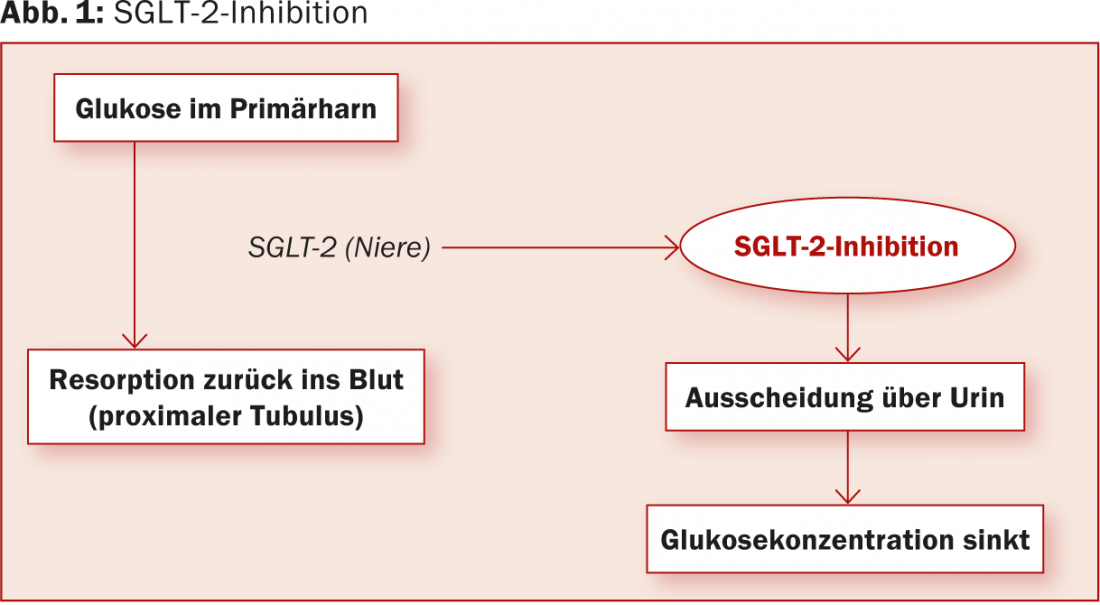
 

“This reduces plasma glucose, addresses hyperglycemia, and supports weight loss. The likelihood of hypoglycemia is comparable to placebo. All of this is completely insulin-independent. So, unlike other therapies, an effect can still be achieved when insulin secretion decreases,” says the expert [1].
In addition, SGLT-1 inhibition also delays intestinal glucose absorption. Various such substances are currently being clinically tested.

How does dapagliflozin fit into the overall concept of therapy?

Dapagliflozin is administered once daily. taken as a tablet (5 and 10 mg). “It is usable as an add-on combination therapy with other glucose-lowering medical agents (including insulin), and when these together with exercise and diet did not provide adequate glycemic control,” Prof. Bailey explained. “As monotherapy, it is used in metformin-intolerant patients in whom neither exercise nor diet produced sufficient effect.”

Clinical trial

A multicenter, placebo-controlled, randomized phase III trial and its extension to up to 102 weeks [2,3] showed the following benefits of treatment with dapagliflozin (as an add-on to metformin):

  • Significant and sustained HbA1c reduction
  • Sustained weight reduction
  • Low incidence of hypoglycemia
  • May also help control blood pressure
  • Is compatible with other diabetic therapies.

“Various phase III studies, some of which were presented at last year’s EASD congress, confirmed the (long-lasting) effect of dapagliflozin on HbA1c in type 2 diabetes mellitus, in various combinations (metformin, insulin). The efficacy here depends on whether renal function is normal or impaired: in type 2 patients with moderate renal impairment, dapagliflozin did not affect HbA1c, but continued to affect weight and blood pressure [4]. The effect on weight (reduction or at least stabilization) was confirmed in various phase III studies, in monotherapy, but also in combination with metformin, glimepiride, pioglitazone and insulin,” says Prof. Gottfried Rudofsky, MD, Kantonsspital Olten. “Dapagliflozin does not harm the kidney. Similarly, an increase in bladder and breast cancer incidences initially observed in clinical trials could not be confirmed. One concern, however, is urogenital infections, which are more common with dapagliflozin and have led (in part but rarely) to treatment discontinuation.”

Source: “SGLT2 Inhibition: Novel Oral Treatment Options for Type 2 Diabetes,” AstraZeneca Satellite Symposium at ESCIM Congress, May 14-16, 2014, Geneva.

Literature:

  1. Bailey CJ: Renal glucose reabsorption inhibitors to treat diabetes. Trends Pharmacol Sci 2011 Feb; 32(2): 63-71.
  2. Bailey CJ, et al: Effect of dapagliflozin in patients with type 2 diabetes who have inadequate glycaemic control with metformin: a randomised, double-blind, placebo-controlled trial. Lancet 2010 Jun 26; 375(9733): 2223-2233.
  3. Bailey CJ, et al: Dapagliflozin add-on to metformin in type 2 diabetes inadequately controlled with metformin: a randomized, double-blind, placebo-controlled 102-week trial. BMC Med 2013 Feb 20; 11: 43.
  4. Kohan DE, et al: Long-term study of patients with type 2 diabetes and moderate renal impairment shows that dapagliflozin reduces weight and blood pressure but does not improve glycemic control. Kidney Int 2014 Apr; 85(4): 962-971.

CONGRESS SPECIAL 2014; 5(2): 25-26

Autoren
  • Andreas Grossmann
Publikation
  • InFo NEUROLOGIE & PSYCHIATRIE
Related Topics
  • Dapagliflozin
  • Diabetes
  • Glucose
  • Glucosuria
  • Hyperglycemia
  • Hypoglycemia
  • Monotherapy
  • Plasma glucose
  • SGLT-2 inhibitors
  • Sugar
Previous Article
  • Intracerebral hemorrhage and stroke

Nursing home residents do not benefit from occupational therapy after stroke

  • Cardiology
  • Congress Reports
  • Geriatrics
  • Neurology
  • Physical medicine and rehabilitation
  • RX
  • Studies
View Post
Next Article
  • Chronic renal failure, dialysis and kidney transplantation

“Diabesity – a new epidemic?

  • Congress Reports
  • Departments
  • Endocrinology and Diabetology
  • Nephrology
  • RX
  • Studies
View Post
You May Also Like
View Post
  • 4 min
  • From symptom to diagnosis

Multilocular cystic renal cell carcinoma (MCRCC)

    • RX
    • Cases
    • Education
    • Nephrology
    • Oncology
    • Radiology
    • Studies
    • Surgery
View Post
  • 3 min
  • Shaping the Future with LLM & Co.

AI in Everyday Clinical Practice: Friend or Foe?

    • RX
    • General Internal Medicine
    • Practice Management
    • Prevention and health care
View Post
  • 5 min
  • Ulcerative colitis: current evidence on anti-inflammatory therapies

Remission induction and maintenance with biologics and JAK-i

    • RX
    • Congress Reports
    • Gastroenterology and Hepatology
    • General Internal Medicine
    • Studies
View Post
  • 4 min
  • Bronchiectasis

New strategies against neutrophilic inflammation

    • RX
    • Congress Reports
    • General Internal Medicine
    • Infectiology
    • Pneumology
    • Studies
View Post
  • 3 min
  • IBD in childhood

Pneumococcal vaccination without negative consequences

    • RX
    • Education
    • Gastroenterology and Hepatology
    • General Internal Medicine
    • Infectiology
    • Pediatrics
    • Prevention and health care
View Post
  • 7 min
  • Plastic surgery and reconstructive microsurgery for DFS

Functional limb preservation between infection control, vascular medicine and resurfacing

    • RX
    • Angiology
    • CME continuing education
    • Dermatology and venereology
    • Endocrinology and Diabetology
    • General Internal Medicine
    • Geriatrics
    • Physical medicine and rehabilitation
    • Surgery
View Post
  • 14 min
  • Seborrheic Dermatitis in Adults and Adolescents

Current State of Knowledge and New Therapeutic Approaches

    • RX
    • CME continuing education
    • Dermatology and venereology
    • Studies
View Post
  • 7 min
  • Orthobiologics for knee osteoarthritis

PRP and hyaluronic acid injections as building blocks in a multimodal concept

    • RX
    • Congress Reports
    • General Internal Medicine
    • Orthopedics
    • Rheumatology
    • Sports Medicine
    • Studies
    • Surgery
  • IBD matters

    Zum Thema
Top CME content
  • 1
    Current State of Knowledge and New Therapeutic Approaches
  • 2
    Why is it so hard to lose weight?
  • 3
    Functional limb preservation between infection control, vascular medicine and resurfacing
  • 4
    Algorithms, avatars and the unburdened mind
  • 5
    Communication as the key to therapy adherence

Newsletter

Sign up and stay up to date

Subscribe
Medizinonline Medizinonline
  • Contact
  • General terms and conditions
  • Imprint

Input your search keywords and press Enter.