Medizinonline Medizinonline
  • News
    • News
    • Market & Medicine
  • Patients
    • Disease patterns
    • Diagnostics
    • Therapy
  • Partner Content
    • Diabetes
      • Dia-Month Club – Type 2 Diabetes
      • Diabetes in Motion
    • Gastroenterology
      • IBD matters
    • Oncology
      • Swiss Oncology in motion
    • Orthopedics
      • Osteoporosis in motion
  • Departments
    • Allergology and clinical immunology
    • General Internal Medicine
    • Anesthesiology
    • Angiology
    • Surgery
    • Dermatology and venereology
    • Endocrinology and Diabetology
    • Nutrition
    • Gastroenterology and Hepatology
    • Genetics
    • Geriatrics
    • Gynecology
    • Hematology
    • Infectiology
    • Cardiology
    • Nephrology
    • Neurology
    • Emergency and intensive care medicine
    • Nuclear Medicine
    • Oncology
    • Ophthalmology
    • ORL
    • Orthopedics
    • Pediatrics
    • Pharmacology and toxicology
    • Pharmaceutical medicine
    • Phlebology
    • Physical medicine and rehabilitation
    • Pneumology
    • Prevention and health care
    • Psychiatry and psychotherapy
    • Radiology
    • Forensic Medicine
    • Rheumatology
    • Sports Medicine
    • Traumatology and trauma surgery
    • Tropical and travel medicine
    • Urology
    • Dentistry
  • CME & Congresses
    • CME continuing education
    • Congress Reports
    • Congress calendar
  • Practice
    • Noctimed
    • Practice Management
    • Jobs
    • Interviews
  • Log In
  • Register
  • My account
  • Contact
  • Publications
  • Contact
  • Deutsch
  • English
  • Français
  • Italiano
  • Português
  • Español
Subscribe
Medizinonline Medizinonline
  • News
    • News
    • Market & Medicine
  • Patienten
    • Krankheitsbilder
    • Diagnostik
    • Therapie
  • Partner Content
    • Diabetes
      • Dia-Month Club – Type 2 Diabetes
      • Diabetes in Motion
    • Gastroenterology
      • IBD matters
    • Oncology
      • Swiss Oncology in motion
    • Orthopedics
      • Osteoporosis in motion
    • Phytotherapie
    • Rheumatology
  • Departments
    • Fachbereiche 1-13
      • Allergology and clinical immunology
      • General Internal Medicine
      • Anesthesiology
      • Angiology
      • Surgery
      • Dermatology and venereology
      • Endocrinology and Diabetology
      • Nutrition
      • Gastroenterology and Hepatology
      • Genetics
      • Geriatrics
      • Gynecology
      • Hematology
    • Fachbereiche 14-26
      • Infectiology
      • Cardiology
      • Nephrology
      • Neurology
      • Emergency and intensive care medicine
      • Nuclear Medicine
      • Oncology
      • Ophthalmology
      • ORL
      • Orthopedics
      • Pediatrics
      • Pharmacology and toxicology
      • Pharmaceutical medicine
    • Fachbereiche 26-38
      • Phlebology
      • Physical medicine and rehabilitation
      • Phytotherapy
      • Pneumology
      • Prevention and health care
      • Psychiatry and psychotherapy
      • Radiology
      • Forensic Medicine
      • Rheumatology
      • Sports Medicine
      • Traumatology and trauma surgery
      • Tropical and travel medicine
      • Urology
      • Dentistry
  • CME & Congresses
    • CME continuing education
    • Congress Reports
    • Congress calendar
  • Practice
    • Noctimed
    • Practice Management
    • Jobs
    • Interviews
Login

Sie haben noch keinen Account? Registrieren

  • Diabetic foot ulcers

Slippers for adherence

    • Endocrinology and Diabetology
    • Geriatrics
    • Prevention and health care
    • RX
    • Studies
  • 4 minute read

Foot ulcers are a common complication in patients with diabetes and represent a major burden for those affected as well as for nursing staff and the healthcare system. Due to the high risk of foot ulceration and its recurrence, prevention is of fundamental importance. However, special shoes are often not worn at home. Dutch researchers have now developed customized slippers that are designed to increase indoor adherence.

Custom-made footwear is an effective measure for preventing foot ulcers and is recommended in international guidelines. The aim of such footwear is to reduce the risk of ulcers by redistributing and reducing the load in risk areas of the foot. However, for people with diabetes who have a high ulcer risk, wearing custom-made shoes is a challenge; they often do without them at home and instead wear normal ready-made shoes, barefoot or with socks only.

A recent systematic review found only one study that attempted to improve adherence to footwear recommendations through motivational interviewing: Participants gave a variety of reasons why they did not adhere to recommendations in the home, including, for example, the weight of the footwear, difficulty putting on and taking off shoes, and difficulty moving around the house with custom-made shoes.

Custom-made street shoes are rarely worn indoors

Dr. Renske Keukenkamp, Department of Rehabilitation Medicine, University of Amsterdam, and her colleagues have developed custom-made slippers [1]. This was based on an assessment of the needs and preferences of people with diabetes and a set of design principles that such shoes should fulfill. Their aim was to investigate the short- and long-term changes in shoe adherence of people with diabetes who are at high risk of foot ulcers after being fitted with regular custom-made street shoes and custom-made slippers.

Inclusion criteria for participants were diabetes mellitus type 1 or 2, moderate to high risk of foot ulcers (International Working Group on the Diabetic Foot, risk 2 or 3) and ownership of custom-made shoes. Exclusion criteria were a pre-existing ulcer, Charcot foot deformity or active Charcot neuroarthropathy, a previous amputation above the tarsometatarsal joint and the inability to walk unaided.

During the study, in addition to their normal custom-made shoes, the participants were given specially designed indoor slippers that provided the same biomechanical pressure relief, were ankle-high and had a custom-made insole similar to that in the regular shoes. For ease of use, the shoes could be closed with Velcro and zippers (Fig. 1).
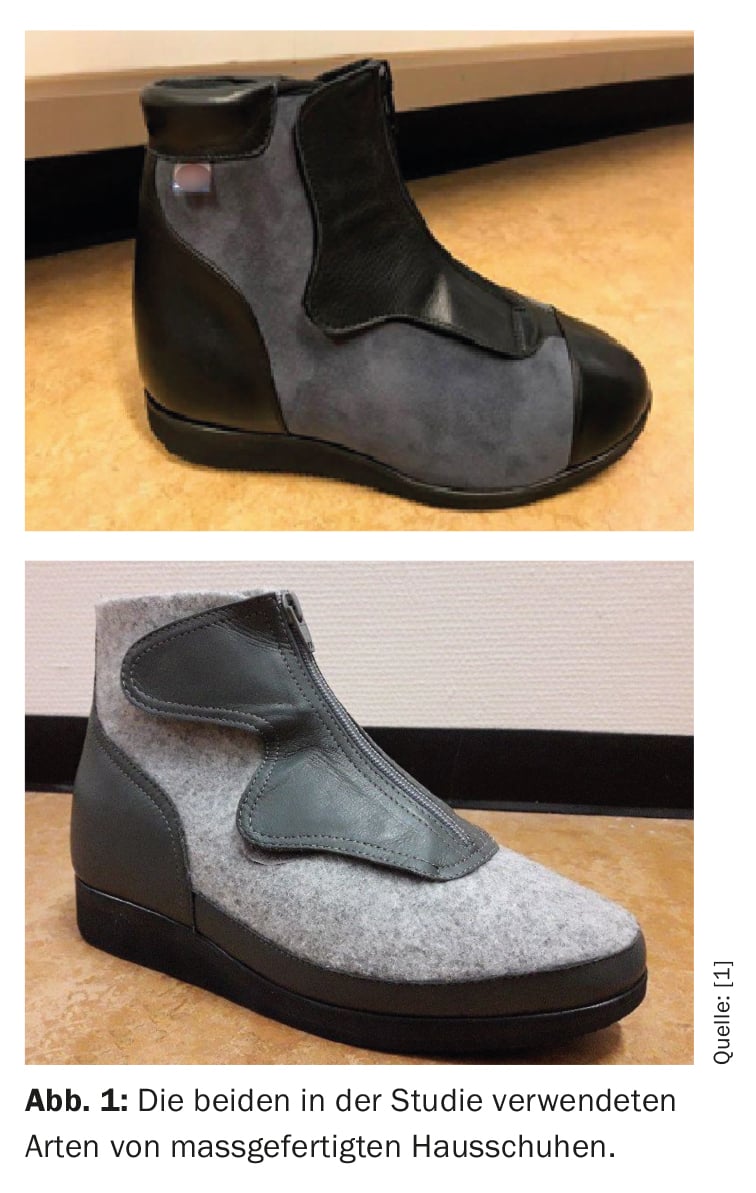
After three months, participants were sent a questionnaire to assess the ease of use, satisfaction and appearance of the slippers, as well as their willingness to pay for the slippers if they were prescribed in clinical practice. Adherence was redefined after one and 12 months. Any ulcer (recurrence) that had occurred in the previous 12 months was identified by participant or podiatrist report. Using a pedometer on the ankle and temperature sensors in the shoes, the authors determined how consistently the street shoes and slippers were worn.

Adherence significantly increased

Of 31 participants, 23 had low baseline adherence in the home, defined as <80% of steps taken with the shoes. Overall adherence in this group increased significantly from a median of 65% at baseline to 77% after 1 month (p=0.002) and 87% after 12 months (p<0.001). This was due to a significant increase in adherence at home: Here, adherence increased from baseline median 48% to 71% after 1 month and 77% after 12 months. The average peak pressure in the sole of the foot was comparable between the slippers and the street shoes. The participants were positive about the user-friendliness. The ulcer recurrence rate after one year was 26%.

Study participants who initially already had a high frequency of wearing their regular custom-made street shoes indoors also maintained this during the intervention phase. The Dutch researchers emphasize the finding that the majority of indoor steps were taken in slippers after one month and still almost half after 12 months. This indicates that people with high adherence also benefit from the provision of slippers and suggests that the provision of slippers should not be restricted to people with low adherence.

The vast majority of participants were satisfied with their slippers after one year, and most rated the user-friendliness positively. However, only 43% of respondents liked the design. Due to the significantly improved adherence, the combination of custom-made slippers and normal shoes offers a more continuous low-pressure environment for the foot at risk. The implementation of this measure could have a positive effect on the recurrence of ulcers, but this should be investigated in future studies.

Literature:

  1. Keukenkamp R, van Netten JJ, Busch-Westbroek TE, Bus SA: Custom-made footwear designed for indoor use increases short-term and long-term adherence in people with diabetes at high ulcer risk. BMJ Open Diabetes Res Care 2022; 10: e002593; doi: 10.1136/bmjdrc-2021-002593.

InFo DIABETOLOGY & ENDOCRINOLOGY 2024: 2(1): 27

Autoren
  • Jens Dehn
Publikation
  • InFo DIABETOLOGIE & ENDOKRINOLOGIE
Related Topics
  • Adherence
  • Diabetes
  • diabetic foot
  • Foot ulcers
  • Slippers
  • Ulcer recurrence
Previous Article
  • Practice Management

Improved quality of care aims for satisfied patients

  • RX
  • CME continuing education
  • General Internal Medicine
  • Practice Management
  • Prevention and health care
  • Studies
View Post
Next Article
  • Obesity

GLP-1-based drugs close the treatment gap

  • Congress Reports
  • Endocrinology and Diabetology
  • General Internal Medicine
  • Interviews
  • RX
View Post
You May Also Like
View Post
  • 9 min
  • Atopic Dermatitis: Precisely Targeting Immunological Targets

Interleukin blockade or OX40-(L) inhibition?

    • RX
    • Allergology and clinical immunology
    • Dermatology and venereology
    • Education
    • Studies
View Post
  • 14 min
  • Fibromyalgia Syndrome

Development, Diagnosis, Epidemiology, and Treatment of a Disease Entity

    • General Internal Medicine
    • CME continuing education
    • Geriatrics
    • Neurology
    • Orthopedics
    • Rheumatology
    • RX
View Post
  • 27 min
  • Across All Types of Cancer

Four-Legged Medical Assistants – Therapy Dogs in Clinical Settings

    • RX
    • CME continuing education
    • General Internal Medicine
    • Geriatrics
    • Hematology
    • Oncology
    • Pediatrics
    • Physical medicine and rehabilitation
    • Prevention and health care
    • Studies
View Post
  • 8 min
  • Obesity: More than half of those affected have fatty liver disease

From screening to multimodal intervention with GLP-1-RA or resmetirom

    • RX
    • Education
    • Endocrinology and Diabetology
    • Gastroenterology and Hepatology
    • General Internal Medicine
    • Nutrition
    • Studies
View Post
  • 6 min
  • Innovative Oral Treatment Options for Psoriasis: Icotrokinra and Zasocitinib

First-class immunomodulation combined with convenience—the data available so far is convincing

    • RX
    • Congress Reports
    • Dermatology and venereology
    • Rheumatology
    • Studies
View Post
  • 4 min
  • Preclinical Study on a Special Ginkgo biloba Extract

What role do proanthocyanidins play?

    • RX
    • Education
    • General Internal Medicine
    • Geriatrics
    • Neurology
    • Pharmaceutical medicine
    • Pharmacology and toxicology
    • Phytotherapy
    • Studies
View Post
  • 6 min
  • Myasthenia gravis: immunomodulatory therapies for long-term treatment

Expanded Possibilities Thanks to Innovative Classes of Active Ingredients

    • RX
    • Congress Reports
    • General Internal Medicine
    • Neurology
    • Ophthalmology
    • Studies
View Post
  • 10 min
  • Interstitial Lung Diseases

Update on Idiopathic Pulmonary Fibrosis

    • RX
    • CME continuing education
    • Pneumology
    • Studies
  • IBD matters

    Zum Thema
Top CME content
  • 1
    Four-Legged Medical Assistants – Therapy Dogs in Clinical Settings
  • 2
    Functional limb preservation between infection control, vascular medicine and resurfacing
  • 3
    Update on Idiopathic Pulmonary Fibrosis
  • 4
    Update on Idiopathic Pulmonary Fibrosis
  • 5
    Current status of PAT

Newsletter

Sign up and stay up to date

Subscribe
Medizinonline Medizinonline
  • Contact
  • General terms and conditions
  • Imprint

Input your search keywords and press Enter.