In an interview with DERMATOLOGIE PRAXIS, Prof. Dr. med. Peter Elsner, Director of the Clinic for Dermatological Diseases at the University Hospital Jena, provides information on the epidemiology of allergic contact dermatitis in Europe. He also talks about possible triggers and ways of therapy, which should sometimes take into account the great psychological burden of the disease.
Prof. Elsner, what can be said about the prevalence and incidence of allergic contact dermatitis in Europe?
Prof. Elsner:
Population-based studies show that the prevalence of contact allergy to at least one allergen in Europe is about 20% of the population. The most common allergens that tested positive were nickel, thimerosal, and fragrance mix. A Dutch study found an incidence of 7.9 per 1000 person-years nationally for contact dermatitis, which is not further defined. Incidences reported from specific occupations are significantly higher.
Are there triggers that are particularly observable in certain occupations?
There are specific allergens for each profession. For example, hair dye allergies are common among hairdressers, chromate allergies among construction workers, although these are now being replaced by epoxy resin allergies, and allergies to emulsifiers and preservatives in cooling lubricants among metal workers.
How do you counsel and treat patients who suddenly develop lifelong contact dermatitis for occupational reasons?
Allergic contact dermatitis due to occupational influences often first develops on the basis of irritant contact dermatitis. If it is possible to diagnose and treat these patients at an early stage, and above all to establish preventive measures such as good skin protection in the workplace, the sensitization that may follow and the development of allergic contact dermatitis can often be avoided. The dermatologist’s report and the dermatological procedure of the statutory accident insurance offer numerous preventive options such as dermatological curative treatment, but also skin protection training and inpatient curative procedures.
Contact dermatitis can be divided into a sensitization phase and a trigger phase. What biological processes occur in the body during the two phases?
Highly reactive small molecules are usually responsible for the induction of allergic contact dermatitis. These molecules bind to larger molecules physiologically present in the skin and form protein-hapten complexes that can be presented as peptide-hapten complexes by antigen-presenting cells via major histocompatibility complex II (MHC II). Primed Langerhans cells migrate to regional lymph nodes where, during the sensitization phase, specific CD4+ T helper cells recognize the peptide-hapten complex presented via MHC II, are activated, and form a specific memory cell population. The memory T cells leave the lymph nodes, and a fraction reaches the skin, where during the effector phase of allergic contact dermatitis, these cells respond with greatly increased intensity to repeated contact with the sensitizing agent. Cytokines such as interferon-α (IFN-α), interleukin-2 (IL-2) and IL-17 of T cells, IL-1, IL-6, tumor necrosis factor-α α(TNF-α), granulocyte-macrophage colony-stimulating factor (GM-CSF), IL-8, interferon-inducible protein-9 (IP-9) and IP-10 play a role. This cocktail of cytokines is highly chemotactic and effectively induces potent local inflammation.
How does the clinic differ depending on the level of awareness and frequency of contact?
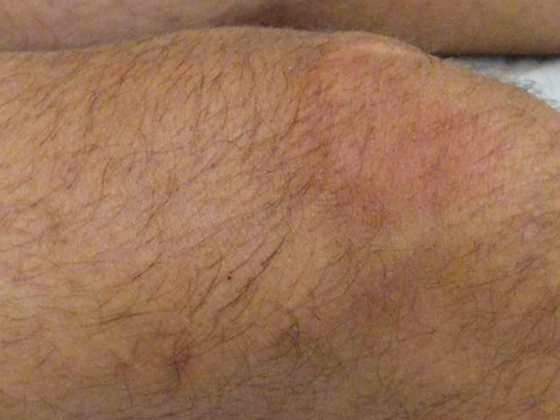
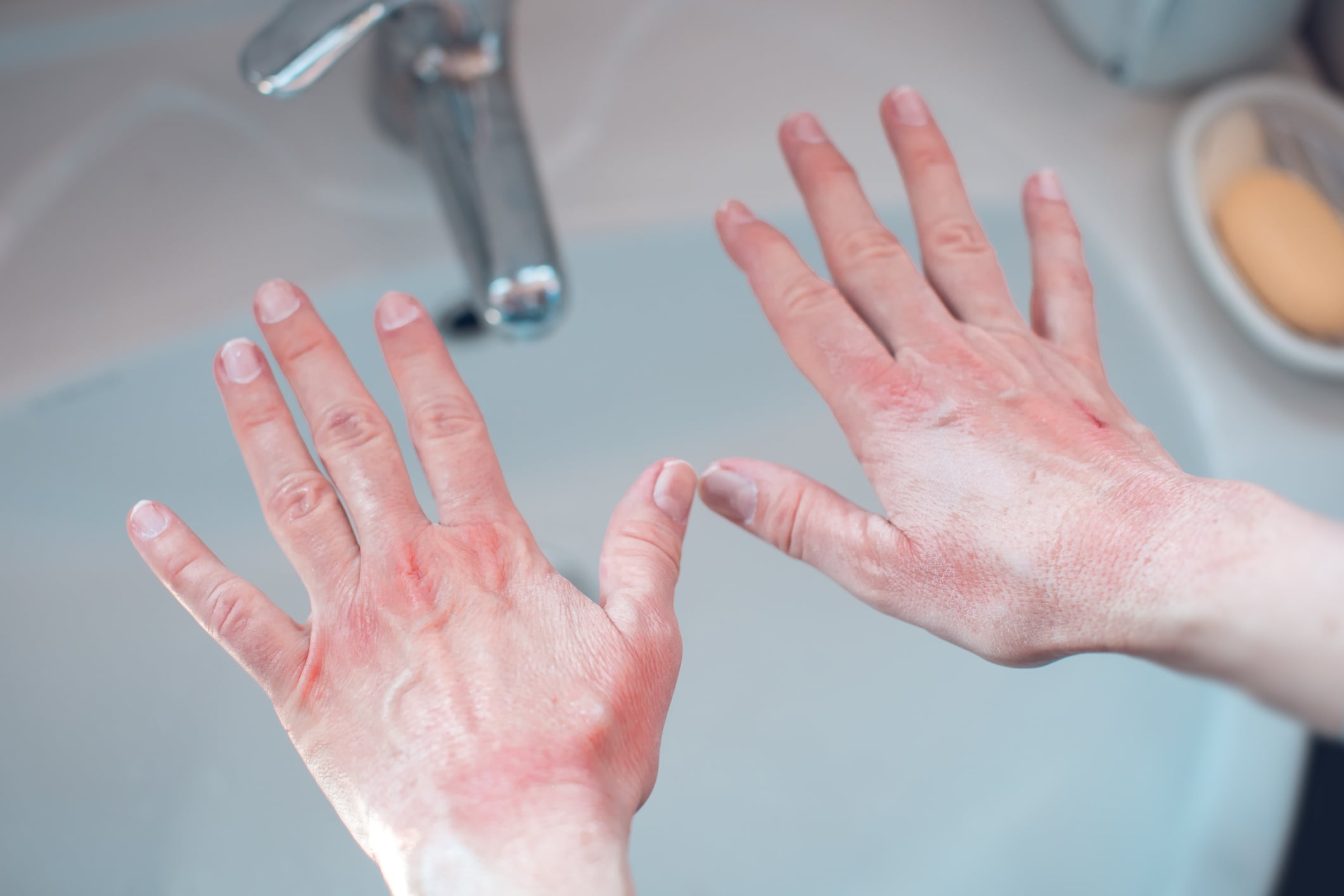
The clinical manifestations of allergic contact dermatitis are papules, papulovesicles, followed by erosion, crusting and scaling. Chronic progression results in lichenification. The expression of the symptoms and the time course (“incubation period”, specific interval after exposure of the skin to the noxious agent) are determined by the immunological processes of the cellular-mediated reaction type. The stronger the sensitization and the more intense the skin contact with the allergen, the stronger the clinical reaction. In severe hair dye allergies, for example, there is pronounced erythema and edema in the facial area.
When is chronification imminent?
The chronification of irritant and allergic contact eczema is always imminent if the skin symptoms cannot heal but are maintained by continuous contact with irritants and/or allergens. In this case, an inpatient stay and/or a longer-term sick leave for consistent allergen avoidance, therapy and regeneration of the epidermal barrier may be necessary, such as offered by the “Tertiary Individual Prevention Procedure” of the statutory accident insurance.
In addition to allergen avoidance, what drug therapies show good efficacy in the acute form in clinically controlled trials? Has there been any decisive progress in this regard in recent years?
In allergic contact dermatitis, the identification of the responsible allergen and its avoidance is indeed the be-all and end-all of therapy. This requires expert and time-consuming allergological clarification by means of the epicutaneous test, which is unfortunately becoming increasingly limited in practice due to increasing regulatory limitations and inadequate remuneration. Without consistent avoidance of the allergen, it will not be possible to remain in occupation with occupational allergens in the long term. In acute allergic contact dermatitis, topical treatment with glucocorticosteroids or, in very pronounced forms, short-term systemic therapy with glucocorticosteroids is the primary treatment.
What alternatives are there if avoidance of the contact allergens is not possible because they could not be elicited by epicutaneous testing?
Experience shows that the relevant allergens can be elicited in a very high percentage by an experienced allergist using the epicutaneous test. In case of negative test results and recurrent relapses in the sense of allergic contact dermatitis, the test procedure should be critically reviewed. The medical history must also be taken again in detail – it is possible that important substances with which the patient deals have been overlooked.
The skin is a visible organ that is central to our interpersonal contacts with others. To what extent should the psychological component be included in the therapy of allergic contact dermatitis?
Numerous studies, including those from the DDG’s CARPE registry on severe chronic hand eczema, show that dermatologists easily underestimate the impairment of quality of life caused by chronic eczema in their patients. A not insignificant proportion of our eczema patients are at risk of depression, not least because chronic eczema can lead to loss of employment and social interactions. We dermatologists should be sensitized to this and incorporate these aspects into our treatment decisions. If necessary, psychosomatic accompaniment of dermatological therapy is also advisable.
Interview: Andreas Grossmann
DERMATOLOGIE PRAXIS 2014; 24(2): 28-29