Medizinonline Medizinonline
  • News
    • News
    • Market & Medicine
  • Patients
    • Disease patterns
    • Diagnostics
    • Therapy
  • Partner Content
    • Diabetes
      • Dia-Month Club – Type 2 Diabetes
      • Diabetes in Motion
    • Gastroenterology
      • IBD matters
    • Oncology
      • Swiss Oncology in motion
    • Orthopedics
      • Osteoporosis in motion
  • Departments
    • Allergology and clinical immunology
    • General Internal Medicine
    • Anesthesiology
    • Angiology
    • Surgery
    • Dermatology and venereology
    • Endocrinology and Diabetology
    • Nutrition
    • Gastroenterology and Hepatology
    • Genetics
    • Geriatrics
    • Gynecology
    • Hematology
    • Infectiology
    • Cardiology
    • Nephrology
    • Neurology
    • Emergency and intensive care medicine
    • Nuclear Medicine
    • Oncology
    • Ophthalmology
    • ORL
    • Orthopedics
    • Pediatrics
    • Pharmacology and toxicology
    • Pharmaceutical medicine
    • Phlebology
    • Physical medicine and rehabilitation
    • Pneumology
    • Prevention and health care
    • Psychiatry and psychotherapy
    • Radiology
    • Forensic Medicine
    • Rheumatology
    • Sports Medicine
    • Traumatology and trauma surgery
    • Tropical and travel medicine
    • Urology
    • Dentistry
  • CME & Congresses
    • CME continuing education
    • Congress Reports
    • Congress calendar
  • Practice
    • Noctimed
    • Practice Management
    • Jobs
    • Interviews
  • Log In
  • Register
  • My account
  • Contact
  • Publications
  • Contact
  • Deutsch
  • English
  • Français
  • Italiano
  • Português
  • Español
Subscribe
Medizinonline Medizinonline
  • News
    • News
    • Market & Medicine
  • Patienten
    • Krankheitsbilder
    • Diagnostik
    • Therapie
  • Partner Content
    • Diabetes
      • Dia-Month Club – Type 2 Diabetes
      • Diabetes in Motion
    • Gastroenterology
      • IBD matters
    • Oncology
      • Swiss Oncology in motion
    • Orthopedics
      • Osteoporosis in motion
    • Phytotherapie
    • Rheumatology
  • Departments
    • Fachbereiche 1-13
      • Allergology and clinical immunology
      • General Internal Medicine
      • Anesthesiology
      • Angiology
      • Surgery
      • Dermatology and venereology
      • Endocrinology and Diabetology
      • Nutrition
      • Gastroenterology and Hepatology
      • Genetics
      • Geriatrics
      • Gynecology
      • Hematology
    • Fachbereiche 14-26
      • Infectiology
      • Cardiology
      • Nephrology
      • Neurology
      • Emergency and intensive care medicine
      • Nuclear Medicine
      • Oncology
      • Ophthalmology
      • ORL
      • Orthopedics
      • Pediatrics
      • Pharmacology and toxicology
      • Pharmaceutical medicine
    • Fachbereiche 26-38
      • Phlebology
      • Physical medicine and rehabilitation
      • Phytotherapy
      • Pneumology
      • Prevention and health care
      • Psychiatry and psychotherapy
      • Radiology
      • Forensic Medicine
      • Rheumatology
      • Sports Medicine
      • Traumatology and trauma surgery
      • Tropical and travel medicine
      • Urology
      • Dentistry
  • CME & Congresses
    • CME continuing education
    • Congress Reports
    • Congress calendar
  • Practice
    • Noctimed
    • Practice Management
    • Jobs
    • Interviews
Login

Sie haben noch keinen Account? Registrieren

  • Delirium - Multifactorial status

There is a threat of deterioration of the prognosis

    • Congress Reports
    • Psychiatry and psychotherapy
    • RX
  • 3 minute read

Delirium, an acute confused state, was the focus of a presentation at the ESCIM Congress in Geneva. Some of the key points discussed revolved around the proper definition of this condition, the predisposing and precipitating factors, and possible management approaches. As an expert, Prof. Gabriel Gold, MD, of Geneva University Hospitals, presented a broad overview of the topic.

(ag) First, Prof. Gabriel Gold, MD, University Hospitals of Geneva, answered the question of how to define delirium in the first place: “According to DSM V, it is an acute confused status with altered consciousness and attention that ends in a cognitive disorder that cannot be better described by a preexisting condition. Delirium fluctuates in severity and appears to be due to a presenting medical condition.” The prevalence in the general population is 1- 2%, with delirium being particularly common during hospitalization in the intensive care unit and in patients with dementia.

Predisposing factors are summarized in Table 1.

Triggering factors may include: psychoactive drugs, physical restraints, urinary catheter, elevated serum urea levels, electrolytic disturbance, infections, and iatrogenic events [1]. Further research concludes that polypharmacy, the presence of various medical conditions, malignancy, or even surgery, as well as pain and abnormal serum albumin levels, may also result in delirium.

“Consequently, delirium is usually multifactorial, which is why targeting a single risk factor can hardly be efficient. Rather, broad approaches are useful to prevent or resolve delirium,” the expert said.

Significantly worse prognosis

Not only does delirium increase mortality, e.g., in the intensive care unit or emergency department,  but also the risk of cognitive decline or institutionalization.

“Cognitive impairment must be differentiated into delirium, dementia, and depression for differential diagnosis,” Prof. Gold explained (Table 2).
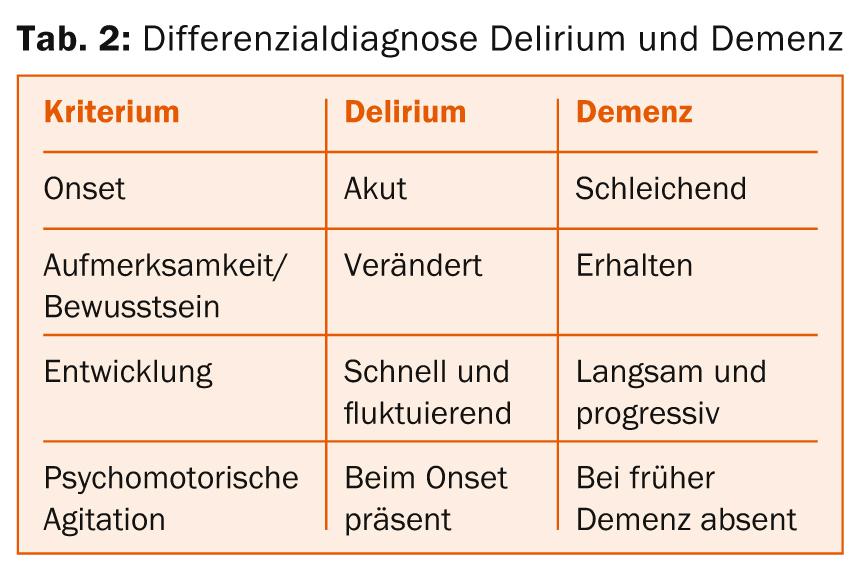
“More than 20 different diagnostic tools exist to detect delirium, yet delirium is often misdiagnosed or underdiagnosed. The most widely used is the so-called Confusion Assessment Method (CAM) [2]. The sensitivity is 94, and the specificity is 89%. There are adapted versions for use in the ICU. Thus, it is by far the best diagnostic tool currently available.” Four points are critical in CAM [2]:

  1. The acute onset and fluctuating course (reliable history with the help of caregivers and family members to document acute changes in mental status and fluctuations throughout the day).
  2. Inattention (difficulty focusing attention; easily distracted).
  3. Disorganized thinking (incoherent, rambling, irrelevant conversation; illogical flow of thought; unpredictable topic jumps)
  4. Altered consciousness (alert, hyperalert; lethargic but easily aroused; stuporous and not easily aroused; comatose and not aroused at all).

The diagnosis of delirium requires the presence of items 1 and 2 and one or both of items 3 and 4.

Management

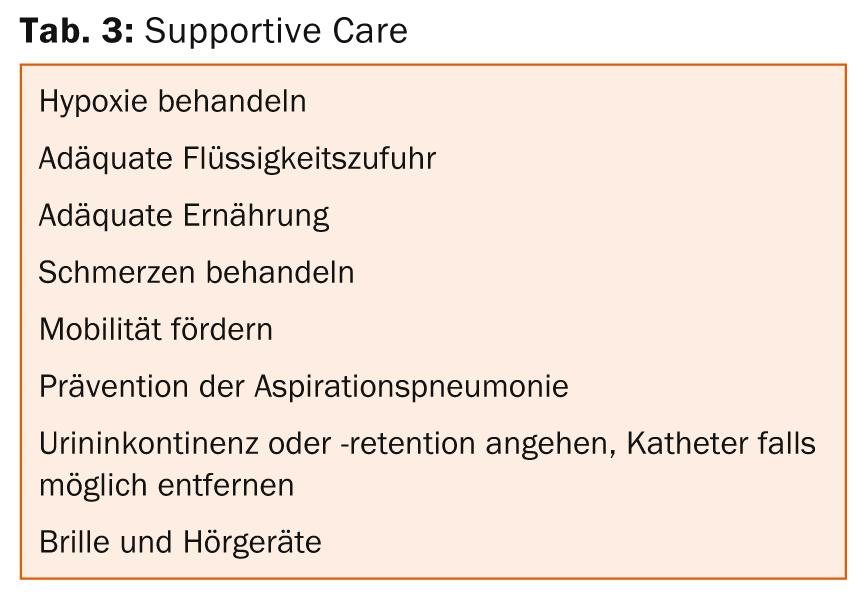
In addition to specific treatment of the underlying disease and general support measures, as shown in Table 3 , behavioral management is also critical.
“Whenever possible, physical restraint should be avoided and the presence of familiar people and things should be encouraged. Neuroleptics that can be considered are haloperidol in low doses and possibly atypical neuroleptics such as quetiapine, ripseridone, or olanzapine [3]. Benzodiazepines and cholinesterase inhibitors such as rivastigmine should not be used, as these have no effect in prevention and only increase the number of side effects. The preventive effect of neuroleptics has also been studied. The results are inconsistent so far,” Prof. Gold concluded.

Source: “How to deal with delirium,” seminar at ESCIM Congress, May 14-16, 2014, Geneva.

Literature:

  1. Inouye SK, Westendorp RG, Saczynski JS: Delirium in elderly people. Lancet 2014 Mar 8; 383(9920): 911-922.
  2. Inouye SK, et al: Clarifying confusion: the confusion assessment method. A new method for detection of delirium. Ann Intern Med 1990 Dec 15; 113(12): 941-948.
  3. Yoon HJ, et al: Efficacy and safety of haloperidol versus atypical antipsychotic medications in the treatment of delirium. BMC Psychiatry 2013 Sep 30; 13: 240.

InFo NEUROLOGY & PSYCHIATRY 2014, 12(4): 36-37.

Autoren
  • Andreas Grossmann
Publikation
  • InFo NEUROLOGIE & PSYCHIATRIE
Related Topics
  • Delirium
  • Drugs
  • ESCIM
  • Management approach
  • Serum urea levels
  • supportive care
Previous Article
  • Substitution-assisted treatment for opioid dependence in Switzerland

Advanced pharmacotherapy options

  • Education
  • Psychiatry and psychotherapy
  • RX
View Post
Next Article
  • Arteriovenous malformation

Interdisciplinary treatment in an interventional-surgical hybrid room

  • Angiology
  • Cases
  • Neurology
  • Radiology
  • RX
  • Surgery
View Post
You May Also Like
View Post
  • 27 min
  • Across All Types of Cancer

Four-Legged Medical Assistants – Therapy Dogs in Clinical Settings

    • RX
    • CME continuing education
    • General Internal Medicine
    • Geriatrics
    • Hematology
    • Oncology
    • Pediatrics
    • Physical medicine and rehabilitation
    • Prevention and health care
    • Studies
View Post
  • 8 min
  • Obesity: More than half of those affected have fatty liver disease

From screening to multimodal intervention with GLP-1-RA or resmetirom

    • RX
    • Education
    • Endocrinology and Diabetology
    • Gastroenterology and Hepatology
    • General Internal Medicine
    • Nutrition
    • Studies
View Post
  • 6 min
  • Innovative Oral Treatment Options for Psoriasis: Icotrokinra and Zasocitinib

First-class immunomodulation combined with convenience—the data available so far is convincing

    • RX
    • Congress Reports
    • Dermatology and venereology
    • Rheumatology
    • Studies
View Post
  • 4 min
  • Preclinical Study on a Special Ginkgo biloba Extract

What role do proanthocyanidins play?

    • RX
    • Education
    • General Internal Medicine
    • Geriatrics
    • Neurology
    • Pharmaceutical medicine
    • Pharmacology and toxicology
    • Phytotherapy
    • Studies
View Post
  • 6 min
  • Myasthenia gravis: immunomodulatory therapies for long-term treatment

Expanded Possibilities Thanks to Innovative Classes of Active Ingredients

    • RX
    • Congress Reports
    • General Internal Medicine
    • Neurology
    • Ophthalmology
    • Studies
View Post
  • 10 min
  • Interstitial Lung Diseases

Update on Idiopathic Pulmonary Fibrosis

    • RX
    • CME continuing education
    • Pneumology
    • Studies
View Post
  • 7 min
  • Plastic surgery and reconstructive microsurgery for DFS

Functional limb preservation between infection control, vascular medicine and resurfacing

    • RX
    • Angiology
    • CME continuing education
    • Dermatology and venereology
    • Endocrinology and Diabetology
    • General Internal Medicine
    • Geriatrics
    • Physical medicine and rehabilitation
    • Surgery
View Post
  • 7 min
  • Ischemic stroke: Are smaller or larger brain arteries affected?

Recent study findings on intravenous lysis therapy with fibrinolytic agents

    • RX
    • Congress Reports
    • Emergency and intensive care medicine
    • General Internal Medicine
    • Neurology
    • Pharmacology and toxicology
    • Studies
    • Surgery
  • IBD matters

    Zum Thema
Top CME content
  • 1
    Four-Legged Medical Assistants – Therapy Dogs in Clinical Settings
  • 2
    Functional limb preservation between infection control, vascular medicine and resurfacing
  • 3
    Update on Idiopathic Pulmonary Fibrosis
  • 4
    Update on Idiopathic Pulmonary Fibrosis
  • 5
    Current status of PAT

Newsletter

Sign up and stay up to date

Subscribe
Medizinonline Medizinonline
  • Contact
  • General terms and conditions
  • Imprint

Input your search keywords and press Enter.