Medizinonline Medizinonline
  • News
    • News
    • Market & Medicine
  • Patients
    • Disease patterns
    • Diagnostics
    • Therapy
  • Partner Content
    • Diabetes
      • Dia-Month Club – Type 2 Diabetes
      • Diabetes in Motion
      • Diabetes Podcasts
    • Gastroenterology
      • IBD matters
    • Oncology
      • Swiss Oncology in motion
    • Orthopedics
      • Osteoporosis in motion
  • Departments
    • Allergology and clinical immunology
    • General Internal Medicine
    • Anesthesiology
    • Angiology
    • Surgery
    • Dermatology and venereology
    • Endocrinology and Diabetology
    • Nutrition
    • Gastroenterology and Hepatology
    • Genetics
    • Geriatrics
    • Gynecology
    • Hematology
    • Infectiology
    • Cardiology
    • Nephrology
    • Neurology
    • Emergency and intensive care medicine
    • Nuclear Medicine
    • Oncology
    • Ophthalmology
    • ORL
    • Orthopedics
    • Pediatrics
    • Pharmacology and toxicology
    • Pharmaceutical medicine
    • Phlebology
    • Physical medicine and rehabilitation
    • Pneumology
    • Prevention and health care
    • Psychiatry and psychotherapy
    • Radiology
    • Forensic Medicine
    • Rheumatology
    • Sports Medicine
    • Traumatology and trauma surgery
    • Tropical and travel medicine
    • Urology
    • Dentistry
  • CME & Congresses
    • CME continuing education
    • Congress Reports
    • Congress calendar
  • Practice
    • Noctimed
    • Practice Management
    • Jobs
    • Interviews
  • Log In
  • Register
  • My account
  • Contact
  • Publications
  • Contact
  • Deutsch
  • English
  • Français
  • Italiano
  • Português
  • Español
Subscribe
Medizinonline Medizinonline
  • News
    • News
    • Market & Medicine
  • Patienten
    • Krankheitsbilder
    • Diagnostik
    • Therapie
  • Partner Content
    • Diabetes
      • Dia-Month Club – Type 2 Diabetes
      • Diabetes in Motion
      • Diabetes Podcasts
    • Gastroenterology
      • IBD matters
    • Oncology
      • Swiss Oncology in motion
    • Orthopedics
      • Osteoporosis in motion
    • Phytotherapie
    • Rheumatology
  • Departments
    • Fachbereiche 1-13
      • Allergology and clinical immunology
      • General Internal Medicine
      • Anesthesiology
      • Angiology
      • Surgery
      • Dermatology and venereology
      • Endocrinology and Diabetology
      • Nutrition
      • Gastroenterology and Hepatology
      • Genetics
      • Geriatrics
      • Gynecology
      • Hematology
    • Fachbereiche 14-26
      • Infectiology
      • Cardiology
      • Nephrology
      • Neurology
      • Emergency and intensive care medicine
      • Nuclear Medicine
      • Oncology
      • Ophthalmology
      • ORL
      • Orthopedics
      • Pediatrics
      • Pharmacology and toxicology
      • Pharmaceutical medicine
    • Fachbereiche 26-38
      • Phlebology
      • Physical medicine and rehabilitation
      • Phytotherapy
      • Pneumology
      • Prevention and health care
      • Psychiatry and psychotherapy
      • Radiology
      • Forensic Medicine
      • Rheumatology
      • Sports Medicine
      • Traumatology and trauma surgery
      • Tropical and travel medicine
      • Urology
      • Dentistry
  • CME & Congresses
    • CME continuing education
    • Congress Reports
    • Congress calendar
  • Practice
    • Noctimed
    • Practice Management
    • Jobs
    • Interviews
Login

Sie haben noch keinen Account? Registrieren

  • PARTNER study

To what extent do diabetic patients with severe aortic valve stenosis benefit from TAVI?

    • Cardiology
    • Endocrinology and Diabetology
    • RX
    • Studies
  • 3 minute read

The PARTNER trial was the first randomized trial to demonstrate that TAVI (transcatheter aortic valve implantation) is a valid alternative to surgical aortic valve replacement in patients at high surgical risk. A post-hoc analysis from cohort A now examined the potential benefit of TAVI in patients who also had diabetes.

(ag) The PARTNER trial was a multicenter, randomized study that enrolled 699 patients with severe symptomatic aortic valve stenosis at high surgical risk between May 2007 and August 2009. Recent post-hoc data taken from Cohort A and presented at last year’s ESC Congress [1] address a specific patient population: How does TAVI compare with surgical valve replacement in diabetic patients with severe aortic valve stenosis and high surgical risk? 275 diabetic patients (42% of all 657 patients treated) from cohort A were included in this analysis. 145 of these underwent TAVI, and 130 received surgical aortic valve replacement. Otherwise, the two groups of patients did not differ significantly in their clinical characteristics. The primary endpoint was 1-year all-cause mortality.

Diabetes as a relevant comorbidity

Patients with severe aortic valve stenosis often suffer from diabetes. This comorbidity is associated with increased morbidity and mortality after surgical aortic valve replacement. Inflammation, oxidative stress, and reperfusion injury (caused by cardiac arrest and use of the heart-lung machine) appear to be particularly deleterious, and it was hypothesized that a less invasive procedure (i.e., TAVI) might improve clinical outcomes in this population.

Results: For 1-year all-cause mortality (primary endpoint), there was a significant interaction (p=0.048) between diabetes status and treatment group (TAVI vs. surgical replacement). After twelve months, all-cause mortality was

  • 18% in diabetics after TAVI
  • in diabetic patients after surgical aortic valve replacement was 27.4% (Fig. 1).
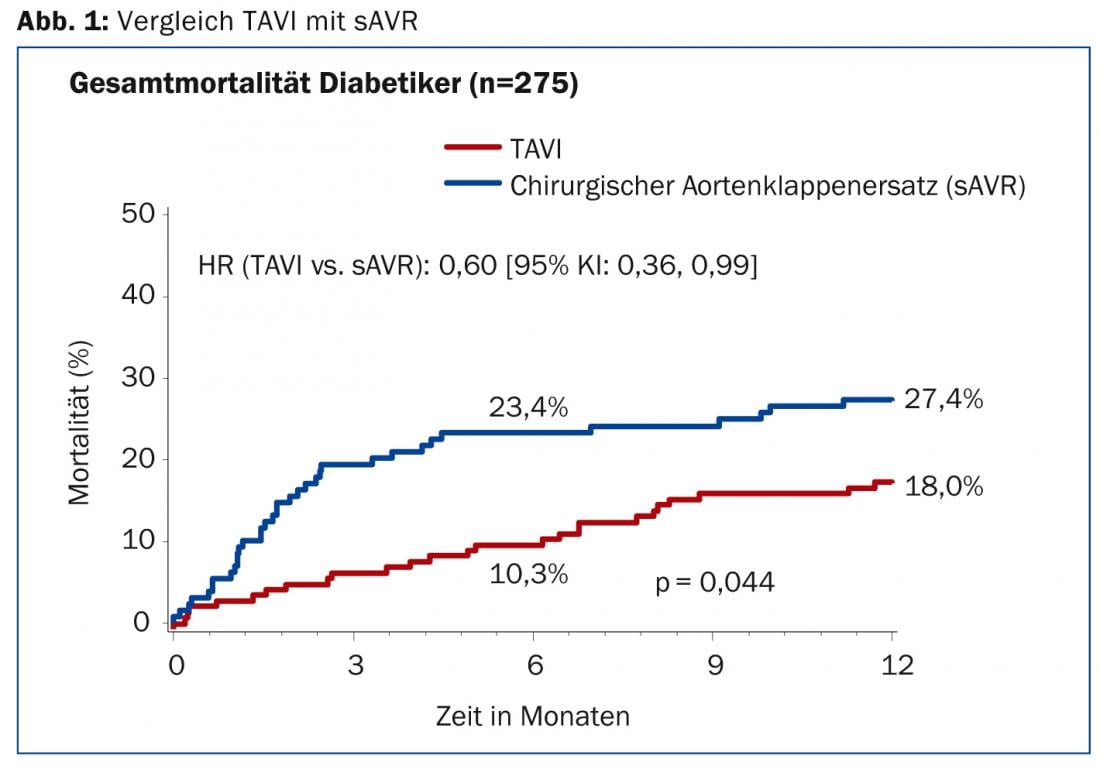
Whether TAVI was via the transapical or transfemoral route made no difference. In contrast, no significant difference in all-cause mortality was observed in non-diabetic patients between the two therapies (TAVI vs. sAVR) (p=0.48).

In addition, TAVI significantly (p=0.05) reduced the need for dialysis due to renal failure at one year and, if dialysis was needed, significantly reduced the need for dialysis to be maintained for 30 days (p=0.003). These patients showed significantly lower symptomatology (NYHA III and IV) at the time of hospital discharge and 30 days thereafter. Quality of life (KCCQ) was significantly improved with TAVI at 30 days.

Relevance of the results

Post-hoc analysis suggests that diabetic patients with severe aortic valve stenosis and high surgical risk benefit more from TAVI than from surgical aortic valve replacement. In this study population, there was a 9% absolute and 35% relative reduction in all-cause mortality with TAVI no difference in the number of strokes at 1 year a lower rate of renal failure with TAVI (at 1 year) a significant improvement in symptoms with TAVI (at 30 days).

According to the authors, the analysis should give rise to further research in this area and generate new hypotheses. Because diabetes status was not a prespecified subgroup analysis in the PARTNER trial, the finding of a survival benefit in diabetic patients undergoing TAVI would need to be confirmed in the future.

Literature:

  1. Lindman BR, et al: Transcatheter Versus Surgical Aortic Valve Replacement in Patients With Diabetes and Severe Aortic Stenosis at High Risk for Surgery: An Analysis of the PARTNER Trial (Placement of Aortic Transcatheter Valve). J Am Coll Cardiol March 25 2014; 63(11): 1090-1099 doi:10.1016/j.jacc.2013.10.057.

HAUSARZT PRAXIS 2014; 9(7): 6

Autoren
  • Andreas Grossmann
Publikation
  • HAUSARZT PRAXIS
Related Topics
  • aortic valve stenosis
  • Diabetes
  • PARTNER
  • sAVR
  • TAVI
Previous Article
  • Diabetes

A multifaceted look at the widespread disease

  • Education
  • Endocrinology and Diabetology
  • RX
View Post
Next Article
  • Focus on the feet

Set an example for healthy feet

  • News
  • Orthopedics
  • Rheumatology
  • RX
View Post
You May Also Like
View Post
  • 4 min
  • SwissDiab Study: New Analysis Published

How are diabetes complications associated with quality of life?

    • RX
    • Endocrinology and Diabetology
    • General Internal Medicine
    • Studies
View Post
  • 6 min
  • Pre-acclimatization on Mount Everest

Exploring the physiological limits

    • RX
    • Congress Reports
    • General Internal Medicine
    • Pneumology
    • Studies
    • Tropical and travel medicine
View Post
  • 5 min
  • Viloxazine for ADHD

A non-stimulating option—but with limited evidence

    • RX
    • Education
    • Neurology
    • Pediatrics
    • Pharmacology and toxicology
    • Psychiatry and psychotherapy
    • Studies
View Post
  • 6 min
  • Preclinical study on phytotherapeutic agent

Active ingredient combination of peppermint and caraway oil modified fecal microbiota

    • RX
    • Education
    • Gastroenterology and Hepatology
    • General Internal Medicine
    • Pharmaceutical medicine
    • Phytotherapy
    • Studies
View Post
  • 4 min
  • Casuistry

Rituximab used effectively against IgG4-RD colitis

    • RX
    • Cases
    • Education
    • Gastroenterology and Hepatology
    • General Internal Medicine
    • Radiology
    • Rheumatology
View Post
  • 5 min
  • Sarcoidosis

New options from JAKi to mTOR

    • RX
    • Congress Reports
    • General Internal Medicine
    • Pneumology
    • Studies
View Post
  • 6 min
  • Head and neck squamous cell carcinoma

Precision immunotherapy and local treatment

    • RX
    • Congress Reports
    • Dermatology and venereology
    • Oncology
    • ORL
    • Studies
View Post
  • 3 min
  • From symptom to diagnosis

Abdominal pain – Prostate cysts

    • RX
    • Cases
    • Education
    • General Internal Medicine
    • Radiology
    • Surgery
    • Urology
  • IBD matters

    Zum Thema
Top CME content
  • 1
    Current State of Knowledge and New Therapeutic Approaches
  • 2
    Why is it so hard to lose weight?
  • 3
    Functional limb preservation between infection control, vascular medicine and resurfacing
  • 4
    Algorithms, avatars and the unburdened mind
  • 5
    Communication as the key to therapy adherence

Newsletter

Sign up and stay up to date

Subscribe
Medizinonline Medizinonline
  • Contact
  • General terms and conditions
  • Imprint

Input your search keywords and press Enter.