Medizinonline Medizinonline
  • News
    • News
    • Market & Medicine
  • Patients
    • Disease patterns
    • Diagnostics
    • Therapy
  • Partner Content
    • Diabetes
      • Dia-Month Club – Type 2 Diabetes
      • Diabetes in Motion
      • Diabetes Podcasts
    • Gastroenterology
      • IBD matters
    • Oncology
      • Swiss Oncology in motion
    • Orthopedics
      • Osteoporosis in motion
  • Departments
    • Allergology and clinical immunology
    • General Internal Medicine
    • Anesthesiology
    • Angiology
    • Surgery
    • Dermatology and venereology
    • Endocrinology and Diabetology
    • Nutrition
    • Gastroenterology and Hepatology
    • Genetics
    • Geriatrics
    • Gynecology
    • Hematology
    • Infectiology
    • Cardiology
    • Nephrology
    • Neurology
    • Emergency and intensive care medicine
    • Nuclear Medicine
    • Oncology
    • Ophthalmology
    • ORL
    • Orthopedics
    • Pediatrics
    • Pharmacology and toxicology
    • Pharmaceutical medicine
    • Phlebology
    • Physical medicine and rehabilitation
    • Pneumology
    • Prevention and health care
    • Psychiatry and psychotherapy
    • Radiology
    • Forensic Medicine
    • Rheumatology
    • Sports Medicine
    • Traumatology and trauma surgery
    • Tropical and travel medicine
    • Urology
    • Dentistry
  • CME & Congresses
    • CME continuing education
    • Congress Reports
    • Congress calendar
  • Practice
    • Noctimed
    • Practice Management
    • Jobs
    • Interviews
  • Log In
  • Register
  • My account
  • Contact
  • Publications
  • Contact
  • Deutsch
  • English
  • Français
  • Italiano
  • Português
  • Español
Subscribe
Medizinonline Medizinonline
  • News
    • News
    • Market & Medicine
  • Patienten
    • Krankheitsbilder
    • Diagnostik
    • Therapie
  • Partner Content
    • Diabetes
      • Dia-Month Club – Type 2 Diabetes
      • Diabetes in Motion
      • Diabetes Podcasts
    • Gastroenterology
      • IBD matters
    • Oncology
      • Swiss Oncology in motion
    • Orthopedics
      • Osteoporosis in motion
    • Phytotherapie
    • Rheumatology
  • Departments
    • Fachbereiche 1-13
      • Allergology and clinical immunology
      • General Internal Medicine
      • Anesthesiology
      • Angiology
      • Surgery
      • Dermatology and venereology
      • Endocrinology and Diabetology
      • Nutrition
      • Gastroenterology and Hepatology
      • Genetics
      • Geriatrics
      • Gynecology
      • Hematology
    • Fachbereiche 14-26
      • Infectiology
      • Cardiology
      • Nephrology
      • Neurology
      • Emergency and intensive care medicine
      • Nuclear Medicine
      • Oncology
      • Ophthalmology
      • ORL
      • Orthopedics
      • Pediatrics
      • Pharmacology and toxicology
      • Pharmaceutical medicine
    • Fachbereiche 26-38
      • Phlebology
      • Physical medicine and rehabilitation
      • Phytotherapy
      • Pneumology
      • Prevention and health care
      • Psychiatry and psychotherapy
      • Radiology
      • Forensic Medicine
      • Rheumatology
      • Sports Medicine
      • Traumatology and trauma surgery
      • Tropical and travel medicine
      • Urology
      • Dentistry
  • CME & Congresses
    • CME continuing education
    • Congress Reports
    • Congress calendar
  • Practice
    • Noctimed
    • Practice Management
    • Jobs
    • Interviews
Login

Sie haben noch keinen Account? Registrieren

  • Diabetes Management

Type 1 diabetics benefit from additive oral therapy

    • Congress Reports
    • Education
    • Endocrinology and Diabetology
    • Partner Content
    • RX
    • Studies
  • 3 minute read

Type 1 diabetics with obesity in whom insulin therapy alone is insufficient for glycemic control may additionally benefit from oral treatment with an SGLT2 inhibitor. Recent study results show good results of add-on therapy. However, good adherence and monitoring for ketoacidosis risk are indicated.

(red) Worldwide, the annual incidence of type 1 diabetes mellitus is increasing by approximately 2-3% per year [1,2]. The disease is a result of autoimmune or nonimmune destruction of insulin-producing pancreatic β-cells and leads to an increase in glycated hemoglobin (HbA1c). Strict glycemic control may reduce the risk of microvascular (e.g., diabetic retinopathy, nephropathy, and neuropathy) and macrovascular (e.g., coronary artery disease and peripheral vascular disease) complications in patients with type 1 diabetes. Insulin remains the mainstay of drug treatment for type 1 diabetics. However, glycemic targets are not always achieved by insulin therapy alone [3]. Hypoglycemia and weight gain remain significant adverse events associated with insulin therapy. With the SGLT2 inhibitor dapagliflozin or the dual SGLT1-/SGLT2 inhibitor sotagliflozin, two additional options are now available that have shown good results, especially in diabetics with a BMI of 27 kg/m2 and above.

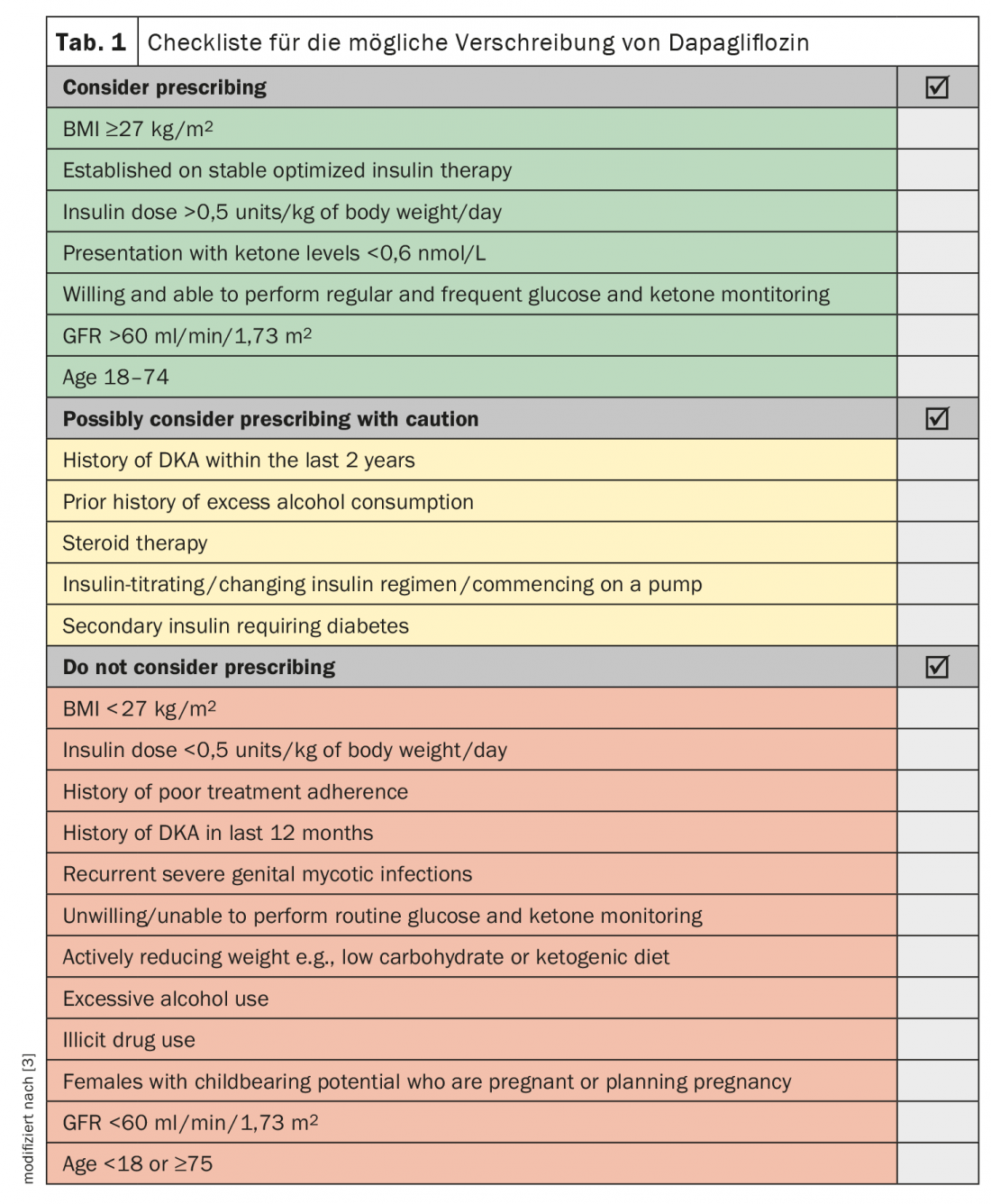
For dapagliflozin, the DEPICT clinical trial program has shown that as an add-on administration, it can support the achievement of glycemic goals in type 1 diabetic patients [3–5]. At week 52 in DEPICT1, placebo-adjusted changes in HbA1c and weight in the dapagliflozin 5/10 mg groups were -0.33/-0.%/–0,36% and -2.95 kg/-4.5 kg, respectively. Weight loss is likely to be important for many people with type 1 diabetes and may also limit subsequent cardiovascular risk. Patients best suited for dapagliflozin are likely to be those with a BMI ≥27 kg/m2 based on stable optimized insulin therapy and high insulin requirements (>0.5 units/kg body weight/day) (Table 1).


To improve glycemic control complementary to insulin therapy in adults with type 1 diabetes and a body mass index ≥27 kg/m2 who do not achieve adequate glycemic control despite optimal insulin therapy, the SGLT1/SGLT2 inhibitor sotagliflozin can also be used [6]. SGLT1 provides glucose uptake in the gastrointestinal tract and SGLT2 provides glucose reuptake in the kidneys. In the pivotal phase III Tandem study 3, 28.6% of type 1 diabetic patients dosed with sotagliflozin 400 mg once daily achieved HbA1c <7% (primary endpoint). In the placebo group, the figure was only 15.2%. However, attention should be paid to the risk of ketoacidosis, as significantly more ketoacidoses occurred (3% vs. 0.6%) [7].

Source: EASD 2020
 

Literature:

  1. Maahs DM, West NA, Lawrence JM, Mayer-Davis EJ: Epidemiology of type 1 diabetes. Endocrinol Metab Clin North Am. 2010; 39(3): 481-497.
  2. Mayer-Davis EJ, Lawrence JM, Dabelea D, et al: Incidence trends of type 1 and type 2 diabetes in adolescents, 2002-2012. N Engl J Med. 2017; 376(15): 1419-1429.
  3. Evans M, et al: Optimising the Benefits of SGLT2 Inhibitors for Type 1 Diabetes. Diabetes Therapy 2020; 11: 37-52.
  4. Eliasson B: Adjunctive therapies in people with type 1 diabetes – beyond insulin. What is he future of type 1 diabetes treatment? Prof. Dr. Björn Eliasson, EASD Virtual Meeting, 23.09.2020
  5. Mathieu C, et al: Efficacy and Safety of Dapagliflozin in Patients With Inadequately Controlled Type 1 Diabetes (the DEPICT-2 Study): 24-Week Results From a Randomized Controlled Trial. Diabetes Care 2018; 41(9): 1938-1946.
  6. MMW: Dual SGLT inhibitor receives marketing approval. MMW – Advances in Medicine 161, 58 (2019). https://link.springer.com/article/10.1007%2Fs15006-019-0564-y
  7. Garg SK, et al: Effects of sotagliflozin added to insulin in patients with type 1 diabetes. N Engl J Med 2017; 377: 2337-2348.


CARDIOVASC 2020; 19(4): 38 (published 9/12/20, ahead of print).

Publikation
  • CARDIOVASC
Related Topics
  • Diabetes
  • diabetes type 1
Previous Article
  • Breast Cancer

News from the world of HER2-targeted treatment options

  • Congress Reports
  • Gynecology
  • Oncology
  • RX
  • Studies
View Post
Next Article
  • Scar Management

New s2k guideline on the treatment of hypertrophic scars and keloids

  • Dermatology and venereology
  • Education
  • RX
View Post
You May Also Like
View Post
  • 2 min
  • Wearables: screening via smartwatch?

New study on atrial fibrillation in high-risk patients

    • RX
    • Cardiology
    • Practice Management
    • Prevention and health care
    • Studies
View Post
  • 11 min
  • Peristomal skin health

Focus on preventive care options

    • RX
    • Cases
    • CME continuing education
    • Dermatology and venereology
    • Gastroenterology and Hepatology
    • Infectiology
    • Physical medicine and rehabilitation
    • Prevention and health care
    • Surgery
View Post
  • 5 min
  • Mental Health with GLP-1 RAs

Benefits of Semaglutide and Liraglutide

    • RX
    • Education
    • Endocrinology and Diabetology
    • General Internal Medicine
    • Nutrition
    • Psychiatry and psychotherapy
    • Studies
View Post
  • 4 min
  • Bronchiolitis obliterans

Out of shape even without popcorn

    • RX
    • Education
    • General Internal Medicine
    • Infectiology
    • Pediatrics
    • Pneumology
    • Studies
View Post
  • 8 min
  • Case study

Guillain-Barré syndrome with a fulminant course

    • RX
    • Cases
    • Education
    • Infectiology
    • Neurology
    • Pharmacology and toxicology
    • Radiology
    • Studies
View Post
  • 5 min
  • Suspicion of neuroborreliosis?

Detection of borrelia-specific CSF parameters provides certainty

    • RX
    • Congress Reports
    • Infectiology
    • Neurology
    • Studies
View Post
  • 12 min
  • The Brain and the Motivation to Eat

Why is it so hard to lose weight?

    • RX
    • CME continuing education
    • Endocrinology and Diabetology
    • General Internal Medicine
    • Nutrition
    • Pharmacology and toxicology
    • Prevention and health care
    • Psychiatry and psychotherapy
    • Studies
View Post
  • 12 min
  • Global Recommendation, Swissmedic Approval, and SL Limitation

WHO Guidelines on GLP-1 for Obesity

    • RX
    • Cardiology
    • Education
    • Endocrinology and Diabetology
    • General Internal Medicine
    • Nutrition
    • Pharmacology and toxicology
    • Prevention and health care
    • Studies
  • IBD matters

    Zum Thema
Top CME content
  • 1
    Focus on preventive care options
  • 2
    Inflammation as a Treatment Goal in Its Own Right
  • 3
    Personalized Treatment Before a Planned Pregnancy
  • 4
    Current State of Knowledge and New Therapeutic Approaches
  • 5
    Why is it so hard to lose weight?

Newsletter

Sign up and stay up to date

Subscribe
Medizinonline Medizinonline
  • Contact
  • General terms and conditions
  • Imprint

Input your search keywords and press Enter.