Medizinonline Medizinonline
  • News
    • News
    • Market & Medicine
  • Patients
    • Disease patterns
    • Diagnostics
    • Therapy
  • Partner Content
    • Diabetes
      • Dia-Month Club – Type 2 Diabetes
      • Diabetes in Motion
    • Gastroenterology
      • IBD matters
    • Oncology
      • Swiss Oncology in motion
    • Orthopedics
      • Osteoporosis in motion
  • Departments
    • Allergology and clinical immunology
    • General Internal Medicine
    • Anesthesiology
    • Angiology
    • Surgery
    • Dermatology and venereology
    • Endocrinology and Diabetology
    • Nutrition
    • Gastroenterology and Hepatology
    • Genetics
    • Geriatrics
    • Gynecology
    • Hematology
    • Infectiology
    • Cardiology
    • Nephrology
    • Neurology
    • Emergency and intensive care medicine
    • Nuclear Medicine
    • Oncology
    • Ophthalmology
    • ORL
    • Orthopedics
    • Pediatrics
    • Pharmacology and toxicology
    • Pharmaceutical medicine
    • Phlebology
    • Physical medicine and rehabilitation
    • Pneumology
    • Prevention and health care
    • Psychiatry and psychotherapy
    • Radiology
    • Forensic Medicine
    • Rheumatology
    • Sports Medicine
    • Traumatology and trauma surgery
    • Tropical and travel medicine
    • Urology
    • Dentistry
  • CME & Congresses
    • CME continuing education
    • Congress Reports
    • Congress calendar
  • Practice
    • Noctimed
    • Practice Management
    • Jobs
    • Interviews
  • Log In
  • Register
  • My account
  • Contact
  • Publications
  • Contact
  • Deutsch
  • English
  • Français
  • Italiano
  • Português
  • Español
Subscribe
Medizinonline Medizinonline
  • News
    • News
    • Market & Medicine
  • Patienten
    • Krankheitsbilder
    • Diagnostik
    • Therapie
  • Partner Content
    • Diabetes
      • Dia-Month Club – Type 2 Diabetes
      • Diabetes in Motion
    • Gastroenterology
      • IBD matters
    • Oncology
      • Swiss Oncology in motion
    • Orthopedics
      • Osteoporosis in motion
    • Phytotherapie
    • Rheumatology
  • Departments
    • Fachbereiche 1-13
      • Allergology and clinical immunology
      • General Internal Medicine
      • Anesthesiology
      • Angiology
      • Surgery
      • Dermatology and venereology
      • Endocrinology and Diabetology
      • Nutrition
      • Gastroenterology and Hepatology
      • Genetics
      • Geriatrics
      • Gynecology
      • Hematology
    • Fachbereiche 14-26
      • Infectiology
      • Cardiology
      • Nephrology
      • Neurology
      • Emergency and intensive care medicine
      • Nuclear Medicine
      • Oncology
      • Ophthalmology
      • ORL
      • Orthopedics
      • Pediatrics
      • Pharmacology and toxicology
      • Pharmaceutical medicine
    • Fachbereiche 26-38
      • Phlebology
      • Physical medicine and rehabilitation
      • Phytotherapy
      • Pneumology
      • Prevention and health care
      • Psychiatry and psychotherapy
      • Radiology
      • Forensic Medicine
      • Rheumatology
      • Sports Medicine
      • Traumatology and trauma surgery
      • Tropical and travel medicine
      • Urology
      • Dentistry
  • CME & Congresses
    • CME continuing education
    • Congress Reports
    • Congress calendar
  • Practice
    • Noctimed
    • Practice Management
    • Jobs
    • Interviews
Login

Sie haben noch keinen Account? Registrieren

  • Colorectal cancer screening

Screening colonoscopy reduces colorectal cancer incidence and mortality

    • Education
    • Gastroenterology and Hepatology
    • General Internal Medicine
    • Oncology
    • Prevention and health care
    • RX
    • Studies
  • 4 minute read

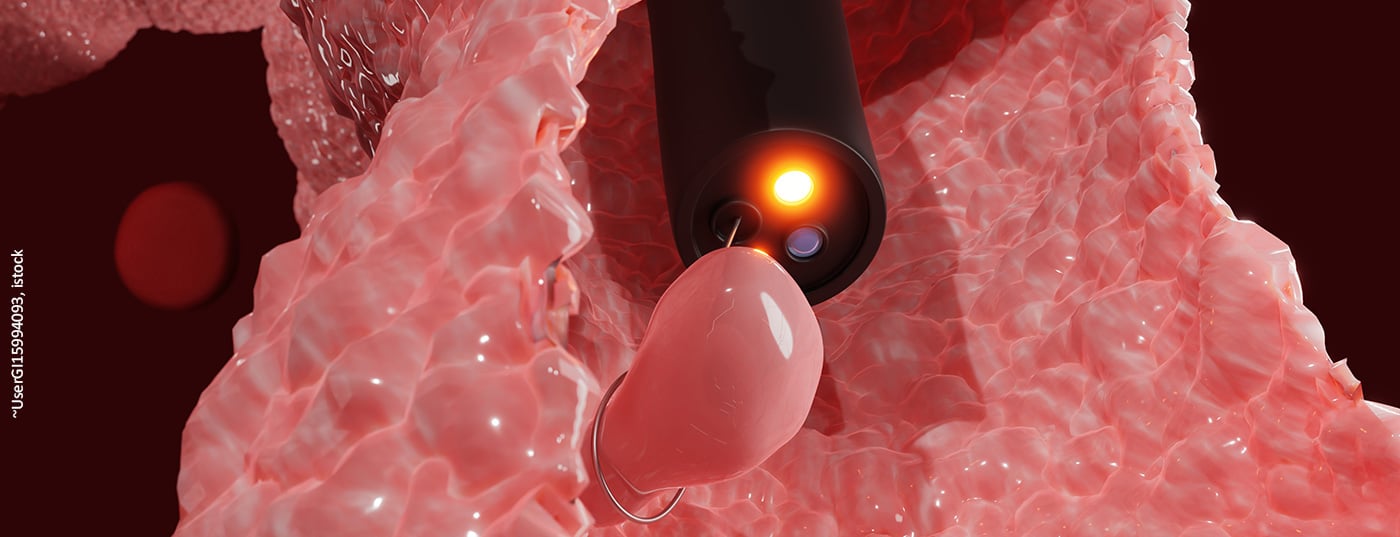
Of the colorectal tumors that are detected during a screening examination, many are still at an early stage and are readily treatable. Not only can colonoscopy detect colorectal cancer, but polyps can be removed immediately. Therefore, in some cases, a screening colonoscopy can prevent colorectal cancer from developing in the first place. The results of a prospective long-term study support the high benefit of colonoscopy for screening purposes.

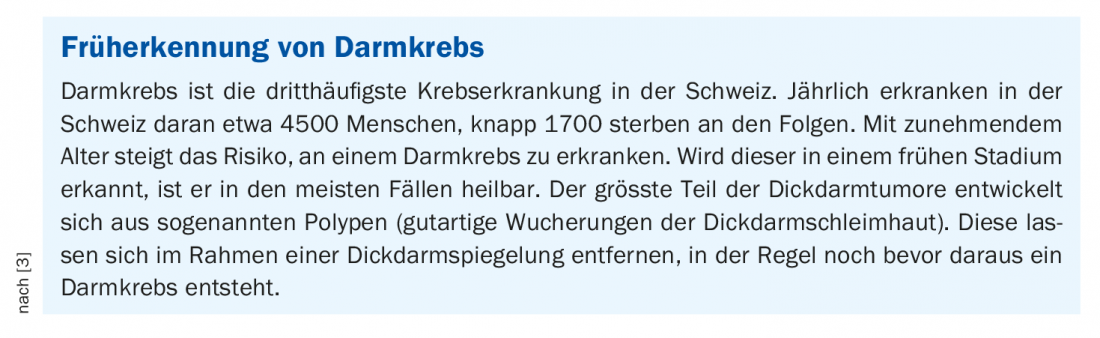
The intestine fulfills various vital functions, such as the absorption of nutrients from food, which are subsequently channeled into the bloodstream. In addition, the intestinal flora consists of billions of microorganisms that are significantly involved in the function of the intestine-associated immune system. Many people suffer from gastrointestinal complaints. In most cases, these are harmless, but not always. Colorectal cancer is the third most common cancer in Switzerland [1]. Malignant intestinal tumors occur mainly as colorectal carcinoma (cancer of the colon and rectum), and less frequently as anal carcinoma or malignant tumor of the small intestine. Colorectal carcinoma develops over a period of years from precancerous lesions that can be detected and immediately removed during colonoscopy [2]. The risk of developing colorectal cancer increases with age. Colonoscopy is recommended from the age of 50 years, possibly earlier if there is a family history of colorectal cancer [3].

Colonoscopy is considered the gold standard for colorectal cancer screening

Symptoms for which a colonoscopy should usually be performed are, for example, blood in the stool or an unclear weight loss. Colonoscopy may also be useful for other complaints such as changes in bowel habits or unexplained abdominal pain [3]. Colonoscopy is generally considered the gold standard for colorectal cancer screening because it visualizes the entire colon and neoplasms can be removed directly [4].

Cohort study provides impressive evidence of preventive benefits

Epidemiologists at the German Cancer Research Center (DFKZ) evaluated data from more than 9000 participants as part of the ESTHER* study (box). [2,5]. Study participants were interviewed at regular intervals about their health and lifestyle, and their treatment and cancer registry data were recorded. After an observation period of approximately 17 years, 268 cases of colorectal cancer had occurred among the study participants, and 98 participants had died of colorectal cancer. Those ESTHER participants who had taken advantage of a screening colonoscopy had a 60 percent lower risk of a colorectal cancer diagnosis than study participants who had not taken advantage of the screening offer. The risk of dying from colorectal cancer was as much as 75 percent lower in the screening group in the 10 years after colonoscopy.

*  Epidemiological studyon opportunities for prevention, early detection and optimized THerapy ofchronic ERdiseases.


Implement early detection masses broadly

“The participants in our study represent a cross-section of the population. They use the normal screening services offered in their region and are not examined in special centers. Therefore, we can now quantify for the first time in a long-term study from Germany what contribution screening colonoscopy makes to cancer prevention in real life,” explains Prof. Dr. Hermann Brenner, Deputy Director, Division of Clinical Epidemiology and Aging Research, DKFZ [2]. To date, there have been very few studies on this subject worldwide, and almost all of them originated in the USA, where colonoscopy had already been used on a larger scale. Prof. Brenner summarizes the conclusion of the study as follows: “Our results quantify the enormous contribution that screening colonoscopy can make to cancer prevention. But the best screening examination is of little use if it is not sufficiently taken advantage of. Almost 25,000 people still die of colorectal cancer in Germany every year. Most of these deaths would be preventable through colorectal cancer screening. We still need to find ways to motivate more people to use the potentially life-saving screening examinations for colorectal cancer” [2]. In Switzerland, mandatory health insurance covers the costs of colorectal cancer screening in individuals aged 50 to 69 years. Payment is made for a “blood-in-stool test” every two years or a colonoscopy every ten years [6]. “In cantons that do not have organized screening programs, however, screening is not exempt from the deductible” regrets Guido Biscontin, specialist in early detection at the Swiss Cancer League [7]. Experts aim to increase the age limit from 69 to 74 years, which means that the compulsory health insurance would have to cover the costs of screening examinations until the age of 75 [7]. This would bring Switzerland in line with international recommendations.


Literature:

  1. swiss cancer screening, www.swisscancerscreening.ch/krebs-frueherkennung/darm/fakten-zu-darmkrebs, (last accessed May 13, 2022).
  2. “70 percent fewer colorectal cancer deaths after screening colonoscopy,” German Cancer Research Center, Feb. 26, 2021.
  3. “At what age is a colonoscopy useful?”, Luzerner Kantonsspital, 02.01.2022.
  4. Guo F: Effects of colorectal cancer screening on colorectal cancer incidence and mortality in Germany, https://archiv.ub.uni-heidelberg.de/volltextserver/30430/1/Guo_Fen.pdf (last accessed May 13, 2022).
  5. Guo F, et al: Strong reduction of colorectal cancer incidence and mortality after screening colonoscopy: prospective cohort study from Germany. The American Journal of Gastroenterology 2021, DOI: 10.14309/ajg.00000000001146.
  6. Krebsliga Schweiz, www.krebsliga.ch/beratung-unterstuetzung/praevention-und-frueherkennung/frueherkennung/darmkrebs/darmkrebs-screening-programm (last accessed 13.05.2022)
  7. “What is missing for systematic colorectal cancer screening in Switzerland?” Swiss Cancer League, 01.03.2022


HAUSARZT PRAXIS 2022; 17(6): 20
InFo ONCOLOGY & HEMATOLOGY 2022; 10(3): 32.

Autoren
  • Mirjam Peter, M.Sc.
Publikation
  • HAUSARZT PRAXIS
Related Topics
  • Colonoscopy
  • colonoscopy
  • Colorectal cancer
Previous Article
  • Neurointensive Care

Focus on interprofessional delirium management

  • Congress Reports
  • Neurology
  • Pharmacology and toxicology
  • RX
  • Studies
View Post
Next Article
  • Asthma as a risk factor

Treatment of allergies during pregnancy

  • Allergology and clinical immunology
  • Education
  • Gynecology
  • Pneumology
  • RX
  • Studies
View Post
You May Also Like
View Post
  • 6 min
  • Innovative Oral Treatment Options for Psoriasis: Icotrokinra and Zasocitinib

First-class immunomodulation combined with convenience—the data available so far is convincing

    • RX
    • Congress Reports
    • Dermatology and venereology
    • Rheumatology
    • Studies
View Post
  • 4 min
  • Preclinical Study on a Special Ginkgo biloba Extract

What role do proanthocyanidins play?

    • RX
    • Education
    • General Internal Medicine
    • Geriatrics
    • Neurology
    • Pharmaceutical medicine
    • Pharmacology and toxicology
    • Phytotherapy
    • Studies
View Post
  • 6 min
  • Myasthenia gravis: immunomodulatory therapies for long-term treatment

Expanded Possibilities Thanks to Innovative Classes of Active Ingredients

    • RX
    • Congress Reports
    • General Internal Medicine
    • Neurology
    • Ophthalmology
    • Studies
View Post
  • 7 min
  • Plastic surgery and reconstructive microsurgery for DFS

Functional limb preservation between infection control, vascular medicine and resurfacing

    • RX
    • Angiology
    • CME continuing education
    • Dermatology and venereology
    • Endocrinology and Diabetology
    • General Internal Medicine
    • Geriatrics
    • Physical medicine and rehabilitation
    • Surgery
View Post
  • 10 min
  • Interstitial Lung Diseases

Update on Idiopathic Pulmonary Fibrosis

    • RX
    • CME continuing education
    • Pneumology
    • Studies
View Post
  • 7 min
  • Ischemic stroke: Are smaller or larger brain arteries affected?

Recent study findings on intravenous lysis therapy with fibrinolytic agents

    • RX
    • Congress Reports
    • Emergency and intensive care medicine
    • General Internal Medicine
    • Neurology
    • Pharmacology and toxicology
    • Studies
    • Surgery
View Post
  • 7 min
  • Interview

“On par with the gold standards for trauma”

    • RX
    • Education
    • Interviews
    • Neurology
    • Physical medicine and rehabilitation
    • Psychiatry and psychotherapy
    • Studies
View Post
  • 5 min
  • Psychology: Emotional Freedom Techniques (EFT)

Emotional Healing Through Tapping

    • RX
    • Education
    • General Internal Medicine
    • Neurology
    • Physical medicine and rehabilitation
    • Psychiatry and psychotherapy
    • Studies
  • IBD matters

    Zum Thema
Top CME content
  • 1
    Functional limb preservation between infection control, vascular medicine and resurfacing
  • 2
    Update on Idiopathic Pulmonary Fibrosis
  • 3
    Update on Idiopathic Pulmonary Fibrosis
  • 4
    Current status of PAT
  • 5
    Darier’s Disease, also known as Follicular Keratosis – Update 2026

Newsletter

Sign up and stay up to date

Subscribe
Medizinonline Medizinonline
  • Contact
  • General terms and conditions
  • Imprint

Input your search keywords and press Enter.