Medizinonline Medizinonline
  • News
    • News
    • Market & Medicine
  • Patients
    • Disease patterns
    • Diagnostics
    • Therapy
  • Partner Content
    • Diabetes
      • Dia-Month Club – Type 2 Diabetes
      • Diabetes in Motion
    • Gastroenterology
      • IBD matters
    • Oncology
      • Swiss Oncology in motion
    • Orthopedics
      • Osteoporosis in motion
  • Departments
    • Allergology and clinical immunology
    • General Internal Medicine
    • Anesthesiology
    • Angiology
    • Surgery
    • Dermatology and venereology
    • Endocrinology and Diabetology
    • Nutrition
    • Gastroenterology and Hepatology
    • Genetics
    • Geriatrics
    • Gynecology
    • Hematology
    • Infectiology
    • Cardiology
    • Nephrology
    • Neurology
    • Emergency and intensive care medicine
    • Nuclear Medicine
    • Oncology
    • Ophthalmology
    • ORL
    • Orthopedics
    • Pediatrics
    • Pharmacology and toxicology
    • Pharmaceutical medicine
    • Phlebology
    • Physical medicine and rehabilitation
    • Pneumology
    • Prevention and health care
    • Psychiatry and psychotherapy
    • Radiology
    • Forensic Medicine
    • Rheumatology
    • Sports Medicine
    • Traumatology and trauma surgery
    • Tropical and travel medicine
    • Urology
    • Dentistry
  • CME & Congresses
    • CME continuing education
    • Congress Reports
    • Congress calendar
  • Practice
    • Noctimed
    • Practice Management
    • Jobs
    • Interviews
  • Log In
  • Register
  • My account
  • Contact
  • Publications
  • Contact
  • Deutsch
  • English
  • Français
  • Italiano
  • Português
  • Español
Subscribe
Medizinonline Medizinonline
  • News
    • News
    • Market & Medicine
  • Patienten
    • Krankheitsbilder
    • Diagnostik
    • Therapie
  • Partner Content
    • Diabetes
      • Dia-Month Club – Type 2 Diabetes
      • Diabetes in Motion
    • Gastroenterology
      • IBD matters
    • Oncology
      • Swiss Oncology in motion
    • Orthopedics
      • Osteoporosis in motion
    • Phytotherapie
    • Rheumatology
  • Departments
    • Fachbereiche 1-13
      • Allergology and clinical immunology
      • General Internal Medicine
      • Anesthesiology
      • Angiology
      • Surgery
      • Dermatology and venereology
      • Endocrinology and Diabetology
      • Nutrition
      • Gastroenterology and Hepatology
      • Genetics
      • Geriatrics
      • Gynecology
      • Hematology
    • Fachbereiche 14-26
      • Infectiology
      • Cardiology
      • Nephrology
      • Neurology
      • Emergency and intensive care medicine
      • Nuclear Medicine
      • Oncology
      • Ophthalmology
      • ORL
      • Orthopedics
      • Pediatrics
      • Pharmacology and toxicology
      • Pharmaceutical medicine
    • Fachbereiche 26-38
      • Phlebology
      • Physical medicine and rehabilitation
      • Phytotherapy
      • Pneumology
      • Prevention and health care
      • Psychiatry and psychotherapy
      • Radiology
      • Forensic Medicine
      • Rheumatology
      • Sports Medicine
      • Traumatology and trauma surgery
      • Tropical and travel medicine
      • Urology
      • Dentistry
  • CME & Congresses
    • CME continuing education
    • Congress Reports
    • Congress calendar
  • Practice
    • Noctimed
    • Practice Management
    • Jobs
    • Interviews
Login

Sie haben noch keinen Account? Registrieren

  • COPD - Acute exacerbations

Less antibiotics through CRP testing

    • Congress Reports
    • General Internal Medicine
    • Pneumology
    • RX
    • Studies
  • 3 minute read

When acute exacerbations occur in COPD patients, antibiotics are often the first-line treatment. However, their use is always associated with the risk of potentially unfavorable effects. Researchers have investigated the possibility of using CRP measurement before the possible start of antibiotic administration to reduce its necessity.

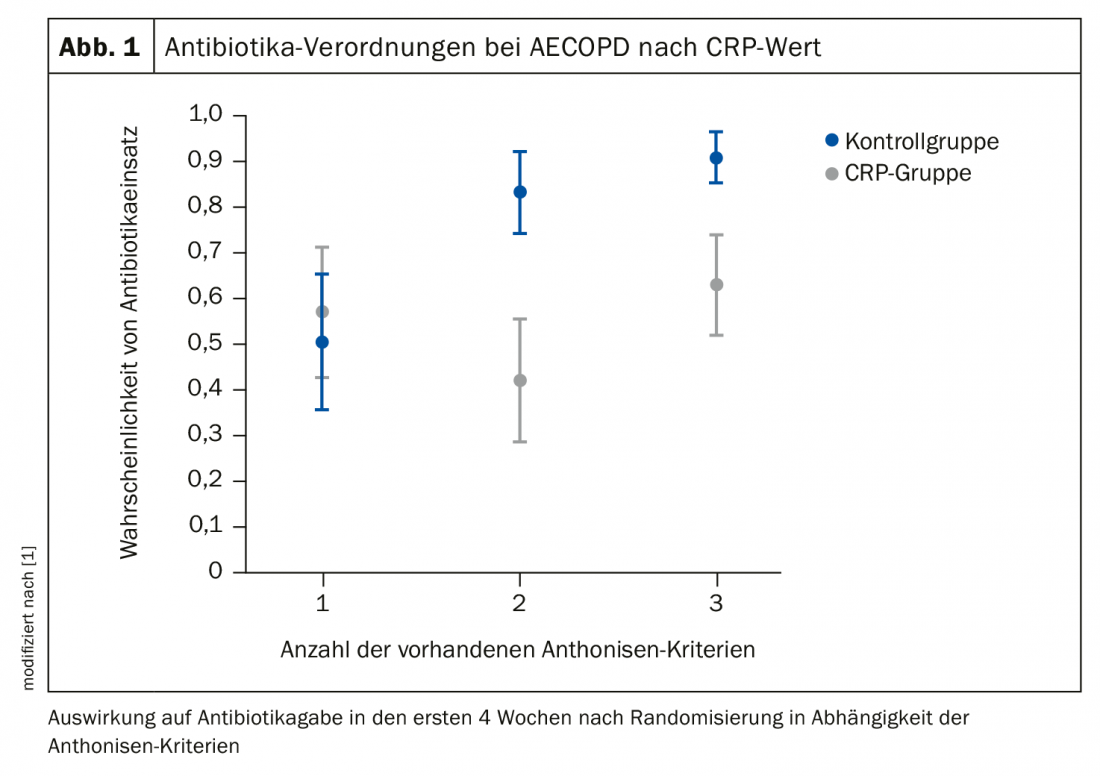
According to the GOLD recommendations, antibiotics (according to the Anthonisen criteria) should be used either in patients with the three cardiac symptoms of increase in dyspnea, sputum volume, and purulent sputum, or in patients with two of these symptoms if the increase in purulent sputum is one of them. If a patient is so severely impaired that he or she must be treated in the intensive care unit, antibiotics should be used as a matter of principle, regardless of the clinical constellation.

A general practitioner-level study [1] addressed the question of the extent to which C-reactive protein (CRP) can be used as a biomarker for or against the use of antibiotic therapy. 653 patients from England and Wales diagnosed with COPD were randomized into two groups: The first group underwent a so-called point-of-care test in GP practices with an immediate response after 10 minutes. Based on this result, a recommendation pro or contra antibiotics was made. In contrast, the control group was treated with standard therapy according to the usual criteria. The recommendations given to colleagues were divided according to CRP level

  • <20 mg/l: no recommendation on antibiotics, as the probability of efficacy is considered low.
  • 20-40 mg/l: antibiotic use may be considered (purulent sputum is mentioned here as an additional decision criterion).
  • >40 mg/l: Antibiotic use is very likely to be helpful

The result of the evaluation: using the described CRP algorithm, patients in the CRP group received significantly fewer antibiotics (57%) compared to the control (77.4%) (Fig. 1) . The probability of antibiotic prescription was thus reduced by 31%.


The second study [2] had a similar approach, but included only patients (n=220) who presented with acute COPD exacerbations and were hospitalized. Again, CRP was measured and either the GOLD strategy was used or a CRP value ≥50 mg/l was taken as an indicator of antibiotic use. Endpoints included antibiotic use in the first 24 hours, rate of 30-day treatment failure, duration of hospitalization, and time to next exacerbation.

This study also found that significantly fewer patients received antibiotics in the CRP-guided group (n=101), 31.7%, than in the GOLD group (n=119), 46.2% (p=0.028). The 30 day treatment failure rate was nearly identical (44.5% CRP vs. 45.5% GOLD, p=0.881). Thus, it has also been shown that there is no harm to the patient and there is no increase in therapy care when the CRP strategy has been followed.

In summary, despite the different settings of the two studies (different countries of origin, different severity of disease in patients), the effect of CRP testing was approximately the same. The use of the protein as a biomarker thus appears to work and be worthwhile in that it can be used to significantly and clinically relevantly reduce the use of antibiotics. There is also no evidence that this strategy is associated with risks to the patient.

Source: Pneumo-Update, Mainz (D)


Literature:

  1. Butler CC, et al: N Engl J Med 2019; 381: 111-120.
  2. Prins HJ, et al: Eur Respir J 2019; 53(5).

Autoren
  • Jens Dehn
Publikation
  • InFo PNEUMOLOGIE & ALLERGOLOGIE
Related Topics
  • AECOPD
  • COPD
  • CRP measurement
  • Exacerbations
Previous Article
  • PUBLICITY/ADVERTISEMENT

Semaglutide – a GLP-1 analogue from a cardiovascular perspective.

  • Endocrinology and Diabetology
  • News
  • Partner Content
  • RX
View Post
Next Article
  • Chronic renal failure

Aspects of the treatment of metabolic acidosis

  • Education
  • Nephrology
  • RX
View Post
You May Also Like
View Post
  • 8 min
  • Obesity: More than half of those affected have fatty liver disease

From screening to multimodal intervention with GLP-1-RA or resmetirom

    • RX
    • Education
    • Endocrinology and Diabetology
    • Gastroenterology and Hepatology
    • General Internal Medicine
    • Nutrition
    • Studies
View Post
  • 6 min
  • Innovative Oral Treatment Options for Psoriasis: Icotrokinra and Zasocitinib

First-class immunomodulation combined with convenience—the data available so far is convincing

    • RX
    • Congress Reports
    • Dermatology and venereology
    • Rheumatology
    • Studies
View Post
  • 4 min
  • Preclinical Study on a Special Ginkgo biloba Extract

What role do proanthocyanidins play?

    • RX
    • Education
    • General Internal Medicine
    • Geriatrics
    • Neurology
    • Pharmaceutical medicine
    • Pharmacology and toxicology
    • Phytotherapy
    • Studies
View Post
  • 6 min
  • Myasthenia gravis: immunomodulatory therapies for long-term treatment

Expanded Possibilities Thanks to Innovative Classes of Active Ingredients

    • RX
    • Congress Reports
    • General Internal Medicine
    • Neurology
    • Ophthalmology
    • Studies
View Post
  • 7 min
  • Plastic surgery and reconstructive microsurgery for DFS

Functional limb preservation between infection control, vascular medicine and resurfacing

    • RX
    • Angiology
    • CME continuing education
    • Dermatology and venereology
    • Endocrinology and Diabetology
    • General Internal Medicine
    • Geriatrics
    • Physical medicine and rehabilitation
    • Surgery
View Post
  • 10 min
  • Interstitial Lung Diseases

Update on Idiopathic Pulmonary Fibrosis

    • RX
    • CME continuing education
    • Pneumology
    • Studies
View Post
  • 7 min
  • Ischemic stroke: Are smaller or larger brain arteries affected?

Recent study findings on intravenous lysis therapy with fibrinolytic agents

    • RX
    • Congress Reports
    • Emergency and intensive care medicine
    • General Internal Medicine
    • Neurology
    • Pharmacology and toxicology
    • Studies
    • Surgery
View Post
  • 7 min
  • Interview

“On par with the gold standards for trauma”

    • RX
    • Education
    • Interviews
    • Neurology
    • Physical medicine and rehabilitation
    • Psychiatry and psychotherapy
    • Studies
  • IBD matters

    Zum Thema
Top CME content
  • 1
    Functional limb preservation between infection control, vascular medicine and resurfacing
  • 2
    Update on Idiopathic Pulmonary Fibrosis
  • 3
    Update on Idiopathic Pulmonary Fibrosis
  • 4
    Current status of PAT
  • 5
    Darier’s Disease, also known as Follicular Keratosis – Update 2026

Newsletter

Sign up and stay up to date

Subscribe
Medizinonline Medizinonline
  • Contact
  • General terms and conditions
  • Imprint

Input your search keywords and press Enter.