Medizinonline Medizinonline
  • News
    • News
    • Market & Medicine
  • Patients
    • Disease patterns
    • Diagnostics
    • Therapy
  • Partner Content
    • Diabetes
      • Dia-Month Club – Type 2 Diabetes
      • Diabetes in Motion
      • Diabetes Podcasts
    • Gastroenterology
      • IBD matters
    • Oncology
      • Swiss Oncology in motion
    • Orthopedics
      • Osteoporosis in motion
  • Departments
    • Allergology and clinical immunology
    • General Internal Medicine
    • Anesthesiology
    • Angiology
    • Surgery
    • Dermatology and venereology
    • Endocrinology and Diabetology
    • Nutrition
    • Gastroenterology and Hepatology
    • Genetics
    • Geriatrics
    • Gynecology
    • Hematology
    • Infectiology
    • Cardiology
    • Nephrology
    • Neurology
    • Emergency and intensive care medicine
    • Nuclear Medicine
    • Oncology
    • Ophthalmology
    • ORL
    • Orthopedics
    • Pediatrics
    • Pharmacology and toxicology
    • Pharmaceutical medicine
    • Phlebology
    • Physical medicine and rehabilitation
    • Pneumology
    • Prevention and health care
    • Psychiatry and psychotherapy
    • Radiology
    • Forensic Medicine
    • Rheumatology
    • Sports Medicine
    • Traumatology and trauma surgery
    • Tropical and travel medicine
    • Urology
    • Dentistry
  • CME & Congresses
    • CME continuing education
    • Congress Reports
    • Congress calendar
  • Practice
    • Noctimed
    • Practice Management
    • Jobs
    • Interviews
  • Log In
  • Register
  • My account
  • Contact
  • Publications
  • Contact
  • Deutsch
  • English
  • Français
  • Italiano
  • Português
  • Español
Subscribe
Medizinonline Medizinonline
  • News
    • News
    • Market & Medicine
  • Patienten
    • Krankheitsbilder
    • Diagnostik
    • Therapie
  • Partner Content
    • Diabetes
      • Dia-Month Club – Type 2 Diabetes
      • Diabetes in Motion
      • Diabetes Podcasts
    • Gastroenterology
      • IBD matters
    • Oncology
      • Swiss Oncology in motion
    • Orthopedics
      • Osteoporosis in motion
    • Phytotherapie
    • Rheumatology
  • Departments
    • Fachbereiche 1-13
      • Allergology and clinical immunology
      • General Internal Medicine
      • Anesthesiology
      • Angiology
      • Surgery
      • Dermatology and venereology
      • Endocrinology and Diabetology
      • Nutrition
      • Gastroenterology and Hepatology
      • Genetics
      • Geriatrics
      • Gynecology
      • Hematology
    • Fachbereiche 14-26
      • Infectiology
      • Cardiology
      • Nephrology
      • Neurology
      • Emergency and intensive care medicine
      • Nuclear Medicine
      • Oncology
      • Ophthalmology
      • ORL
      • Orthopedics
      • Pediatrics
      • Pharmacology and toxicology
      • Pharmaceutical medicine
    • Fachbereiche 26-38
      • Phlebology
      • Physical medicine and rehabilitation
      • Phytotherapy
      • Pneumology
      • Prevention and health care
      • Psychiatry and psychotherapy
      • Radiology
      • Forensic Medicine
      • Rheumatology
      • Sports Medicine
      • Traumatology and trauma surgery
      • Tropical and travel medicine
      • Urology
      • Dentistry
  • CME & Congresses
    • CME continuing education
    • Congress Reports
    • Congress calendar
  • Practice
    • Noctimed
    • Practice Management
    • Jobs
    • Interviews
Login

Sie haben noch keinen Account? Registrieren

  • Skin microbiome

Host-microbiome interactions in atopic dermatitis.

    • Allergology and clinical immunology
    • Congress Reports
    • Dermatology and venereology
    • Infectiology
    • RX
    • Studies
  • 3 minute read

Research into the skin microbiome has become increasingly important in recent years. A study presented at the 2019 ADF Annual Meeting examined the effects of topical cortisone externals on the composition of the skin microbiome of atopic patients. In the process, interesting findings were discovered.

In skin diseases such as atopic dermatitis, a restricted diversity of the skin microbiome is measurable compared to healthy skin [1,2,5,6]. In acute phases of atopic eczema, increased colonization with Staphylococcus aureus (S. aureus) and displacement of other bacterial species occurs on affected skin areas. Microbial dysbiosis of inflamed atopic skin lesions has been studied several times. However, the body of evidence on host-microbiome interactions has been limited to date.

Colonization of S. aureus varies

In the present study, lesional and non-lesional skin samples of the elbows of atopic patients (n=7) were analyzed by molecular biology before and after treatment with a topical cortisone preparation (Dermatop®) [7] and compared with biopsies of a skin-healthy control group (n=8) [1,2] (Fig. 1). 16S amplicon sequencing was used with an Illumina MiSeq TM instrument [3], as well as “Rhea”, a set of R-scripts for microbial profile analysis [4].
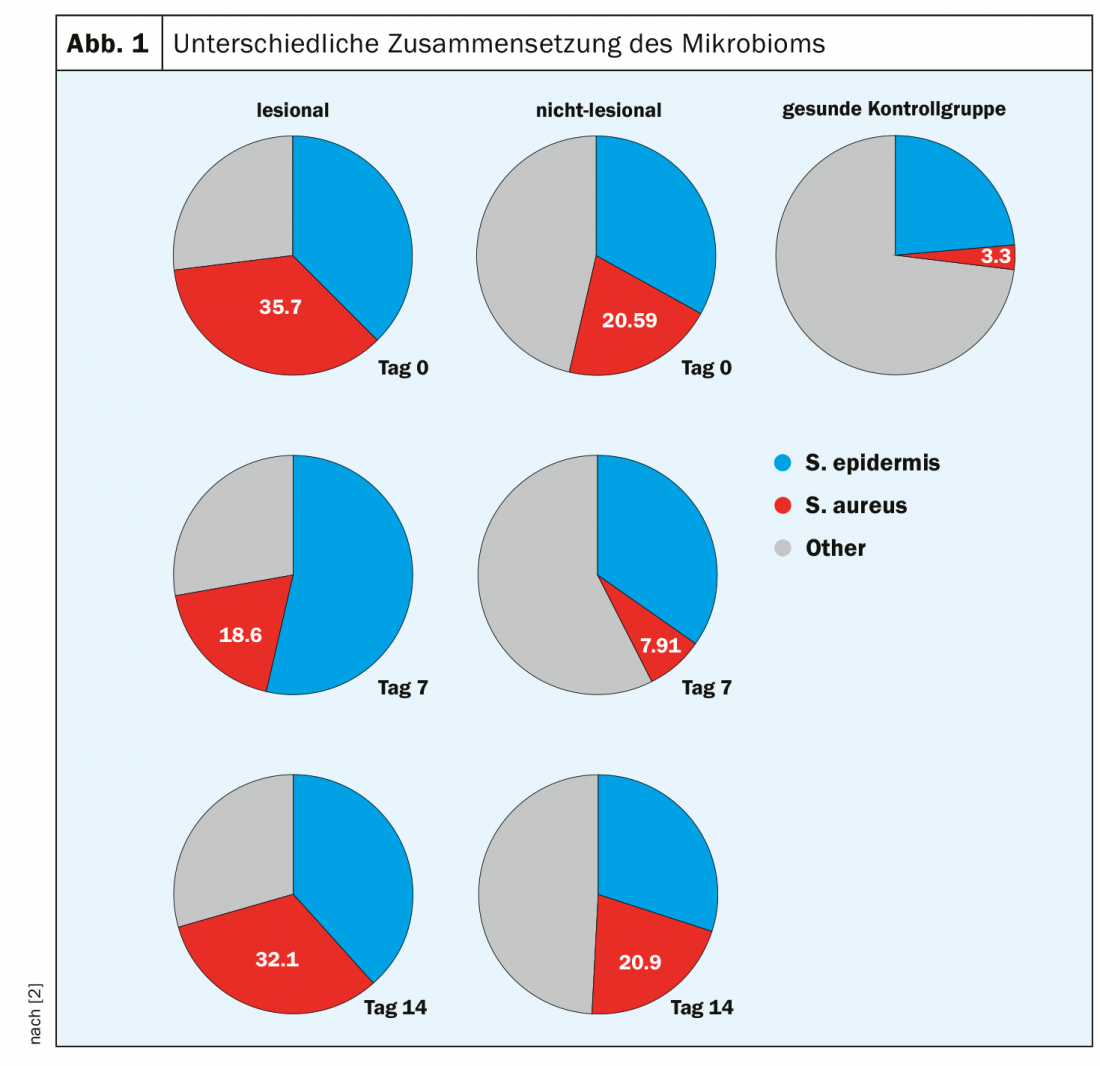


At baseline, the skin microbiome of biopsies in the lesional state contained a greater proportion of S. aureus than in the nonlesional state (35.7% vs. 20.59%). S. aureus colonization innon-atopic skin samples was significantly lower in comparison (<5%). Also distinct are the differences in commensal diversity, which is significantly higher in non-atopic biopsies. After 1 week of treatment with a Dermatop® [7], a decrease in S. aureus colonization was measurable (to 18.60% and 7.91%, respectively) in both the lesional and non-lesional skin microbiome. After 2 weeks of treatment, the percentage of S. aureus increased significantly in both lesional and nonlesional microbiome samples, to values similar to those at baseline (32.10% and 20.90%, respectively).

There is much need for research

How different therapeutic agents affect the skin microbiome in atopic dermatitis is among the many questions still unresolved. For example, it is still not known whether microbial changes in atopic dermatitis (e.g., increased S. aureus colonization) are a cause or consequence of epidermal barrier dysfunction and inflammatory processes [6]. As future treatment strategies, in addition to further development of current therapies, new approaches such as manipulation of the microbiome by topically applied commensals are discussed [5]. In any case, it remains exciting.

Source: ADF, Munich-Garching (D)


Literature:

  1. Amar Y, et al.: Skin microbiome diversity and transcriptome profiling in patients with atopic dermatitis. 46th Annual Meeting of the Arbeitsgemeinschaft Dermatologische Forschung (ADF). P015. Experimental Dermatology 2019; 28(3): e1-e122 https://onlinelibrary.wiley.com/doi/10.1111/exd.13859
  2. Amar Y, et al: Exploration of Microbiome Shifts in Dermatop treated atopic dermatitis patients. Poster presentation, ADF Annual Meeting, Munich-Garching, March 16 2019.
  3. MiSeqTM System, www.illumina.com/content/dam/illumina-marketing/documents/products/datasheets/miseq-data-sheet-770-2011-001-translations/
  4. miseq-specification-sheet-770-2011-001-deu.pdf
  5. Lagkouvardos I, et al: Rhea: a transparent and modular R pipeline for microbial profiling based on 16S rRNA gene amplicons. Peer J 2017; 5:e2836.
  6. Paller, et al: The microbiome in patients with atopic dermatitis. Journal of Allergy and Clinical Immunology 2019; 143 (1); 26-35.
  7. Kim JE, Kim HS: Microbiome of the Skin and Gut in Atopic Dermatitis (AD): Understanding the Pathophysiology and Finding Novel Management Strategies. Clin Med 2019; 8(4). pii: E444. doi: 10.3390/jcm8040444. Dermatop: Technical information. https://info.diagnosia.com/de-de/p/377917/dermatop


DERMATOLOGIE PRAXIS 2019; 29(4): 22

Autoren
  • Mirjam Peter, M.Sc.
Publikation
  • DERMATOLOGIE PRAXIS
Related Topics
  • Eczema
  • microbiome
  • Staphylococcus aureus
Previous Article
  • Coronary heart disease

Platelet aggregation inhibition after stent implantation.

  • Angiology
  • Cardiology
  • Education
  • RX
View Post
Next Article
  • Latent thyroid disease

Subclinical hypothyroidism often overtreated

  • Education
  • Endocrinology and Diabetology
  • General Internal Medicine
  • RX
View Post
You May Also Like
View Post
  • 38 min
  • Psychological dependence on AI assistants, smartphones and short videos

Algorithms, avatars and the unburdened mind

    • RX
    • CME continuing education
    • Neurology
    • Pediatrics
    • Prevention and health care
    • Psychiatry and psychotherapy
    • Studies
View Post
  • 8 min
  • Psychooncology

Communication as the key to therapy adherence

    • CME continuing education
    • Practice Management
    • RX
View Post
  • 12 min
  • The Brain and the Motivation to Eat

Why is it so hard to lose weight?

    • RX
    • CME continuing education
    • Endocrinology and Diabetology
    • General Internal Medicine
    • Nutrition
    • Pharmacology and toxicology
    • Prevention and health care
    • Psychiatry and psychotherapy
    • Studies
View Post
  • 5 min
  • Omaveloxolone for Friedreich's Ataxia

Efficacy and Safety Studied Over 6 Years

    • Neurology
    • Congress Reports
    • Endocrinology and Diabetology
    • RX
    • Studies
View Post
  • 6 min
  • Psoriasis: therapy with biologics and TYK-2-i

Progress assessments based on current long-term and real-world data

    • RX
    • Congress Reports
    • Dermatology and venereology
    • Pharmacology and toxicology
    • Rheumatology
    • Studies
View Post
  • 4 min
  • Hypertension: the most important facts for daily practice

Early dual antihypertensive therapy is usually indicated

    • RX
    • Cardiology
    • Congress Reports
    • General Internal Medicine
View Post
  • 4 min
  • Escitalopram for anxiety disorders

Positive effect, but no immediate improvement in symptoms

    • RX
    • Education
    • Neurology
    • Pharmacology and toxicology
    • Psychiatry and psychotherapy
    • Studies
View Post
  • 4 min
  • Helicobacter pylori infection

Simplified dual therapy beats quadruple regimen

    • RX
    • Education
    • Gastroenterology and Hepatology
    • General Internal Medicine
    • Infectiology
    • Studies
  • IBD matters

    Zum Thema
Top CME content
  • 1
    Why is it so hard to lose weight?
  • 2
    Algorithms, avatars and the unburdened mind
  • 3
    Communication as the key to therapy adherence
  • 4
    Communication as the key to therapy adherence
  • 5
    Solutions to the malnutrition dilemma

Newsletter

Sign up and stay up to date

Subscribe
Medizinonline Medizinonline
  • Contact
  • General terms and conditions
  • Imprint

Input your search keywords and press Enter.