Medizinonline Medizinonline
  • News
    • News
    • Market & Medicine
  • Patients
    • Disease patterns
    • Diagnostics
    • Therapy
  • Partner Content
    • Dermatology
      • Atopic dermatitis and psoriasis news
    • Diabetes
      • Dia-Month Club – Type 2 Diabetes
      • Diabetes in Motion
      • Diabetes Podcasts
    • Gastroenterology
      • IBD matters
    • Oncology
      • Swiss Oncology in motion
    • Orthopedics
      • Osteoporosis in motion
  • Departments
    • Allergology and clinical immunology
    • General Internal Medicine
    • Anesthesiology
    • Angiology
    • Surgery
    • Dermatology and venereology
    • Endocrinology and Diabetology
    • Nutrition
    • Gastroenterology and Hepatology
    • Genetics
    • Geriatrics
    • Gynecology
    • Hematology
    • Infectiology
    • Cardiology
    • Nephrology
    • Neurology
    • Emergency and intensive care medicine
    • Nuclear Medicine
    • Oncology
    • Ophthalmology
    • ORL
    • Orthopedics
    • Pediatrics
    • Pharmacology and toxicology
    • Pharmaceutical medicine
    • Phlebology
    • Physical medicine and rehabilitation
    • Pneumology
    • Prevention and health care
    • Psychiatry and psychotherapy
    • Radiology
    • Forensic Medicine
    • Rheumatology
    • Sports Medicine
    • Traumatology and trauma surgery
    • Tropical and travel medicine
    • Urology
    • Dentistry
  • CME & Congresses
    • CME continuing education
    • Congress Reports
    • Congress calendar
  • Practice
    • Noctimed
    • Practice Management
    • Jobs
    • Interviews
  • Log In
  • Register
  • My account
  • Contact
  • Publications
  • Contact
  • Deutsch
  • English
  • Français
  • Italiano
  • Português
  • Español
Subscribe
Medizinonline Medizinonline
  • News
    • News
    • Market & Medicine
  • Patienten
    • Krankheitsbilder
    • Diagnostik
    • Therapie
  • Partner Content
    • Dermatology
      • Atopic dermatitis and psoriasis news
    • Diabetes
      • Dia-Month Club – Type 2 Diabetes
      • Diabetes in Motion
      • Diabetes Podcasts
    • Gastroenterology
      • IBD matters
    • Oncology
      • Swiss Oncology in motion
    • Orthopedics
      • Osteoporosis in motion
    • Phytotherapie
    • Rheumatology
  • Departments
    • Fachbereiche 1-13
      • Allergology and clinical immunology
      • General Internal Medicine
      • Anesthesiology
      • Angiology
      • Surgery
      • Dermatology and venereology
      • Endocrinology and Diabetology
      • Nutrition
      • Gastroenterology and Hepatology
      • Genetics
      • Geriatrics
      • Gynecology
      • Hematology
    • Fachbereiche 14-26
      • Infectiology
      • Cardiology
      • Nephrology
      • Neurology
      • Emergency and intensive care medicine
      • Nuclear Medicine
      • Oncology
      • Ophthalmology
      • ORL
      • Orthopedics
      • Pediatrics
      • Pharmacology and toxicology
      • Pharmaceutical medicine
    • Fachbereiche 26-38
      • Phlebology
      • Physical medicine and rehabilitation
      • Phytotherapy
      • Pneumology
      • Prevention and health care
      • Psychiatry and psychotherapy
      • Radiology
      • Forensic Medicine
      • Rheumatology
      • Sports Medicine
      • Traumatology and trauma surgery
      • Tropical and travel medicine
      • Urology
      • Dentistry
  • CME & Congresses
    • CME continuing education
    • Congress Reports
    • Congress calendar
  • Practice
    • Noctimed
    • Practice Management
    • Jobs
    • Interviews
Login

Sie haben noch keinen Account? Registrieren

  • Annual Meeting of the Swiss Brain Stroke Society, Zurich

PCSK9 inhibitors keep acute coronary syndrome at bay

    • Cardiology
    • Congress Reports
    • RX
    • Studies
  • 2 minute read

It is well known that low LDL cholesterol reduces the risk of cardiovascular disease. But in practice, this is often easier said than done. Are PCSK9 inhibitors the solution?

Lowering LDL-C levels is an integral part of risk reduction in patients with myocardial infarction. However, very few achieve the target values of 2.5 mmol/l or 1.8 mmol/l in high-risk patients, which are preferred by the European guideline [1]. In this context, statins have clearly demonstrated their efficacy in the treatment of dyslipidemia. However, the incidence of myalgias, which affect up to 10-25% of patients taking statins, has been underestimated [2]. Therefore, the administration of PCSK-9 inhibitors was investigated as an additional option – with success.

The proprotein convertase subtilisin/kexin type 9 (PCSK9) binds to LDL receptors and marks them for degradation in lysosomes. Thus, the density of receptors on the cell surface is reduced and circulating LDL cholesterol in the blood increases. In contrast, if PCSK9 is inhibited, the LDL receptors on the surface of hepatocytes can be recycled multiple times, allowing them to bind more circulating LDLC and lowering levels. This benefits the overall lipid profile.

High-risk patients benefit

Subanalysis [3] of a large-scale randomized, double-blind, placebo-controlled trial [4] showed that additional administration of the PCSK-9 inhibitor evolocumab consistently reduced LDL-C levels by 59-61% in all three groups. The time of the last infarction, the number of infarctions, or the presence of coronary multivessel disease were irrelevant. From this, the experts concluded that therapy with PCSK-9 inhibitors is indicated primarily in patients in secondary prevention who have additional high-risk characteristics.


The deeper the better

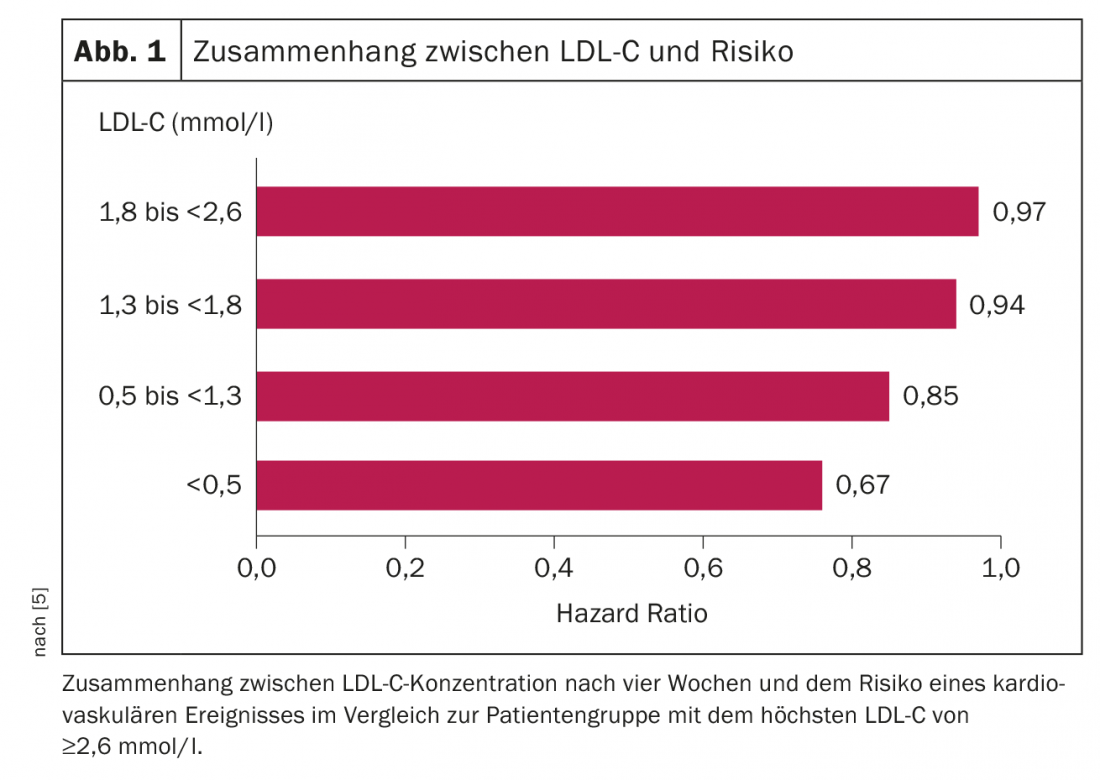
The good response of the patients to the additional lipid-lowering therapy raised a question that had not been asked before: where is the lower LDL-C limit? This is because 10% of the subjects had LDL-C levels of <0.5 mmol/l after four weeks of treatment (median 0.36 mmol/l). Is there any additional clinical benefit to be expected at these levels? Indeed, it was shown that with reduction of LDL cholesterol, the risk of cardiovascular events, such as cardiovascular death, myocardial infarction, stroke, coronary revascularization or hospitalization due to unstable angina pectoris, also decreased (Fig. 1) . The results suggest that even patients already below target levels benefit from further LDL-C reduction. An increase in adverse effects was not observed. Even values <0.5 mmol/l are to be considered safe in the view of the authors on the basis of the results [5], as Prof. Urs Fischer of the University Hospital Bern explained in a lecture.

Source: Swiss Brain Stroke Society Annual Meeting, January 15-16, 2019, Zurich.


Literature:

  1. www.escardio.org/Guidelines/Clinical-Practice-Guidelines/Dyslipidaemias-Management-of (last access: 01/22/2019)
  2. Thompson PD, et al: Statin-associated side effects. J Am Coll Cardiol. 2016; 67: 2395-2410.
  3. Sabatine MS, et al: Clinical Benefit of Evolocumab by Severity and Extend of Coronary Artery Disease: An Analysis from FOURIER. Circulation 2018; 138: 756-766.
  4. Sabatine MS et al: Evolocumab and Clinical Outcomes in Patients with Cardiovascular Disease. N Engl J Med 2017; 376:1713-1722.
  5. Giugliano RP et al: Cognitive Function in a Randomized Trial of Evolocumab. N Engl J Med 2017; 377: 633-643.


CARDIOVASC 2019; 18(1): 36

Autoren
  • Leoni Burggraf
Publikation
  • CARDIOVASC
Related Topics
  • LDL cholesterol
  • Myocardial infarction
  • PCSK9 inhibition
Previous Article
  • Altitude diseases

Up high with children

  • Education
  • General Internal Medicine
  • Pediatrics
  • Prevention and health care
  • RX
View Post
Next Article
  • Coronary heart disease (CHD)

Blood pressure reduction – how deep is deep enough?

  • Cardiology
  • Education
  • RX
View Post
You May Also Like
View Post
  • 6 min
  • What biomarkers reveal about "biological youth" - and what not (yet)

Epigenetic ageing

    • Education
    • Genetics
    • Geriatrics
    • Prevention and health care
    • RX
    • Studies
View Post
  • 4 min
  • Amyotrophic lateral sclerosis and nutrition

Calorie optimization in ALS through digital intervention

    • Education
    • Neurology
    • Nutrition
    • RX
    • Studies
View Post
  • 14 min
  • "Forgotten axis" between plant substances, gut and systemic health

Microbiome and phytotherapy

    • Education
    • Endocrinology and Diabetology
    • Gastroenterology and Hepatology
    • General Internal Medicine
    • Infectiology
    • Neurology
    • Nutrition
    • Pharmaceutical medicine
    • Phytotherapy
    • RX
    • Studies
View Post
  • 4 min
  • HIV: updated EACS guideline

Individualized approach to sustainable prevention and care

    • Cardiology
    • Education
    • General Internal Medicine
    • Infectiology
    • Prevention and health care
    • RX
    • Studies
View Post
  • 5 min
  • Evidence-based diagnostics and treatment in the medical setting

Anxiety and depression disorders in adolescence

    • Education
    • Pediatrics
    • Pharmacology and toxicology
    • Psychiatry and psychotherapy
    • RX
    • Studies
View Post
  • 25 min
  • Neuroenhancement

Can you swallow intelligence? Relevant substance classes times for healthy people

    • CME continuing education
    • Neurology
    • Pharmacology and toxicology
    • Psychiatry and psychotherapy
    • RX
    • Studies
View Post
  • 9 min
  • Microbiome, inflammaging and affective/cognitive health

Gut-brain axis in old age

    • Education
    • Gastroenterology and Hepatology
    • General Internal Medicine
    • Geriatrics
    • Neurology
    • Nutrition
    • Prevention and health care
    • RX
    • Studies
View Post
  • 6 min
  • Vitiligo - the level of suffering should not be underestimated

A lot can be achieved therapeutically nowadays

    • Congress Reports
    • Dermatology and venereology
    • RX
    • Studies
  • IBD matters

    Zum Thema
Top CME content
  • 1
    Can you swallow intelligence? Relevant substance classes times for healthy people
  • 2
    Clinical care from birth to adulthood
  • 3
    Aligning care with the patient
  • 4
    Control instead of a flood of data: AI makes big data and wearables usable
  • 5
    Causes and prevention at work

Newsletter

Sign up and stay up to date

Subscribe
Medizinonline Medizinonline
  • Contact
  • General terms and conditions
  • Imprint

Input your search keywords and press Enter.