Medizinonline Medizinonline
  • News
    • News
    • Market & Medicine
  • Patients
    • Disease patterns
    • Diagnostics
    • Therapy
  • Partner Content
    • Dermatology
      • Atopic dermatitis and psoriasis news
    • Diabetes
      • Dia-Month Club – Type 2 Diabetes
      • Diabetes in Motion
      • Diabetes Podcasts
    • Gastroenterology
      • IBD matters
    • Oncology
      • Swiss Oncology in motion
    • Orthopedics
      • Osteoporosis in motion
  • Departments
    • Allergology and clinical immunology
    • General Internal Medicine
    • Anesthesiology
    • Angiology
    • Surgery
    • Dermatology and venereology
    • Endocrinology and Diabetology
    • Nutrition
    • Gastroenterology and Hepatology
    • Genetics
    • Geriatrics
    • Gynecology
    • Hematology
    • Infectiology
    • Cardiology
    • Nephrology
    • Neurology
    • Emergency and intensive care medicine
    • Nuclear Medicine
    • Oncology
    • Ophthalmology
    • ORL
    • Orthopedics
    • Pediatrics
    • Pharmacology and toxicology
    • Pharmaceutical medicine
    • Phlebology
    • Physical medicine and rehabilitation
    • Pneumology
    • Prevention and health care
    • Psychiatry and psychotherapy
    • Radiology
    • Forensic Medicine
    • Rheumatology
    • Sports Medicine
    • Traumatology and trauma surgery
    • Tropical and travel medicine
    • Urology
    • Dentistry
  • CME & Congresses
    • CME continuing education
    • Congress Reports
    • Congress calendar
  • Practice
    • Noctimed
    • Practice Management
    • Jobs
    • Interviews
  • Log In
  • Register
  • My account
  • Contact
  • Publications
  • Contact
  • Deutsch
  • English
  • Français
  • Italiano
  • Português
  • Español
Subscribe
Medizinonline Medizinonline
  • News
    • News
    • Market & Medicine
  • Patienten
    • Krankheitsbilder
    • Diagnostik
    • Therapie
  • Partner Content
    • Dermatology
      • Atopic dermatitis and psoriasis news
    • Diabetes
      • Dia-Month Club – Type 2 Diabetes
      • Diabetes in Motion
      • Diabetes Podcasts
    • Gastroenterology
      • IBD matters
    • Oncology
      • Swiss Oncology in motion
    • Orthopedics
      • Osteoporosis in motion
    • Phytotherapie
    • Rheumatology
  • Departments
    • Fachbereiche 1-13
      • Allergology and clinical immunology
      • General Internal Medicine
      • Anesthesiology
      • Angiology
      • Surgery
      • Dermatology and venereology
      • Endocrinology and Diabetology
      • Nutrition
      • Gastroenterology and Hepatology
      • Genetics
      • Geriatrics
      • Gynecology
      • Hematology
    • Fachbereiche 14-26
      • Infectiology
      • Cardiology
      • Nephrology
      • Neurology
      • Emergency and intensive care medicine
      • Nuclear Medicine
      • Oncology
      • Ophthalmology
      • ORL
      • Orthopedics
      • Pediatrics
      • Pharmacology and toxicology
      • Pharmaceutical medicine
    • Fachbereiche 26-38
      • Phlebology
      • Physical medicine and rehabilitation
      • Phytotherapy
      • Pneumology
      • Prevention and health care
      • Psychiatry and psychotherapy
      • Radiology
      • Forensic Medicine
      • Rheumatology
      • Sports Medicine
      • Traumatology and trauma surgery
      • Tropical and travel medicine
      • Urology
      • Dentistry
  • CME & Congresses
    • CME continuing education
    • Congress Reports
    • Congress calendar
  • Practice
    • Noctimed
    • Practice Management
    • Jobs
    • Interviews
Login

Sie haben noch keinen Account? Registrieren

  • Vitamin D

What role does nutrition play?

    • News
    • Nutrition
    • RX
  • 2 minute read

The important function of sunlight on bone formation was discovered early, but the knowledge about vitamin D formed only in the last century. Today, the data are clear and it is established that serum concentrations that are too low can have negative effects. 

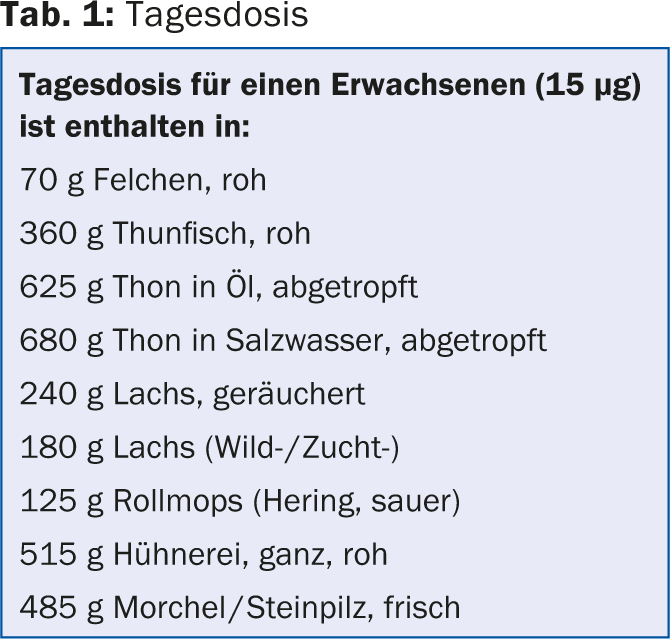
The vitamin D in our body comes from two different sources: It can either be built up through the skin (endogenous, vitamin D3) or supplied through food (exogenous). The UV-A and UV-B rays reach the earth’s surface, but only the UV-B rays trigger vitamin D formation in the skin. This process depends on skin type, age, duration of sun exposure and use of sunscreens. The body’s own vitamin D synthesis usually exceeds vitamin D intake from food. Vitamin D supplied through the diet comes primarily from animal products. Important sources are fatty fish (herring, salmon, sardines), eggs and dairy products (Tab. 1). Vitamin D promotes calcium and phosphate absorption in the intestine and their incorporation into the bones, regulates calcium and phosphate metabolism with other hormones and is important for healthy bone and tooth formation.


Vitamin D deficiency promotes osteoporosis, general fatigue, muscle weakness, and diffuse bone and muscle pain. Risk groups include infants and children, pregnant and breastfeeding women, the elderly, the chronically ill, the obese, and people with dark skin types. Massive vitamin D deficiency can result in rickets in young children and osteomalacia in adults.

Excessive intake of high-dose supplements over a long period of time can lead to overdose, but not through diet or sun exposure. As a result, hypercalcemia occurs.

Situation in Switzerland

It must be assumed that about 50% of the Swiss population have a 25(OH)D concentration of less than 50 nmol/l. However, current data suggest that a 25(OH)D level of at least 50 nmol/l is needed to support bone health in all adults and muscle health in the elderly. Health benefits of serum concentrations above 50 nmol/l have only been confirmed for these two ranges. Evidence for the positive influence of other diseases resp. whose prevention by serum concentrations above 50 nmol/l is absent.

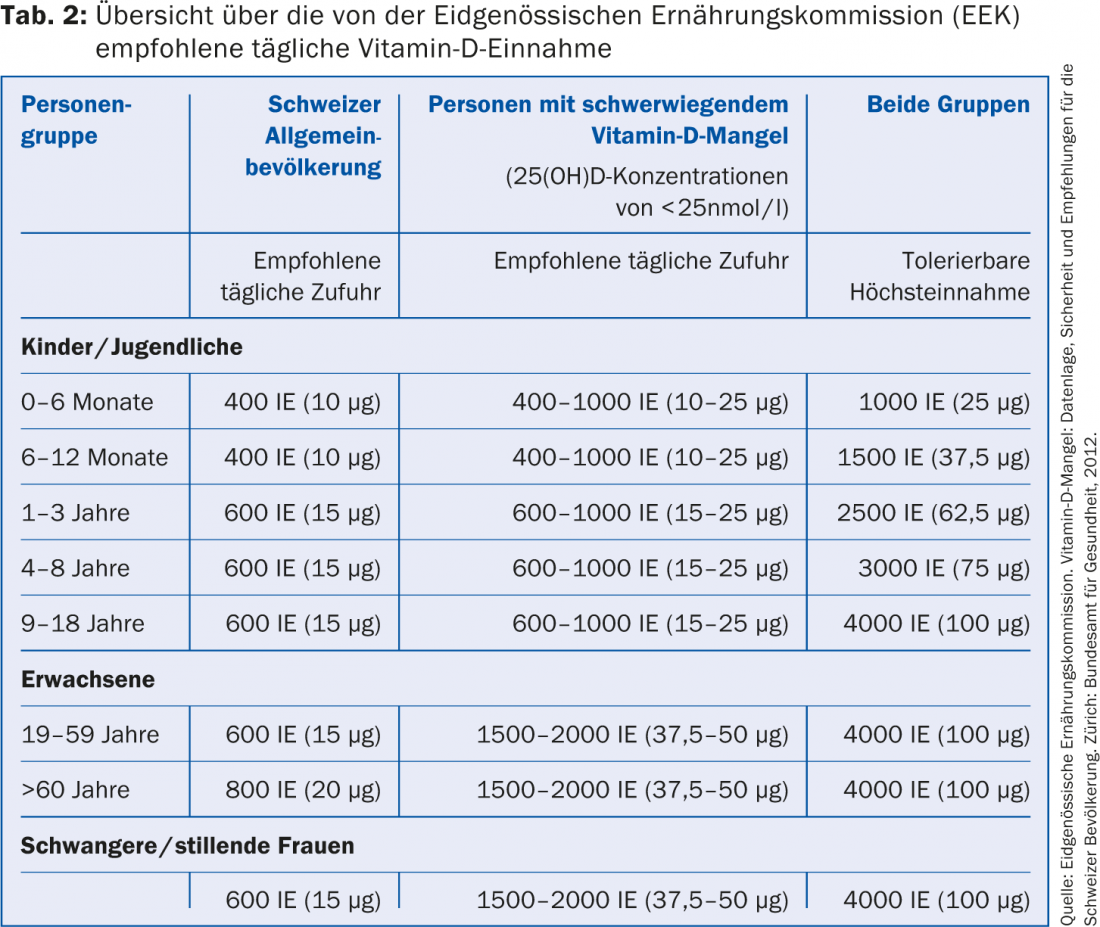
For older persons over 60 years of age, vitamin D administration of 800 IU per day is strongly recommended. This recommendation is based on randomized controlled trials that have shown a 20% reduction in falls and fractures. Table 2 summarizes the recommendations of the EEK.
For detailed information, see the EEK report on vitamin D www.blv.admin.ch/eek.


HAUSARZT PRAXIS 2014; 9(12): 9

Autoren
  • Steffi Schlüchter
Related Topics
  • Nutrition
  • Sunlight
  • Vitamin D
Previous Article
  • Personalized vaccination

Each patient gets his own medicine

  • Congress Reports
  • Oncology
  • RX
  • Studies
View Post
Next Article
  • Esophageal cancer in Switzerland

A rare but dangerous tumor

  • Education
  • Gastroenterology and Hepatology
  • Oncology
  • RX
View Post
You May Also Like
View Post
  • 6 min
  • Findings from research on the generalization of exposure therapy

Treatment of comorbid anxiety

    • Education
    • Psychiatry and psychotherapy
    • RX
    • Studies
asthma_winter_istock-887318372
View Post
  • 4 min
  • Symptom-free despite asthma?

Asthma treatment requirements have increased

    • Congress Reports
    • General Internal Medicine
    • Pharmacology and toxicology
    • Pneumology
    • RX
View Post
  • 9 min
  • Phytotherapy for rhinosinusitis

Evidence, active substances and clinical classification for medical practice

    • Education
    • General Internal Medicine
    • Infectiology
    • ORL
    • Pharmaceutical medicine
    • Phytotherapy
    • RX
    • Studies
View Post
  • 15 min
  • Pulmonary hypertension

PH and lung diseases

    • Cardiology
    • CME continuing education
    • Pneumology
    • RX
    • Studies
View Post
  • 10 min
  • Contact eczema

Causes and prevention at work

    • Allergology and clinical immunology
    • CME continuing education
    • Dermatology and venereology
    • Prevention and health care
    • RX
View Post
  • 6 min
  • Respiratory infections: viral bronchitis or bacterial pneumonia?

Old crucial question in the light of current findings

    • Congress Reports
    • General Internal Medicine
    • Infectiology
    • Pharmaceutical medicine
    • Pharmacology and toxicology
    • Phytotherapy
    • Pneumology
    • RX
View Post
  • 6 min
  • What biomarkers reveal about "biological youth" - and what not (yet)

Epigenetic ageing

    • Education
    • Genetics
    • Geriatrics
    • Prevention and health care
    • RX
    • Studies
View Post
  • 4 min
  • Amyotrophic lateral sclerosis and nutrition

Calorie optimization in ALS through digital intervention

    • Education
    • Neurology
    • Nutrition
    • RX
    • Studies
  • IBD matters

    Zum Thema
Top CME content
  • 1
    Can you swallow intelligence? Relevant substance classes times for healthy people
  • 2
    PH and lung diseases
  • 3
    Causes and prevention at work
  • 4
    Clinical care from birth to adulthood
  • 5
    Aligning care with the patient

Newsletter

Sign up and stay up to date

Subscribe
Medizinonline Medizinonline
  • Contact
  • General terms and conditions
  • Imprint

Input your search keywords and press Enter.