Medizinonline Medizinonline
  • News
    • News
    • Market & Medicine
  • Patients
    • Disease patterns
    • Diagnostics
    • Therapy
  • Partner Content
    • Dermatology
      • Atopic dermatitis and psoriasis news
    • Diabetes
      • Dia-Month Club – Type 2 Diabetes
      • Diabetes in Motion
      • Diabetes Podcasts
    • Gastroenterology
      • IBD matters
    • Oncology
      • Swiss Oncology in motion
    • Orthopedics
      • Osteoporosis in motion
  • Departments
    • Allergology and clinical immunology
    • General Internal Medicine
    • Anesthesiology
    • Angiology
    • Surgery
    • Dermatology and venereology
    • Endocrinology and Diabetology
    • Nutrition
    • Gastroenterology and Hepatology
    • Genetics
    • Geriatrics
    • Gynecology
    • Hematology
    • Infectiology
    • Cardiology
    • Nephrology
    • Neurology
    • Emergency and intensive care medicine
    • Nuclear Medicine
    • Oncology
    • Ophthalmology
    • ORL
    • Orthopedics
    • Pediatrics
    • Pharmacology and toxicology
    • Pharmaceutical medicine
    • Phlebology
    • Physical medicine and rehabilitation
    • Pneumology
    • Prevention and health care
    • Psychiatry and psychotherapy
    • Radiology
    • Forensic Medicine
    • Rheumatology
    • Sports Medicine
    • Traumatology and trauma surgery
    • Tropical and travel medicine
    • Urology
    • Dentistry
  • CME & Congresses
    • CME continuing education
    • Congress Reports
    • Congress calendar
  • Practice
    • Noctimed
    • Practice Management
    • Jobs
    • Interviews
  • Log In
  • Register
  • My account
  • Contact
  • Publications
  • Contact
  • Deutsch
  • English
  • Français
  • Italiano
  • Português
  • Español
Subscribe
Medizinonline Medizinonline
  • News
    • News
    • Market & Medicine
  • Patienten
    • Krankheitsbilder
    • Diagnostik
    • Therapie
  • Partner Content
    • Dermatology
      • Atopic dermatitis and psoriasis news
    • Diabetes
      • Dia-Month Club – Type 2 Diabetes
      • Diabetes in Motion
      • Diabetes Podcasts
    • Gastroenterology
      • IBD matters
    • Oncology
      • Swiss Oncology in motion
    • Orthopedics
      • Osteoporosis in motion
    • Phytotherapie
    • Rheumatology
  • Departments
    • Fachbereiche 1-13
      • Allergology and clinical immunology
      • General Internal Medicine
      • Anesthesiology
      • Angiology
      • Surgery
      • Dermatology and venereology
      • Endocrinology and Diabetology
      • Nutrition
      • Gastroenterology and Hepatology
      • Genetics
      • Geriatrics
      • Gynecology
      • Hematology
    • Fachbereiche 14-26
      • Infectiology
      • Cardiology
      • Nephrology
      • Neurology
      • Emergency and intensive care medicine
      • Nuclear Medicine
      • Oncology
      • Ophthalmology
      • ORL
      • Orthopedics
      • Pediatrics
      • Pharmacology and toxicology
      • Pharmaceutical medicine
    • Fachbereiche 26-38
      • Phlebology
      • Physical medicine and rehabilitation
      • Phytotherapy
      • Pneumology
      • Prevention and health care
      • Psychiatry and psychotherapy
      • Radiology
      • Forensic Medicine
      • Rheumatology
      • Sports Medicine
      • Traumatology and trauma surgery
      • Tropical and travel medicine
      • Urology
      • Dentistry
  • CME & Congresses
    • CME continuing education
    • Congress Reports
    • Congress calendar
  • Practice
    • Noctimed
    • Practice Management
    • Jobs
    • Interviews
Login

Sie haben noch keinen Account? Registrieren

  • Migraine

Avert headaches in advance

    • Congress Reports
    • Education
    • Neurology
    • RX
    • Studies
  • 2 minute read

Migraine is one of the most common of the more than 240 forms of headache and significantly restricts sufferers in their daily lives and quality of life. Although the number of patients is extremely high, the disease is often still underestimated and is undertreated. There are now effective ways of averting migraines before they start.

More than 136 million people worldwide are affected by migraine [1]. Both peripheral and central sensitization processes are involved in the underlying complex pathophysiology. A key role is played by calcitonin gene-related peptide (CGRP), the level of which rises in saliva during an attack and can also be detected elevated in the blood in chronic migraine. In a chronic form of the disease, the sufferer suffers from at least 15 headache days per month for more than three months, eight or more of which manifest as migraines. Until recently, oral medications such as antidepressants, antiepileptics, or beta-blockers were the main drugs available to control the disease at an early stage. However, more than 80% of chronic migraine sufferers discontinue oral prophylaxis within a year due to lack of efficacy or intolerable side effects [2,3].


Insights into pathophysiology

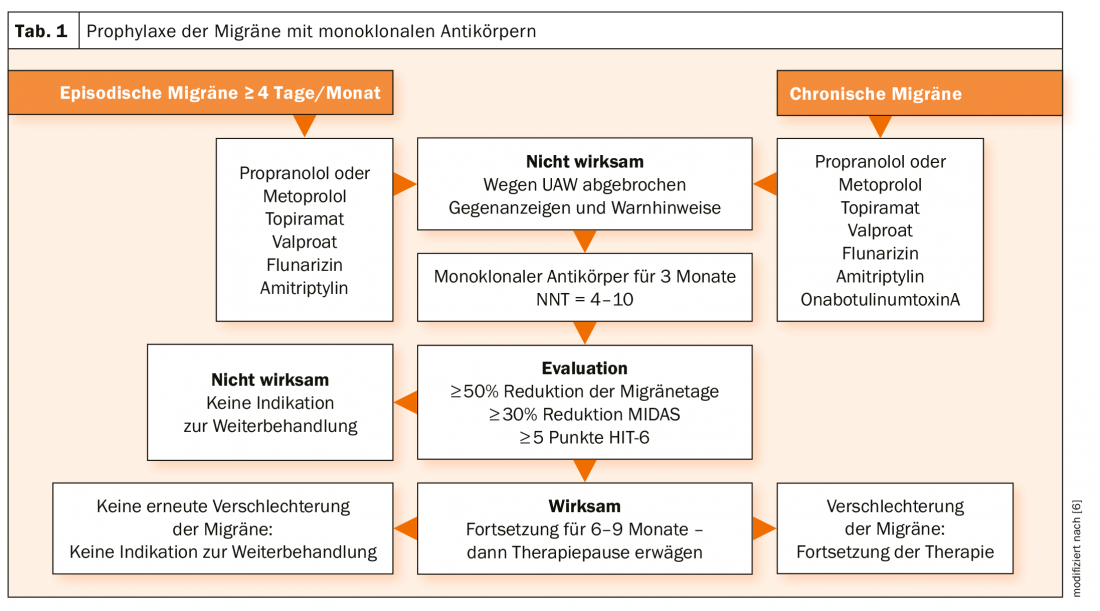
The aim of effective migraine prophylaxis is to reduce the number, severity and duration of migraine attacks (Table 1) . Indications include particular distress, reduced quality of life, and the risk of medication overuse. CGRP antibodies (fremanezumab, galcanezumab, eptinezumab) that specifically dock to the ligand of CGRP have been developed specifically for prevention. This prevents binding of CGRP isoforms to the receptor. Erenumab, on the other hand, binds to the CGRP receptor so that the neurotransmitter can no longer dock. This is because CGRP has been shown to play an important role in the pathophysiology of migraine. CGRP levels increase markedly during an attack and remain elevated in between, especially in the chronic form [4,5].

All study data to date demonstrate a very good benefit-risk profile for the currently available preparations. Side effects may include mainly pain or reaction at the injection site and nasopharyngitis. However, the effect is so convincing that dropout rates are very low. Good results can be achieved even in pretreated patients. The reduction in migraine days per month ranges from 4.3 to 6.6 days for chronic migraine. The responder rate after 3 months ranges from 27% to 57%. Efficacy has also been shown for patients with headaches caused by overuse of painkillers or migraine medications. In addition, effective efficacy with good tolerability has now also been demonstrated for a number of subgroups (e.g., depression, cardiovascular events).


Literature:

  1. Stovner LJ, Nichols E, Steiner TJ, et al: Lancet Neurol 2018; 17: 954-976.
  2. Hepp Z, Dodick DW, Varon SF, et al: Cephalalgia 2017; 37: 470-485.
  3. Blumenfeld AM, Bloudek LM, Becker WJ, et al: Headache 2013; 53: 644-655.
  4. Edvinsson L, Haanes KA, Warfvinge K, Krause DN: Nat Rev Neurol 2018; 14: 336-350.
  5. Cernuda-Morollon E, Larossa D, Ramon C, et al: Neurology 2013; 81:1191-1196.
  6. www.dgn.org/leitlinien/3859-ll-030-057-cgrp-addendum-migraene-leitlinie-2019 (last accessed on 25.05.2020)


InFo NEUROLOGY & PSYCHIATRY 2020; 18(4): 38 (published 6/30/20, ahead of print).

Autoren
  • Leoni Burggraf
Publikation
  • InFo NEUROLOGIE & PSYCHIATRIE
Related Topics
  • migraine
  • Migraine prophylaxis
  • Migraine therapy
Previous Article
  • Spinal muscular atrophy

SMA in adults: the road to personalized treatment

  • Congress Reports
  • Education
  • Neurology
  • RX
View Post
Next Article
  • Heart failure

Empagliflozin Reduces Risk of Cardiovascular Death and Hospitalization Rate in Heart Failure

  • Cardiology
  • Congress Reports
  • RX
  • Studies
View Post
You May Also Like
View Post
  • 9 min
  • Cardiology

Minimally invasive – the quiet triumph of modern heart surgery

    • Cardiology
    • CME continuing education
    • RX
    • Studies
    • Surgery
View Post
  • 0 min
  • Plastic surgery and reconstructive microsurgery for DFS

Functional limb preservation between infection control, vascular medicine and resurfacing

    • Angiology
    • CME continuing education
    • Endocrinology and Diabetology
    • General Internal Medicine
    • Geriatrics
    • Physical medicine and rehabilitation
    • RX
    • Surgery
View Post
  • 6 min
  • Age-related neurocognitive disorders

Neuroprotective effects of Ginkgo biloba extract

    • Education
    • Geriatrics
    • Neurology
    • Pharmaceutical medicine
    • Phytotherapy
    • RX
    • Studies
View Post
  • 6 min
    • Education
    • Endocrinology and Diabetology
    • Pneumology
    • Psychiatry and psychotherapy
    • RX
    • Studies

How origin and place of residence promote CF-associated diabetes

View Post
  • 10 min
  • Patients with leg swelling

DVT and other common DDs with peripheral edema

    • Angiology
    • Cardiology
    • Congress Reports
    • Geriatrics
    • RX
View Post
  • 4 min
  • Pancreatic Cancer

Innovative early detection with a focus on liquid biopsy and AI

    • Education
    • Gastroenterology and Hepatology
    • Oncology
    • Prevention and health care
    • RX
View Post
  • 22 min
  • Cervical Cancer

HPV prevention, screening innovation and sentinel lymph node biopsy

    • CME continuing education
    • Gynecology
    • Infectiology
    • Oncology
    • Prevention and health care
    • RX
    • Studies
View Post
  • 5 min
  • Polypharmacy: use of eHealth tools in Switzerland

Survey study in primary care

    • General Internal Medicine
    • Practice Management
    • Prevention and health care
    • RX
    • Studies
Referenzen Main
  • IBD matters

    Zum Thema
Top CME content
  • 1
    Functional limb preservation between infection control, vascular medicine and resurfacing
  • 2
    Minimally invasive – the quiet triumph of modern heart surgery
  • 3
    HPV prevention, screening innovation and sentinel lymph node biopsy
  • 4
    Clinical care from birth to adulthood
  • 5
    Multidisciplinary teams in oncology

Newsletter

Sign up and stay up to date

Subscribe
Medizinonline Medizinonline
  • Contact
  • General terms and conditions
  • Imprint

Input your search keywords and press Enter.