Medizinonline Medizinonline
  • News
    • News
    • Market & Medicine
  • Patients
    • Disease patterns
    • Diagnostics
    • Therapy
  • Partner Content
    • Diabetes
      • Dia-Month Club – Type 2 Diabetes
      • Diabetes in Motion
      • Diabetes Podcasts
    • Gastroenterology
      • IBD matters
    • Oncology
      • Swiss Oncology in motion
    • Orthopedics
      • Osteoporosis in motion
  • Departments
    • Allergology and clinical immunology
    • General Internal Medicine
    • Anesthesiology
    • Angiology
    • Surgery
    • Dermatology and venereology
    • Endocrinology and Diabetology
    • Nutrition
    • Gastroenterology and Hepatology
    • Genetics
    • Geriatrics
    • Gynecology
    • Hematology
    • Infectiology
    • Cardiology
    • Nephrology
    • Neurology
    • Emergency and intensive care medicine
    • Nuclear Medicine
    • Oncology
    • Ophthalmology
    • ORL
    • Orthopedics
    • Pediatrics
    • Pharmacology and toxicology
    • Pharmaceutical medicine
    • Phlebology
    • Physical medicine and rehabilitation
    • Pneumology
    • Prevention and health care
    • Psychiatry and psychotherapy
    • Radiology
    • Forensic Medicine
    • Rheumatology
    • Sports Medicine
    • Traumatology and trauma surgery
    • Tropical and travel medicine
    • Urology
    • Dentistry
  • CME & Congresses
    • CME continuing education
    • Congress Reports
    • Congress calendar
  • Practice
    • Noctimed
    • Practice Management
    • Jobs
    • Interviews
  • Log In
  • Register
  • My account
  • Contact
  • Publications
  • Contact
  • Deutsch
  • English
  • Français
  • Italiano
  • Português
  • Español
Subscribe
Medizinonline Medizinonline
  • News
    • News
    • Market & Medicine
  • Patienten
    • Krankheitsbilder
    • Diagnostik
    • Therapie
  • Partner Content
    • Diabetes
      • Dia-Month Club – Type 2 Diabetes
      • Diabetes in Motion
      • Diabetes Podcasts
    • Gastroenterology
      • IBD matters
    • Oncology
      • Swiss Oncology in motion
    • Orthopedics
      • Osteoporosis in motion
    • Phytotherapie
    • Rheumatology
  • Departments
    • Fachbereiche 1-13
      • Allergology and clinical immunology
      • General Internal Medicine
      • Anesthesiology
      • Angiology
      • Surgery
      • Dermatology and venereology
      • Endocrinology and Diabetology
      • Nutrition
      • Gastroenterology and Hepatology
      • Genetics
      • Geriatrics
      • Gynecology
      • Hematology
    • Fachbereiche 14-26
      • Infectiology
      • Cardiology
      • Nephrology
      • Neurology
      • Emergency and intensive care medicine
      • Nuclear Medicine
      • Oncology
      • Ophthalmology
      • ORL
      • Orthopedics
      • Pediatrics
      • Pharmacology and toxicology
      • Pharmaceutical medicine
    • Fachbereiche 26-38
      • Phlebology
      • Physical medicine and rehabilitation
      • Phytotherapy
      • Pneumology
      • Prevention and health care
      • Psychiatry and psychotherapy
      • Radiology
      • Forensic Medicine
      • Rheumatology
      • Sports Medicine
      • Traumatology and trauma surgery
      • Tropical and travel medicine
      • Urology
      • Dentistry
  • CME & Congresses
    • CME continuing education
    • Congress Reports
    • Congress calendar
  • Practice
    • Noctimed
    • Practice Management
    • Jobs
    • Interviews
Login

Sie haben noch keinen Account? Registrieren

  • Patient Blood Management

Clarify and treat anemia and iron deficiency preoperatively

    • General Internal Medicine
    • Hematology
    • Practice Management
    • Prevention and health care
    • RX
  • 3 minute read

The Patient Blood Management concept promoted by the World Health Organization offers opportunities in the healthcare sector to increase patient safety and at the same time reduce costs for the general public. Preoperative anemia is an independent predictor of perioperative increased risk of infection and thromboembolism, increased mortality and prolonged hospital stay. This shows the importance of recognizing and treating anemia before elective surgery.

At the end of 2021, the WHO issued an appeal to the top representatives of the health authorities of all member countries to implement Patient Blood Management (PBM) as a standard of care [1]. The WHO had already adopted the resolution “Availability, safety and quality of blood products” in 2010, and since 2011 the WHO has been calling on its member states to implement efficient and coordinated programs for the use of blood and plasma products at institutional level [2,3]. The background to the PBM concept is data indicating a direct correlation between allogeneic blood transfusions, postoperative complications and prolonged hospitalization [4,5].

What are the goals of Patient Blood Management?

The main aim of a PBM is to have a preventive and corrective influence on those risk factors that usually lead to transfusions. The core elements of this include early detection and treatment of anemia before elective procedures with a transfusion risk of over 10% (so-called focus groups) and restrictive transfusion practices [6]. However, the application of the PBM concept is not limited to the phase surrounding an operation, but also applies to other areas of medicine. The concept is based on three pillars [1]:

  1. Treatment of anemia or pre-existing iron deficiency that existed before the operation
  2. Minimization of blood loss
  3. Support and utilization of the physiological anemia tolerance of the individual patient [7]

It also includes the demand for comprehensive patient information and respect for patient autonomy [8].

Preoperative anemia diagnosis and treatment

Anemia and also isolated iron deficiency – the main cause of anemia – are independent predictors of increased morbidity and mortality [1]. A large-scale meta-analysis with data from surgical patients has investigated the relationship between preoperative anemia, morbidity and mortality, taking into account significant covariates. This showed an almost threefold increase in mortality, a 3.75-fold increase in kidney damage, a 1.9-fold increase in hospital-acquired infections and a more than 5-fold increase in the administration of red blood cell transfusions [1,9]. It is well known that blood loss and coagulation disorders with bleeding are also independent predictors of increased morbidity and mortality.
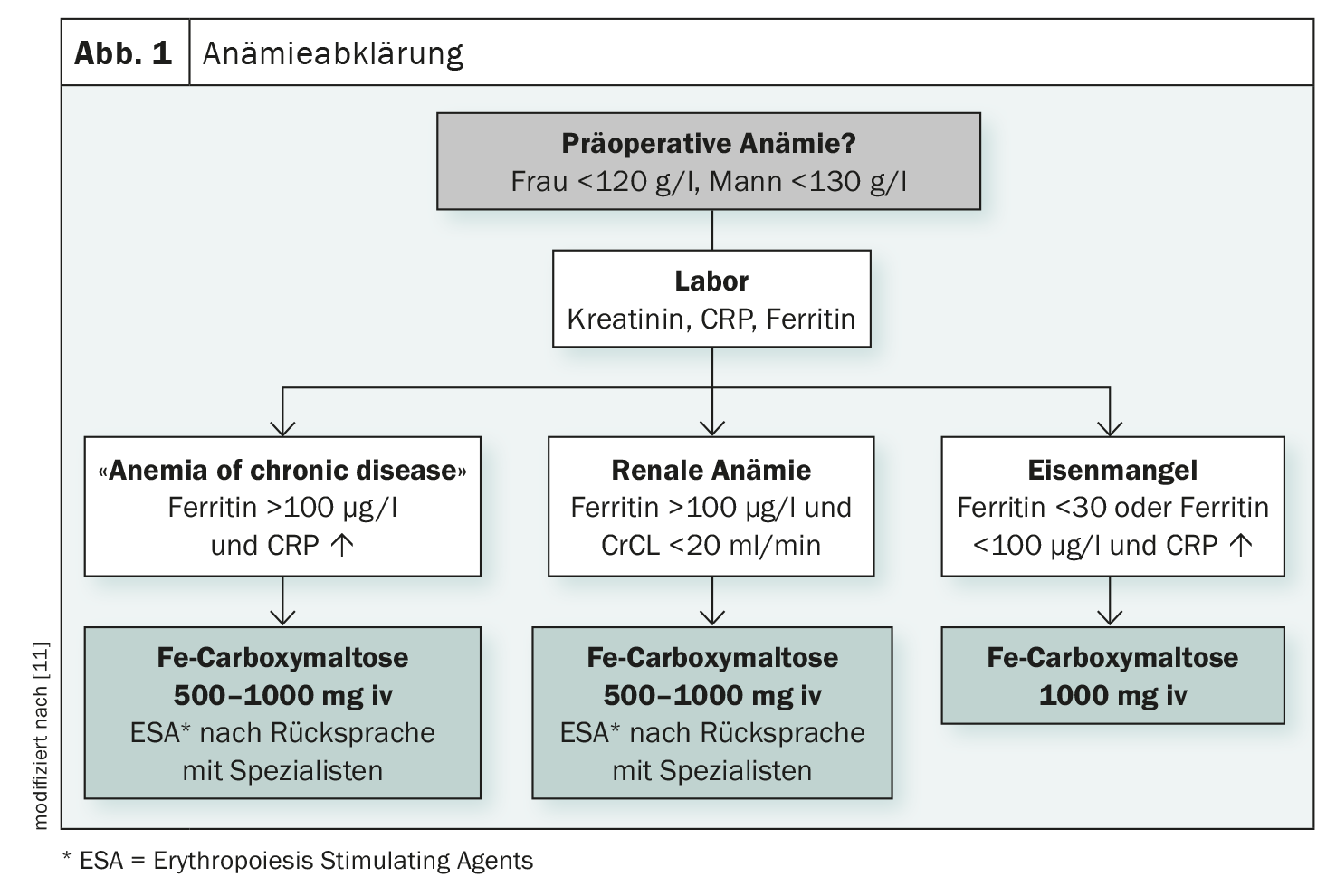
Preoperative assessment of existing anemia or pre-existing iron deficiency prior to elective surgery and treatment (1st pillar of the PBM concept) takes place in the practice or can alternatively be performed on an outpatient basis in hospitals (Fig. 1) [10]. Several weeks before a planned major procedure, pre-existing anemia should be clarified and corrected according to the standardized process of anemia diagnosis and therapy; in the case of very urgent procedures, the lead time can be shortened if necessary [10].

Literature:

  1. Hofmann A, Spahn GH, Spahn DR: Patient Blood Management: Necessary standard of care – worldwide. June 30, 2023, [online], www.suva.ch,(last accessed 11/13/2023)
  2. World Health Organization (WHO): Availability, safety and quality of blood products WHA63.12. 2010; 1-4.
  3. World Health Organization (WHO): Global Forum for Blood Safety: Patient Blood Management. World Health 2011; 1-2.
  4. Murphy P, Heal JM, Blumberg N: Infection or suspected infection after hip replacement surgery with autologous or homologous blood transfusions. Transfusion 1991; 31: 212-217.
  5. Triulzi DJ, et al: A clinical and immunologic study of blood transfusion and postoperative bacterial infection in spinal surgery. Transfusion 1992; 32: 517-524.
  6. Harmsa C, Metzger R, Bhendc H: Improving patient outcome through rational handling of blood products Patient Blood Management in small hospitals. Swiss Medical Forum – Schweizerisches Medizin-Forum 2020; 20(23-26): 355-361.
  7. Leahy MF, et al: Improved outcomes and reduced costs associated with a health-system-wide patient blood management program: a retrospective observational study in four major adult tertiary-care hospitals. Transfusion 2017; 57(6): 1347-1358.
  8. Shander A, et al: A Global Definition of Patient Blood Management 2022; 135(3): 476-488.
  9. Goobie SM: Patient Blood Management Is a New Standard of Care to Optimize Blood Health. Anesth Analg 2022; 135(3): 443-446.
  10. “Patient Blood Management”, www.zgks.ch/zuweiser/patient-blood-management,(last accessed 13.11.2023).
  11. “Patient Blood Management”, https://spitalzofingen.ch/zuweisende/patient-blood-management,(last accessed 13.11.2023).

InFo ONCOLOGY & HEMATOLOGY 2023; 11(6): 43

Autoren
  • Mirjam Peter, M.Sc.
Publikation
  • InFo ONKOLOGIE & HÄMATOLOGIE
Related Topics
  • Patient Blood Management
  • transfusions
Previous Article
  • ESC Guideline 2023 on ACS

What is new in antithrombotic therapy?

  • Angiology
  • Cardiology
  • Education
  • RX
  • Studies
View Post
Next Article
  • Guideline recommendations

Update on autoimmune liver diseases

  • Congress Reports
  • Gastroenterology and Hepatology
  • General Internal Medicine
  • Infectiology
  • RX
  • Studies
View Post
You May Also Like
View Post
  • 7 min
  • Crohn's disease: focus on long-term results

“Top-down” approach or classic step therapy?

    • RX
    • Congress Reports
    • Gastroenterology and Hepatology
    • General Internal Medicine
    • Studies
View Post
  • 4 min
  • SwissDiab Study: New Analysis Published

How are diabetes complications associated with quality of life?

    • RX
    • Endocrinology and Diabetology
    • General Internal Medicine
    • Studies
View Post
  • 6 min
  • Pre-acclimatization on Mount Everest

Exploring the physiological limits

    • RX
    • Congress Reports
    • General Internal Medicine
    • Pneumology
    • Studies
    • Tropical and travel medicine
View Post
  • 5 min
  • Viloxazine for ADHD

A non-stimulating option—but with limited evidence

    • RX
    • Education
    • Neurology
    • Pediatrics
    • Pharmacology and toxicology
    • Psychiatry and psychotherapy
    • Studies
View Post
  • 6 min
  • Preclinical study on phytotherapeutic agent

Active ingredient combination of peppermint and caraway oil modified fecal microbiota

    • RX
    • Education
    • Gastroenterology and Hepatology
    • General Internal Medicine
    • Pharmaceutical medicine
    • Phytotherapy
    • Studies
View Post
  • 4 min
  • Casuistry

Rituximab used effectively against IgG4-RD colitis

    • RX
    • Cases
    • Education
    • Gastroenterology and Hepatology
    • General Internal Medicine
    • Radiology
    • Rheumatology
View Post
  • 5 min
  • Sarcoidosis

New options from JAKi to mTOR

    • RX
    • Congress Reports
    • General Internal Medicine
    • Pneumology
    • Studies
View Post
  • 6 min
  • Head and neck squamous cell carcinoma

Precision immunotherapy and local treatment

    • RX
    • Congress Reports
    • Dermatology and venereology
    • Oncology
    • ORL
    • Studies
  • IBD matters

    Zum Thema
Top CME content
  • 1
    Current State of Knowledge and New Therapeutic Approaches
  • 2
    Why is it so hard to lose weight?
  • 3
    Functional limb preservation between infection control, vascular medicine and resurfacing
  • 4
    Algorithms, avatars and the unburdened mind
  • 5
    Communication as the key to therapy adherence

Newsletter

Sign up and stay up to date

Subscribe
Medizinonline Medizinonline
  • Contact
  • General terms and conditions
  • Imprint

Input your search keywords and press Enter.