Medizinonline Medizinonline
  • News
    • News
    • Market & Medicine
  • Patients
    • Disease patterns
    • Diagnostics
    • Therapy
  • Partner Content
    • Diabetes
      • Dia-Month Club – Type 2 Diabetes
      • Diabetes in Motion
      • Diabetes Podcasts
    • Gastroenterology
      • IBD matters
    • Oncology
      • Swiss Oncology in motion
    • Orthopedics
      • Osteoporosis in motion
  • Departments
    • Allergology and clinical immunology
    • General Internal Medicine
    • Anesthesiology
    • Angiology
    • Surgery
    • Dermatology and venereology
    • Endocrinology and Diabetology
    • Nutrition
    • Gastroenterology and Hepatology
    • Genetics
    • Geriatrics
    • Gynecology
    • Hematology
    • Infectiology
    • Cardiology
    • Nephrology
    • Neurology
    • Emergency and intensive care medicine
    • Nuclear Medicine
    • Oncology
    • Ophthalmology
    • ORL
    • Orthopedics
    • Pediatrics
    • Pharmacology and toxicology
    • Pharmaceutical medicine
    • Phlebology
    • Physical medicine and rehabilitation
    • Pneumology
    • Prevention and health care
    • Psychiatry and psychotherapy
    • Radiology
    • Forensic Medicine
    • Rheumatology
    • Sports Medicine
    • Traumatology and trauma surgery
    • Tropical and travel medicine
    • Urology
    • Dentistry
  • CME & Congresses
    • CME continuing education
    • Congress Reports
    • Congress calendar
  • Practice
    • Noctimed
    • Practice Management
    • Jobs
    • Interviews
  • Log In
  • Register
  • My account
  • Contact
  • Publications
  • Contact
  • Deutsch
  • English
  • Français
  • Italiano
  • Português
  • Español
Subscribe
Medizinonline Medizinonline
  • News
    • News
    • Market & Medicine
  • Patienten
    • Krankheitsbilder
    • Diagnostik
    • Therapie
  • Partner Content
    • Diabetes
      • Dia-Month Club – Type 2 Diabetes
      • Diabetes in Motion
      • Diabetes Podcasts
    • Gastroenterology
      • IBD matters
    • Oncology
      • Swiss Oncology in motion
    • Orthopedics
      • Osteoporosis in motion
    • Phytotherapie
    • Rheumatology
  • Departments
    • Fachbereiche 1-13
      • Allergology and clinical immunology
      • General Internal Medicine
      • Anesthesiology
      • Angiology
      • Surgery
      • Dermatology and venereology
      • Endocrinology and Diabetology
      • Nutrition
      • Gastroenterology and Hepatology
      • Genetics
      • Geriatrics
      • Gynecology
      • Hematology
    • Fachbereiche 14-26
      • Infectiology
      • Cardiology
      • Nephrology
      • Neurology
      • Emergency and intensive care medicine
      • Nuclear Medicine
      • Oncology
      • Ophthalmology
      • ORL
      • Orthopedics
      • Pediatrics
      • Pharmacology and toxicology
      • Pharmaceutical medicine
    • Fachbereiche 26-38
      • Phlebology
      • Physical medicine and rehabilitation
      • Phytotherapy
      • Pneumology
      • Prevention and health care
      • Psychiatry and psychotherapy
      • Radiology
      • Forensic Medicine
      • Rheumatology
      • Sports Medicine
      • Traumatology and trauma surgery
      • Tropical and travel medicine
      • Urology
      • Dentistry
  • CME & Congresses
    • CME continuing education
    • Congress Reports
    • Congress calendar
  • Practice
    • Noctimed
    • Practice Management
    • Jobs
    • Interviews
Login

Sie haben noch keinen Account? Registrieren

  • Job description family doctor

David, Goliath or Hercules after all?

    • Congress Reports
    • Prevention and health care
    • RX
  • 3 minute read

At the fourth congress of the Young Family Physicians of Switzerland (JHaS) at the Thun Congress Center, Prof. Dr. Thomas Rosemann, MD, Zurich, on the tasks of today’s family doctor. How has demand changed? What is the role of the primary care provider in the overall medical system? And how can collaboration within this network be improved?

(ag) According to Prof. Dr. med. Thomas Rosemann from the Institute of Family Medicine at the University Hospital Zurich, the complexity of care is increasing, especially in the outpatient sector. Thus, the often lamented increase in chronic diseases and chronically ill patients is not a failure of the health care system, but rather the consequence of highly developed care, which makes it possible to survive and survive with chronic diseases in the first place. This shifts the morbidity burden from acute to chronic and multimorbid conditions, consultation needs from singular events to structured, continuous follow-up or monitoring, and the approach to care changes from reactive to proactive. “So care is clearly becoming more complex, seemingly a Herculean task,” concluded Prof. Rosemann.

The challenge in family practice is not to fall into a “more-is-more”, i.e. a Goliath strategy, in view of multimorbidity and complexity, i.e. to prescribe as many different drugs as possible. Quite apart from the threat of interactions, studies [1] show that discontinuity of use of different drugs need not result in significant side effects or directly related deaths. On the contrary, 88% of elderly patients even reported an overall improvement in health after partial discontinuation of medication.

According to Prof. Rosemann, it is also interesting to note a study [2] that came to the conclusion that diabetes mellitus patients who were treated only by their general practitioner were less likely to receive absolutely guideline-compliant treatment than those who saw a specialist, but they also died less frequently. This association persisted even in patients without comorbidities. The question of what negative consequences a possible “Goliath” therapy can have in addition to the pure improvement of certain disease values is therefore justified.

Primary care as a team approach

In any case, for the primary care physician to be able to fulfill his or her demanding task, a team approach is required, which is achieved, for example, through the more active involvement of medical office staff. In particular, MPAs could take on the following tasks, which would also mean upgrading the profession:

  • Regular monitoring, proactive calling of patients
  • Early detection of changes, faster response
  • More active involvement in diagnosis and therapy.

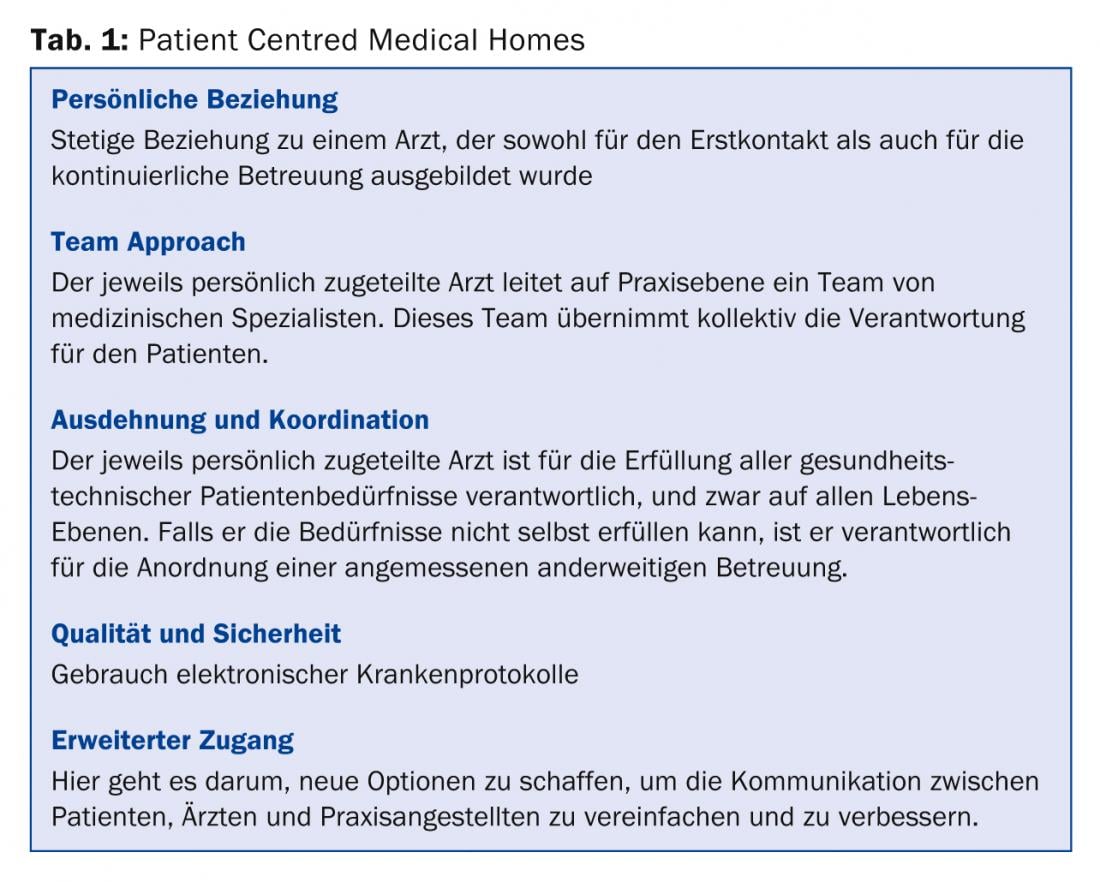
American models see so-called “Patient Centred Medical Homes” as the medical practices of the future. Table 1 shows the key points of this networked collaboration. In this context, the primary care physician is not only the caregiver, but also the coordinator of the network and the patient’s first point of contact. “This is a particularly important point for communication,” Prof. Rosemann explained. “Studies show that patients (e.g., with acute coronary syndrome) know little and only inaccurate information about their condition, i.e., their symptoms and possible treatment options, even after diagnosis and numerous interactions with physicians and other health care workers [3]. It is seemingly left to the primary care physician to gather all the information that the patient has already received, process it, and reproduce it in a way that is appropriate for the patient. A truly Herculean task, but one that is becoming increasingly important given the flood of information in the medical system. After all, surveys indicate that patients trust their family doctor the most when it comes to health issues, even ahead of specialists and clinicians.”
Growing into a Goliath at the Herculean task

In summary, according to Prof. Rosemann, demographics, medical progress and the commercialization of medicine are both a challenge and an opportunity for the family doctor. It thus increasingly fulfills the tasks that remain open elsewhere in the system:

  • Advisor, companion and pilot in an increasingly fragmented and specialized health care system
  • Coordinator of co-morbidity and multimorbidity and tightrope walker between “evidence” and individuality
  • Manager/Player in an interdisciplinary team with defined tasks
  • Landlord and confidant in the patient-centered “medical home.”

Source: “Family doctor – David, Goliath or Hercules”, lecture at the 4th JHaS Congress, April 5, 2014, Thun

Literature:

  1. Garfinkel D, Mangin D: Feasibility study of a systematic approach for discontinuation of multiple medications in older adults: addressing polypharmacy. Arch Intern Med 2010 Oct 11; 170(18): 1648-1654. doi: 10.1001/archinternmed.2010.355.
  2. McAlister FA, et al: The effect of specialist care within the first year on subsequent outcomes in 24,232 adults with new-onset diabetes mellitus: population-based cohort study. Qual Saf Health Care 2007 Feb; 16(1): 6-11.
  3. Dracup K, et al: Acute coronary syndrome: what do patients know? Arch Intern Med2008 May 26; 168(10): 1049-1054. doi: 10.1001/archinte.168.10.1049.

HAUSARZT PRAXIS 2014; 9(5): 40-41

Autoren
  • Andreas Grossmann
Publikation
  • HAUSARZT PRAXIS
Related Topics
  • Basic supply
  • Demand
  • Family Doctor
  • Family doctor
  • Family Medicine
  • JHaS
  • Medical system
  • Thun
Previous Article
  • Family Doctors Day Bern

Anxiety disorders and depression are difficult to distinguish

  • Congress Reports
  • Psychiatry and psychotherapy
  • RX
View Post
Next Article
  • Update Neurology St. Gallen

Good news with practical relevance

  • Congress Reports
  • Neurology
  • RX
View Post
You May Also Like
View Post
  • 13 min
  • Obesity Treatment

Oral GLP-1 Therapies: ATTAIN-1 and OASIS-4—The Next Leap Forward

    • RX
    • Education
    • Endocrinology and Diabetology
    • General Internal Medicine
    • Nutrition
    • Prevention and health care
    • Studies
View Post
  • 5 min
  • Older patients with atopic dermatitis

Why the Use of Biologics Is Recommended

    • RX
    • Allergology and clinical immunology
    • Congress Reports
    • Dermatology and venereology
    • Studies
View Post
  • 4 min
  • Disorders of the Gut-Brain Interaction

Peppermint-Caraway Oil Supplement Proves Effective in Phase IV Trial

    • RX
    • Education
    • Gastroenterology and Hepatology
    • General Internal Medicine
    • Pharmaceutical medicine
    • Pharmacology and toxicology
    • Phytotherapy
    • Studies
View Post
  • 5 min
  • Gepante for Migraines

Relief from pain, symptoms, and improved functional ability—both acute and preventive

    • RX
    • Education
    • General Internal Medicine
    • Neurology
    • Pharmacology and toxicology
    • Studies
View Post
  • 12 min
  • Why the Finerenon Boom Is Giving Hyperkalemia Treatment New Relevance

Potassium binders as enablers of RAASi optimization

    • RX
    • Cardiology
    • Education
    • General Internal Medicine
    • Nephrology
    • Studies
View Post
  • 3 min
  • Asthma in Adults: Bronchodilation and Anti-Inflammatory Therapy

Remodeling can be counteracted through a proactive treatment strategy

    • RX
    • Allergology and clinical immunology
    • Congress Reports
    • General Internal Medicine
    • Pneumology
    • Studies
View Post
  • 3 min
  • From symptom to diagnosis

Gynecomastia and Adipomastia

    • RX
    • Cases
    • Education
    • Endocrinology and Diabetology
    • General Internal Medicine
    • Gynecology
    • Radiology
    • Surgery
View Post
  • 7 min
  • Plastic surgery and reconstructive microsurgery for DFS

Functional limb preservation between infection control, vascular medicine and resurfacing

    • RX
    • Angiology
    • CME continuing education
    • Dermatology and venereology
    • Endocrinology and Diabetology
    • General Internal Medicine
    • Geriatrics
    • Physical medicine and rehabilitation
    • Surgery
  • IBD matters

    Zum Thema
Top CME content
  • 1
    Update on Anti-Rheumatic Medications
  • 2
    Psychiatry versus Neuro-Oncology: Diagnostic Pitfalls
  • 3
    Focus on preventive care options
  • 4
    Inflammation as a Treatment Goal in Its Own Right
  • 5
    Personalized Treatment Before a Planned Pregnancy

Newsletter

Sign up and stay up to date

Subscribe
Medizinonline Medizinonline
  • Contact
  • General terms and conditions
  • Imprint

Input your search keywords and press Enter.