Medizinonline Medizinonline
  • News
    • News
    • Market & Medicine
  • Patients
    • Disease patterns
    • Diagnostics
    • Therapy
  • Partner Content
    • Diabetes
      • Dia-Month Club – Type 2 Diabetes
      • Diabetes in Motion
      • Diabetes Podcasts
    • Gastroenterology
      • IBD matters
    • Oncology
      • Swiss Oncology in motion
    • Orthopedics
      • Osteoporosis in motion
  • Departments
    • Allergology and clinical immunology
    • General Internal Medicine
    • Anesthesiology
    • Angiology
    • Surgery
    • Dermatology and venereology
    • Endocrinology and Diabetology
    • Nutrition
    • Gastroenterology and Hepatology
    • Genetics
    • Geriatrics
    • Gynecology
    • Hematology
    • Infectiology
    • Cardiology
    • Nephrology
    • Neurology
    • Emergency and intensive care medicine
    • Nuclear Medicine
    • Oncology
    • Ophthalmology
    • ORL
    • Orthopedics
    • Pediatrics
    • Pharmacology and toxicology
    • Pharmaceutical medicine
    • Phlebology
    • Physical medicine and rehabilitation
    • Pneumology
    • Prevention and health care
    • Psychiatry and psychotherapy
    • Radiology
    • Forensic Medicine
    • Rheumatology
    • Sports Medicine
    • Traumatology and trauma surgery
    • Tropical and travel medicine
    • Urology
    • Dentistry
  • CME & Congresses
    • CME continuing education
    • Congress Reports
    • Congress calendar
  • Practice
    • Noctimed
    • Practice Management
    • Jobs
    • Interviews
  • Log In
  • Register
  • My account
  • Contact
  • Publications
  • Contact
  • Deutsch
  • English
  • Français
  • Italiano
  • Português
  • Español
Subscribe
Medizinonline Medizinonline
  • News
    • News
    • Market & Medicine
  • Patienten
    • Krankheitsbilder
    • Diagnostik
    • Therapie
  • Partner Content
    • Diabetes
      • Dia-Month Club – Type 2 Diabetes
      • Diabetes in Motion
      • Diabetes Podcasts
    • Gastroenterology
      • IBD matters
    • Oncology
      • Swiss Oncology in motion
    • Orthopedics
      • Osteoporosis in motion
    • Phytotherapie
    • Rheumatology
  • Departments
    • Fachbereiche 1-13
      • Allergology and clinical immunology
      • General Internal Medicine
      • Anesthesiology
      • Angiology
      • Surgery
      • Dermatology and venereology
      • Endocrinology and Diabetology
      • Nutrition
      • Gastroenterology and Hepatology
      • Genetics
      • Geriatrics
      • Gynecology
      • Hematology
    • Fachbereiche 14-26
      • Infectiology
      • Cardiology
      • Nephrology
      • Neurology
      • Emergency and intensive care medicine
      • Nuclear Medicine
      • Oncology
      • Ophthalmology
      • ORL
      • Orthopedics
      • Pediatrics
      • Pharmacology and toxicology
      • Pharmaceutical medicine
    • Fachbereiche 26-38
      • Phlebology
      • Physical medicine and rehabilitation
      • Phytotherapy
      • Pneumology
      • Prevention and health care
      • Psychiatry and psychotherapy
      • Radiology
      • Forensic Medicine
      • Rheumatology
      • Sports Medicine
      • Traumatology and trauma surgery
      • Tropical and travel medicine
      • Urology
      • Dentistry
  • CME & Congresses
    • CME continuing education
    • Congress Reports
    • Congress calendar
  • Practice
    • Noctimed
    • Practice Management
    • Jobs
    • Interviews
Login

Sie haben noch keinen Account? Registrieren

  • Direct oral anticoagulants

DOAKs in renal insufficiency – GFR tipping the scales

    • Cardiology
    • Congress Reports
    • General Internal Medicine
    • Nephrology
    • RX
  • 3 minute read

Any anticoagulation is a balancing act between thromboembolism and bleeding risk. This is particularly true in the case of chronic kidney dysfunction (CKD). In mild to moderate renal disease, all currently approved DOAKs in Switzerland can be used in normal doses, whereas in advanced renal insufficiency, the individual risk profile should be taken into account and, if necessary, an adjusted dosage should be used. Caution is advised in CKD stage 5.

Currently, various direct oral anticoagulants (DOAKs) are prescribed in Switzerland for the prevention and treatment of thromboembolic disease. The effect of DOAKs is based on the specific and direct inhibition of activated coagulation factors. With regard to dabigatran, this concerns thrombin; with regard to rivaroxaban, edoxaban and apixaban, activated factor X (Xa). The substances currently approved in Switzerland differ in terms of renal elimination rate. Dabigatran (Pradaxa®) is excreted 80% by the kidney, whereas apixaban (Eliquis®) is excreted only 27%. Edoxaban (Lixiana®) is 50% and rivaroxaban (Xarelto®) is 35% renally eliminated [1,2]. “Up to a GFR of 60 ml/min, all substances can be used,” said Prof. Thomas Fehr, MD, Chief of Internal Medicine, Graubünden Cantonal Hospital, summarizing the current guideline recommendations for a use of the four currently approved DOAKs in mild and moderate renal insufficiency (Tab. 1) [1,3]. Apixaban was even shown to have a significantly greater reduction in bleeding risk compared with vitamin K antagonists above a GFR <50 (>30) ml/min [4,5].
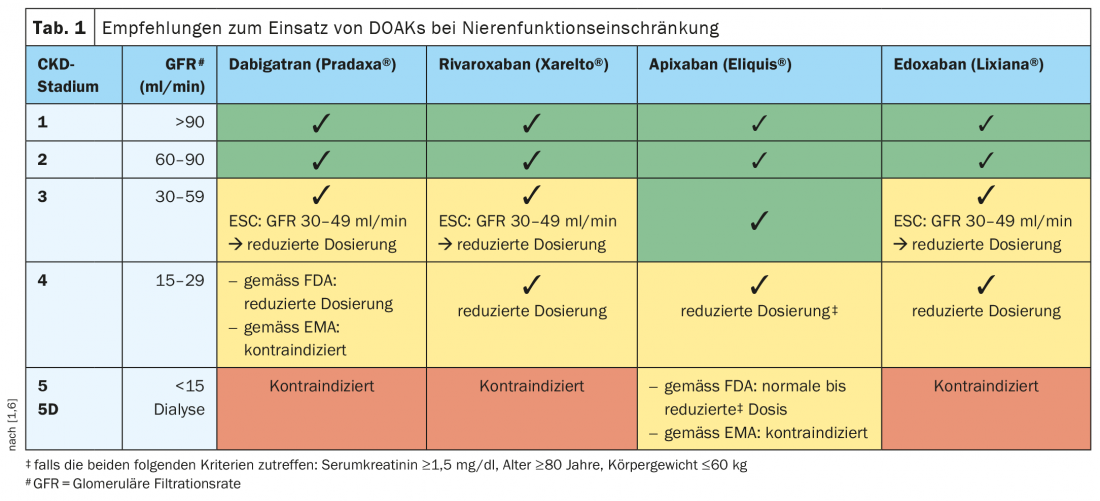


DOAKs in adapted dosage generally applicable up to GFR >15 ml/min

Most dosing recommendations are based on pharmacokinetic calculations rather than clinical studies. Empirical data on anticoagulation with DOAKs or vitamin K antagonists in patients with a CrCl* <25 ml/min are scarce because this patient population was excluded from most RCTs. Only the studies with apixaban included patients with GFR up to 20 ml/min [5]. The current ESC guideline recommendation is that rivaroxaban, edoxaban, and apixaban can be used in adjusted dosing in severe CKD (CrCl 15-30 ml/min) [3]. There is a relative contraindication in patients with a GFR<15 ml/min. Prof. Fehr explains, “There is insufficient evidence to systematically anticoagulate patients on hemodialysis with nonvalvular atrial fibrillation for stroke prevention because the bleeding risks are very high and there is no documented benefit.” In these patients, an individual risk assessment is necessary to determine whether anticoagulation is appropriate or not in each case, the speaker said.

* CrCl = creatinine clearance


Congress: SGAIM Spring Congress 2021


Literature:

  1. Fehr T: DOAKs & renal insufficiency, Prof. Dr. med. Thomas Fehr, SGAIM Spring Congress, 19-21.05.2021
  2. Swissmedic: Medicinal Product Information, www.swissmedicinfo.ch (last accessed 11.06.21).
  3. The Task Force for the diagnosis and management of atrial fibrillation of the ESC. 2020 ESC Guidelines for the diagnosis and management of atrial fibrillation developed in collaboration with the European Association for Cardio-Thoracic Surgery (EACTS). European Heart Journal 2020; 42: 373-498.
  4. Hohnloser SH, et al: Efficacy of apixaban when compared with warfarin in relation to renal function in patients with atrial fibrillation: insights from the ARISTOTLE trial. European heart journal 2012; 33: 2821-2830.
  5. Rosemann A: New/Direct Anticoagulants (DOAK), last modified 11/2020, www.hausarztmedizin.uzh.ch (last accessed 11/06/2021).
  6. Stamellou E, Floege J: Novel oral anticoagulants in patients with chronic kidney disease and atrial fibrillation. Nephrol Dial Transplant 2018; 33(10): 1683-1689.


HAUSARZT PRAXIS 2021; 16(7): 23 (published 6/28/21, ahead of print).
Autoren
  • Mirjam Peter, M.Sc.
Publikation
  • HAUSARZT PRAXIS
Related Topics
  • Anticoagulation
  • DOAK
Previous Article
  • SARS-CoV-2

Routine dermatological care in times of pandemic

  • Dermatology and venereology
  • Education
  • Infectiology
  • News
  • Oncology
  • Prevention and health care
  • RX
View Post
Next Article
  • Diabetes Management

Fresh wind through new possibilities – what is now possible

  • Cardiology
  • Congress Reports
  • Endocrinology and Diabetology
  • Partner Content
  • RX
  • Studies
View Post
You May Also Like
View Post
  • 8 min
  • Proteins in wound healing

Do special amino acids lead to success?

    • CME continuing education
    • Dermatology and venereology
    • Endocrinology and Diabetology
    • Nutrition
    • RX
    • Studies
View Post
  • 0 min
  • Psychedelic-assisted therapy

Current status of PAT

    • CME continuing education
    • General Internal Medicine
    • Pharmacology and toxicology
    • Psychiatry and psychotherapy
    • RX
    • Studies
View Post
  • 5 min
  • Hepatitis B prophylaxis

Vaccination protection for healthcare staff with patient contact – an update

    • Congress Reports
    • General Internal Medicine
    • Infectiology
    • Prevention and health care
    • RX
View Post
  • 7 min
  • Plastic surgery and reconstructive microsurgery for DFS

Functional limb preservation between infection control, vascular medicine and resurfacing

    • Angiology
    • CME continuing education
    • Endocrinology and Diabetology
    • General Internal Medicine
    • Geriatrics
    • Physical medicine and rehabilitation
    • RX
    • Surgery
View Post
  • 14 min
  • Adrenogenital syndrome

Clinical care from birth to adulthood

    • CME continuing education
    • Endocrinology and Diabetology
    • Nephrology
    • Pediatrics
    • RX
    • Studies
View Post
  • 14 min
  • New approvals, current study data and ADC development

Antibody-drug conjugates in gynecologic oncology

    • Education
    • Gynecology
    • Oncology
    • RX
    • Studies
View Post
  • 11 min
  • Type 2 diabetes: cardiovascular risk reduction is realistic

Modern active ingredients and lifestyle – every step counts

    • Cardiology
    • Congress Reports
    • Endocrinology and Diabetology
    • Prevention and health care
    • RX
    • Studies
View Post
  • 5 min
  • From symptom to diagnosis

Pneumology – Covid-19: a review

    • Cases
    • Education
    • Infectiology
    • Pneumology
    • Prevention and health care
    • Radiology
    • RX
  • IBD matters

    Zum Thema
Top CME content
  • 1
    Current status of PAT
  • 2
    Do special amino acids lead to success?
  • 3
    Functional limb preservation between infection control, vascular medicine and resurfacing
  • 4
    Minimally invasive – the quiet triumph of modern heart surgery
  • 5
    HPV prevention, screening innovation and sentinel lymph node biopsy

Newsletter

Sign up and stay up to date

Subscribe
Medizinonline Medizinonline
  • Contact
  • General terms and conditions
  • Imprint

Input your search keywords and press Enter.