Medizinonline Medizinonline
  • News
    • News
    • Market & Medicine
  • Patients
    • Disease patterns
    • Diagnostics
    • Therapy
  • Partner Content
    • Diabetes
      • Dia-Month Club – Type 2 Diabetes
      • Diabetes in Motion
      • Diabetes Podcasts
    • Gastroenterology
      • IBD matters
    • Oncology
      • Swiss Oncology in motion
    • Orthopedics
      • Osteoporosis in motion
  • Departments
    • Allergology and clinical immunology
    • General Internal Medicine
    • Anesthesiology
    • Angiology
    • Surgery
    • Dermatology and venereology
    • Endocrinology and Diabetology
    • Nutrition
    • Gastroenterology and Hepatology
    • Genetics
    • Geriatrics
    • Gynecology
    • Hematology
    • Infectiology
    • Cardiology
    • Nephrology
    • Neurology
    • Emergency and intensive care medicine
    • Nuclear Medicine
    • Oncology
    • Ophthalmology
    • ORL
    • Orthopedics
    • Pediatrics
    • Pharmacology and toxicology
    • Pharmaceutical medicine
    • Phlebology
    • Physical medicine and rehabilitation
    • Pneumology
    • Prevention and health care
    • Psychiatry and psychotherapy
    • Radiology
    • Forensic Medicine
    • Rheumatology
    • Sports Medicine
    • Traumatology and trauma surgery
    • Tropical and travel medicine
    • Urology
    • Dentistry
  • CME & Congresses
    • CME continuing education
    • Congress Reports
    • Congress calendar
  • Practice
    • Noctimed
    • Practice Management
    • Jobs
    • Interviews
  • Log In
  • Register
  • My account
  • Contact
  • Publications
  • Contact
  • Deutsch
  • English
  • Français
  • Italiano
  • Português
  • Español
Subscribe
Medizinonline Medizinonline
  • News
    • News
    • Market & Medicine
  • Patienten
    • Krankheitsbilder
    • Diagnostik
    • Therapie
  • Partner Content
    • Diabetes
      • Dia-Month Club – Type 2 Diabetes
      • Diabetes in Motion
      • Diabetes Podcasts
    • Gastroenterology
      • IBD matters
    • Oncology
      • Swiss Oncology in motion
    • Orthopedics
      • Osteoporosis in motion
    • Phytotherapie
    • Rheumatology
  • Departments
    • Fachbereiche 1-13
      • Allergology and clinical immunology
      • General Internal Medicine
      • Anesthesiology
      • Angiology
      • Surgery
      • Dermatology and venereology
      • Endocrinology and Diabetology
      • Nutrition
      • Gastroenterology and Hepatology
      • Genetics
      • Geriatrics
      • Gynecology
      • Hematology
    • Fachbereiche 14-26
      • Infectiology
      • Cardiology
      • Nephrology
      • Neurology
      • Emergency and intensive care medicine
      • Nuclear Medicine
      • Oncology
      • Ophthalmology
      • ORL
      • Orthopedics
      • Pediatrics
      • Pharmacology and toxicology
      • Pharmaceutical medicine
    • Fachbereiche 26-38
      • Phlebology
      • Physical medicine and rehabilitation
      • Phytotherapy
      • Pneumology
      • Prevention and health care
      • Psychiatry and psychotherapy
      • Radiology
      • Forensic Medicine
      • Rheumatology
      • Sports Medicine
      • Traumatology and trauma surgery
      • Tropical and travel medicine
      • Urology
      • Dentistry
  • CME & Congresses
    • CME continuing education
    • Congress Reports
    • Congress calendar
  • Practice
    • Noctimed
    • Practice Management
    • Jobs
    • Interviews
Login

Sie haben noch keinen Account? Registrieren

  • Parkinson's disease

Effective therapy management: mastering challenges

    • Congress Reports
    • Geriatrics
    • Neurology
    • RX
  • 3 minute read

An effective treatment regimen in PD is closely linked to a personalized approach. Depending on the age of onset and subtype of the disease, the challenges are different. In addition to the control of non-motor symptoms, the focus is on the therapy of motor symptoms. Especially in the long-term, combinations can achieve effective control.

Idiopathic Parkinson’s disease (IPS) is a systemic disorder that can cause multiple symptoms in numerous organs. Predominantly, these are non-motor in nature. These include psychological complaints such as depression, apathy, or anxiety disorders, olfactory dysfunction, visual disturbances, gastrointestinal symptoms, sleep disturbances, or autonomic cardiovascular symptoms. Accordingly, IPS patients show pathological results in quantitative olfactory tests in 80-100%, as Prof. Dr. med. Claudia Trenkwalder, Kassel (D), pointed out. Approximately 51% of those affected have anosmia, 35% have severe olfactory dysfunction, and 14% have moderate olfactory dysfunction. Gastrointestinal complaints such as motility disorders can be attributed to various causes. For example, hyper-permeability of the intestinal wall, alpha-synuclein deposition in the myenteric plexus, or changes in the composition of the microbiome. In addition, 80% of all affected individuals develop clinically relevant dysphagia during the course of the disease. This is associated with a significant reduction in quality of life, difficulty taking medication, and malnutrition. Underlying this is a multifactorial genesis involving dopaminergic and non-dopaminergic pathways of the central swallowing network as well as peripheral neuromuscular influences. Speech therapy, optimization of dopaminergic medication, and intensive expiratory muscle strength training can help, she said.

Motor symptoms in view

Motor symptoms of IPS include bradykinesia, rigor, and tremor. They are also the ones who determine the diagnosis. In order to initiate effective therapy management, it is crucial to detect the respective subtype and its course, emphasized Prof. Lars Timmermann, MD, Giessen, Germany. This is because the clinical course of tremor-dominant Parkinson’s, for example, is much slower than other forms. In the early phase of the disease, the therapies usually work very well. However, as the disease progresses, motor complications increase and gait disturbances or dysarthria may occur. The late phase is then characterized by increasing need for care and often dementia.

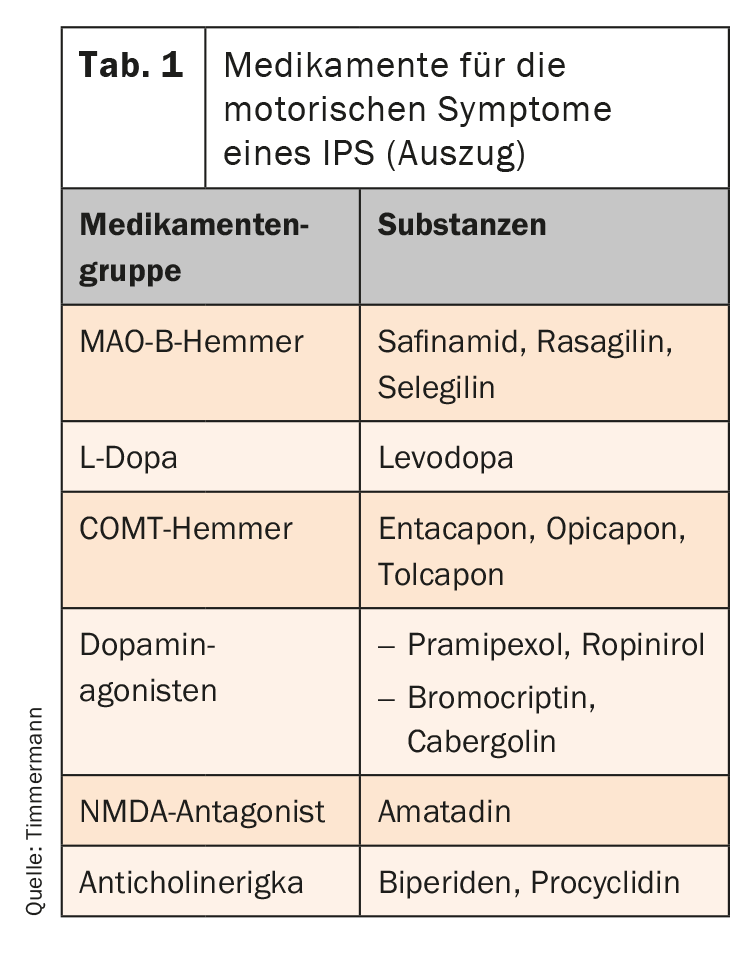
The pharmacological portfolio has been significantly expanded in recent years. Six drug groups are now available (tab. 1). First and foremost, L-dopa – also combined with a decarboxylase inhibitor – is used. It is converted to dopamine in the CNS and is thus available as a transmitter. However, fluctuations in effect occur during long-term use. They initially manifest as end-of-dose deterioration, but can extend to unplannable “off” conditions. An MAO-B inhibitor, for example, can then be used as an add-on therapy. By selectively inhibiting MAO-B, they increase the concentration of dopamine and are very well tolerated. Safinamide has a dual mechanism of action. Selective, reversible inhibition of monoamine oxidase (MAO)-B and simultaneous regulation of glutamate release, which is increased in PD, can achieve balanced and long-lasting control of motor symptoms.


Avoid escalations

When pharmacological interventions are no longer effective in particularly severe cases, therapy can be escalated with continuous stimulating procedures. Currently, the most thoroughly studied is deep brain stimulation. It can significantly improve poor mobility condition, fluctuations and dyskinesias. Jejunal L-dopa pump infusion can improve fluctuations, and subcutaneous administration of apomorphine via a pump system is effective primarily for fluctuations but not for dyskinesias.

Source: DGN 2020


InFo NEUROLOGY & PSYCHIATRY 2021, 19(1): 21 (published 2/3/21, ahead of print).

Autoren
  • Leoni Burggraf
Publikation
  • InFo NEUROLOGIE & PSYCHIATRIE
Related Topics
  • Brain Stimulation
  • CNS
  • Dopamine
  • L-Dopa
  • Parkinson's
Previous Article
  • COVID-19

Protection against infection in the doctor’s office

  • Education
  • General Internal Medicine
  • Infectiology
  • News
  • Prevention and health care
  • RX
View Post
Next Article
  • Lipid management: LDL cholesterol reduction

Add-on to statin therapy recommended in patients at high cardiovascular risk

  • Cardiology
  • Congress Reports
  • General Internal Medicine
  • RX
  • Studies
View Post
You May Also Like
View Post
  • 8 min
  • Psychooncology

Communication as the key to therapy adherence

    • RX
    • CME continuing education
    • General Internal Medicine
    • Practice Management
View Post
  • 9 min
  • Cardiology

Minimally invasive – the quiet triumph of modern heart surgery

    • RX
    • Cardiology
    • CME continuing education
    • Studies
    • Surgery
View Post
  • 6 min
  • Schizophrenia in the early-onset stage

Which antipsychotic should be used for treatment-naive patients?

    • RX
    • Education
    • Pharmacology and toxicology
    • Psychiatry and psychotherapy
    • Studies
View Post
  • 4 min
  • Diarrhea in children

The problem of parental expectations

    • RX
    • Education
    • Gastroenterology and Hepatology
    • General Internal Medicine
    • Infectiology
    • Pediatrics
    • Studies
View Post
  • 4 min
  • From symptom to diagnosis

Multilocular cystic renal cell carcinoma (MCRCC)

    • RX
    • Cases
    • Education
    • Nephrology
    • Oncology
    • Radiology
    • Studies
    • Surgery
View Post
  • 3 min
  • Shaping the Future with LLM & Co.

AI in Everyday Clinical Practice: Friend or Foe?

    • RX
    • General Internal Medicine
    • Practice Management
    • Prevention and health care
View Post
  • 5 min
  • Ulcerative colitis: current evidence on anti-inflammatory therapies

Remission induction and maintenance with biologics and JAK-i

    • RX
    • Congress Reports
    • Gastroenterology and Hepatology
    • General Internal Medicine
    • Studies
View Post
  • 4 min
  • Bronchiectasis

New strategies against neutrophilic inflammation

    • RX
    • Congress Reports
    • General Internal Medicine
    • Infectiology
    • Pneumology
    • Studies
  • IBD matters

    Zum Thema
Top CME content
  • 1
    Current State of Knowledge and New Therapeutic Approaches
  • 2
    Why is it so hard to lose weight?
  • 3
    Functional limb preservation between infection control, vascular medicine and resurfacing
  • 4
    Algorithms, avatars and the unburdened mind
  • 5
    Communication as the key to therapy adherence

Newsletter

Sign up and stay up to date

Subscribe
Medizinonline Medizinonline
  • Contact
  • General terms and conditions
  • Imprint

Input your search keywords and press Enter.