Medizinonline Medizinonline
  • News
    • News
    • Market & Medicine
  • Patients
    • Disease patterns
    • Diagnostics
    • Therapy
  • Partner Content
    • Diabetes
      • Dia-Month Club – Type 2 Diabetes
      • Diabetes in Motion
      • Diabetes Podcasts
    • Gastroenterology
      • IBD matters
    • Oncology
      • Swiss Oncology in motion
    • Orthopedics
      • Osteoporosis in motion
  • Departments
    • Allergology and clinical immunology
    • General Internal Medicine
    • Anesthesiology
    • Angiology
    • Surgery
    • Dermatology and venereology
    • Endocrinology and Diabetology
    • Nutrition
    • Gastroenterology and Hepatology
    • Genetics
    • Geriatrics
    • Gynecology
    • Hematology
    • Infectiology
    • Cardiology
    • Nephrology
    • Neurology
    • Emergency and intensive care medicine
    • Nuclear Medicine
    • Oncology
    • Ophthalmology
    • ORL
    • Orthopedics
    • Pediatrics
    • Pharmacology and toxicology
    • Pharmaceutical medicine
    • Phlebology
    • Physical medicine and rehabilitation
    • Pneumology
    • Prevention and health care
    • Psychiatry and psychotherapy
    • Radiology
    • Forensic Medicine
    • Rheumatology
    • Sports Medicine
    • Traumatology and trauma surgery
    • Tropical and travel medicine
    • Urology
    • Dentistry
  • CME & Congresses
    • CME continuing education
    • Congress Reports
    • Congress calendar
  • Practice
    • Noctimed
    • Practice Management
    • Jobs
    • Interviews
  • Log In
  • Register
  • My account
  • Contact
  • Publications
  • Contact
  • Deutsch
  • English
  • Français
  • Italiano
  • Português
  • Español
Subscribe
Medizinonline Medizinonline
  • News
    • News
    • Market & Medicine
  • Patienten
    • Krankheitsbilder
    • Diagnostik
    • Therapie
  • Partner Content
    • Diabetes
      • Dia-Month Club – Type 2 Diabetes
      • Diabetes in Motion
      • Diabetes Podcasts
    • Gastroenterology
      • IBD matters
    • Oncology
      • Swiss Oncology in motion
    • Orthopedics
      • Osteoporosis in motion
    • Phytotherapie
    • Rheumatology
  • Departments
    • Fachbereiche 1-13
      • Allergology and clinical immunology
      • General Internal Medicine
      • Anesthesiology
      • Angiology
      • Surgery
      • Dermatology and venereology
      • Endocrinology and Diabetology
      • Nutrition
      • Gastroenterology and Hepatology
      • Genetics
      • Geriatrics
      • Gynecology
      • Hematology
    • Fachbereiche 14-26
      • Infectiology
      • Cardiology
      • Nephrology
      • Neurology
      • Emergency and intensive care medicine
      • Nuclear Medicine
      • Oncology
      • Ophthalmology
      • ORL
      • Orthopedics
      • Pediatrics
      • Pharmacology and toxicology
      • Pharmaceutical medicine
    • Fachbereiche 26-38
      • Phlebology
      • Physical medicine and rehabilitation
      • Phytotherapy
      • Pneumology
      • Prevention and health care
      • Psychiatry and psychotherapy
      • Radiology
      • Forensic Medicine
      • Rheumatology
      • Sports Medicine
      • Traumatology and trauma surgery
      • Tropical and travel medicine
      • Urology
      • Dentistry
  • CME & Congresses
    • CME continuing education
    • Congress Reports
    • Congress calendar
  • Practice
    • Noctimed
    • Practice Management
    • Jobs
    • Interviews
Login

Sie haben noch keinen Account? Registrieren

  • Antiemesis

Effectively counteract chemotherapy-induced nausea and vomiting

    • Education
    • Oncology
    • RX
  • 2 minute read

As one of the most important treatment options for malignant diseases, chemotherapy remains the focus of many therapeutic regimens. However, cisplatin-based treatment in particular is considered highly emetogenic. Nausea and vomiting can be the result. Patients’ quality of life should then be improved by effective control of side effects.

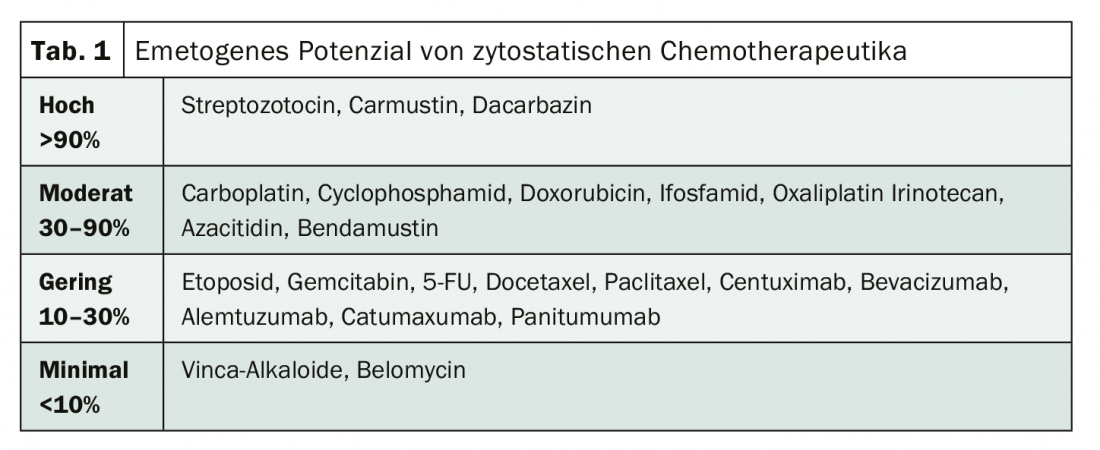
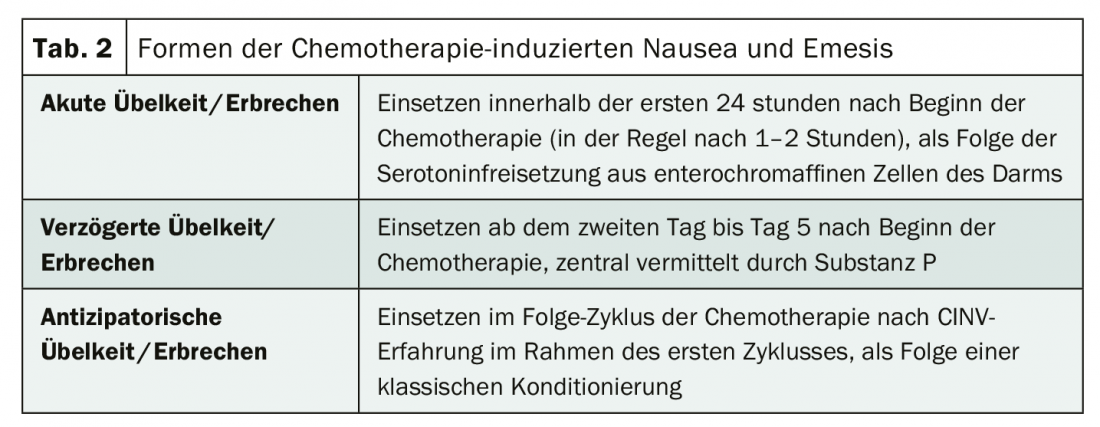
Chemotherapy plays a major role in the treatment of malignant diseases. However, the cytostatic drugs used cause chemotherapy-induced side effects such as nausea and vomiting in up to 50% of patients despite guideline-compliant prophylaxis – with serious consequences for the quality of life of those affected [1]. Therefore, concomitant antiemetic treatment is mandatory in patients undergoing highly emetogenic chemotherapy (Table 1) [2]. It can be divided into acute, delayed, and anticipatory forms of chemotherapy-induced nausea and vomiting (CINV) (Tab. 2). While acute CINV episodes, which usually occur within 1 to 2 hours of chemotherapy initiation, are generally preventable since the introduction of 5-HT3 antagonists, delayed CINV still poses a challenge. It does not set in until 24 hours to five days after the start of chemotherapy, when the patient has already left the hospital. Therefore, the problem is often underestimated, but perceived by those affected as the most unpleasant side effect of chemotherapy [3,4]. On this basis, the German S3 guideline “Supportive Therapy in Oncological Patients” recommends defining and initiating the strategy of antiemesis for the acute and delayed phase of nausea and vomiting already before the start of tumor therapy [4].


Focus on combination therapies

In recent years, the combination of NK1- receptor antagonist, 5-HT3 receptor antagonist, and dexamethasone has been established as an effective option. With one capsule before starting chemotherapy, this combination spares over 80% of patients from CINV – both acute and delayed. Since the results have since been confirmed in everyday practice, this procedure is considered standard [5].


The aim of another combination is to extend this success even further: the atypical neuroleptic with antiemetic properties olanzapine was administered in addition to standard prophylaxis. It was shown that the additional administration of 10 mg/d day 1-4 may well show significant benefits. Over the entire period, 37% of patients did not suffer from nausea. For the triple combination, it was 25% [6]. However, a marked increase in sleepiness appeared. Similar results were obtained in another study in which olanzapine was administered at a dosage of 5 mg on days 1-4 as an adjunct to standard antiemesis. Acute nausea was prevented in 98% vs. 89%, and delayed nausea in 79% vs. 66% [7].

Literature:

  1. www.krebsinformationsdienst.de/leben/uebelkeit/uebelkeit-index.php (last accessed 03.06.2020).
  2. Karthaus M: Antiemetic adjunctive therapy: proven and options. Dtsch Arztebl 2016; 113(39).
  3. Sun CC, et al: Support Care Cancer 2005; 13: 219-227.
  4. www.awmf.org/uploads/tx_szleitlinien/032-054OLl_S3_Supportiv_2019-11.pdf (last accessed on 03.06.2020)
  5. Karthaus M, et al: Blood 2018; 132:4844.
  6. https://deutsch.medscape.com/artikelansicht/4905125#vp_1 (last accessed on 03.06.2020)
  7. www.dgho.de/aktuelles/news/newsarchiv/2019/download-news-2019/asco-2019-antiemese.pdf (last accessed on 03.06.2020)


InFo ONCOLOGY & HEMATOLOGY 2020; 8(3): 33.

Autoren
  • Leoni Burggraf
Related Topics
  • chemotherapy
  • Nausea
  • Nausea
Previous Article
  • Corona pandemic

Allergy diagnostics in times of SARS-CoV-2

  • Allergology and clinical immunology
  • Infectiology
  • News
  • RX
View Post
Next Article
  • Atrial fibrillation

Early rhythm control aims for better outcomes

  • Cardiology
  • Congress Reports
  • RX
  • Studies
View Post
You May Also Like
View Post
  • 4 min
  • Bronchiolitis obliterans

Out of shape even without popcorn

    • RX
    • Education
    • General Internal Medicine
    • Infectiology
    • Pediatrics
    • Pneumology
    • Studies
View Post
  • 8 min
  • Case study

Guillain-Barré syndrome with a fulminant course

    • RX
    • Cases
    • Education
    • Infectiology
    • Neurology
    • Pharmacology and toxicology
    • Radiology
    • Studies
View Post
  • 5 min
  • Suspicion of neuroborreliosis?

Detection of borrelia-specific CSF parameters provides certainty

    • RX
    • Congress Reports
    • Infectiology
    • Neurology
    • Studies
View Post
  • 12 min
  • The Brain and the Motivation to Eat

Why is it so hard to lose weight?

    • RX
    • CME continuing education
    • Endocrinology and Diabetology
    • General Internal Medicine
    • Nutrition
    • Pharmacology and toxicology
    • Prevention and health care
    • Psychiatry and psychotherapy
    • Studies
View Post
  • 12 min
  • Global Recommendation, Swissmedic Approval, and SL Limitation

WHO Guidelines on GLP-1 for Obesity

    • RX
    • Cardiology
    • Education
    • Endocrinology and Diabetology
    • General Internal Medicine
    • Nutrition
    • Pharmacology and toxicology
    • Prevention and health care
    • Studies
View Post
  • 7 min
  • Obesity in Children and Adolescents

Gene-Environment Interactions: Polygenic or Monogenic Determinants?

    • RX
    • Education
    • General Internal Medicine
    • Genetics
    • Nutrition
    • Pediatrics
View Post
  • 18 min
  • From Risk Identification to Anti-Inflammatory Intervention

Inflammation as a Treatment Goal in Its Own Right

    • RX
    • Angiology
    • Cardiology
    • CME continuing education
    • Endocrinology and Diabetology
    • General Internal Medicine
    • Nutrition
    • Studies
View Post
  • 7 min
  • H. pylori infection: current study data

Fewer gastric carcinomas and peptic ulcers after eradication

    • RX
    • Gastroenterology and Hepatology
    • General Internal Medicine
    • Infectiology
    • Oncology
    • Studies
  • IBD matters

    Zum Thema
Top CME content
  • 1
    Inflammation as a Treatment Goal in Its Own Right
  • 2
    Personalized Treatment Before a Planned Pregnancy
  • 3
    Current State of Knowledge and New Therapeutic Approaches
  • 4
    Why is it so hard to lose weight?
  • 5
    Functional limb preservation between infection control, vascular medicine and resurfacing

Newsletter

Sign up and stay up to date

Subscribe
Medizinonline Medizinonline
  • Contact
  • General terms and conditions
  • Imprint

Input your search keywords and press Enter.