Medizinonline Medizinonline
  • News
    • News
    • Market & Medicine
  • Patients
    • Disease patterns
    • Diagnostics
    • Therapy
  • Partner Content
    • Diabetes
      • Dia-Month Club – Type 2 Diabetes
      • Diabetes in Motion
      • Diabetes Podcasts
    • Gastroenterology
      • IBD matters
    • Oncology
      • Swiss Oncology in motion
    • Orthopedics
      • Osteoporosis in motion
  • Departments
    • Allergology and clinical immunology
    • General Internal Medicine
    • Anesthesiology
    • Angiology
    • Surgery
    • Dermatology and venereology
    • Endocrinology and Diabetology
    • Nutrition
    • Gastroenterology and Hepatology
    • Genetics
    • Geriatrics
    • Gynecology
    • Hematology
    • Infectiology
    • Cardiology
    • Nephrology
    • Neurology
    • Emergency and intensive care medicine
    • Nuclear Medicine
    • Oncology
    • Ophthalmology
    • ORL
    • Orthopedics
    • Pediatrics
    • Pharmacology and toxicology
    • Pharmaceutical medicine
    • Phlebology
    • Physical medicine and rehabilitation
    • Pneumology
    • Prevention and health care
    • Psychiatry and psychotherapy
    • Radiology
    • Forensic Medicine
    • Rheumatology
    • Sports Medicine
    • Traumatology and trauma surgery
    • Tropical and travel medicine
    • Urology
    • Dentistry
  • CME & Congresses
    • CME continuing education
    • Congress Reports
    • Congress calendar
  • Practice
    • Noctimed
    • Practice Management
    • Jobs
    • Interviews
  • Log In
  • Register
  • My account
  • Contact
  • Publications
  • Contact
  • Deutsch
  • English
  • Français
  • Italiano
  • Português
  • Español
Subscribe
Medizinonline Medizinonline
  • News
    • News
    • Market & Medicine
  • Patienten
    • Krankheitsbilder
    • Diagnostik
    • Therapie
  • Partner Content
    • Diabetes
      • Dia-Month Club – Type 2 Diabetes
      • Diabetes in Motion
      • Diabetes Podcasts
    • Gastroenterology
      • IBD matters
    • Oncology
      • Swiss Oncology in motion
    • Orthopedics
      • Osteoporosis in motion
    • Phytotherapie
    • Rheumatology
  • Departments
    • Fachbereiche 1-13
      • Allergology and clinical immunology
      • General Internal Medicine
      • Anesthesiology
      • Angiology
      • Surgery
      • Dermatology and venereology
      • Endocrinology and Diabetology
      • Nutrition
      • Gastroenterology and Hepatology
      • Genetics
      • Geriatrics
      • Gynecology
      • Hematology
    • Fachbereiche 14-26
      • Infectiology
      • Cardiology
      • Nephrology
      • Neurology
      • Emergency and intensive care medicine
      • Nuclear Medicine
      • Oncology
      • Ophthalmology
      • ORL
      • Orthopedics
      • Pediatrics
      • Pharmacology and toxicology
      • Pharmaceutical medicine
    • Fachbereiche 26-38
      • Phlebology
      • Physical medicine and rehabilitation
      • Phytotherapy
      • Pneumology
      • Prevention and health care
      • Psychiatry and psychotherapy
      • Radiology
      • Forensic Medicine
      • Rheumatology
      • Sports Medicine
      • Traumatology and trauma surgery
      • Tropical and travel medicine
      • Urology
      • Dentistry
  • CME & Congresses
    • CME continuing education
    • Congress Reports
    • Congress calendar
  • Practice
    • Noctimed
    • Practice Management
    • Jobs
    • Interviews
Login

Sie haben noch keinen Account? Registrieren

  • Pulmonary hypertension

Hemodynamic thresholds and prognostic assurance.

    • Cardiology
    • Congress Reports
    • General Internal Medicine
    • Nephrology
    • Pneumology
    • RX
    • Studies
  • 2 minute read

In pulmonary hypertension, the pulmonary vessels are narrowed or blocked. This can lead to increased stress on the right ventricle and ultimately insufficiency. However, diagnostics are not always given the care that is needed. Even a moderate increase has a negative impact on the prognosis of those affected.

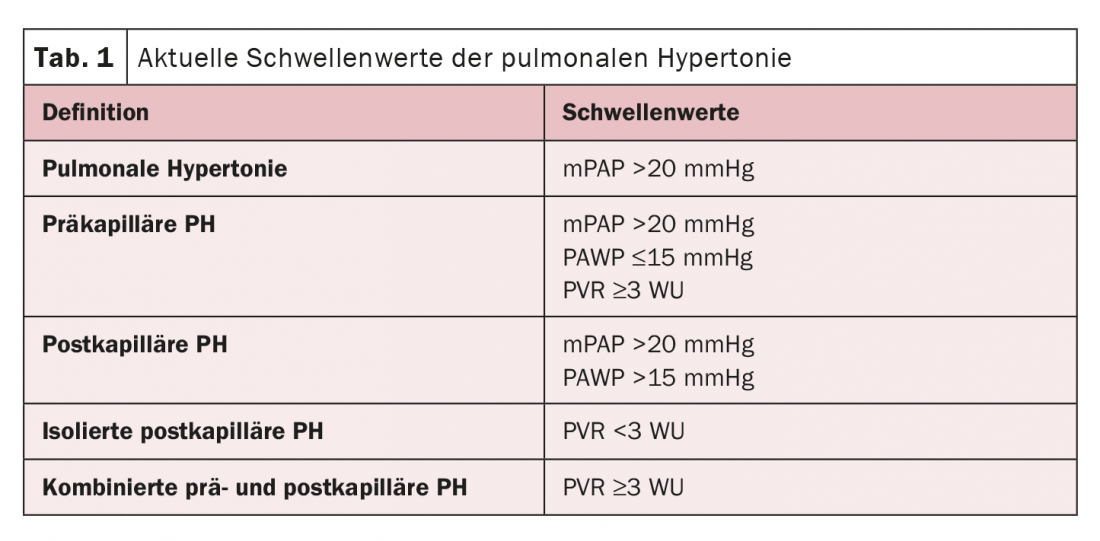
If pulmonary hypertension (PH) is also suspected, an echocardiographic examination is usually performed in the clinical setting. However, the underlying cause often cannot be visualized, warned Prof. Stephan Rosenkranz, MD, Cologne (D). The right heart catheter is then needed to define the disease. Regarding thresholds, there has been a recent proposal from the World Symposium that may be incorporated into the new ESC/ERS guidelines expected in the fall (Tab. 1). The rationale for lowering the threshold is that there is a correlation with mortality and hospitalization even at a moderate increase. Several study results have shown that even a small increase in pressure from any cause is significant for patients, the expert said. These findings currently have no implications for the treatment of arterial PH. This is because the studies on the efficacy and safety of PH medications available to date have been performed with the threshold ≥25 mmHg. In clinical practice, PH patients usually present with significantly higher values anyway. The gray area between 20 mmHg and 25 mmHg, which seems to be prognostically relevant, only comes into play in special patient groups.


However, the importance of right heart failure even in moderate pressure elevation cannot be dismissed. Systemic congestion as a result of hemodynamic changes and RVLV interaction with often decreased systemic output then come into play. Both have a great influence on many other organ systems.

High-quality measurements as a basis

The right heart catheter examination is the basis of further therapeutic procedures and should be performed in a high quality. The quality of hemodynamic measurements in particular often leaves much to be desired, the expert emphasized. In this context, pressure measurement alone is not enough. The other parameters in the pulmonary stroma must also be recorded. In addition to measured parameters, calculated parameters are also included, which are also important for patient prognosis. These include, for example, the transpulmonary gradient (TPG) as the difference between PAPm and PAWP, and transpulmonary resistance (PVR). Further, the diastolic pulmonary gradient (PAPd-PAWP) and pulse pressure (PAPs-PAPd) are considered. With regard to treatment decision, PAWP measurement is crucial for distinguishing pre-capillary from post-capillary PH.

A comprehensive study also took a closer look at pulmonary resistance. It was shown that the threshold value of >3 WU is very likely too high. The results demonstrate that a PVR >2.1 WU is associated with an increased risk of mortality.


Source: Pulmonary Hypertension – New Aspects from Different Perspectives, Working Group Meeting, 04/20/2022, 1:30-15:00 p.m.

Congress: 88th Annual Meeting of the German Society of Cardiology (DGK)


CARDIOVASC 2022; 21(2): 22 

Autoren
  • Leoni Burggraf
Publikation
  • CARDIOVASC
Related Topics
  • Hypertension
  • Hypertension
  • Pulmonary vessels
Previous Article
  • Cervical Cancer

The HPV vaccination – a success story

  • Education
  • Gynecology
  • Oncology
  • Pediatrics
  • Prevention and health care
  • RX
View Post
Next Article
  • Depression in old age

Screening, diagnosis and treatment

  • Education
  • General Internal Medicine
  • Geriatrics
  • Psychiatry and psychotherapy
  • RX
  • Studies
View Post
You May Also Like
View Post
  • 4 min
  • Trichophyton indotineae

Terbinafine-resistant dermatophytoses are on the rise in Central Europe

    • Allergology and clinical immunology
    • Congress Reports
    • Dermatology and venereology
    • Infectiology
    • RX
    • Studies
    • Tropical and travel medicine
View Post
  • 11 min
  • Peristomal skin health

Focus on preventive care options

    • Cases
    • CME continuing education
    • Dermatology and venereology
    • Gastroenterology and Hepatology
    • Infectiology
    • Physical medicine and rehabilitation
    • Prevention and health care
    • RX
    • Surgery
View Post
  • 7 min
  • Disease-modifying therapies for ATTR-CM

TTR stabilizers, gene silencing and gene scissors: where do we stand?

    • Cardiology
    • Congress Reports
    • Genetics
    • RX
    • Studies
View Post
  • 8 min
  • Proteins in wound healing

Do special amino acids lead to success?

    • CME continuing education
    • Dermatology and venereology
    • Endocrinology and Diabetology
    • Nutrition
    • RX
    • Studies
View Post
  • 4 min
  • HER2+ early breast cancer

DESTINY-Breast11 – neoadjuvant T-DXd without anthracyclines

    • Education
    • Gynecology
    • Oncology
    • RX
    • Studies
View Post
  • 3 min
  • Lavender aromatherapy

Take away the fear of the dentist

    • Dentistry
    • Education
    • Pharmaceutical medicine
    • Phytotherapy
    • Psychiatry and psychotherapy
    • RX
    • Studies
View Post
  • 4 min
  • Digital dermatology: innovative project examples

AI and eHealth tools in HS care

    • Dermatology and venereology
    • General Internal Medicine
    • Practice Management
    • Prevention and health care
    • RX
    • Studies
View Post
  • 5 min
  • Mantle cell lymphoma

Recurrence after BTK inhibition – prognostic factors and treatment options

    • Education
    • Hematology
    • Oncology
    • RX
  • IBD matters

    Zum Thema
Top CME content
  • 1
    Communication as the key to therapy adherence
  • 2
    Solutions to the malnutrition dilemma
  • 3
    Solutions to the malnutrition dilemma
  • 4
    Focus on preventive care options
  • 5
    Fertility preservation from gonads to genomes to genoids

Newsletter

Sign up and stay up to date

Subscribe
Medizinonline Medizinonline
  • Contact
  • General terms and conditions
  • Imprint

Input your search keywords and press Enter.