Medizinonline Medizinonline
  • News
    • News
    • Market & Medicine
  • Patients
    • Disease patterns
    • Diagnostics
    • Therapy
  • Partner Content
    • Diabetes
      • Dia-Month Club – Type 2 Diabetes
      • Diabetes in Motion
      • Diabetes Podcasts
    • Gastroenterology
      • IBD matters
    • Oncology
      • Swiss Oncology in motion
    • Orthopedics
      • Osteoporosis in motion
  • Departments
    • Allergology and clinical immunology
    • General Internal Medicine
    • Anesthesiology
    • Angiology
    • Surgery
    • Dermatology and venereology
    • Endocrinology and Diabetology
    • Nutrition
    • Gastroenterology and Hepatology
    • Genetics
    • Geriatrics
    • Gynecology
    • Hematology
    • Infectiology
    • Cardiology
    • Nephrology
    • Neurology
    • Emergency and intensive care medicine
    • Nuclear Medicine
    • Oncology
    • Ophthalmology
    • ORL
    • Orthopedics
    • Pediatrics
    • Pharmacology and toxicology
    • Pharmaceutical medicine
    • Phlebology
    • Physical medicine and rehabilitation
    • Pneumology
    • Prevention and health care
    • Psychiatry and psychotherapy
    • Radiology
    • Forensic Medicine
    • Rheumatology
    • Sports Medicine
    • Traumatology and trauma surgery
    • Tropical and travel medicine
    • Urology
    • Dentistry
  • CME & Congresses
    • CME continuing education
    • Congress Reports
    • Congress calendar
  • Practice
    • Noctimed
    • Practice Management
    • Jobs
    • Interviews
  • Log In
  • Register
  • My account
  • Contact
  • Publications
  • Contact
  • Deutsch
  • English
  • Français
  • Italiano
  • Português
  • Español
Subscribe
Medizinonline Medizinonline
  • News
    • News
    • Market & Medicine
  • Patienten
    • Krankheitsbilder
    • Diagnostik
    • Therapie
  • Partner Content
    • Diabetes
      • Dia-Month Club – Type 2 Diabetes
      • Diabetes in Motion
      • Diabetes Podcasts
    • Gastroenterology
      • IBD matters
    • Oncology
      • Swiss Oncology in motion
    • Orthopedics
      • Osteoporosis in motion
    • Phytotherapie
    • Rheumatology
  • Departments
    • Fachbereiche 1-13
      • Allergology and clinical immunology
      • General Internal Medicine
      • Anesthesiology
      • Angiology
      • Surgery
      • Dermatology and venereology
      • Endocrinology and Diabetology
      • Nutrition
      • Gastroenterology and Hepatology
      • Genetics
      • Geriatrics
      • Gynecology
      • Hematology
    • Fachbereiche 14-26
      • Infectiology
      • Cardiology
      • Nephrology
      • Neurology
      • Emergency and intensive care medicine
      • Nuclear Medicine
      • Oncology
      • Ophthalmology
      • ORL
      • Orthopedics
      • Pediatrics
      • Pharmacology and toxicology
      • Pharmaceutical medicine
    • Fachbereiche 26-38
      • Phlebology
      • Physical medicine and rehabilitation
      • Phytotherapy
      • Pneumology
      • Prevention and health care
      • Psychiatry and psychotherapy
      • Radiology
      • Forensic Medicine
      • Rheumatology
      • Sports Medicine
      • Traumatology and trauma surgery
      • Tropical and travel medicine
      • Urology
      • Dentistry
  • CME & Congresses
    • CME continuing education
    • Congress Reports
    • Congress calendar
  • Practice
    • Noctimed
    • Practice Management
    • Jobs
    • Interviews
Login

Sie haben noch keinen Account? Registrieren

  • Multiple sclerosis

Individual life situation in the focus of effective therapy

    • Congress Reports
    • Gynecology
    • Neurology
    • RX
  • 2 minute read

Intensive research in the field of multiple sclerosis (MS) has led to the availability of different treatment options – depending on the form of the disease and its severity. Until now, the focus of science has been on efficacy and safety in long-term use. In the meantime, the focus has shifted more and more to the individual life situation of female patients in particular. Pregnancy and MS are no longer mutually exclusive.

The inflammatory, degenerative disease of the central nervous system primarily affects women, with a ratio of 3:1. And these are predominantly of childbearing age at the time of diagnosis. Lifelong treatment is needed to curb the progression of the disease. It is not only work and social life that are limited by MS – family planning also needs to be carefully considered, as Dr Letizia Leocani, Milan (IT) explained. Because pregnancy has a great influence on the disease. This results in many questions that need to be answered (Tab. 1).
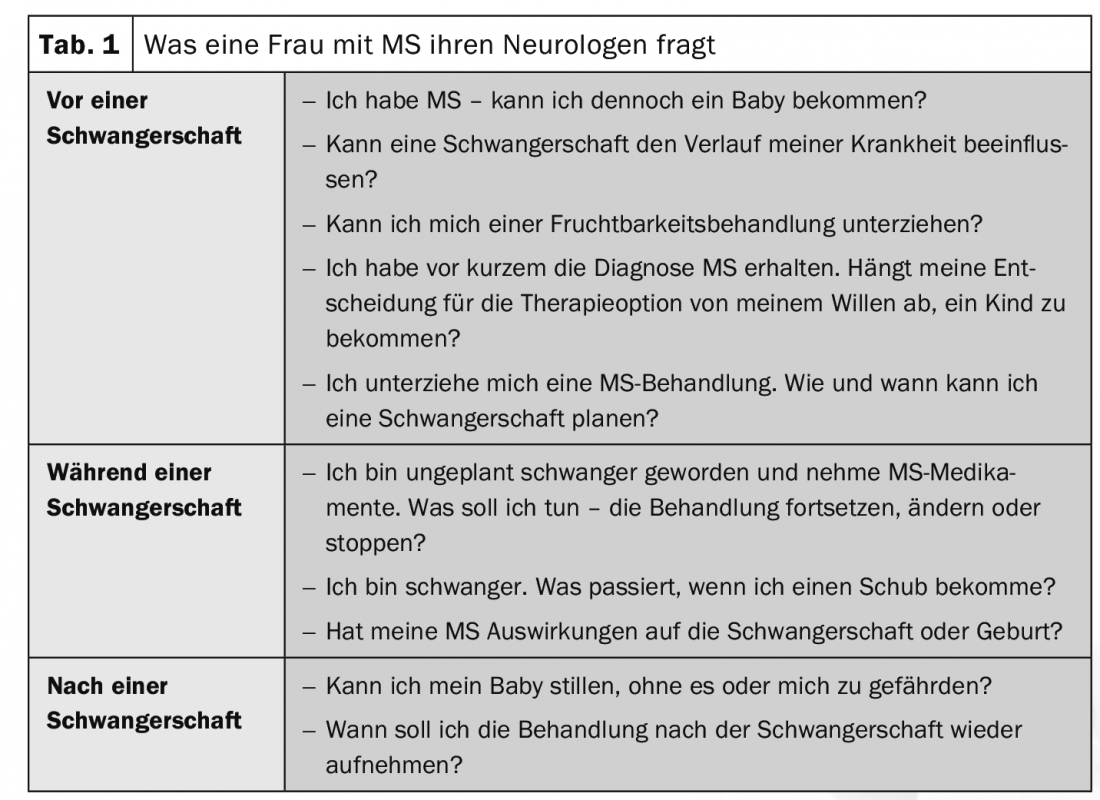


Whether the child inherits the disease depends on several factors. Basically, MS results from an interaction of genetics and environmental factors. The familial frequency is about 15%. If only one parent has MS, the risk that the child will also develop MS is 2%; if both parents have MS, the risk is 20%. But pregnancy also exerts a great influence on the mother and her disease. While the thrust rate is reduced by 70% in the third trimester, it increases significantly after birth. Only after a year does it return to its pre-pregnancy level. This is mainly due to increased hormone production of estrogen, progesterone and prolactin, reduction of pro-inflammatory genes and the shift from Th1 to Th2. The expert therefore advocates planning a pregnancy – ideally only in patients with a stable disease – in order to be able to provide patients with optimal support.


Continue treatment or interrupt – that is the question here

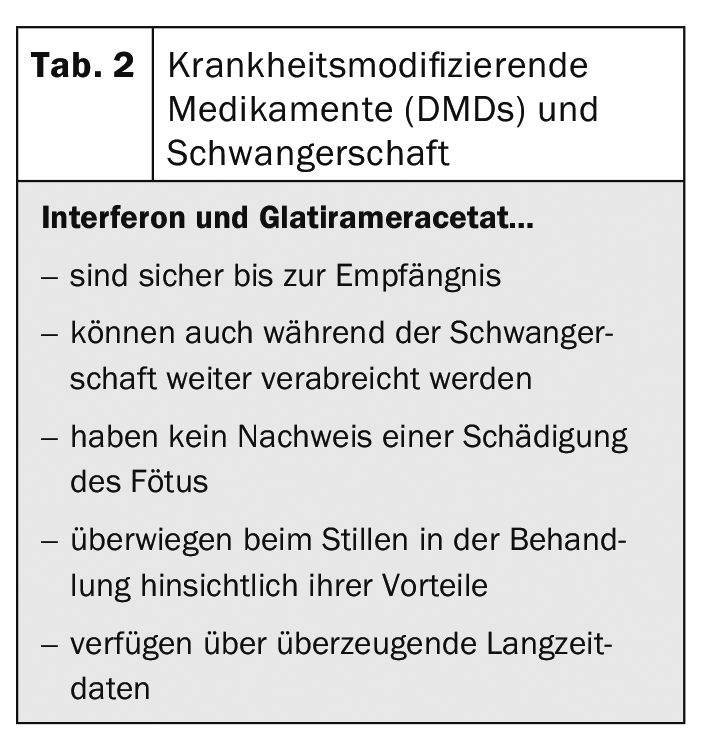
Established immunotherapies such as interferons or glatiramer acetate have convincing long-term data and a good benefit-risk profile. In case of pregnancy, it is necessary to keep in mind the risk for the baby (premature birth, weight, size, maldevelopment) in case of further treatment and the risk for the mother (reactivation of the disease, accumulation of disability) in case of stopping the treatment. In the meantime, there are numerous data regarding therapy management during pregnancy. For example, for interferon beta, the relative risk of congenital anomalies was shown to be 0.51 compared with other MS therapies. Since interferons are large molecules, they do not pass into breast milk, so there is nothing wrong with breastfeeding. The contraindication “pregnancy” could therefore be deleted from the technical information for interferons (Tab. 2) . Therefore, it can be discussed individually with the patient whether the therapy is continued during pregnancy, the expert concluded.

Source: EAN Virtual Congress 2020


InFo NEUROLOGY & PSYCHIATRY 2020; 18(4): 32 (published 6/30/20, ahead of print).

Autoren
  • Leoni Burggraf
Publikation
  • InFo NEUROLOGIE & PSYCHIATRIE
Related Topics
  • MS
  • Multiple sclerosis
Previous Article
  • September

Migraine and Headache Awareness Month

  • Neurology
  • News
  • RX
View Post
Next Article
  • Ovarian Cancer

Updated S3 guideline recommends PARP inhibitors and radiotherapy

  • Education
  • Gynecology
  • Oncology
  • RX
View Post
You May Also Like
View Post
  • 11 min
  • Peristomal skin health

Focus on preventive care options

    • RX
    • Cases
    • CME continuing education
    • Dermatology and venereology
    • Gastroenterology and Hepatology
    • Infectiology
    • Physical medicine and rehabilitation
    • Prevention and health care
    • Surgery
View Post
  • 5 min
  • Mental Health with GLP-1 RAs

Benefits of Semaglutide and Liraglutide

    • RX
    • Education
    • Endocrinology and Diabetology
    • General Internal Medicine
    • Nutrition
    • Psychiatry and psychotherapy
    • Studies
View Post
  • 4 min
  • Bronchiolitis obliterans

Out of shape even without popcorn

    • RX
    • Education
    • General Internal Medicine
    • Infectiology
    • Pediatrics
    • Pneumology
    • Studies
View Post
  • 8 min
  • Case study

Guillain-Barré syndrome with a fulminant course

    • RX
    • Cases
    • Education
    • Infectiology
    • Neurology
    • Pharmacology and toxicology
    • Radiology
    • Studies
View Post
  • 5 min
  • Suspicion of neuroborreliosis?

Detection of borrelia-specific CSF parameters provides certainty

    • RX
    • Congress Reports
    • Infectiology
    • Neurology
    • Studies
View Post
  • 12 min
  • The Brain and the Motivation to Eat

Why is it so hard to lose weight?

    • RX
    • CME continuing education
    • Endocrinology and Diabetology
    • General Internal Medicine
    • Nutrition
    • Pharmacology and toxicology
    • Prevention and health care
    • Psychiatry and psychotherapy
    • Studies
View Post
  • 12 min
  • Global Recommendation, Swissmedic Approval, and SL Limitation

WHO Guidelines on GLP-1 for Obesity

    • RX
    • Cardiology
    • Education
    • Endocrinology and Diabetology
    • General Internal Medicine
    • Nutrition
    • Pharmacology and toxicology
    • Prevention and health care
    • Studies
View Post
  • 7 min
  • Obesity in Children and Adolescents

Gene-Environment Interactions: Polygenic or Monogenic Determinants?

    • RX
    • Education
    • General Internal Medicine
    • Genetics
    • Nutrition
    • Pediatrics
  • IBD matters

    Zum Thema
Top CME content
  • 1
    Focus on preventive care options
  • 2
    Inflammation as a Treatment Goal in Its Own Right
  • 3
    Personalized Treatment Before a Planned Pregnancy
  • 4
    Current State of Knowledge and New Therapeutic Approaches
  • 5
    Why is it so hard to lose weight?

Newsletter

Sign up and stay up to date

Subscribe
Medizinonline Medizinonline
  • Contact
  • General terms and conditions
  • Imprint

Input your search keywords and press Enter.