Medizinonline Medizinonline
  • News
    • News
    • Market & Medicine
  • Patients
    • Disease patterns
    • Diagnostics
    • Therapy
  • Partner Content
    • Diabetes
      • Dia-Month Club – Type 2 Diabetes
      • Diabetes in Motion
      • Diabetes Podcasts
    • Gastroenterology
      • IBD matters
    • Oncology
      • Swiss Oncology in motion
    • Orthopedics
      • Osteoporosis in motion
  • Departments
    • Allergology and clinical immunology
    • General Internal Medicine
    • Anesthesiology
    • Angiology
    • Surgery
    • Dermatology and venereology
    • Endocrinology and Diabetology
    • Nutrition
    • Gastroenterology and Hepatology
    • Genetics
    • Geriatrics
    • Gynecology
    • Hematology
    • Infectiology
    • Cardiology
    • Nephrology
    • Neurology
    • Emergency and intensive care medicine
    • Nuclear Medicine
    • Oncology
    • Ophthalmology
    • ORL
    • Orthopedics
    • Pediatrics
    • Pharmacology and toxicology
    • Pharmaceutical medicine
    • Phlebology
    • Physical medicine and rehabilitation
    • Pneumology
    • Prevention and health care
    • Psychiatry and psychotherapy
    • Radiology
    • Forensic Medicine
    • Rheumatology
    • Sports Medicine
    • Traumatology and trauma surgery
    • Tropical and travel medicine
    • Urology
    • Dentistry
  • CME & Congresses
    • CME continuing education
    • Congress Reports
    • Congress calendar
  • Practice
    • Noctimed
    • Practice Management
    • Jobs
    • Interviews
  • Log In
  • Register
  • My account
  • Contact
  • Publications
  • Contact
  • Deutsch
  • English
  • Français
  • Italiano
  • Português
  • Español
Subscribe
Medizinonline Medizinonline
  • News
    • News
    • Market & Medicine
  • Patienten
    • Krankheitsbilder
    • Diagnostik
    • Therapie
  • Partner Content
    • Diabetes
      • Dia-Month Club – Type 2 Diabetes
      • Diabetes in Motion
      • Diabetes Podcasts
    • Gastroenterology
      • IBD matters
    • Oncology
      • Swiss Oncology in motion
    • Orthopedics
      • Osteoporosis in motion
    • Phytotherapie
    • Rheumatology
  • Departments
    • Fachbereiche 1-13
      • Allergology and clinical immunology
      • General Internal Medicine
      • Anesthesiology
      • Angiology
      • Surgery
      • Dermatology and venereology
      • Endocrinology and Diabetology
      • Nutrition
      • Gastroenterology and Hepatology
      • Genetics
      • Geriatrics
      • Gynecology
      • Hematology
    • Fachbereiche 14-26
      • Infectiology
      • Cardiology
      • Nephrology
      • Neurology
      • Emergency and intensive care medicine
      • Nuclear Medicine
      • Oncology
      • Ophthalmology
      • ORL
      • Orthopedics
      • Pediatrics
      • Pharmacology and toxicology
      • Pharmaceutical medicine
    • Fachbereiche 26-38
      • Phlebology
      • Physical medicine and rehabilitation
      • Phytotherapy
      • Pneumology
      • Prevention and health care
      • Psychiatry and psychotherapy
      • Radiology
      • Forensic Medicine
      • Rheumatology
      • Sports Medicine
      • Traumatology and trauma surgery
      • Tropical and travel medicine
      • Urology
      • Dentistry
  • CME & Congresses
    • CME continuing education
    • Congress Reports
    • Congress calendar
  • Practice
    • Noctimed
    • Practice Management
    • Jobs
    • Interviews
Login

Sie haben noch keinen Account? Registrieren

  • Anti-dementia drugs

Insight into everyday care in Switzerland

    • Education
    • Geriatrics
    • Pharmacology and toxicology
    • Psychiatry and psychotherapy
    • RX
    • Studies
  • 2 minute read

The proportion of anti-dementia drugs used varies according to age. While ginkgo biloba predominates up to the age of 70, cholinesterase inhibitors and memantine are used comparatively more from the age of 76. One trend that emerged in all age groups in the 2016-2022 observation period was an increasing demand for Ginkgo biloba.

The number of people with dementia in Switzerland is estimated to be 153,000 by 2023 and is set to rise due to demographic trends [1]. Anti-dementia drugs are primarily used to stabilize the cognitive symptoms of dementia and the impairment of everyday activities [2,3]. They have also been shown to be partially effective in the treatment of behavioral and psychological symptoms of dementia (BPSD). BPSD is common and can include depression, agitation, aggression, sleep disturbances, delusions, hallucinations, anxiety or apathy.

The following substances are currently subsumed under anti-dementia drugs [4]:

  • Ginkgo biloba is used for mild cognitive impairment (MCI) and incipient dementia (off-label). In addition to the indications mentioned, Ginkgo biloba is also effective for dizziness, tinnitus and peripheral arterial occlusive disease (PAOD).
  • The cholinesterase inhibitors donepezil, rivastigmine and galantamine are prescribed for mild to moderate dementia.
  • Memantine is reserved for cases of moderate to severe dementia.

According to the Obsan report commissioned by the National Dementia Platform (Federal Office of Public Health FOPH) and accompanied by a group of experts, older people take more anti-dementia drugs than younger people, as expected [4]. The use of the various anti-dementia drugs is distributed differently across the age groups (Fig. 1): up to and including the 66-70 age group, mainly Ginkgo biloba is used. In the 71- to 75-year-olds, it is relatively balanced and from around 76 years of age, cholinesterase inhibitors and memantine predominate. This distribution remained fairly stable over the years observed (2016-2022). The health insurance data analyzed also shows that during this observation period, an increase of +34.4% and +37.1% was recorded for Ginkgo biloba among 61- to 70-year-olds and ≥80-year-olds, while a decrease was observed for choliesterase inhibitors and memantine.
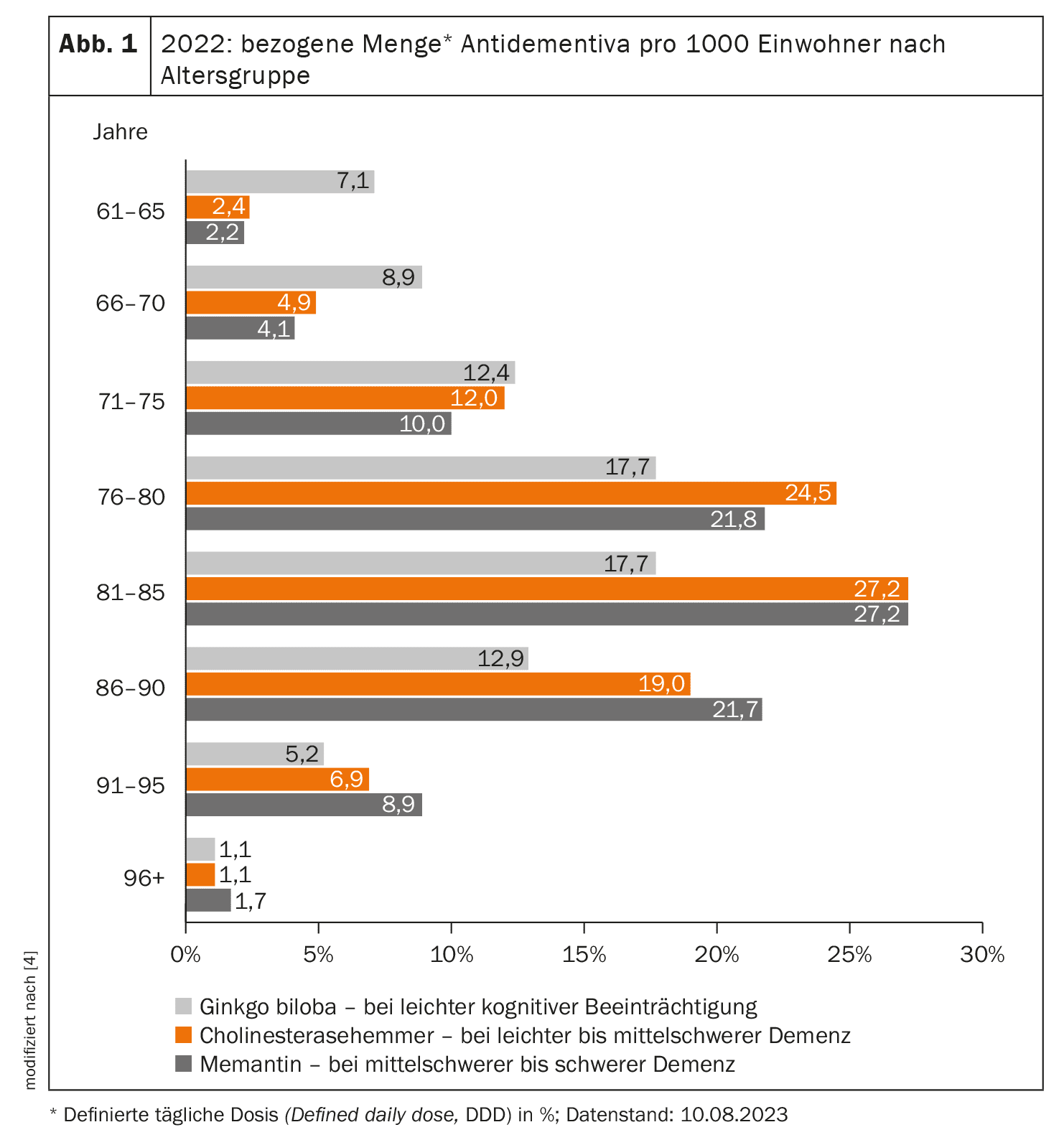
Broken down by outpatient vs. inpatient setting, the situation is as follows: in the outpatient sector, the volume of Ginkgo biloba increased by 32.6%. In contrast, cholinesterase inhibitors (-11.9%) and memantine (-10.1%) are used significantly less than at the beginning of the observation period. In nursing homes, Ginkgo biloba accounts for just under a third of prescribed anti-dementia drugs. One possible explanation for the increasing use of Ginkgo biloba is its prophylactic benefit and its applicability for subjective disorders. The analyses included medication purchases via compulsory health insurance (OKP). For example, EGb 761® (Tebokan®) is a special Ginkgo biloba extract for the symptomatic treatment of loss of mental performance, vertigo, tinnitus and PAD that is approved by health insurance companies [5].

Literature:

1. “Annual review 2023: Together for a good life with dementia”, www.alzheimer-schweiz.ch,(last accessed 20.11.2024).

2 Baskys A, Cheng JX: Pharmacological prevention and treatment of vascular dementia: Approaches and perspectives. Exp Gerontol 2012; 47: 887-891.

3. “Dementia: Diagnosis, treatment and care”, www.alzheimer-schweiz.ch/fileadmin/dam/Alzheimer_Schweiz/Dokumente/Publikationen-Produkte/159_D_Diagnose_2018_web.pdf,(last accessed 20.11.2024).

4. “Psychopharmaceuticals in dementia treatment”, www.obsan.admin.ch/sites/default/files/2024-06/obsan_bulletin_2024_01_d.pdf,(last accessed 20.11.2024).

5. technical information Tebokan®; https://www.swissmedicinfo.ch; status: April 2022.

InFo NEUROLOGY & PSYCHIATRY 2024; 22(6): 36
HAUSARZT PRAXIS 2024; 19(12): 28

Autoren
  • Mirjam Peter, M.Sc.
Publikation
  • HAUSARZT PRAXIS
  • InFo NEUROLOGIE & PSYCHIATRIE
Related Topics
  • anti-dementia drugs
  • Dementia
  • Ginkgo biloba
  • MCI
  • Memantine
Previous Article
  • Melanoma early detection

New study on tumor-specific antibodies

  • RX
  • Congress Reports
  • Dermatology and venereology
  • Oncology
  • Prevention and health care
  • Studies
View Post
Next Article
  • LDL cholesterol level

On the way to the (LDL-C) target

  • Cardiology
  • Education
  • General Internal Medicine
  • Hematology
  • RX
  • Studies
View Post
You May Also Like
View Post
  • 4 min
  • SwissDiab Study: New Analysis Published

How are diabetes complications associated with quality of life?

    • RX
    • Endocrinology and Diabetology
    • General Internal Medicine
    • Studies
View Post
  • 6 min
  • Pre-acclimatization on Mount Everest

Exploring the physiological limits

    • RX
    • Congress Reports
    • General Internal Medicine
    • Pneumology
    • Studies
    • Tropical and travel medicine
View Post
  • 5 min
  • Viloxazine for ADHD

A non-stimulating option—but with limited evidence

    • RX
    • Education
    • Neurology
    • Pediatrics
    • Pharmacology and toxicology
    • Psychiatry and psychotherapy
    • Studies
View Post
  • 6 min
  • Preclinical study on phytotherapeutic agent

Active ingredient combination of peppermint and caraway oil modified fecal microbiota

    • RX
    • Education
    • Gastroenterology and Hepatology
    • General Internal Medicine
    • Pharmaceutical medicine
    • Phytotherapy
    • Studies
View Post
  • 4 min
  • Casuistry

Rituximab used effectively against IgG4-RD colitis

    • RX
    • Cases
    • Education
    • Gastroenterology and Hepatology
    • General Internal Medicine
    • Radiology
    • Rheumatology
View Post
  • 5 min
  • Sarcoidosis

New options from JAKi to mTOR

    • RX
    • Congress Reports
    • General Internal Medicine
    • Pneumology
    • Studies
View Post
  • 6 min
  • Head and neck squamous cell carcinoma

Precision immunotherapy and local treatment

    • RX
    • Congress Reports
    • Dermatology and venereology
    • Oncology
    • ORL
    • Studies
View Post
  • 3 min
  • From symptom to diagnosis

Abdominal pain – Prostate cysts

    • RX
    • Cases
    • Education
    • General Internal Medicine
    • Radiology
    • Surgery
    • Urology
  • IBD matters

    Zum Thema
Top CME content
  • 1
    Current State of Knowledge and New Therapeutic Approaches
  • 2
    Why is it so hard to lose weight?
  • 3
    Functional limb preservation between infection control, vascular medicine and resurfacing
  • 4
    Algorithms, avatars and the unburdened mind
  • 5
    Communication as the key to therapy adherence

Newsletter

Sign up and stay up to date

Subscribe
Medizinonline Medizinonline
  • Contact
  • General terms and conditions
  • Imprint

Input your search keywords and press Enter.