Medizinonline Medizinonline
  • News
    • News
    • Market & Medicine
  • Patients
    • Disease patterns
    • Diagnostics
    • Therapy
  • Partner Content
    • Dermatology
      • Atopic dermatitis and psoriasis news
    • Diabetes
      • Dia-Month Club – Type 2 Diabetes
      • Diabetes in Motion
      • Diabetes Podcasts
    • Gastroenterology
      • IBD matters
    • Oncology
      • Swiss Oncology in motion
    • Orthopedics
      • Osteoporosis in motion
  • Departments
    • Allergology and clinical immunology
    • General Internal Medicine
    • Anesthesiology
    • Angiology
    • Surgery
    • Dermatology and venereology
    • Endocrinology and Diabetology
    • Nutrition
    • Gastroenterology and Hepatology
    • Genetics
    • Geriatrics
    • Gynecology
    • Hematology
    • Infectiology
    • Cardiology
    • Nephrology
    • Neurology
    • Emergency and intensive care medicine
    • Nuclear Medicine
    • Oncology
    • Ophthalmology
    • ORL
    • Orthopedics
    • Pediatrics
    • Pharmacology and toxicology
    • Pharmaceutical medicine
    • Phlebology
    • Physical medicine and rehabilitation
    • Pneumology
    • Prevention and health care
    • Psychiatry and psychotherapy
    • Radiology
    • Forensic Medicine
    • Rheumatology
    • Sports Medicine
    • Traumatology and trauma surgery
    • Tropical and travel medicine
    • Urology
    • Dentistry
  • CME & Congresses
    • CME continuing education
    • Congress Reports
    • Congress calendar
  • Practice
    • Noctimed
    • Practice Management
    • Jobs
    • Interviews
  • Log In
  • Register
  • My account
  • Contact
  • Publications
  • Contact
  • Deutsch
  • English
  • Français
  • Italiano
  • Português
  • Español
Subscribe
Medizinonline Medizinonline
  • News
    • News
    • Market & Medicine
  • Patienten
    • Krankheitsbilder
    • Diagnostik
    • Therapie
  • Partner Content
    • Dermatology
      • Atopic dermatitis and psoriasis news
    • Diabetes
      • Dia-Month Club – Type 2 Diabetes
      • Diabetes in Motion
      • Diabetes Podcasts
    • Gastroenterology
      • IBD matters
    • Oncology
      • Swiss Oncology in motion
    • Orthopedics
      • Osteoporosis in motion
    • Phytotherapie
    • Rheumatology
  • Departments
    • Fachbereiche 1-13
      • Allergology and clinical immunology
      • General Internal Medicine
      • Anesthesiology
      • Angiology
      • Surgery
      • Dermatology and venereology
      • Endocrinology and Diabetology
      • Nutrition
      • Gastroenterology and Hepatology
      • Genetics
      • Geriatrics
      • Gynecology
      • Hematology
    • Fachbereiche 14-26
      • Infectiology
      • Cardiology
      • Nephrology
      • Neurology
      • Emergency and intensive care medicine
      • Nuclear Medicine
      • Oncology
      • Ophthalmology
      • ORL
      • Orthopedics
      • Pediatrics
      • Pharmacology and toxicology
      • Pharmaceutical medicine
    • Fachbereiche 26-38
      • Phlebology
      • Physical medicine and rehabilitation
      • Phytotherapy
      • Pneumology
      • Prevention and health care
      • Psychiatry and psychotherapy
      • Radiology
      • Forensic Medicine
      • Rheumatology
      • Sports Medicine
      • Traumatology and trauma surgery
      • Tropical and travel medicine
      • Urology
      • Dentistry
  • CME & Congresses
    • CME continuing education
    • Congress Reports
    • Congress calendar
  • Practice
    • Noctimed
    • Practice Management
    • Jobs
    • Interviews
Login

Sie haben noch keinen Account? Registrieren

  • Therapy-refractory focal epilepsy

New add-on antiepileptic drug significantly reduces seizure frequency

    • Education
    • General Internal Medicine
    • Neurology
    • RX
    • Studies
  • 3 minute read

For the treatment of focal epilepsy that cannot be adequately controlled despite previous therapy with at least two anticonvulsants, a new add-on therapy has recently become available for adults – an antiepileptic agent from the carbamate group.

Long-term drug therapy for epilepsy is symptomatic with the aim of reducing the frequency of seizures. Although numerous new antiepileptic drugs have come on the market in recent decades, about 35-40% of newly diagnosed patients do not achieve permanent seizure freedom despite taking several drugs [1,2]. Epilepsy is considered refractory when adequate seizure control is not achieved despite therapy with at least two antiepileptic drugs [3]. In focal seizures, pathological neurological activity occurs in the brain in a circumscribed area of the brain (temporal lobe, frontal lobe, parietal lobe, or occipital lobe) [4]. Clinically, this manifests itself, for example, as rhythmic twitching or cramping of individual limbs, although the affected person is usually conscious.

Since July 2022, cenobamate (Ontozry®) has been approved in Switzerland for adult epileptics as an add-on therapy for focal seizures that are not adequately controlled despite a history of treatment with at least two antiepileptic drugs [5]. According to current knowledge, cenobamate has a dual mechanism of action in that it acts as a sodium channel blocker on the one hand and modulates the presynaptic release of GABA (γ-aminobutyric acid) on the other.

High response rates in clinical trial

The clinical efficacy of cenobamate was evaluated in a randomized-controlled, double-blinded C017 multicenter trial, among others [6]. An inclusion criterion for the C017 study was that at least 3 or 4 partial seizures per 28 days occurred during the 8-week prospective baseline period, with a seizure-free period not to exceed 3 to 4 weeks. This was followed by an 18-week treatment period, including 12 weeks of fixed dose. 397 randomized study participants were included in the modified intention-to-treat maintenance phase population: Cenobamate 100 mg (n=102), Cenobamate 200 mg (n=98), Cenobamate 400 mg (n=95), Placebo (n=102). More than three-quarters of patients were taking two or more antiepileptic drugs concomitantly at the time of enrollment, the most common being levetiracetam, lamotrigine, carbamazepine, and lacosamide [5].
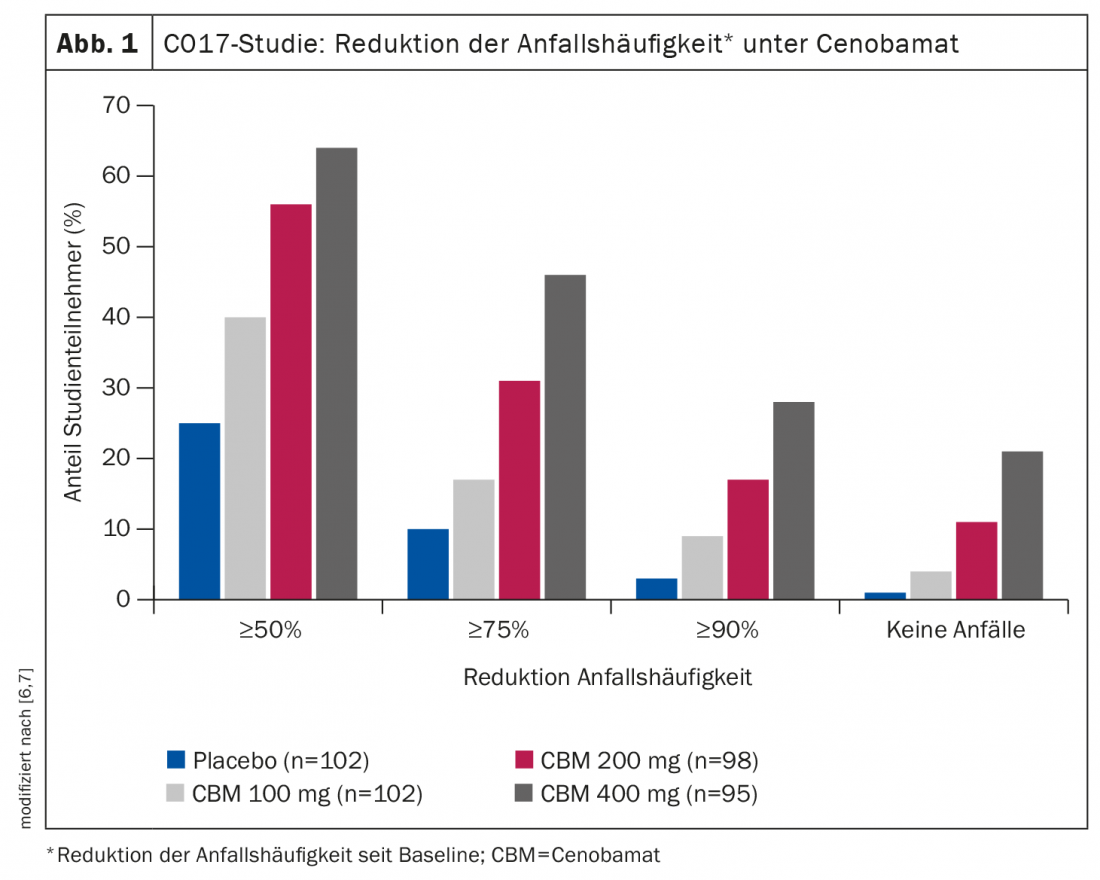


The main study results are shown in Figure 1 [7]: A reduction in seizure frequency of ≥50% from baseline, was achieved by 40% on 100 mg cenobamate, 56% on 200 mg, and 64% on 400 mg versus approximately 25% in the placebo group. Seizure-free rates were 21% in the 400 mg group and 11% in the 200 mg group versus 1% on placebo. Side effects were significantly more frequent with the 400 mg dose. The most common adverse reactions leading to discontinuation were ataxia, dizziness, somnolence, nystagmus, and double vision [8].


Literature:

  1. Chen Z, et al: Treatment outcomes in patients with newly diagnosed epilepsy treated with established and new antiepileptic drugs: a 30-year longitudinal cohort study. JAMA Neurol 2018;75(3): 279-86.
  2. Tian N, et al: Active epilepsy and seizure control in adults-United States, 2013.
  3. Institute for Quality and Efficiency in Health Care (IQWiG) 2020, www.iqwig.de/methoden/allgemeine-methoden_version-6-0.pdf?rev=180500, (last accessed 07/22/2022).
  4. S1 Guideline: First epileptic seizure and epilepsies in adulthood, 2017, https://www.awmf.org/uploads/tx_szleitlinien/030-041l_S1_Erster-epileptischer-Anfall_Epilespien_2018-05.pdf, (last accessed 07/22/2022).
  5. Swiss Drug Compendium, https://compendium.ch, (last retrieved
  6. Krauss GL, et al: Safety and efficacy of adjunctive cenobamate (YKP3089) in patients with uncontrolled focal seizures: a multicentre, double-blind, randomised, placebo-controlled, dose-response trial. The Lancet Neurology 2020; 19(1): 38-48.
  7. Chung SS: Cenobamate: new antiseizure medication with high seizure freedom and dual mechanisms of action. J Pharmacol Pharm Res 2021; 4(2): 2-3, https://researchopenworld.com/wp-content/uploads/2021/07/JPPR-4-424.pdf
  8. Drugs: Cenobamate: Ontozry®, www.pharmazeutische-zeitung.de/arzneistoffe/daten/2021/cenobamatontozryr152021 (last accessed 07/22/2022).


HAUSARZT PRAXIS 2022; 17(8): 21
InFo NEUROLOGY & PSYCHIATRY 2022; 20(5): 33.

Autoren
  • Mirjam Peter, M.Sc.
Publikation
  • HAUSARZT PRAXIS
Related Topics
  • Epilepsy
  • frequency of occurrence
Previous Article
  • Brain diseases

Supply strategies discussed on an interdisciplinary basis

  • Congress Reports
  • Neurology
  • Pharmacology and toxicology
  • Psychiatry and psychotherapy
  • RX
  • Studies
View Post
Next Article
  • Psoriasis

Tissue-resident memory T cells as “key players”.

  • Allergology and clinical immunology
  • Congress Reports
  • Dermatology and venereology
  • Genetics
  • Rheumatology
  • RX
View Post
You May Also Like
View Post
  • 6 min
  • Angiosarcoma of the heart

A diagnostic and therapeutic “black box”

    • Cardiology
    • Education
    • Oncology
    • Radiology
    • RX
    • Studies
View Post
  • 5 min
  • Ataxias

Friedreich’s ataxia: when the energy metabolism attacks the nervous system

    • Education
    • Genetics
    • Neurology
    • RX
    • Studies
View Post
  • 3 min
  • Risk of osteoporosis in autoimmune liver diseases

Always determine bone density in PBC, PSC and AIH

    • Education
    • Gastroenterology and Hepatology
    • General Internal Medicine
    • Orthopedics
    • RX
    • Studies
View Post
  • 3 min
  • Case report: Complication after type 2 diabetes

Topical corticosteroids lead to ketoacidosis

    • Cases
    • Education
    • Endocrinology and Diabetology
    • Ophthalmology
    • RX
View Post
  • 12 min
  • NSCLC

Bispecific antibodies for rare EGFR mutations

    • Education
    • Oncology
    • Pneumology
    • RX
    • Studies
View Post
  • 6 min
  • Type 2 diabetes - glycemic control and prevention of secondary diseases

Utilizing pleiotropic cardio- and nephroprotective effects of SGLT-2-i and GLP-1-RA

    • Cardiology
    • Congress Reports
    • Endocrinology and Diabetology
    • Nephrology
    • RX
    • Studies
View Post
  • 6 min
  • Subsyndromal anxiety disorders: Family doctor as first point of contact

Practical recommendations for diagnostics and therapy

    • Education
    • General Internal Medicine
    • Pharmacology and toxicology
    • Phytotherapy
    • Psychiatry and psychotherapy
    • RX
    • Studies
View Post
  • 12 min
  • Patient-centered rounds in medicine

Aligning care with the patient

    • CME continuing education
    • Education
    • General Internal Medicine
    • Prevention and health care
    • RX
    • Studies
Banner Landingpage Kurzfachinfo
  • IBD matters

    Zum Thema
Top CME content
  • 1
    Interplay between cancer and mental illness
  • 2
    Can you swallow intelligence? Relevant substance classes times for healthy people
  • 3
    PH and lung diseases
  • 4
    Causes and prevention at work
  • 5
    Clinical care from birth to adulthood

Newsletter

Sign up and stay up to date

Subscribe
Medizinonline Medizinonline
  • Contact
  • General terms and conditions
  • Imprint

Input your search keywords and press Enter.