Medizinonline Medizinonline
  • News
    • News
    • Market & Medicine
  • Patients
    • Disease patterns
    • Diagnostics
    • Therapy
  • Partner Content
    • Diabetes
      • Dia-Month Club – Type 2 Diabetes
      • Diabetes in Motion
    • Gastroenterology
      • IBD matters
    • Oncology
      • Swiss Oncology in motion
    • Orthopedics
      • Osteoporosis in motion
  • Departments
    • Allergology and clinical immunology
    • General Internal Medicine
    • Anesthesiology
    • Angiology
    • Surgery
    • Dermatology and venereology
    • Endocrinology and Diabetology
    • Nutrition
    • Gastroenterology and Hepatology
    • Genetics
    • Geriatrics
    • Gynecology
    • Hematology
    • Infectiology
    • Cardiology
    • Nephrology
    • Neurology
    • Emergency and intensive care medicine
    • Nuclear Medicine
    • Oncology
    • Ophthalmology
    • ORL
    • Orthopedics
    • Pediatrics
    • Pharmacology and toxicology
    • Pharmaceutical medicine
    • Phlebology
    • Physical medicine and rehabilitation
    • Pneumology
    • Prevention and health care
    • Psychiatry and psychotherapy
    • Radiology
    • Forensic Medicine
    • Rheumatology
    • Sports Medicine
    • Traumatology and trauma surgery
    • Tropical and travel medicine
    • Urology
    • Dentistry
  • CME & Congresses
    • CME continuing education
    • Congress Reports
    • Congress calendar
  • Practice
    • Noctimed
    • Practice Management
    • Jobs
    • Interviews
  • Log In
  • Register
  • My account
  • Contact
  • Publications
  • Contact
  • Deutsch
  • English
  • Français
  • Italiano
  • Português
  • Español
Subscribe
Medizinonline Medizinonline
  • News
    • News
    • Market & Medicine
  • Patienten
    • Krankheitsbilder
    • Diagnostik
    • Therapie
  • Partner Content
    • Diabetes
      • Dia-Month Club – Type 2 Diabetes
      • Diabetes in Motion
    • Gastroenterology
      • IBD matters
    • Oncology
      • Swiss Oncology in motion
    • Orthopedics
      • Osteoporosis in motion
    • Phytotherapie
    • Rheumatology
  • Departments
    • Fachbereiche 1-13
      • Allergology and clinical immunology
      • General Internal Medicine
      • Anesthesiology
      • Angiology
      • Surgery
      • Dermatology and venereology
      • Endocrinology and Diabetology
      • Nutrition
      • Gastroenterology and Hepatology
      • Genetics
      • Geriatrics
      • Gynecology
      • Hematology
    • Fachbereiche 14-26
      • Infectiology
      • Cardiology
      • Nephrology
      • Neurology
      • Emergency and intensive care medicine
      • Nuclear Medicine
      • Oncology
      • Ophthalmology
      • ORL
      • Orthopedics
      • Pediatrics
      • Pharmacology and toxicology
      • Pharmaceutical medicine
    • Fachbereiche 26-38
      • Phlebology
      • Physical medicine and rehabilitation
      • Phytotherapy
      • Pneumology
      • Prevention and health care
      • Psychiatry and psychotherapy
      • Radiology
      • Forensic Medicine
      • Rheumatology
      • Sports Medicine
      • Traumatology and trauma surgery
      • Tropical and travel medicine
      • Urology
      • Dentistry
  • CME & Congresses
    • CME continuing education
    • Congress Reports
    • Congress calendar
  • Practice
    • Noctimed
    • Practice Management
    • Jobs
    • Interviews
Login

Sie haben noch keinen Account? Registrieren

  • ADHD

Symptom change masks disease in adulthood

    • Education
    • Neurology
    • Pediatrics
    • Pharmacology and toxicology
    • RX
  • 3 minute read

ADHD is a neurodevelopmental disorder that begins in childhood or early adolescence and often persists into adulthood with different trajectories across the lifespan. However, due to a change in symptoms, the disease is often not detected in adulthood. As a result, there is still a clear gap in the treatment of adult ADHD.

Although attention deficit/hyperactivity disorder (ADHD) was first described in 1775 and can therefore look back on a long history, there are still divergent opinions on this disorder, not only among the general public, but also among some experts. In a survey, just half of those questioned stated that they considered the symptoms to be a mental illness. One in five people do not believe that ADHD is a real disorder and most were convinced that childhood ADHD is due to the family-social context. The causes of ADHD are subject to a multifunctional process and are very diverse. One neurobiological cause of the disease is thought to be faulty impulse processing between cortical and subcortical structures in the brain. Pathophysiologically, it is assumed that there is a disturbance in neurotransmitter metabolism, particularly in dopamine and noradrenaline. The hereditary component should not be ignored either.

Symptoms in childhood

The first signs of ADHD can already be detected in infancy. The main characteristics are long crying phases, eating and sleeping problems, refusal of physical contact and restlessness. Of course, all of this can also be observed for a number of other causes, so they are not diagnostic. However, we know from the experience of crying outpatients that infants with early childhood regulatory disorders such as sleep and feeding disorders, dysphoric restlessness, excessive crying, defiance and clinging as well as sleep-wake regulation disorders are more likely to develop ADHD later on. In toddlers, rapid changes in activity, little stamina when playing, conspicuous defiant behavior and an accumulation of accidents or accident-prone behavior stand out. This also applies to motor deficits that become apparent around the second or third year of life. At school age, the typical symptom triad of hyperactivity, inattention and impulsivity is often recognized. Around 3-5% of all children and adolescents are affected by ADHD – boys significantly more often than girls. This makes ADHD one of the most common child psychiatric disorders.
Symptom change in adulthood

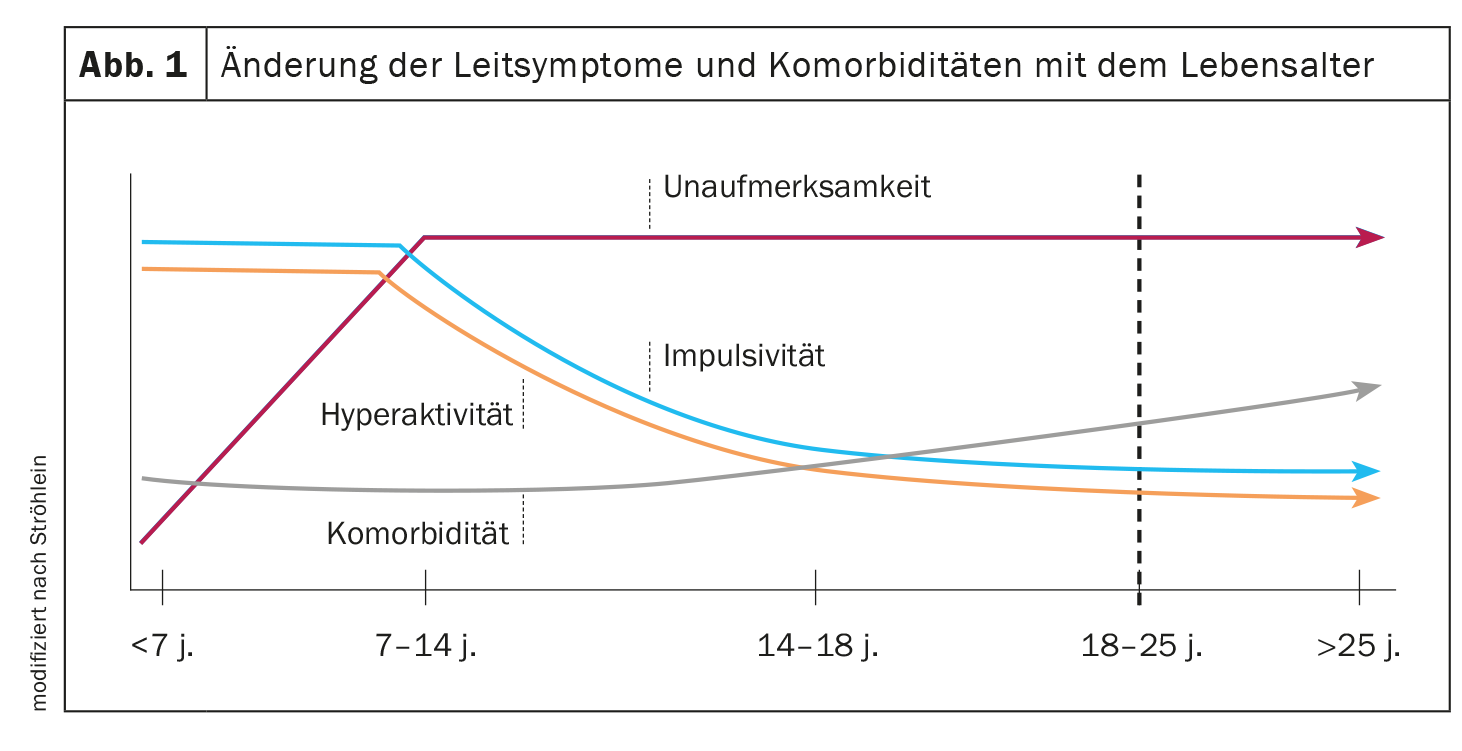
ADHD is a chronic disorder with a high tendency to persist. According to estimates by a German group of experts, in up to 80% of cases of ADHD, some or all of the symptoms of the disorder persist in adulthood. However, the typical symptoms can change, so that the disease is perceived differently in adults. The hyperactivity is often no longer acted out, but rather gives way to an inner restlessness. Sitting still for long periods is generally avoided. If this is not possible, many sufferers try to reduce their restlessness by tapping their foot or drumming their fingers continuously. The inattention remains in most cases and is now noticeable in the form of concentration difficulties. Patients remain easily distracted and often have difficulty concentrating on details or distinguishing the important from the unimportant. Impulsivity is also still found in adult ADHD.

When diagnosing ADHD, a distinction is therefore made between subtypes of the disorder, which are dependent on the primary symptoms:

  • the ADHD subtype with predominant attention deficit disorder
  • the ADHD subtype with predominant hyperactivity and impulsivity
  • the ADHD mixed type (with attention deficit disorder plus hyperactivity-impulsivity).

Symptom supplements are a burden for those affected

However, in addition to the main symptoms, many adult ADHD patients also report other symptoms that can significantly restrict their quality of life. These include rash actions, emotional lability, increased irritability, emotional hyper-reactivity and disorganized behaviour. In a doctor’s office, adult ADHD patients stand out, for example, because they repeatedly forget their appointments, fail to bring required documents and often throw the entire office routine into chaos. In addition, ADHD rarely comes alone. It is not uncommon for undiagnosed sufferers to present with depression or an anxiety disorder, for example, which can occur comorbidly with ADHD. The motto here is: Be vigilant!

Further reading:

  • Speerforck, et al: JAD 2019; 25: 783-793.
  • Purper-Quakil D: Med Sci (Paris). 2010; 26(5): 487-496.
  • S3 guideline “Attention deficit/hyperactivity disorder (ADHD) in children, adolescents and adults” (2018), AWMF register number 028-045.
  • www.adhs-infoportal.de/adhs-bei-erwachsenen
  • Ströhlein B, et al: Transition in ADHD: Critical developmental tasks and their management. NeuroTransmitter 2016; 27.

InFo NEUROLOGY & PSYCHIATRY 2024; 22(3): 30

Autoren
  • Leoni Burggraf
Publikation
  • InFo NEUROLOGIE & PSYCHIATRIE
  • HAUSARZT PRAXIS
Related Topics
  • ADHD
  • adult ADHD
Previous Article
  • Hypomagnesemia

Renal or extrarenal causes?

  • Education
  • General Internal Medicine
  • Hematology
  • Nephrology
  • RX
  • Studies
View Post
Next Article
  • Allergic rhinitis

AIT reduces nasal sprays – temporarily

  • Allergology and clinical immunology
  • ORL
  • RX
  • Studies
View Post
You May Also Like
View Post
  • 4 min
  • Preclinical Study on a Special Ginkgo biloba Extract

What role do proanthocyanidins play?

    • RX
    • Education
    • General Internal Medicine
    • Geriatrics
    • Neurology
    • Pharmaceutical medicine
    • Pharmacology and toxicology
    • Phytotherapy
    • Studies
View Post
  • 6 min
  • Myasthenia gravis: immunomodulatory therapies for long-term treatment

Expanded Possibilities Thanks to Innovative Classes of Active Ingredients

    • RX
    • Congress Reports
    • General Internal Medicine
    • Neurology
    • Ophthalmology
    • Studies
View Post
  • 10 min
  • Interstitial Lung Diseases

Update on Idiopathic Pulmonary Fibrosis

    • RX
    • CME continuing education
    • Pneumology
    • Studies
View Post
  • 7 min
  • Plastic surgery and reconstructive microsurgery for DFS

Functional limb preservation between infection control, vascular medicine and resurfacing

    • RX
    • Angiology
    • CME continuing education
    • Dermatology and venereology
    • Endocrinology and Diabetology
    • General Internal Medicine
    • Geriatrics
    • Physical medicine and rehabilitation
    • Surgery
View Post
  • 7 min
  • Ischemic stroke: Are smaller or larger brain arteries affected?

Recent study findings on intravenous lysis therapy with fibrinolytic agents

    • RX
    • Congress Reports
    • Emergency and intensive care medicine
    • General Internal Medicine
    • Neurology
    • Pharmacology and toxicology
    • Studies
    • Surgery
View Post
  • 7 min
  • Interview

“On par with the gold standards for trauma”

    • RX
    • Education
    • Interviews
    • Neurology
    • Physical medicine and rehabilitation
    • Psychiatry and psychotherapy
    • Studies
View Post
  • 5 min
  • Psychology: Emotional Freedom Techniques (EFT)

Emotional Healing Through Tapping

    • RX
    • Education
    • General Internal Medicine
    • Neurology
    • Physical medicine and rehabilitation
    • Psychiatry and psychotherapy
    • Studies
View Post
  • 5 min
  • Systemic Lupus (SLE): What Does the Diagnosis and Treatment Toolbox Have to Offer?

Treat-to-Target – Consensus Recommendations for GC Tapering and the Use of DMARDs

    • RX
    • Congress Reports
    • General Internal Medicine
    • Nephrology
    • Rheumatology
    • Studies
  • IBD matters

    Zum Thema
Top CME content
  • 1
    Functional limb preservation between infection control, vascular medicine and resurfacing
  • 2
    Update on Idiopathic Pulmonary Fibrosis
  • 3
    Update on Idiopathic Pulmonary Fibrosis
  • 4
    Current status of PAT
  • 5
    Darier’s Disease, also known as Follicular Keratosis – Update 2026

Newsletter

Sign up and stay up to date

Subscribe
Medizinonline Medizinonline
  • Contact
  • General terms and conditions
  • Imprint

Input your search keywords and press Enter.