Medizinonline Medizinonline
  • News
    • News
    • Market & Medicine
  • Patients
    • Disease patterns
    • Diagnostics
    • Therapy
  • Partner Content
    • Diabetes
      • Dia-Month Club – Type 2 Diabetes
      • Diabetes in Motion
    • Gastroenterology
      • IBD matters
    • Oncology
      • Swiss Oncology in motion
    • Orthopedics
      • Osteoporosis in motion
  • Departments
    • Allergology and clinical immunology
    • General Internal Medicine
    • Anesthesiology
    • Angiology
    • Surgery
    • Dermatology and venereology
    • Endocrinology and Diabetology
    • Nutrition
    • Gastroenterology and Hepatology
    • Genetics
    • Geriatrics
    • Gynecology
    • Hematology
    • Infectiology
    • Cardiology
    • Nephrology
    • Neurology
    • Emergency and intensive care medicine
    • Nuclear Medicine
    • Oncology
    • Ophthalmology
    • ORL
    • Orthopedics
    • Pediatrics
    • Pharmacology and toxicology
    • Pharmaceutical medicine
    • Phlebology
    • Physical medicine and rehabilitation
    • Pneumology
    • Prevention and health care
    • Psychiatry and psychotherapy
    • Radiology
    • Forensic Medicine
    • Rheumatology
    • Sports Medicine
    • Traumatology and trauma surgery
    • Tropical and travel medicine
    • Urology
    • Dentistry
  • CME & Congresses
    • CME continuing education
    • Congress Reports
    • Congress calendar
  • Practice
    • Noctimed
    • Practice Management
    • Jobs
    • Interviews
  • Log In
  • Register
  • My account
  • Contact
  • Publications
  • Contact
  • Deutsch
  • English
  • Français
  • Italiano
  • Português
  • Español
Subscribe
Medizinonline Medizinonline
  • News
    • News
    • Market & Medicine
  • Patienten
    • Krankheitsbilder
    • Diagnostik
    • Therapie
  • Partner Content
    • Diabetes
      • Dia-Month Club – Type 2 Diabetes
      • Diabetes in Motion
    • Gastroenterology
      • IBD matters
    • Oncology
      • Swiss Oncology in motion
    • Orthopedics
      • Osteoporosis in motion
    • Phytotherapie
    • Rheumatology
  • Departments
    • Fachbereiche 1-13
      • Allergology and clinical immunology
      • General Internal Medicine
      • Anesthesiology
      • Angiology
      • Surgery
      • Dermatology and venereology
      • Endocrinology and Diabetology
      • Nutrition
      • Gastroenterology and Hepatology
      • Genetics
      • Geriatrics
      • Gynecology
      • Hematology
    • Fachbereiche 14-26
      • Infectiology
      • Cardiology
      • Nephrology
      • Neurology
      • Emergency and intensive care medicine
      • Nuclear Medicine
      • Oncology
      • Ophthalmology
      • ORL
      • Orthopedics
      • Pediatrics
      • Pharmacology and toxicology
      • Pharmaceutical medicine
    • Fachbereiche 26-38
      • Phlebology
      • Physical medicine and rehabilitation
      • Phytotherapy
      • Pneumology
      • Prevention and health care
      • Psychiatry and psychotherapy
      • Radiology
      • Forensic Medicine
      • Rheumatology
      • Sports Medicine
      • Traumatology and trauma surgery
      • Tropical and travel medicine
      • Urology
      • Dentistry
  • CME & Congresses
    • CME continuing education
    • Congress Reports
    • Congress calendar
  • Practice
    • Noctimed
    • Practice Management
    • Jobs
    • Interviews
Login

Sie haben noch keinen Account? Registrieren

  • Cranberry and cranberry

Very similar, but not identical

    • General Internal Medicine
    • News
    • Pharmaceutical medicine
    • RX
    • Studies
    • Urology
  • 3 minute read

A cranberry preparation as an additional treatment for cystitis: this is often recommended in doctors’ offices and pharmacies. But few experts know that in Europe most of these preparations do not contain cranberries but cranberries, and that cranberry is not the English word for cranberry.

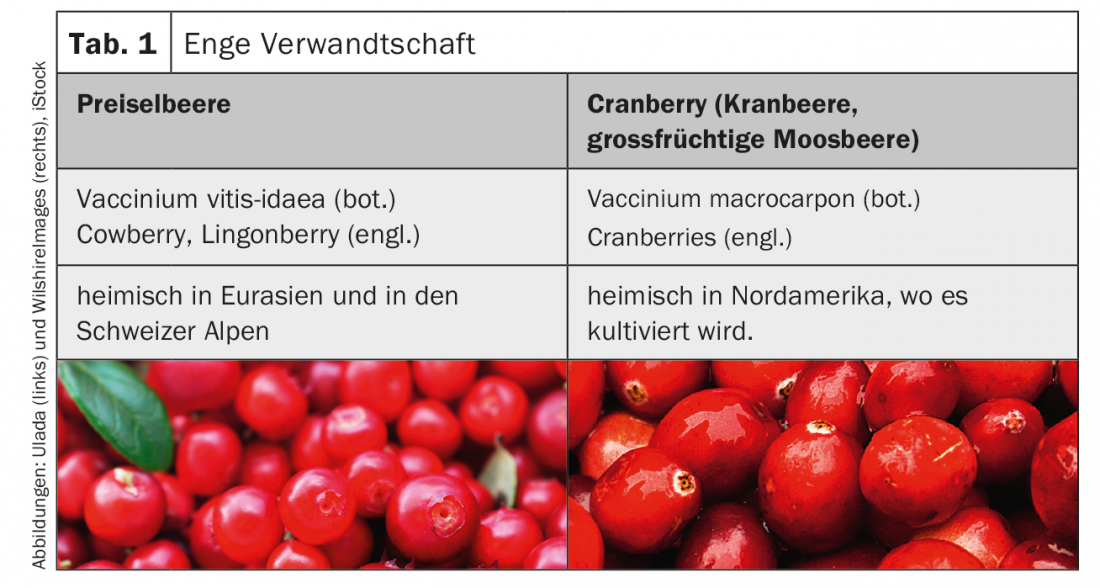
Both medicinal plants belong to the genus Vaccinium (blueberries) of the heather family (Ericaceae), to which the bilberry also belongs. European cranberry is less common because it is less scientifically studied. Cranberry and cranberry can be easily distinguished by their size. Cranberries are about the size of grapes, while cranberries are similar in size to peas (Table 1).


What’s in it?

In both species of the genus Vaccinium, the highest concentration of very similar ingredients is found, especially in the berries. First and foremost are A-type proanthocyanidins, which belong to the flavonoids. Type A proanthocyanidins represent a mixture of oligomers consisting predominantly of epicatechin units (isomers of catechin). In addition, anthocyanins and organic acids such as benzoic acid and ascorbic acid, vitamins, tannins and minerals are found in both medicinal plants.

Effect and application

Due to the largely identical ingredients, the applications and effects are also comparable. Preparations from the fruit are used for prevention and treatment of recurrent urinary tract infections. The two medicinal plants possess anti-adhesive, antimicrobial, anti-inflammatory and antioxidant properties. The A-type proanthocyanidins are mainly responsible for this. They inhibit the attachment of bacteria to the cells of the urinary bladder. Clinical studies with cranberries showed efficacy at 30-300 ml of pure juice per day.

Studies

In a study, the daily intake of 50 ml of a Finnish combination preparation (cranberry + lingonberry) led to a reduction of urinary tract infection recurrences by about 20% after six months compared to Lactobacillus preparations or placebo. No difference was observed after twelve months [1]. Another clinical study showed that cranberry preparations were as effective as antibiotics in preventing urinary tract infections in both healthy children and children with present urogenital abnormalities [2]. The renowned Cochrane Collaboration has also looked into the effectiveness of cranberry. In a report, she notes “that cranberry juice appears to reduce the incidence of recurrence in women with recurrent UTIs during a 12-month surveillance period.” Nevertheless, the overall assessment holds that cranberry juice cannot be recommended for the reduction of UTI [3]. On the other hand, a meta-analysis declared that the efficacy of cranberry juice for prophylaxis of UTI was given [4]. No clinical studies could be found about the effectiveness of cranberries, there are only some pharmacological studies.

Summary

Cranberries and cranberries are closely related botanically and have a nearly identical spectrum of constituents that confer efficacy on both medicinal plants for the treatment and prevention of UTIs and the prevention of recurrences, respectively. In this regard, both preparations can be used. However, actual clinical studies are only available for cranberries, where there are also negative studies. The problem probably lies in the fact that for the (American) studies simply “cranberryjuice” was used, the corresponding preparation was thus quantitatively not standardized.


Preparations in Switzerland
There are several cranberry and some cranberry preparations available in Switzerland. However, they are not approved as medicines, but are registered as dietary supplements. Therefore, they are on the negative list, i.e. they may not be reimbursed by health insurance companies.


Literature:

  1. Kontiokari T, et al: BMJ 2001; 322: 1571.
  2. Durham SA, et al: Ann Pharmacother 2015; 49(12): 1349-1356.
  3. Jepson RG, et al: Cranberries for preventing urinary tract infections. Cochrane Database Syst Rev 2012; 10: CD001321.
  4. Micali S, et al: Cranberry and recurrent cystitis: more than marketing? Crit Rev Food Sci Nutr 2014; 54(8): 1063-1075.


HAUSARZT PRAXIS 2019; 14(4): 4

Autoren
  • Dr. pharm. Christoph Bachmann
Publikation
  • HAUSARZT PRAXIS
Related Topics
  • Cranberry
  • Cranberry
  • cystitis
  • Cystitis
Previous Article
  • Metastatic renal cell carcinoma (mRCC)

Individual therapy management improves treatment success

  • Education
  • Nephrology
  • Oncology
  • RX
  • Studies
  • Urology
View Post
Next Article
  • Respiratory

New study confirms effect of pelargonium root extract on rhinovirus infection

  • General Internal Medicine
  • Market & Medicine
  • Pharmaceutical medicine
  • Pneumology
  • RX
  • Studies
View Post
You May Also Like
View Post
  • 14 min
  • Fibromyalgia Syndrome

Development, Diagnosis, Epidemiology, and Treatment of a Disease Entity

    • General Internal Medicine
    • CME continuing education
    • Geriatrics
    • Neurology
    • Orthopedics
    • Rheumatology
    • RX
View Post
  • 27 min
  • Across All Types of Cancer

Four-Legged Medical Assistants – Therapy Dogs in Clinical Settings

    • RX
    • CME continuing education
    • General Internal Medicine
    • Geriatrics
    • Hematology
    • Oncology
    • Pediatrics
    • Physical medicine and rehabilitation
    • Prevention and health care
    • Studies
View Post
  • 8 min
  • Obesity: More than half of those affected have fatty liver disease

From screening to multimodal intervention with GLP-1-RA or resmetirom

    • RX
    • Education
    • Endocrinology and Diabetology
    • Gastroenterology and Hepatology
    • General Internal Medicine
    • Nutrition
    • Studies
View Post
  • 6 min
  • Innovative Oral Treatment Options for Psoriasis: Icotrokinra and Zasocitinib

First-class immunomodulation combined with convenience—the data available so far is convincing

    • RX
    • Congress Reports
    • Dermatology and venereology
    • Rheumatology
    • Studies
View Post
  • 4 min
  • Preclinical Study on a Special Ginkgo biloba Extract

What role do proanthocyanidins play?

    • RX
    • Education
    • General Internal Medicine
    • Geriatrics
    • Neurology
    • Pharmaceutical medicine
    • Pharmacology and toxicology
    • Phytotherapy
    • Studies
View Post
  • 6 min
  • Myasthenia gravis: immunomodulatory therapies for long-term treatment

Expanded Possibilities Thanks to Innovative Classes of Active Ingredients

    • RX
    • Congress Reports
    • General Internal Medicine
    • Neurology
    • Ophthalmology
    • Studies
View Post
  • 10 min
  • Interstitial Lung Diseases

Update on Idiopathic Pulmonary Fibrosis

    • RX
    • CME continuing education
    • Pneumology
    • Studies
View Post
  • 7 min
  • Plastic surgery and reconstructive microsurgery for DFS

Functional limb preservation between infection control, vascular medicine and resurfacing

    • RX
    • Angiology
    • CME continuing education
    • Dermatology and venereology
    • Endocrinology and Diabetology
    • General Internal Medicine
    • Geriatrics
    • Physical medicine and rehabilitation
    • Surgery
  • IBD matters

    Zum Thema
Top CME content
  • 1
    Four-Legged Medical Assistants – Therapy Dogs in Clinical Settings
  • 2
    Functional limb preservation between infection control, vascular medicine and resurfacing
  • 3
    Update on Idiopathic Pulmonary Fibrosis
  • 4
    Update on Idiopathic Pulmonary Fibrosis
  • 5
    Current status of PAT

Newsletter

Sign up and stay up to date

Subscribe
Medizinonline Medizinonline
  • Contact
  • General terms and conditions
  • Imprint

Input your search keywords and press Enter.