Medizinonline Medizinonline
  • News
    • News
    • Market & Medicine
  • Patients
    • Disease patterns
    • Diagnostics
    • Therapy
  • Partner Content
    • Diabetes
      • Dia-Month Club – Type 2 Diabetes
      • Diabetes in Motion
      • Diabetes Podcasts
    • Gastroenterology
      • IBD matters
    • Oncology
      • Swiss Oncology in motion
    • Orthopedics
      • Osteoporosis in motion
  • Departments
    • Allergology and clinical immunology
    • General Internal Medicine
    • Anesthesiology
    • Angiology
    • Surgery
    • Dermatology and venereology
    • Endocrinology and Diabetology
    • Nutrition
    • Gastroenterology and Hepatology
    • Genetics
    • Geriatrics
    • Gynecology
    • Hematology
    • Infectiology
    • Cardiology
    • Nephrology
    • Neurology
    • Emergency and intensive care medicine
    • Nuclear Medicine
    • Oncology
    • Ophthalmology
    • ORL
    • Orthopedics
    • Pediatrics
    • Pharmacology and toxicology
    • Pharmaceutical medicine
    • Phlebology
    • Physical medicine and rehabilitation
    • Pneumology
    • Prevention and health care
    • Psychiatry and psychotherapy
    • Radiology
    • Forensic Medicine
    • Rheumatology
    • Sports Medicine
    • Traumatology and trauma surgery
    • Tropical and travel medicine
    • Urology
    • Dentistry
  • CME & Congresses
    • CME continuing education
    • Congress Reports
    • Congress calendar
  • Practice
    • Noctimed
    • Practice Management
    • Jobs
    • Interviews
  • Log In
  • Register
  • My account
  • Contact
  • Publications
  • Contact
  • Deutsch
  • English
  • Français
  • Italiano
  • Português
  • Español
Subscribe
Medizinonline Medizinonline
  • News
    • News
    • Market & Medicine
  • Patienten
    • Krankheitsbilder
    • Diagnostik
    • Therapie
  • Partner Content
    • Diabetes
      • Dia-Month Club – Type 2 Diabetes
      • Diabetes in Motion
      • Diabetes Podcasts
    • Gastroenterology
      • IBD matters
    • Oncology
      • Swiss Oncology in motion
    • Orthopedics
      • Osteoporosis in motion
    • Phytotherapie
    • Rheumatology
  • Departments
    • Fachbereiche 1-13
      • Allergology and clinical immunology
      • General Internal Medicine
      • Anesthesiology
      • Angiology
      • Surgery
      • Dermatology and venereology
      • Endocrinology and Diabetology
      • Nutrition
      • Gastroenterology and Hepatology
      • Genetics
      • Geriatrics
      • Gynecology
      • Hematology
    • Fachbereiche 14-26
      • Infectiology
      • Cardiology
      • Nephrology
      • Neurology
      • Emergency and intensive care medicine
      • Nuclear Medicine
      • Oncology
      • Ophthalmology
      • ORL
      • Orthopedics
      • Pediatrics
      • Pharmacology and toxicology
      • Pharmaceutical medicine
    • Fachbereiche 26-38
      • Phlebology
      • Physical medicine and rehabilitation
      • Phytotherapy
      • Pneumology
      • Prevention and health care
      • Psychiatry and psychotherapy
      • Radiology
      • Forensic Medicine
      • Rheumatology
      • Sports Medicine
      • Traumatology and trauma surgery
      • Tropical and travel medicine
      • Urology
      • Dentistry
  • CME & Congresses
    • CME continuing education
    • Congress Reports
    • Congress calendar
  • Practice
    • Noctimed
    • Practice Management
    • Jobs
    • Interviews
Login

Sie haben noch keinen Account? Registrieren

  • Breast Cancer

10-year data favor partial irradiation

    • Congress Reports
    • Gynecology
    • Oncology
    • Prevention and health care
    • RX
  • 3 minute read

Results of a 10-year follow-up show that partial breast irradiation should become the new standard of care for patients with early, low-risk breast cancer. This is because there are significantly fewer adverse events with better cosmetic results compared to whole breast irradiation.

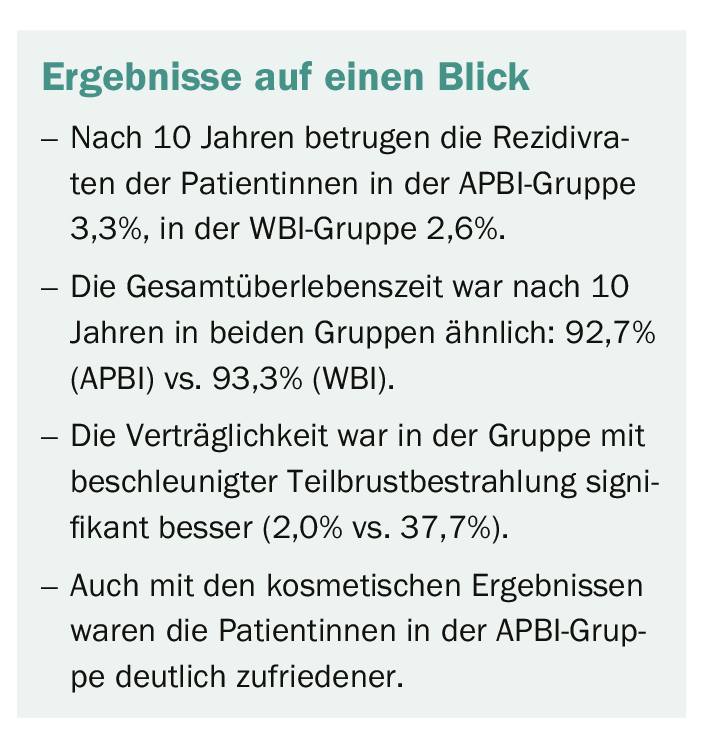
Many patients diagnosed with early breast cancer undergo lumpectomy followed by radiation. Postoperative radiation remains a mainstay of adjuvant breast cancer treatment, capable of significantly reducing local recurrence rates. In recent years, researchers have tried to determine whether partial-breast irradiation might be as effective as full-breast irradiation in preventing recurrences. A 10-year follow-up study of patients with breast cancer who had received accelerated partial breast irradiation (APBI) after surgery now showed that their disease recurrence rates were similar to those of patients who had received whole breast irradiation (WBI).

The Phase III trial, which included 520 patients with early-stage breast cancer, aimed to determine the long-term efficacy, safety and cosmetic outcomes of partial or total breast irradiation. All enrolled patients were at least 40 years old and had a maximum pathological tumor size of 25 mm. Patients were randomized in a 1:1 ratio to receive either whole breast irradiation (WBI) at a dose of 50 Gy in 25 fractions, followed by 10 Gy in five fractions delivered to the tumor bed or APBI delivered to the tumor bed at a dose of 30 Gy in five daily fractions. The primary endpoint was recurrence of ipsilateral breast tumor (IBTR). Secondary endpoints were overall survival, breast cancer-specific survival, distant metastasis-free survival, locoregional recurrence, and contralateral breast cancer. Adverse events and cosmetic aspects were also evaluated.

Five-year data confirmed

Interim results published after five years showed no significant difference in survival rates or IBTR between treatment techniques, and the results of the present 10-year analysis confirmed these. No significant differences were observed between groups for any of the primary or secondary endpoints, indicating that the main efficacy outcomes were not affected by the type of irradiation.  Overall survival at 10 years showed 92.7% for women treated with APBI and 93.3% for those receiving WBI. Breast cancer-specific survival was 97.6% for women who received APBI and 97.5% for women who received WBI. The distant metastasis-free survival rate was 96.9% for both groups.


Better tolerance with more beautiful results

However, the safety profiles and cosmetic outcomes differed significantly. Adverse events of all severities occurred significantly more frequently with WBI than with APBI. Acute adverse events grade 2 or higher occurred in 37.7% of patients treated with WBI compared with only 2.0% of patients treated with APBI. The rate of grade 2 or higher adverse events remained significantly higher in the late phase in the WBI group than in the APBI group, although with a smaller margin than in the acute phase (2.7% versus 0%). Skin toxicity rates followed a similar pattern, favoring APBI in both the acute phase (66.5% vs. 21.1%) and the late phase (30.0% vs. 4.5%). In further support of APBI, cosmetic outcomes, as measured by the Harvard Breast Cosmetic Scale, were significantly better in the APBI group than in the WBI group. Both physicians and patients were significantly more likely to report good or excellent cosmetic outcomes with APBI than with WBI.

Source: www.abstractsonline.com/pp8/#!/7946/presentation/1921; 
SABCS 2019


InFo ONCOLOGY & HEMATOLOGY 2020, 8(1): 30 (published 2/24/20, ahead of print).

Autoren
  • Leoni Burggraf
Publikation
  • InFo ONKOLOGIE & HÄMATOLOGIE
Related Topics
  • Breast Cancer
  • Breast Cancer
  • irradiation
Previous Article
  • Parkinson's disease

From clinical syndrome to molecular diagnostics and modern therapy

  • Education
  • Neurology
  • RX
View Post
Next Article
  • Disease Management

“Face up to rosacea”: contributing to the promotion of the doctor-patient dialogue

  • Dermatology and venereology
  • Market & Medicine
  • RX
View Post
You May Also Like
View Post
  • 11 min
  • Peristomal skin health

Focus on preventive care options

    • Cases
    • CME continuing education
    • Dermatology and venereology
    • Gastroenterology and Hepatology
    • Infectiology
    • Physical medicine and rehabilitation
    • Prevention and health care
    • RX
    • Surgery
View Post
  • 7 min
  • Disease-modifying therapies for ATTR-CM

TTR stabilizers, gene silencing and gene scissors: where do we stand?

    • Cardiology
    • Congress Reports
    • Genetics
    • RX
    • Studies
View Post
  • 8 min
  • Proteins in wound healing

Do special amino acids lead to success?

    • CME continuing education
    • Dermatology and venereology
    • Endocrinology and Diabetology
    • Nutrition
    • RX
    • Studies
View Post
  • 4 min
  • HER2+ early breast cancer

DESTINY-Breast11 – neoadjuvant T-DXd without anthracyclines

    • Education
    • Gynecology
    • Oncology
    • RX
    • Studies
View Post
  • 3 min
  • Lavender aromatherapy

Take away the fear of the dentist

    • Dentistry
    • Education
    • Pharmaceutical medicine
    • Phytotherapy
    • Psychiatry and psychotherapy
    • RX
    • Studies
View Post
  • 4 min
  • Digital dermatology: innovative project examples

AI and eHealth tools in HS care

    • Dermatology and venereology
    • General Internal Medicine
    • Practice Management
    • Prevention and health care
    • RX
    • Studies
View Post
  • 5 min
  • Mantle cell lymphoma

Recurrence after BTK inhibition – prognostic factors and treatment options

    • Education
    • Hematology
    • Oncology
    • RX
View Post
  • 3 min
  • Dementia risk with type 2 diabetes

SGLT2 inhibitors with advantages vs. DPP4 inhibitors

    • Education
    • Endocrinology and Diabetology
    • Geriatrics
    • Neurology
    • Pharmacology and toxicology
    • Psychiatry and psychotherapy
    • RX
    • Studies
  • IBD matters

    Zum Thema
Top CME content
  • 1
    Communication as the key to therapy adherence
  • 2
    Solutions to the malnutrition dilemma
  • 3
    Solutions to the malnutrition dilemma
  • 4
    Focus on preventive care options
  • 5
    Fertility preservation from gonads to genomes to genoids

Newsletter

Sign up and stay up to date

Subscribe
Medizinonline Medizinonline
  • Contact
  • General terms and conditions
  • Imprint

Input your search keywords and press Enter.