Medizinonline Medizinonline
  • News
    • News
    • Market & Medicine
  • Patients
    • Disease patterns
    • Diagnostics
    • Therapy
  • Partner Content
    • Diabetes
      • Dia-Month Club – Type 2 Diabetes
      • Diabetes in Motion
    • Gastroenterology
      • IBD matters
    • Oncology
      • Swiss Oncology in motion
    • Orthopedics
      • Osteoporosis in motion
  • Departments
    • Allergology and clinical immunology
    • General Internal Medicine
    • Anesthesiology
    • Angiology
    • Surgery
    • Dermatology and venereology
    • Endocrinology and Diabetology
    • Nutrition
    • Gastroenterology and Hepatology
    • Genetics
    • Geriatrics
    • Gynecology
    • Hematology
    • Infectiology
    • Cardiology
    • Nephrology
    • Neurology
    • Emergency and intensive care medicine
    • Nuclear Medicine
    • Oncology
    • Ophthalmology
    • ORL
    • Orthopedics
    • Pediatrics
    • Pharmacology and toxicology
    • Pharmaceutical medicine
    • Phlebology
    • Physical medicine and rehabilitation
    • Pneumology
    • Prevention and health care
    • Psychiatry and psychotherapy
    • Radiology
    • Forensic Medicine
    • Rheumatology
    • Sports Medicine
    • Traumatology and trauma surgery
    • Tropical and travel medicine
    • Urology
    • Dentistry
  • CME & Congresses
    • CME continuing education
    • Congress Reports
    • Congress calendar
  • Practice
    • Noctimed
    • Practice Management
    • Jobs
    • Interviews
  • Log In
  • Register
  • My account
  • Contact
  • Publications
  • Contact
  • Deutsch
  • English
  • Français
  • Italiano
  • Português
  • Español
Subscribe
Medizinonline Medizinonline
  • News
    • News
    • Market & Medicine
  • Patienten
    • Krankheitsbilder
    • Diagnostik
    • Therapie
  • Partner Content
    • Diabetes
      • Dia-Month Club – Type 2 Diabetes
      • Diabetes in Motion
    • Gastroenterology
      • IBD matters
    • Oncology
      • Swiss Oncology in motion
    • Orthopedics
      • Osteoporosis in motion
    • Phytotherapie
    • Rheumatology
  • Departments
    • Fachbereiche 1-13
      • Allergology and clinical immunology
      • General Internal Medicine
      • Anesthesiology
      • Angiology
      • Surgery
      • Dermatology and venereology
      • Endocrinology and Diabetology
      • Nutrition
      • Gastroenterology and Hepatology
      • Genetics
      • Geriatrics
      • Gynecology
      • Hematology
    • Fachbereiche 14-26
      • Infectiology
      • Cardiology
      • Nephrology
      • Neurology
      • Emergency and intensive care medicine
      • Nuclear Medicine
      • Oncology
      • Ophthalmology
      • ORL
      • Orthopedics
      • Pediatrics
      • Pharmacology and toxicology
      • Pharmaceutical medicine
    • Fachbereiche 26-38
      • Phlebology
      • Physical medicine and rehabilitation
      • Phytotherapy
      • Pneumology
      • Prevention and health care
      • Psychiatry and psychotherapy
      • Radiology
      • Forensic Medicine
      • Rheumatology
      • Sports Medicine
      • Traumatology and trauma surgery
      • Tropical and travel medicine
      • Urology
      • Dentistry
  • CME & Congresses
    • CME continuing education
    • Congress Reports
    • Congress calendar
  • Practice
    • Noctimed
    • Practice Management
    • Jobs
    • Interviews
Login

Sie haben noch keinen Account? Registrieren

  • Atopic dermatitis

The JAK/STAT pathway as a therapeutic target.

    • Allergology and clinical immunology
    • Dermatology and venereology
    • Education
    • RX
    • Studies
  • 3 minute read

Janus kinase (JAK) inhibitors inhibit signal transduction of numerous proinflammatory cytokines with varying selectivity. With baricitinib, upadacitinib and abrocitinib, three oral JAK inhibitors are currently approved in Switzerland for the treatment of moderate to severe atopic dermatitis.

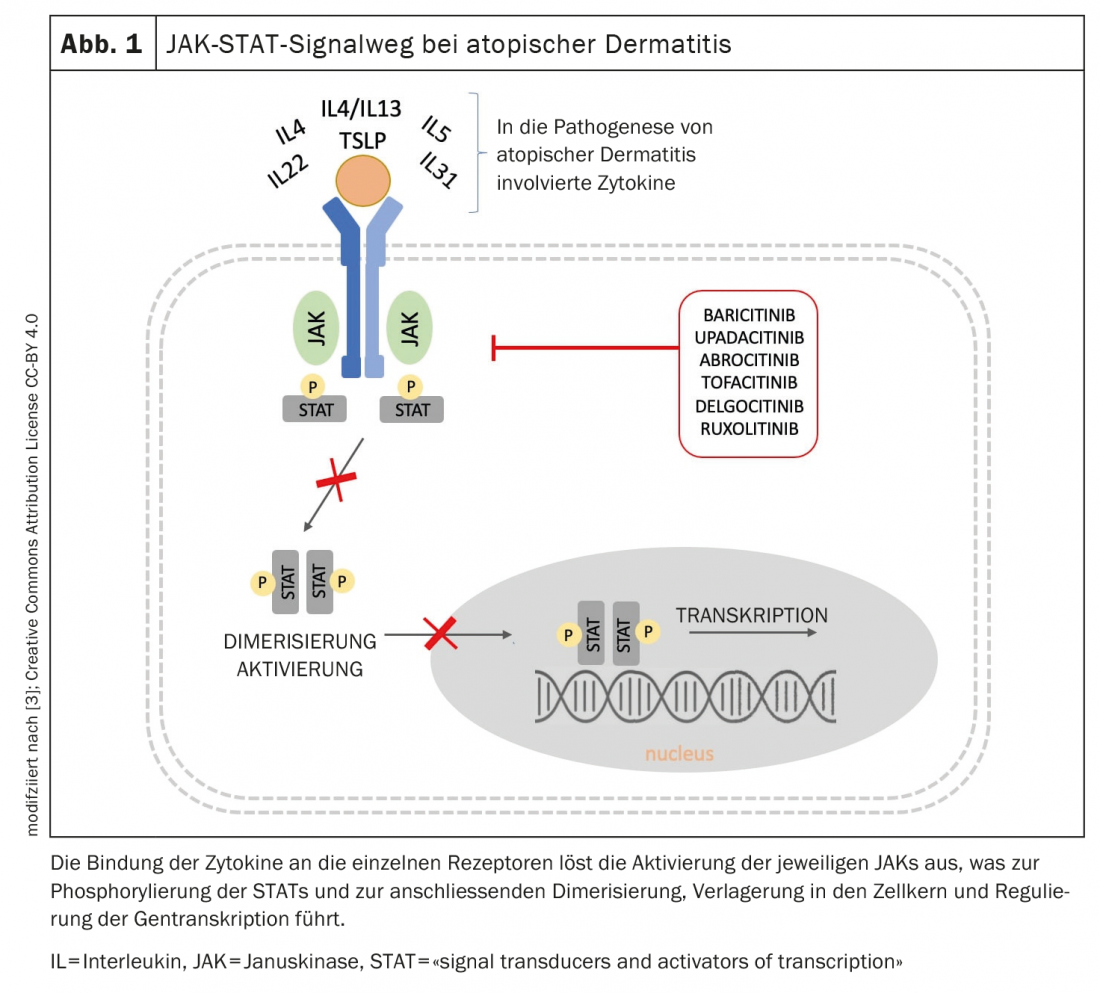
In recent years, an increasingly better understanding of the pathogenesis of atopic dermatitis has led to the development of novel therapeutic molecules targeting key inflammatory components of the disease [3]. Janus kinases (JAKs) are enzymes that transduce intracellular signals from cytokine or growth factor receptor interactions at the cell membrane to control cellular processes of hematopoiesis and immune cell function. Within the intracellular signaling pathway, JAKs phosphorylate and activate signal transducers and activators of transcription (STATs), which in turn activate gene expression within the cell. Signal transduction within the cell occurs via the JAK-STAT signaling pathway (Fig. 1), ultimately leading to the expression of additional proinflammatory cytokines [3]. By inhibiting the enzymatic activity of one or more Janus kinases, phosphorylation and activation of STATs are reduced. The currently approved JAK inhibitors modulate, among others, interleukin(IL)-4 and IL-13, two key cytokines in the pathogenesis of atopic dermatitis.


Rapid onset of itch relief

Janus kinase inhibitors are characterized by a rapid onset of action, as well as rapid and sustained relief of itching. In addition to a reduction in the number of exacerbations, an improvement in quality of life with regard to depression, anxiety and sleep disturbances is one of the therapeutic effects of JAK inhibitors. The oral dosage form as a tablet is easy for patients to handle. In Switzerland, baricitinib (Olumiant®), upadacitinib (Rinvoq®) and abrocitinib (Cibinqo®) are currently approved for the indication area of atopic dermatitis [1].

Baricitinib is a selective and reversible inhibitor of JAK1 and JAK2. In the BREEZE-AD1 and BREEZE-AD2 monotherapy trials, a significantly higher proportion of patients receiving baricitinib 4 mg achieved an IGA 0 or 1, an EASI-75*, or an improvement of ≥4 points on the pruritus NRS at week 16
#
compared with placebo [1]. A significantly higher proportion of patients randomized to baricitinib 4 mg achieved ≥4 points improvement in NRS within the first week of treatment compared with placebo (p<0.001).

* EASI-75 = min. 75 percent improvement in Eczema Area and Severity Index.
# The Peak Pruritus NRS [2] captures itchiness, with a value of 0 corresponding to no itchiness and a value of 10 corresponding to the worst imaginable itchiness. An improvement of ≥4 points is considered a relevant improvement.


Upadacitinib is a is a selective and reversible inhibitor of JAK1. In the MEASURE UP monotherapy trials, a significantly higher proportion of patients treated with upadacitinib 15 mg achieved a vIGA-AD response of 0 or 1 and an EASI-75 at week 16 compared with placebo [1]. During the same period, a significantly higher proportion taking upadacitinib manifested a reduction in pruritus of ≥4 points on the pruritus NRS compared with placebo. Significant differences in itch reduction in favor of the upadacitinib arm were already evident after week 1 (p<0.001).

Abrocitinib is also a specific JAK1 inhibitor. In the phase III MONO-1 and MONO-2 trials, treatment with abrocitinib 100 mg (1× d) achieved both primary endpoints IGA 0 or 1 and/or EASI-75 in a significantly greater proportion at week 12 [1]. In combination with TCS**, the JAK inhibitor proved significantly superior to placebo in the COMPARE trial at week 16 with respect to these two endpoints. A reduction in itch by ≥4 points on the pruritus NRS manifested with abrocitinib versus placebo as early as week 2 in a significantly higher proportion of study participants.

** TCS=topical steroids


Literature:

  1. Drug Information, www.swissmedicinfo.ch, (last accessed Aug. 18, 2022).
  2. Yosipovitch G, et al: Peak Pruritus Numerical Rating Scale: psychometric validation and responder definition for assessing itch in moderate-to-severe atopic dermatitis. Br J Dermatol 2019; 181(4): 761-769.
  3. Tsiogka A, et al: The JAK/STAT Pathway and Its Selective Inhibition in the Treatment of Atopic Dermatitis: A Systematic Review. J Clin Med 2022; 11(15): 4431.


DERMATOLOGY PRACTICE 2022; 32(4): 28

Autoren
  • Mirjam Peter, M.Sc.
Publikation
  • DERMATOLOGIE PRAXIS
Related Topics
  • Atopic dermatitits
  • Eczema
  • signal path
Previous Article
  • Influenza vaccination

High age – high dose!

  • Congress Reports
  • General Internal Medicine
  • Geriatrics
  • Infectiology
  • News
  • Prevention and health care
  • RX
  • Studies
View Post
Next Article
  • Iron deficiency

Ferritin standard values vary according to patient population

  • Cardiology
  • Congress Reports
  • General Internal Medicine
  • Hematology
  • RX
View Post
You May Also Like
View Post
  • 4 min
  • CKD and High Blood Pressure

Keeping an Eye on Bidirectional Interactions

    • RX
    • Cardiology
    • Congress Reports
    • General Internal Medicine
    • Nephrology
    • Studies
View Post
  • 20 min
  • Molecular Classification, FIGO 2023, and Chemoimmunotherapy

Endometrial carcinoma

    • RX
    • CME continuing education
    • Gynecology
    • Oncology
    • Studies
View Post
  • 4 min
  • Psoriatic Arthritis

Older patients at risk for tachyarrhythmias

    • RX
    • Cardiology
    • Dermatology and venereology
    • Education
    • General Internal Medicine
    • Geriatrics
    • Pharmacology and toxicology
    • Rheumatology
    • Studies
View Post
  • 3 min
  • Genetic Kidney Disease: DOUBLE PROTECT Alport

The SGLT-2 inhibitor dapagliflozin as an add-on to RAS blockade

    • RX
    • Education
    • General Internal Medicine
    • Genetics
    • Nephrology
    • Studies
View Post
  • 4 min
  • Case Study: Cystic Fibrosis in Adults

Recurrent Pneumonia as a Manifestation of Cystic Fibrosis

    • RX
    • Education
    • Infectiology
    • Pneumology
View Post
  • 5 min
  • Long COVID/Fatigue Clinic

An Innovative Approach: Neuroplasticity and Predictive Processing

    • RX
    • Congress Reports
    • General Internal Medicine
    • Infectiology
    • Neurology
    • Physical medicine and rehabilitation
    • Pneumology
    • Psychiatry and psychotherapy
View Post
  • 6 min
  • T-cell lymphomas

Diagnostic Challenges and New Treatment Options

    • RX
    • Education
    • Hematology
    • Oncology
    • Studies
View Post
  • 6 min
  • Interbrain Synchrony

Two Brains, One Thought

    • RX
    • Education
    • Neurology
    • Psychiatry and psychotherapy
    • Studies
  • IBD matters

    Zum Thema
Top CME content
  • 1
    Endometrial carcinoma
  • 2
    Clinical Presentation, Diagnosis, and Treatment of DSPN
  • 3
    Why is it so hard to lose weight?
  • 4
    Four-Legged Medical Assistants – Therapy Dogs in Clinical Settings
  • 5
    Functional limb preservation between infection control, vascular medicine and resurfacing

Newsletter

Sign up and stay up to date

Subscribe
Medizinonline Medizinonline
  • Contact
  • General terms and conditions
  • Imprint

Input your search keywords and press Enter.