Medizinonline Medizinonline
  • News
    • News
    • Market & Medicine
  • Patients
    • Disease patterns
    • Diagnostics
    • Therapy
  • Partner Content
    • Dermatology
      • Atopic dermatitis and psoriasis news
    • Diabetes
      • Dia-Month Club – Type 2 Diabetes
      • Diabetes in Motion
      • Diabetes Podcasts
    • Gastroenterology
      • IBD matters
    • Oncology
      • Swiss Oncology in motion
    • Orthopedics
      • Osteoporosis in motion
  • Departments
    • Allergology and clinical immunology
    • General Internal Medicine
    • Anesthesiology
    • Angiology
    • Surgery
    • Dermatology and venereology
    • Endocrinology and Diabetology
    • Nutrition
    • Gastroenterology and Hepatology
    • Genetics
    • Geriatrics
    • Gynecology
    • Hematology
    • Infectiology
    • Cardiology
    • Nephrology
    • Neurology
    • Emergency and intensive care medicine
    • Nuclear Medicine
    • Oncology
    • Ophthalmology
    • ORL
    • Orthopedics
    • Pediatrics
    • Pharmacology and toxicology
    • Pharmaceutical medicine
    • Phlebology
    • Physical medicine and rehabilitation
    • Pneumology
    • Prevention and health care
    • Psychiatry and psychotherapy
    • Radiology
    • Forensic Medicine
    • Rheumatology
    • Sports Medicine
    • Traumatology and trauma surgery
    • Tropical and travel medicine
    • Urology
    • Dentistry
  • CME & Congresses
    • CME continuing education
    • Congress Reports
    • Congress calendar
  • Practice
    • Noctimed
    • Practice Management
    • Jobs
    • Interviews
  • Log In
  • Register
  • My account
  • Contact
  • Publications
  • Contact
  • Deutsch
  • English
  • Français
  • Italiano
  • Português
  • Español
Subscribe
Medizinonline Medizinonline
  • News
    • News
    • Market & Medicine
  • Patienten
    • Krankheitsbilder
    • Diagnostik
    • Therapie
  • Partner Content
    • Dermatology
      • Atopic dermatitis and psoriasis news
    • Diabetes
      • Dia-Month Club – Type 2 Diabetes
      • Diabetes in Motion
      • Diabetes Podcasts
    • Gastroenterology
      • IBD matters
    • Oncology
      • Swiss Oncology in motion
    • Orthopedics
      • Osteoporosis in motion
    • Phytotherapie
    • Rheumatology
  • Departments
    • Fachbereiche 1-13
      • Allergology and clinical immunology
      • General Internal Medicine
      • Anesthesiology
      • Angiology
      • Surgery
      • Dermatology and venereology
      • Endocrinology and Diabetology
      • Nutrition
      • Gastroenterology and Hepatology
      • Genetics
      • Geriatrics
      • Gynecology
      • Hematology
    • Fachbereiche 14-26
      • Infectiology
      • Cardiology
      • Nephrology
      • Neurology
      • Emergency and intensive care medicine
      • Nuclear Medicine
      • Oncology
      • Ophthalmology
      • ORL
      • Orthopedics
      • Pediatrics
      • Pharmacology and toxicology
      • Pharmaceutical medicine
    • Fachbereiche 26-38
      • Phlebology
      • Physical medicine and rehabilitation
      • Phytotherapy
      • Pneumology
      • Prevention and health care
      • Psychiatry and psychotherapy
      • Radiology
      • Forensic Medicine
      • Rheumatology
      • Sports Medicine
      • Traumatology and trauma surgery
      • Tropical and travel medicine
      • Urology
      • Dentistry
  • CME & Congresses
    • CME continuing education
    • Congress Reports
    • Congress calendar
  • Practice
    • Noctimed
    • Practice Management
    • Jobs
    • Interviews
Login

Sie haben noch keinen Account? Registrieren

  • Multiple sclerosis

Diagnosis, differential diagnosis and treatment up to date

    • Congress Reports
    • Education
    • Neurology
    • RX
  • 3 minute read

Depending on its course, multiple sclerosis can lead to rapid losses in quality of life. Research is working at full speed to further detect the pathology of the disease and to provide targeted measures for diagnosis and therapy. In addition to new biomarkers that primarily facilitate differential diagnosis, effective compounds are also available to halt demyelination.

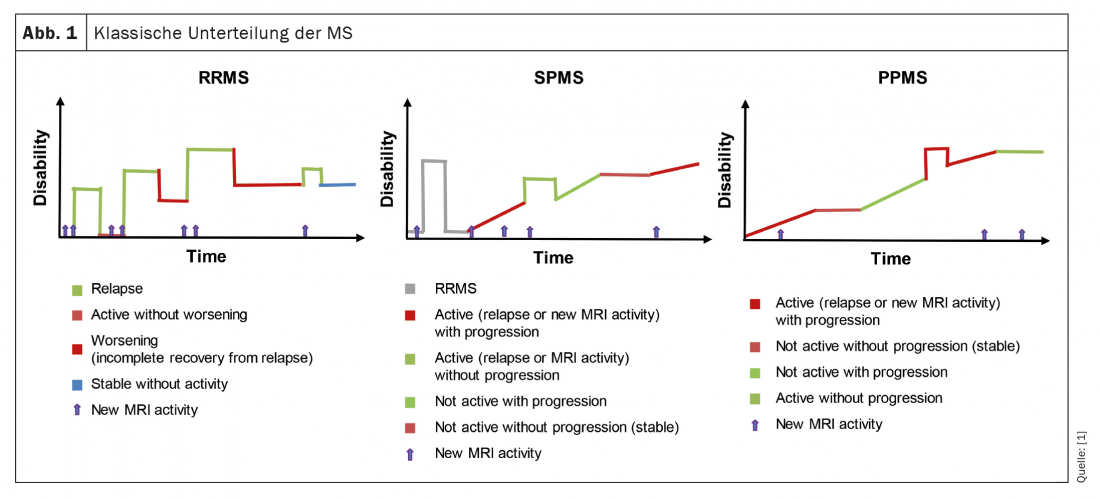
Multiple sclerosis (MS) is an autoimmune chronic inflammatory and degenerative disease of the central nervous system that affects more than 2.3 million people worldwide. It is characterized by both focal and diffuse damage. Physiopathologically, MS is due to circulating autoaggressive lymphocytes that penetrate the blood-brain barrier and attack the myelin layer of axons. This provokes demyelination and axonal damage, demonstrated Prof. Christina Granziera, MD, Basel. Traditionally, three manifestations of relapsing-remitting (RRMS), secondary progressive (SPMS) and primary progressive (PPMS) MS are distinguished ( Fig. 1). All are associated with different levels of inflammatory activity and clinical progression.


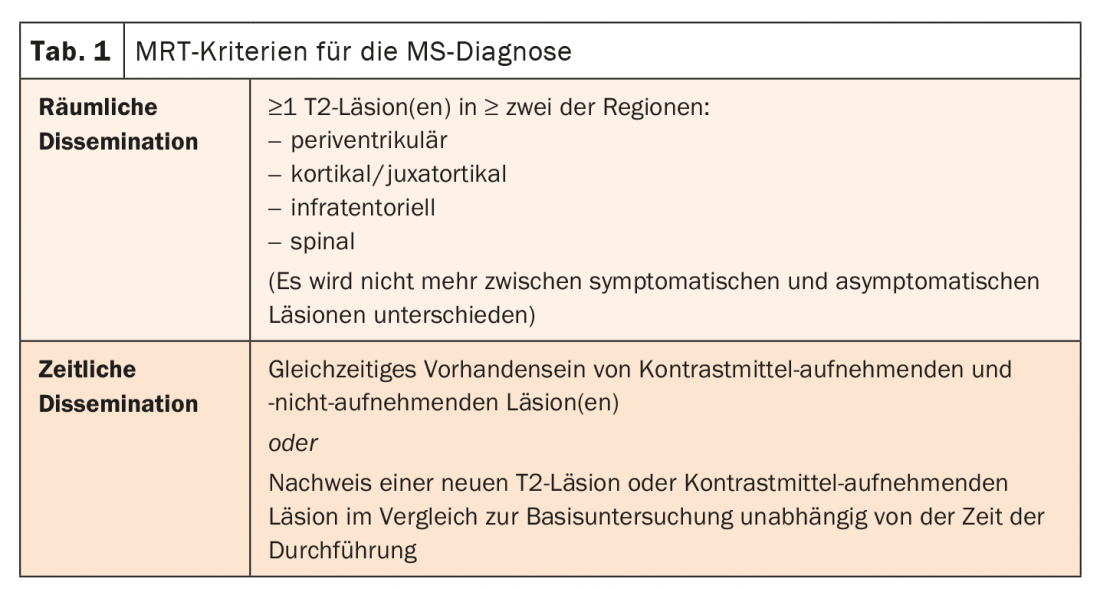
The diagnosis of relapsing-remitting MS is made on the basis of at least two clinically demonstrated relapses and at least two lesions. Lesions must be objectively demonstrated clinically. If only one relapse or lesion can be detected, additional requirements must be met with spatial and/or temporal dissemination (Tab. 1). PPMS is diagnosed when the patient has been in clinical disability progression without relapses for at least one year and at least two of the following factors are met:

  • A T2 lesion on MRI and at least one periventricular, cortical/juxtacortical, or infratentorial lesion.
  • at least two T2 lesions on spinal MRI
  • intrathecal immunoglobulin synthesis

To date, there is no consensus for the diagnosis of SPMS. Different definitional options have been proposed. For example, the presence of continuous deterioration for at least one year, two consecutive sustained disabling events (independent of relapses), or steadily increasing neurologic dysfunction without clear improvement. According to the population-based MS-Base study, a clinical diagnosis of SPMS exists when at least three months of EDSS progression can be demonstrated in the absence of a relapse. In addition, the deterioration must amount to at least one EDSS level if the EDSS was below six before progression and 0.5 EDSS level if it was above six. Also, the EDSS after progression must be at least four with a pyramidal FS score greater than two.


Focus on differential diagnoses

When a patient presents with clinical deficits consistent with an MS relapse and the MRI scan demonstrates spatial dissemination, the following differential diagnoses should be considered:

  • Infections/inflammations
  • Neoplasia, NMOSD/MOGAD
  • Cerebrovascular diseases
  • Migraine
  • Leukodystrophies, mitochondrial diseases

However, not only the characteristics of the lesions, but also their localizations can provide clues to possible other diseases. In recent years, several important radiological biomarkers have been developed to aid MS diagnosis. This includes, for example, the central vein. If at least 35% of CV lesions and two CVS lesions have a central vein, the presence of MS can be assumed with high specificity and sensitivity. Another biomarker are so-called paramagnetic rim lesions (PRL). It identifies activated, iron-containing cells and usually indicates chronic inflammatory lesions, the expert said. The differential diagnosis of other inflammatory demyelinating diseases of the CNS is particularly challenging. These include NMOSD, ADEM, MOG, or Baló disease, among others. In addition to clinical features, radiological and fluid biomarkers can also help distinguish MS from other diseases.


Effective therapy management

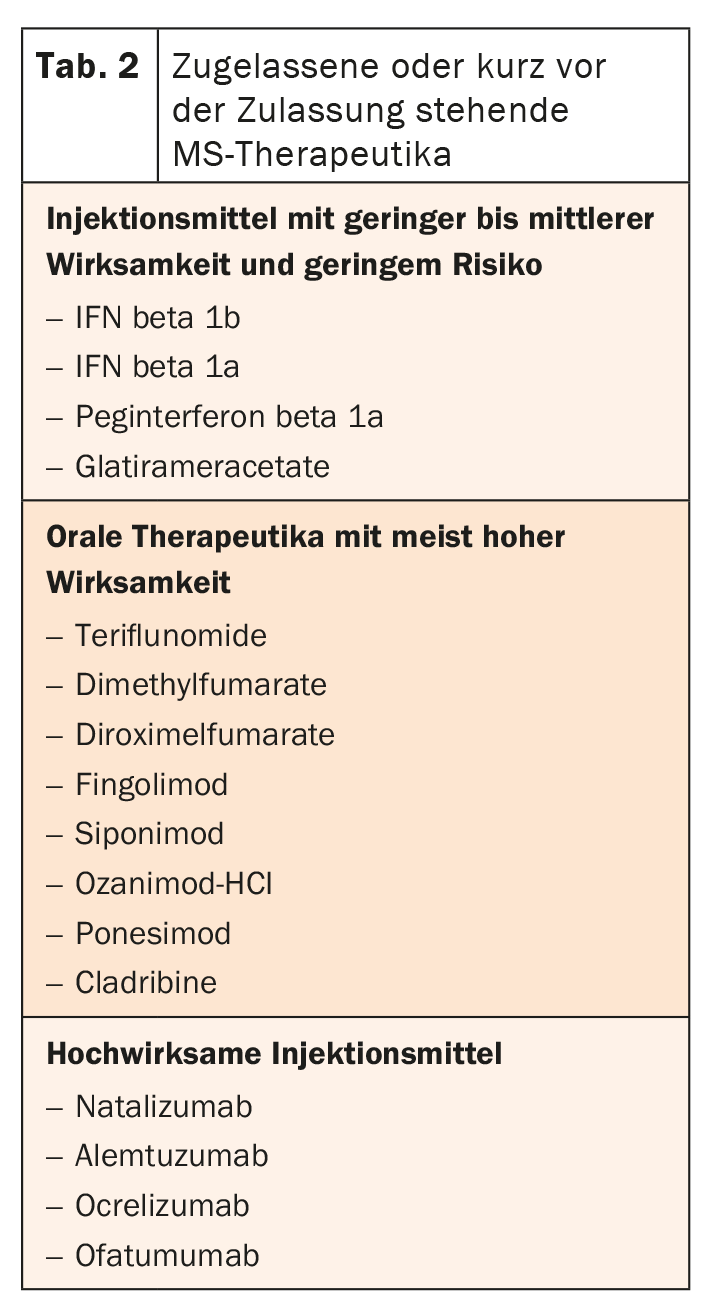
Most of the available MS therapies target B and T cells outside the CNS, but other options also act directly in the CNS (Table 2) . Most drugs are approved for RRMS. IFN beta 1a and siponimod can also be used for SPMS, and ocrelizumab can also be used for PPMS. Other preparations are currently undergoing clinical trials in this regard and have already demonstrated positive effects.


Congress: Forum for Continuing Medical Education


Source:

  1. Lublin FD, et al: Neurology. 2014; 83: 278-286; www.nationalmssociety.org/What-is-MS/Types-of-MS.


InFo NEUROLOGY & PSYCHIATRY 2021; 19(2): 24-26.

Autoren
  • Leoni Burggraf
Publikation
  • InFo NEUROLOGIE & PSYCHIATRIE
Related Topics
  • MS
  • Multiple sclerosis
Previous Article
  • Psoriatic arthritis (PsoA)

Cardiovascular risk assessment in PsoA – a current “top priority”.

  • Cardiology
  • Congress Reports
  • Dermatology and venereology
  • General Internal Medicine
  • Rheumatology
  • RX
  • Studies
View Post
Next Article
  • Diagnosis and therapy of SSc-ILD

No simple cases

  • Education
  • General Internal Medicine
  • Pneumology
  • Rheumatology
  • RX
View Post
You May Also Like
View Post
  • 6 min
  • Respiratory infections: viral bronchitis or bacterial pneumonia?

Old crucial question in the light of current findings

    • Congress Reports
    • General Internal Medicine
    • Infectiology
    • Pharmaceutical medicine
    • Pharmacology and toxicology
    • Phytotherapy
    • Pneumology
    • RX
View Post
  • 6 min
  • What biomarkers reveal about "biological youth" - and what not (yet)

Epigenetic ageing

    • Education
    • Genetics
    • Geriatrics
    • Prevention and health care
    • RX
    • Studies
View Post
  • 4 min
  • Amyotrophic lateral sclerosis and nutrition

Calorie optimization in ALS through digital intervention

    • Education
    • Neurology
    • Nutrition
    • RX
    • Studies
View Post
  • 14 min
  • "Forgotten axis" between plant substances, gut and systemic health

Microbiome and phytotherapy

    • Education
    • Endocrinology and Diabetology
    • Gastroenterology and Hepatology
    • General Internal Medicine
    • Infectiology
    • Neurology
    • Nutrition
    • Pharmaceutical medicine
    • Phytotherapy
    • RX
    • Studies
View Post
  • 4 min
  • HIV: updated EACS guideline

Individualized approach to sustainable prevention and care

    • Cardiology
    • Education
    • General Internal Medicine
    • Infectiology
    • Prevention and health care
    • RX
    • Studies
View Post
  • 5 min
  • Evidence-based diagnostics and treatment in the medical setting

Anxiety and depression disorders in adolescence

    • Education
    • Pediatrics
    • Pharmacology and toxicology
    • Psychiatry and psychotherapy
    • RX
    • Studies
View Post
  • 25 min
  • Neuroenhancement

Can you swallow intelligence? Relevant substance classes times for healthy people

    • CME continuing education
    • Neurology
    • Pharmacology and toxicology
    • Psychiatry and psychotherapy
    • RX
    • Studies
View Post
  • 9 min
  • Microbiome, inflammaging and affective/cognitive health

Gut-brain axis in old age

    • Education
    • Gastroenterology and Hepatology
    • General Internal Medicine
    • Geriatrics
    • Neurology
    • Nutrition
    • Prevention and health care
    • RX
    • Studies
  • IBD matters

    Zum Thema
Top CME content
  • 1
    Can you swallow intelligence? Relevant substance classes times for healthy people
  • 2
    Clinical care from birth to adulthood
  • 3
    Aligning care with the patient
  • 4
    Control instead of a flood of data: AI makes big data and wearables usable
  • 5
    Causes and prevention at work

Newsletter

Sign up and stay up to date

Subscribe
Medizinonline Medizinonline
  • Contact
  • General terms and conditions
  • Imprint

Input your search keywords and press Enter.