Medizinonline Medizinonline
  • News
    • News
    • Market & Medicine
  • Patients
    • Disease patterns
    • Diagnostics
    • Therapy
  • Partner Content
    • Diabetes
      • Dia-Month Club – Type 2 Diabetes
      • Diabetes in Motion
      • Diabetes Podcasts
    • Gastroenterology
      • IBD matters
    • Oncology
      • Swiss Oncology in motion
    • Orthopedics
      • Osteoporosis in motion
  • Departments
    • Allergology and clinical immunology
    • General Internal Medicine
    • Anesthesiology
    • Angiology
    • Surgery
    • Dermatology and venereology
    • Endocrinology and Diabetology
    • Nutrition
    • Gastroenterology and Hepatology
    • Genetics
    • Geriatrics
    • Gynecology
    • Hematology
    • Infectiology
    • Cardiology
    • Nephrology
    • Neurology
    • Emergency and intensive care medicine
    • Nuclear Medicine
    • Oncology
    • Ophthalmology
    • ORL
    • Orthopedics
    • Pediatrics
    • Pharmacology and toxicology
    • Pharmaceutical medicine
    • Phlebology
    • Physical medicine and rehabilitation
    • Pneumology
    • Prevention and health care
    • Psychiatry and psychotherapy
    • Radiology
    • Forensic Medicine
    • Rheumatology
    • Sports Medicine
    • Traumatology and trauma surgery
    • Tropical and travel medicine
    • Urology
    • Dentistry
  • CME & Congresses
    • CME continuing education
    • Congress Reports
    • Congress calendar
  • Practice
    • Noctimed
    • Practice Management
    • Jobs
    • Interviews
  • Log In
  • Register
  • My account
  • Contact
  • Publications
  • Contact
  • Deutsch
  • English
  • Français
  • Italiano
  • Português
  • Español
Subscribe
Medizinonline Medizinonline
  • News
    • News
    • Market & Medicine
  • Patienten
    • Krankheitsbilder
    • Diagnostik
    • Therapie
  • Partner Content
    • Diabetes
      • Dia-Month Club – Type 2 Diabetes
      • Diabetes in Motion
      • Diabetes Podcasts
    • Gastroenterology
      • IBD matters
    • Oncology
      • Swiss Oncology in motion
    • Orthopedics
      • Osteoporosis in motion
    • Phytotherapie
    • Rheumatology
  • Departments
    • Fachbereiche 1-13
      • Allergology and clinical immunology
      • General Internal Medicine
      • Anesthesiology
      • Angiology
      • Surgery
      • Dermatology and venereology
      • Endocrinology and Diabetology
      • Nutrition
      • Gastroenterology and Hepatology
      • Genetics
      • Geriatrics
      • Gynecology
      • Hematology
    • Fachbereiche 14-26
      • Infectiology
      • Cardiology
      • Nephrology
      • Neurology
      • Emergency and intensive care medicine
      • Nuclear Medicine
      • Oncology
      • Ophthalmology
      • ORL
      • Orthopedics
      • Pediatrics
      • Pharmacology and toxicology
      • Pharmaceutical medicine
    • Fachbereiche 26-38
      • Phlebology
      • Physical medicine and rehabilitation
      • Phytotherapy
      • Pneumology
      • Prevention and health care
      • Psychiatry and psychotherapy
      • Radiology
      • Forensic Medicine
      • Rheumatology
      • Sports Medicine
      • Traumatology and trauma surgery
      • Tropical and travel medicine
      • Urology
      • Dentistry
  • CME & Congresses
    • CME continuing education
    • Congress Reports
    • Congress calendar
  • Practice
    • Noctimed
    • Practice Management
    • Jobs
    • Interviews
Login

Sie haben noch keinen Account? Registrieren

  • Monoclonal Gammopathy of Unclear Significance (MGUS)

Identification of patients at risk

    • Congress Reports
    • Hematology
    • Oncology
    • RX
  • 3 minute read

Patients with monoclonal gammopathy of uncertain significance (MGUS) are at increased risk of developing certain forms of cancer. Regular checks allow changes to be detected at an early stage and any necessary treatment measures to be taken in good time. In any case, management must be tailored to the individual risk in order to avoid unnecessary uncertainty.

MGUS is characterized by the detection of increased, complete or incomplete, monoclonal immunoglobulins in a patient’s serum. These are usually determined as “paraprotein” or “M-protein” in serum electrophoresis. However, unlike multiple myeloma, signs of disease such as hypercalcemia, renal insufficiency, anemia, and bone lesions are absent. Although MGUS has no disease value, it may be the precursor of a malignant disease associated with an increase in plasma monoclonal cells, such as multiple myeloma, Waldenström’s disease, or non-Hodgkin’s lymphoma. Often, the main difficulty in management is to correctly identify patients at high risk of progression.

Delimitation and definition

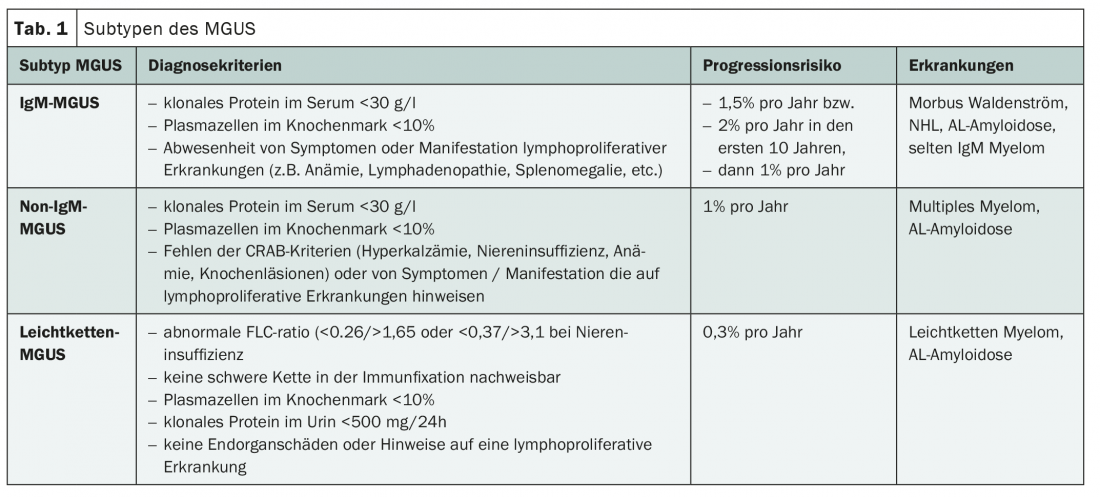
MGUS is defined by a serum IgM protein of less than 30 g/l, less than 10% clonal lymphoplasmacytic cells in the bone marrow, and the absence of symptoms suggestive of multiple myeloma or other B-cell lymphoma. After diagnosis, it must still be clarified whether a plasma cell myeloma is possibly already present. If this is excluded, MGUS is classified into three subtypes (Table 1).


Diagnosis

In addition to a careful history and physical examination, basic diagnostics include a CBC, determination of total protein and albumin in the serum, and quantitative determination of IgG, IgA, and IgM in the blood. If the criteria for MGUS are met, further investigation should follow. In this case, other symptoms suggestive of multiple myeloma requiring treatment must be actively sought and excluded. These include hypercalcemia, anemia, renal insufficiency, and bone lesions – also known by the acronym CRAB. Laboratory determination of electrolytes (sodium, potassium, calcium) and renal values (creatinine including calculated GFR and urea) plays an important role in the analysis of relevant parameters. Since paraproteins can also be deposited as amyloid, and the amyloidosis that subsequently develops mainly affects the heart and kidneys, BNP and NT-proBNP should also be determined.

Risk factors and therapy

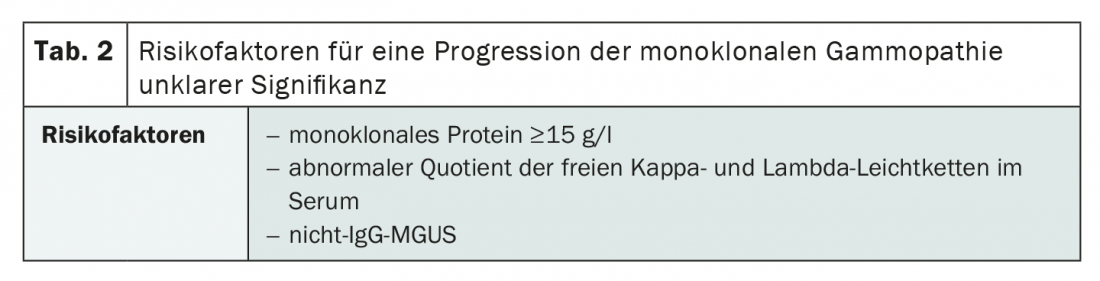
If a more serious disease is suspected, further investigations are required. These are also necessary when high-risk MGUS is present. The most common risk factors for MGUS progression are summarized in Table 2. In the case of low-risk MGUS, however, further examinations are not necessary and are often even counterproductive, as they may cause unnecessary uncertainty in affected individuals.


Unlike multiple myeloma, MGUS is not treated with therapy. Regular check-ups can detect a transition to a disease requiring treatment at an early stage. According to Prof. Jacob Passweg, head of hematology at the University Hospital Basel, this should be done six months after the initial diagnosis. If the laboratory values have not deteriorated in these six months, the interval can be extended to twelve months. In high-risk patients, however, follow-up visits should be performed every six to 24 months. Especially due to the often indolent course, patients at risk should be carefully identified and educated. On the one hand, it is important to avoid secondary diseases. On the other hand, the avoidance of uncertainty is also of great importance.

Source: “Monoclonal Gammopathy of Unclear Significance (MGUS)”, lecture by Prof. Jakob Passweg at the virtual SGAIM Spring Congress 2021, 19.05.2021.


InFo ONCOLOGY & HEMATOLOGY 2021; 9(3): 24-25 (published 6/16-21, ahead of print).
Autoren
  • Isabell Bemfert
Publikation
  • InFo ONKOLOGIE & HÄMATOLOGIE
Related Topics
  • Gammopathy
  • MGUS
Previous Article
  • Leukemic cutaneous T-cell lymphoma (L-CTCL)

Sézary syndrome and mycosis fungoides: STAT5 as a therapeutic target?

  • Congress Reports
  • Dermatology and venereology
  • Genetics
  • Hematology
  • Oncology
  • RX
  • Studies
View Post
Next Article
  • Osteoporosis Management

Match sequential long-term treatment to individual fracture risk

  • Education
  • General Internal Medicine
  • Gynecology
  • Orthopedics
  • RX
  • Studies
View Post
You May Also Like
View Post
  • 5 min
  • Ulcerative colitis: current evidence on anti-inflammatory therapies

Remission induction and maintenance with biologics and JAK-i

    • RX
    • Congress Reports
    • Gastroenterology and Hepatology
    • General Internal Medicine
    • Studies
View Post
  • 4 min
  • Bronchiectasis

New strategies against neutrophilic inflammation

    • RX
    • Congress Reports
    • General Internal Medicine
    • Infectiology
    • Pneumology
    • Studies
View Post
  • 3 min
  • IBD in childhood

Pneumococcal vaccination without negative consequences

    • RX
    • Education
    • Gastroenterology and Hepatology
    • General Internal Medicine
    • Infectiology
    • Pediatrics
    • Prevention and health care
View Post
  • 7 min
  • Plastic surgery and reconstructive microsurgery for DFS

Functional limb preservation between infection control, vascular medicine and resurfacing

    • RX
    • Angiology
    • CME continuing education
    • Dermatology and venereology
    • Endocrinology and Diabetology
    • General Internal Medicine
    • Geriatrics
    • Physical medicine and rehabilitation
    • Surgery
View Post
  • 14 min
  • Seborrheic Dermatitis in Adults and Adolescents

Current State of Knowledge and New Therapeutic Approaches

    • RX
    • CME continuing education
    • Dermatology and venereology
    • Studies
View Post
  • 7 min
  • Orthobiologics for knee osteoarthritis

PRP and hyaluronic acid injections as building blocks in a multimodal concept

    • RX
    • Congress Reports
    • General Internal Medicine
    • Orthopedics
    • Rheumatology
    • Sports Medicine
    • Studies
    • Surgery
View Post
  • 3 min
  • Soft tissue sarcomas of the lower extremity

Diagnostics, subtypes and treatment options

    • RX
    • Education
    • Oncology
View Post
  • 38 min
  • Psychological dependence on AI assistants, smartphones and short videos

Algorithms, avatars and the unburdened mind

    • RX
    • CME continuing education
    • Neurology
    • Pediatrics
    • Prevention and health care
    • Psychiatry and psychotherapy
    • Studies
  • IBD matters

    Zum Thema
Top CME content
  • 1
    Current State of Knowledge and New Therapeutic Approaches
  • 2
    Why is it so hard to lose weight?
  • 3
    Functional limb preservation between infection control, vascular medicine and resurfacing
  • 4
    Algorithms, avatars and the unburdened mind
  • 5
    Communication as the key to therapy adherence

Newsletter

Sign up and stay up to date

Subscribe
Medizinonline Medizinonline
  • Contact
  • General terms and conditions
  • Imprint

Input your search keywords and press Enter.