Medizinonline Medizinonline
  • News
    • News
    • Market & Medicine
  • Patients
    • Disease patterns
    • Diagnostics
    • Therapy
  • Partner Content
    • Dermatology
      • Atopic dermatitis and psoriasis news
    • Diabetes
      • Dia-Month Club – Type 2 Diabetes
      • Diabetes in Motion
      • Diabetes Podcasts
    • Gastroenterology
      • IBD matters
    • Oncology
      • Swiss Oncology in motion
    • Orthopedics
      • Osteoporosis in motion
  • Departments
    • Allergology and clinical immunology
    • General Internal Medicine
    • Anesthesiology
    • Angiology
    • Surgery
    • Dermatology and venereology
    • Endocrinology and Diabetology
    • Nutrition
    • Gastroenterology and Hepatology
    • Genetics
    • Geriatrics
    • Gynecology
    • Hematology
    • Infectiology
    • Cardiology
    • Nephrology
    • Neurology
    • Emergency and intensive care medicine
    • Nuclear Medicine
    • Oncology
    • Ophthalmology
    • ORL
    • Orthopedics
    • Pediatrics
    • Pharmacology and toxicology
    • Pharmaceutical medicine
    • Phlebology
    • Physical medicine and rehabilitation
    • Pneumology
    • Prevention and health care
    • Psychiatry and psychotherapy
    • Radiology
    • Forensic Medicine
    • Rheumatology
    • Sports Medicine
    • Traumatology and trauma surgery
    • Tropical and travel medicine
    • Urology
    • Dentistry
  • CME & Congresses
    • CME continuing education
    • Congress Reports
    • Congress calendar
  • Practice
    • Noctimed
    • Practice Management
    • Jobs
    • Interviews
  • Log In
  • Register
  • My account
  • Contact
  • Publications
  • Contact
  • Deutsch
  • English
  • Français
  • Italiano
  • Português
  • Español
Subscribe
Medizinonline Medizinonline
  • News
    • News
    • Market & Medicine
  • Patienten
    • Krankheitsbilder
    • Diagnostik
    • Therapie
  • Partner Content
    • Dermatology
      • Atopic dermatitis and psoriasis news
    • Diabetes
      • Dia-Month Club – Type 2 Diabetes
      • Diabetes in Motion
      • Diabetes Podcasts
    • Gastroenterology
      • IBD matters
    • Oncology
      • Swiss Oncology in motion
    • Orthopedics
      • Osteoporosis in motion
    • Phytotherapie
    • Rheumatology
  • Departments
    • Fachbereiche 1-13
      • Allergology and clinical immunology
      • General Internal Medicine
      • Anesthesiology
      • Angiology
      • Surgery
      • Dermatology and venereology
      • Endocrinology and Diabetology
      • Nutrition
      • Gastroenterology and Hepatology
      • Genetics
      • Geriatrics
      • Gynecology
      • Hematology
    • Fachbereiche 14-26
      • Infectiology
      • Cardiology
      • Nephrology
      • Neurology
      • Emergency and intensive care medicine
      • Nuclear Medicine
      • Oncology
      • Ophthalmology
      • ORL
      • Orthopedics
      • Pediatrics
      • Pharmacology and toxicology
      • Pharmaceutical medicine
    • Fachbereiche 26-38
      • Phlebology
      • Physical medicine and rehabilitation
      • Phytotherapy
      • Pneumology
      • Prevention and health care
      • Psychiatry and psychotherapy
      • Radiology
      • Forensic Medicine
      • Rheumatology
      • Sports Medicine
      • Traumatology and trauma surgery
      • Tropical and travel medicine
      • Urology
      • Dentistry
  • CME & Congresses
    • CME continuing education
    • Congress Reports
    • Congress calendar
  • Practice
    • Noctimed
    • Practice Management
    • Jobs
    • Interviews
Login

Sie haben noch keinen Account? Registrieren

  • Ovarian cancer and the immune system

The choice of chemotherapy is crucial

    • Education
    • Gynecology
    • Oncology
    • RX
  • 3 minute read

Chemotherapy-induced changes in the immune system can be used therapeutically in the era of immuno-oncology. Accurate characterization of immunologic effects of different agents, in addition to better risk management, will enable the development of new treatment approaches combining chemotherapy and immunotherapy.

Immunologic effects of chemotherapy have historically been primarily a risk of treatment. Depending on the substance used, various defense gaps occur, opportunistic infections with severe courses can be the result. However, to date, the effects of many chemotherapeutic agents on the immune system have not been studied in detail. Taking a closer look at these could be worthwhile in the future – not only for better risk assessment, but also for the targeted development of new therapeutic approaches. This is because, as immunotherapy becomes more widespread, the immunologic consequences of chemotherapy also potentially represent an opportunity. Belgian researchers now analyzed six common chemotherapy regimens in ovarian cancer for their effects on the immune system and found surprising differences.

Carboplatin-paclitaxel as an immunological winner.

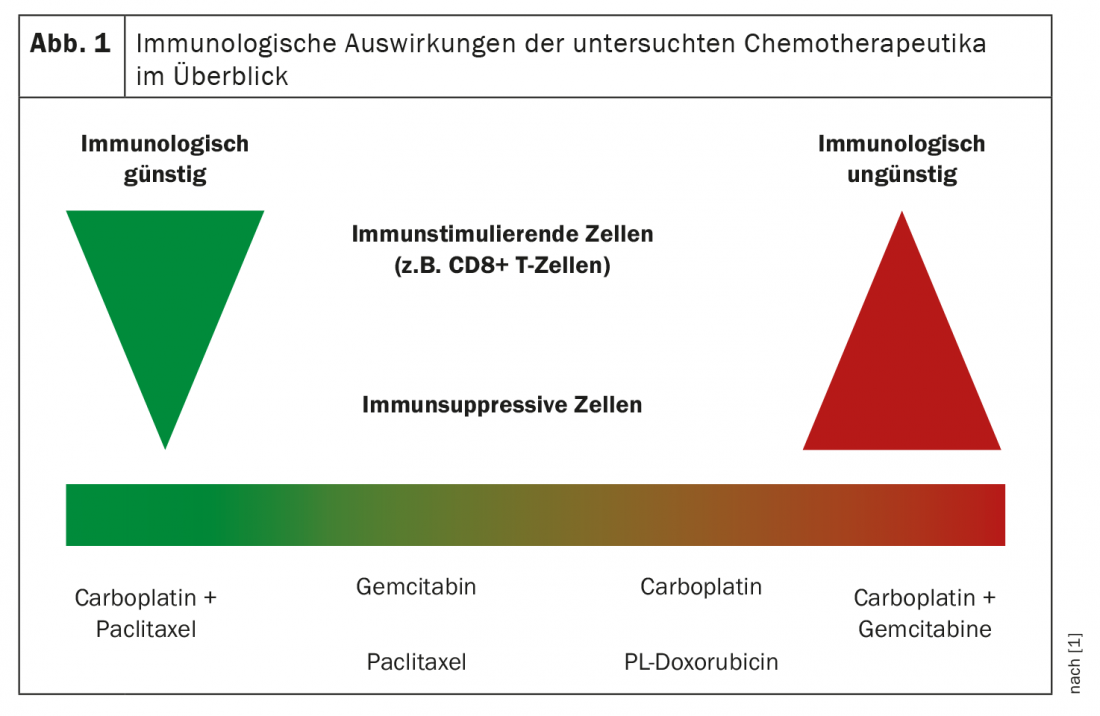
In the recently published paper, the authors compared the immunologic effects of carboplatin, paclitaxel, pegylated liposomal doxorubicin, gemcitabine, carboplatin-paclitaxel, and carboplatin-gemcitabine in a mouse model. While carboplatin-paclitaxel had the most favorable profile, carboplatin-gemcitabine appeared to produce a deleterious immunologic constellation. For evaluation, the researchers analyzed blood samples, peritoneal fluid, and tumor tissue one week after chemotherapy. Here, immunosuppression in peritoneal fluid was lowest with gemcitabine, paclitaxel, and carboplatin-paclitaxel, with carboplatin-paclitaxel suppressing the immune response the least and even demonstrating a decrease in the number of immunosuppressive cells.

In the tumor tissue itself, no statistically significant change in immunological parameters could be detected for any agent, except for carboplatin-gemcitabine. The latter therapy resulted in an increase in the number of regulatory T cells with consecutive suppression of the immune response. Also, treatment with carboplatin-gemcitabine showed a significant increase in the cytokine MIP-1β, which the authors considered unfavorable. Carboplatin-paclitaxel, on the other hand, caused higher serum concentrations of IFNγ, a protective factor. All monotherapies had smaller effects on the immune system than carboplatin-paclitaxel and carboplatin-gemcitabine in the study (Fig. 1).


Significance for future therapies

The authors concluded that carboplatin-gemcitabine is unlikely to be suitable for combination strategies because of increased suppression of the immune system. They attribute the lack of success to date of immunotherapy in ovarian cancer, which has been tested primarily as monotherapy, in part to the pronounced immunosuppression that this entity entails. However, according to the scientists, success could be achieved in the future through suitable combination therapies. Especially if it should be possible to overcome the immunosuppression induced by the tumor. However, a good understanding of the effects of all the substances involved on the immune system is essential for this.

The broader perspective

In other entities, detailed immunological profiling of known agents could also make an important contribution to the success of new therapies, especially combination therapies. With a more precise understanding of drug and also disease-related effects on the immune system, the importance of immunotherapeutic approaches may grow in the future. This is because chemotherapeutic agents not only lead to a loss of immune cells and thus tear gaps in the body’s own defense system, but are also able to strengthen the tumor defense through immunological effects. For example, antigen presentation is generally increased with chemotherapy. Other effects vary depending on the substance and are often not yet conclusively clarified. So there is still plenty of room for preclinical research – and hopefully its translation into clinical practice.


Source:

  1. Vankerckhoven A, et al: Type of chemotherapy has substantial effects on the immune system in ovarian cancer. Transl Oncol. 2021; 14(6): 101076 (published online ahead of print).


InFo ONCOLOGY & HEMATOLOGY 2021; 9(2): 32.
Autoren
  • Med. pract. Amelie Stüger
Publikation
  • InFo ONKOLOGIE & HÄMATOLOGIE
Related Topics
  • chemotherapy
  • immune system
  • ovarian cancer
  • Ovarian Cancer
Previous Article
  • Long-term sequelae of chronic neonatal lung disease.

Early changes and later indicators

  • CME continuing education
  • Education
  • Pediatrics
  • Pneumology
  • RX
  • Studies
View Post
Next Article
  • Type 2 diabetes

Treatment success thanks to individual therapy goals

  • Congress Reports
  • Endocrinology and Diabetology
  • General Internal Medicine
  • RX
View Post
You May Also Like
View Post
  • 14 min
  • "Forgotten axis" between plant substances, gut and systemic health

Microbiome and phytotherapy

    • Education
    • Endocrinology and Diabetology
    • Gastroenterology and Hepatology
    • General Internal Medicine
    • Infectiology
    • Neurology
    • Nutrition
    • Pharmaceutical medicine
    • Phytotherapy
    • RX
    • Studies
View Post
  • 4 min
  • HIV: updated EACS guideline

Individualized approach to sustainable prevention and care

    • Cardiology
    • Education
    • General Internal Medicine
    • Infectiology
    • Prevention and health care
    • RX
    • Studies
View Post
  • 5 min
  • Evidence-based diagnostics and treatment in the medical setting

Anxiety and depression disorders in adolescence

    • Education
    • Pediatrics
    • Pharmacology and toxicology
    • Psychiatry and psychotherapy
    • RX
    • Studies
View Post
  • 25 min
  • Neuroenhancement

Can you swallow intelligence? Relevant substance classes times for healthy people

    • CME continuing education
    • Neurology
    • Pharmacology and toxicology
    • Psychiatry and psychotherapy
    • RX
    • Studies
View Post
  • 9 min
  • Microbiome, inflammaging and affective/cognitive health

Gut-brain axis in old age

    • Education
    • Gastroenterology and Hepatology
    • General Internal Medicine
    • Geriatrics
    • Neurology
    • Nutrition
    • Prevention and health care
    • RX
    • Studies
View Post
  • 6 min
  • Vitiligo - the level of suffering should not be underestimated

A lot can be achieved therapeutically nowadays

    • Congress Reports
    • Dermatology and venereology
    • RX
    • Studies
View Post
  • 7 min
  • Vector-borne infections with skin manifestations

Arboviruses and leishmaniasis in Europe

    • Congress Reports
    • Infectiology
    • Prevention and health care
    • RX
    • Studies
    • Tropical and travel medicine
View Post
  • 14 min
  • Adrenogenital syndrome

Clinical care from birth to adulthood

    • CME continuing education
    • Endocrinology and Diabetology
    • Nephrology
    • Pediatrics
    • RX
    • Studies
  • IBD matters

    Zum Thema
Top CME content
  • 1
    Can you swallow intelligence? Relevant substance classes times for healthy people
  • 2
    Clinical care from birth to adulthood
  • 3
    Aligning care with the patient
  • 4
    Control instead of a flood of data: AI makes big data and wearables usable
  • 5
    Causes and prevention at work

Newsletter

Sign up and stay up to date

Subscribe
Medizinonline Medizinonline
  • Contact
  • General terms and conditions
  • Imprint

Input your search keywords and press Enter.