Medizinonline Medizinonline
  • News
    • News
    • Market & Medicine
  • Patients
    • Disease patterns
    • Diagnostics
    • Therapy
  • Partner Content
    • Diabetes
      • Dia-Month Club – Type 2 Diabetes
      • Diabetes in Motion
    • Gastroenterology
      • IBD matters
    • Oncology
      • Swiss Oncology in motion
    • Orthopedics
      • Osteoporosis in motion
  • Departments
    • Allergology and clinical immunology
    • General Internal Medicine
    • Anesthesiology
    • Angiology
    • Surgery
    • Dermatology and venereology
    • Endocrinology and Diabetology
    • Nutrition
    • Gastroenterology and Hepatology
    • Genetics
    • Geriatrics
    • Gynecology
    • Hematology
    • Infectiology
    • Cardiology
    • Nephrology
    • Neurology
    • Emergency and intensive care medicine
    • Nuclear Medicine
    • Oncology
    • Ophthalmology
    • ORL
    • Orthopedics
    • Pediatrics
    • Pharmacology and toxicology
    • Pharmaceutical medicine
    • Phlebology
    • Physical medicine and rehabilitation
    • Pneumology
    • Prevention and health care
    • Psychiatry and psychotherapy
    • Radiology
    • Forensic Medicine
    • Rheumatology
    • Sports Medicine
    • Traumatology and trauma surgery
    • Tropical and travel medicine
    • Urology
    • Dentistry
  • CME & Congresses
    • CME continuing education
    • Congress Reports
    • Congress calendar
  • Practice
    • Noctimed
    • Practice Management
    • Jobs
    • Interviews
  • Log In
  • Register
  • My account
  • Contact
  • Publications
  • Contact
  • Deutsch
  • English
  • Français
  • Italiano
  • Português
  • Español
Subscribe
Medizinonline Medizinonline
  • News
    • News
    • Market & Medicine
  • Patienten
    • Krankheitsbilder
    • Diagnostik
    • Therapie
  • Partner Content
    • Diabetes
      • Dia-Month Club – Type 2 Diabetes
      • Diabetes in Motion
    • Gastroenterology
      • IBD matters
    • Oncology
      • Swiss Oncology in motion
    • Orthopedics
      • Osteoporosis in motion
    • Phytotherapie
    • Rheumatology
  • Departments
    • Fachbereiche 1-13
      • Allergology and clinical immunology
      • General Internal Medicine
      • Anesthesiology
      • Angiology
      • Surgery
      • Dermatology and venereology
      • Endocrinology and Diabetology
      • Nutrition
      • Gastroenterology and Hepatology
      • Genetics
      • Geriatrics
      • Gynecology
      • Hematology
    • Fachbereiche 14-26
      • Infectiology
      • Cardiology
      • Nephrology
      • Neurology
      • Emergency and intensive care medicine
      • Nuclear Medicine
      • Oncology
      • Ophthalmology
      • ORL
      • Orthopedics
      • Pediatrics
      • Pharmacology and toxicology
      • Pharmaceutical medicine
    • Fachbereiche 26-38
      • Phlebology
      • Physical medicine and rehabilitation
      • Phytotherapy
      • Pneumology
      • Prevention and health care
      • Psychiatry and psychotherapy
      • Radiology
      • Forensic Medicine
      • Rheumatology
      • Sports Medicine
      • Traumatology and trauma surgery
      • Tropical and travel medicine
      • Urology
      • Dentistry
  • CME & Congresses
    • CME continuing education
    • Congress Reports
    • Congress calendar
  • Practice
    • Noctimed
    • Practice Management
    • Jobs
    • Interviews
Login

Sie haben noch keinen Account? Registrieren

  • Migraine

Headache diagnostics and current therapy options

    • Congress Reports
    • General Internal Medicine
    • Neurology
    • RX
  • 3 minute read

When talking about headaches, not necessarily always the same pain is meant. It is much more likely that symptoms present differently from patient to patient. More than 200 different types of headache are now defined. What they have in common is the significant reduction in the quality of life of those affected. Therapy should therefore be comprehensive and adapted to the headache in question.

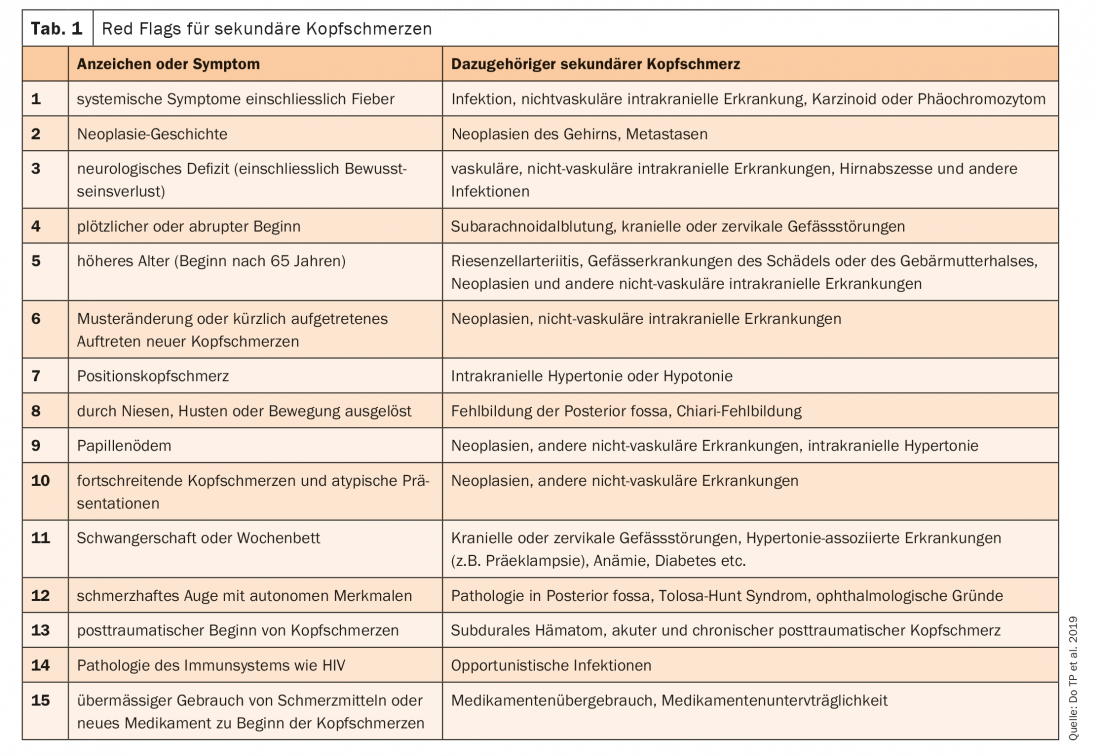
The International Classification of Headache Disorders (ICHD-3) divides headache into primary and secondary headaches, as well as neuropathies and facial pain [1]. In total, more than 200 different types of headache are recorded, which have been grouped into 14 groups. By far the most widespread are tension headaches, followed by migraine, as PD Dr. med. Andreas R. Gantenbein, Bad Zurzach, pointed out. Indeed, only a minority of an estimated 18% worldwide suffer from secondary headaches [2]. Therefore, they are often overlooked. Red flags can be used to increase the likelihood of identifying a secondary etiology (Table 1) [2]. This includes checking for systemic symptoms such as fever, neurologic deficits, or sudden onset, among others. If secondary triggers for the complaints can be excluded, the primary headache must be declared accordingly.


Cluster headaches occur unilaterally around the eye over a four-hour period. The pain peak is reached after about three hours. Eye redness, tearing as well as a blocked nose are noticeable. “Sufferers also frequently “putter” around during the attack,” the expert said. Acute therapy can be given via triptans as a nasal spray as well as O2 administration. To prevent cluster headaches, administration of verapamil, topiramate, lithium, galcanezumab, or prednisone is possible.

Treat migraine effectively and comprehensively

Migraine can be clearly distinguished from tension headaches. Tension headaches are dull, diffuse bilaterally, and mild to moderate in intensity, with no accompanying symptoms. Migraine, on the other hand, is usually unilateral, pulsatile, and is often accompanied by nausea/vomiting and photo/phonophobia. The pain occurs over four to 72 hours and intensifies with movement. Trigger factors, such as the weather, cheese or red wine, among others, can trigger an attack. “During a migraine, rest, sleep and relaxation are most important,” Gantenbein reported. Medication can be used to treat an acute attack with analgesics, NSAIDs, antiemetics, or triptans. The important thing here is that the dose is targeted and high enough, but not taken too frequently. First-line agents for patients with moderate to severe attacks are triptans [3]. However, these may be contraindicated in some patients. Especially in patients with a history of stroke or myocardial infarction. In addition, patients with severe hypertension, coronary artery disease, peripheral arterial occlusive disease (CAD) or transient ischemic attack (TIA) must also avoid this substance class. This is because triptans do not contract intracranial blood vessels exclusively, but also peripheral blood vessels. Two new substance classes are waiting in the wings: Ditane and Gepante. Although the former also target the serotonin receptor, they act selectively at 5-HT1F. Gepante are small molecules that act as antagonists at the CGRP receptor.

Prophylaxis for frequent seizures

If patients suffer from migraines several times a month with very severe or prolonged attacks, prophylactic treatment should be considered. Also, to prevent medication overuse, which in turn can end in headaches. In addition to aerobic endurance training, relaxation therapies and behavioral and psychotherapeutic measures, drug interventions may be effective. Attention should be paid to comorbidities. Beta-blockers are contraindicated in patients with severe asthma or hypotension, for example. In addition, beta-blockers, flunarizine, and topiramate can promote depression. On the other hand, the blood pressure- and pulse-lowering effect of beta-blockers can also be a desirable side effect. Topiramate may promote weight loss, and amitriptyline has a sedative effect. In principle, antidepressants, anticonvulsants, beta-blockers, calcium antagonists, and CGRP antibodies can be used for migraine prophylaxis. Natural substances such as magnesium, coenzyme Q10 and riboflavin or the administration of botulinum toxin type A can also contribute to preventive therapy [3].


Congress: Forum for Continuing Medical Education


Literature:

  1. www.ichd-3.org (last accessed on 13.02.2021)
  2. Do TP et al. Red and orange flags for secondary headaches in clinical practice: SNNOOP10 list. Neurology 2019; 92(3): 134-144.
  3. Therapy recommendations of the Swiss Headache Society. Available at: www.headache.ch/download/Content_attachments/FileBaseDoc/SKG_Therapieempfehlungen_2018_DE_15_WEB.pdf (last accessed on 13.02.2021)


InFo NEUROLOGY & PSYCHIATRY 2021; 19(2): 22-23 (published 3/30/21, ahead of print).

Autoren
  • Leoni Burggraf
Publikation
  • InFo NEUROLOGIE & PSYCHIATRIE
Related Topics
  • cluster headache
  • migraine
Previous Article
  • A reportage from life

The doctor as patient

  • Education
  • General Internal Medicine
  • Interviews
  • Oncology
  • Prevention and health care
  • Psychiatry and psychotherapy
  • RX
View Post
Next Article
  • Inflammatory dermatoses

Acne and rosacea – current trends at a glance

  • Congress Reports
  • Dermatology and venereology
  • RX
  • Studies
View Post
You May Also Like
View Post
  • 4 min
  • Preclinical Study on a Special Ginkgo biloba Extract

What role do proanthocyanidins play?

    • RX
    • Education
    • General Internal Medicine
    • Geriatrics
    • Neurology
    • Pharmaceutical medicine
    • Pharmacology and toxicology
    • Phytotherapy
    • Studies
View Post
  • 6 min
  • Myasthenia gravis: immunomodulatory therapies for long-term treatment

Expanded Possibilities Thanks to Innovative Classes of Active Ingredients

    • RX
    • Congress Reports
    • General Internal Medicine
    • Neurology
    • Ophthalmology
    • Studies
View Post
  • 10 min
  • Interstitial Lung Diseases

Update on Idiopathic Pulmonary Fibrosis

    • RX
    • CME continuing education
    • Pneumology
    • Studies
View Post
  • 7 min
  • Plastic surgery and reconstructive microsurgery for DFS

Functional limb preservation between infection control, vascular medicine and resurfacing

    • RX
    • Angiology
    • CME continuing education
    • Dermatology and venereology
    • Endocrinology and Diabetology
    • General Internal Medicine
    • Geriatrics
    • Physical medicine and rehabilitation
    • Surgery
View Post
  • 7 min
  • Ischemic stroke: Are smaller or larger brain arteries affected?

Recent study findings on intravenous lysis therapy with fibrinolytic agents

    • RX
    • Congress Reports
    • Emergency and intensive care medicine
    • General Internal Medicine
    • Neurology
    • Pharmacology and toxicology
    • Studies
    • Surgery
View Post
  • 7 min
  • Interview

“On par with the gold standards for trauma”

    • RX
    • Education
    • Interviews
    • Neurology
    • Physical medicine and rehabilitation
    • Psychiatry and psychotherapy
    • Studies
View Post
  • 5 min
  • Psychology: Emotional Freedom Techniques (EFT)

Emotional Healing Through Tapping

    • RX
    • Education
    • General Internal Medicine
    • Neurology
    • Physical medicine and rehabilitation
    • Psychiatry and psychotherapy
    • Studies
View Post
  • 5 min
  • Systemic Lupus (SLE): What Does the Diagnosis and Treatment Toolbox Have to Offer?

Treat-to-Target – Consensus Recommendations for GC Tapering and the Use of DMARDs

    • RX
    • Congress Reports
    • General Internal Medicine
    • Nephrology
    • Rheumatology
    • Studies
  • IBD matters

    Zum Thema
Top CME content
  • 1
    Functional limb preservation between infection control, vascular medicine and resurfacing
  • 2
    Update on Idiopathic Pulmonary Fibrosis
  • 3
    Update on Idiopathic Pulmonary Fibrosis
  • 4
    Current status of PAT
  • 5
    Darier’s Disease, also known as Follicular Keratosis – Update 2026

Newsletter

Sign up and stay up to date

Subscribe
Medizinonline Medizinonline
  • Contact
  • General terms and conditions
  • Imprint

Input your search keywords and press Enter.