Medizinonline Medizinonline
  • News
    • News
    • Market & Medicine
  • Patients
    • Disease patterns
    • Diagnostics
    • Therapy
  • Partner Content
    • Diabetes
      • Dia-Month Club – Type 2 Diabetes
      • Diabetes in Motion
    • Gastroenterology
      • IBD matters
    • Oncology
      • Swiss Oncology in motion
    • Orthopedics
      • Osteoporosis in motion
  • Departments
    • Allergology and clinical immunology
    • General Internal Medicine
    • Anesthesiology
    • Angiology
    • Surgery
    • Dermatology and venereology
    • Endocrinology and Diabetology
    • Nutrition
    • Gastroenterology and Hepatology
    • Genetics
    • Geriatrics
    • Gynecology
    • Hematology
    • Infectiology
    • Cardiology
    • Nephrology
    • Neurology
    • Emergency and intensive care medicine
    • Nuclear Medicine
    • Oncology
    • Ophthalmology
    • ORL
    • Orthopedics
    • Pediatrics
    • Pharmacology and toxicology
    • Pharmaceutical medicine
    • Phlebology
    • Physical medicine and rehabilitation
    • Pneumology
    • Prevention and health care
    • Psychiatry and psychotherapy
    • Radiology
    • Forensic Medicine
    • Rheumatology
    • Sports Medicine
    • Traumatology and trauma surgery
    • Tropical and travel medicine
    • Urology
    • Dentistry
  • CME & Congresses
    • CME continuing education
    • Congress Reports
    • Congress calendar
  • Practice
    • Noctimed
    • Practice Management
    • Jobs
    • Interviews
  • Log In
  • Register
  • My account
  • Contact
  • Publications
  • Contact
  • Deutsch
  • English
  • Français
  • Italiano
  • Português
  • Español
Subscribe
Medizinonline Medizinonline
  • News
    • News
    • Market & Medicine
  • Patienten
    • Krankheitsbilder
    • Diagnostik
    • Therapie
  • Partner Content
    • Diabetes
      • Dia-Month Club – Type 2 Diabetes
      • Diabetes in Motion
    • Gastroenterology
      • IBD matters
    • Oncology
      • Swiss Oncology in motion
    • Orthopedics
      • Osteoporosis in motion
    • Phytotherapie
    • Rheumatology
  • Departments
    • Fachbereiche 1-13
      • Allergology and clinical immunology
      • General Internal Medicine
      • Anesthesiology
      • Angiology
      • Surgery
      • Dermatology and venereology
      • Endocrinology and Diabetology
      • Nutrition
      • Gastroenterology and Hepatology
      • Genetics
      • Geriatrics
      • Gynecology
      • Hematology
    • Fachbereiche 14-26
      • Infectiology
      • Cardiology
      • Nephrology
      • Neurology
      • Emergency and intensive care medicine
      • Nuclear Medicine
      • Oncology
      • Ophthalmology
      • ORL
      • Orthopedics
      • Pediatrics
      • Pharmacology and toxicology
      • Pharmaceutical medicine
    • Fachbereiche 26-38
      • Phlebology
      • Physical medicine and rehabilitation
      • Phytotherapy
      • Pneumology
      • Prevention and health care
      • Psychiatry and psychotherapy
      • Radiology
      • Forensic Medicine
      • Rheumatology
      • Sports Medicine
      • Traumatology and trauma surgery
      • Tropical and travel medicine
      • Urology
      • Dentistry
  • CME & Congresses
    • CME continuing education
    • Congress Reports
    • Congress calendar
  • Practice
    • Noctimed
    • Practice Management
    • Jobs
    • Interviews
Login

Sie haben noch keinen Account? Registrieren

  • Multiple sclerosis

Improve quality of life, inhibit disease progression

    • Congress Reports
    • Market & Medicine
    • Neurology
    • RX
  • 2 minute read

Not only the quality of life, but also mobility and inhibition of progression in multiple sclerosis can be sustainably increased thanks to the latest therapeutic approaches. Immunomodulatory drugs have already proven their efficacy in everyday practice.

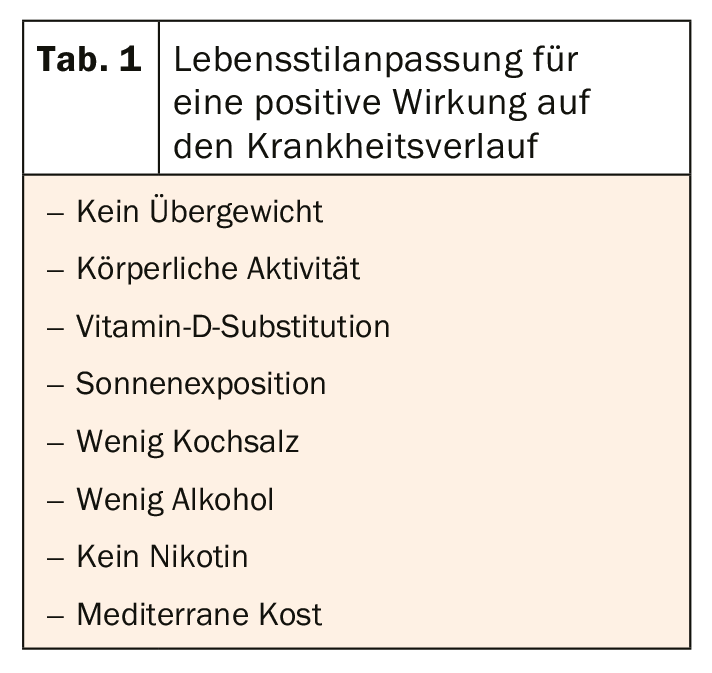
“Today, a good life despite MS is no longer a fiction,” Prof. Judith Haas, MD, Berlin, Germany, is certain. It is true that those affected are still concerned about their mobility, family planning and possible restrictions in their lifestyle or occupation. But more than half of all people with MS are still able to walk more than 500 meters after 27 years of disease, Haas said. Surveys also show that more than half of those affected do not experience any restrictions in their everyday working lives as a result of the disease. Only 28.3% have to interrupt or give up their work. The course of the disease can also be positively influenced by adjusting the lifestyle (Tab. 1). “As far as quality of life is concerned, we must not forget that patients usually assess it on a different basis than we doctors do,” the expert emphasized. While the physician focuses primarily on physical limitations, patients tend to focus on emotional impairments, role problems, or cognitive disadvantages that diminish quality of life. “Therefore, treatment of fatigue and depression also has a critical impact on quality of life,” Haas said.


Immunotherapies convince

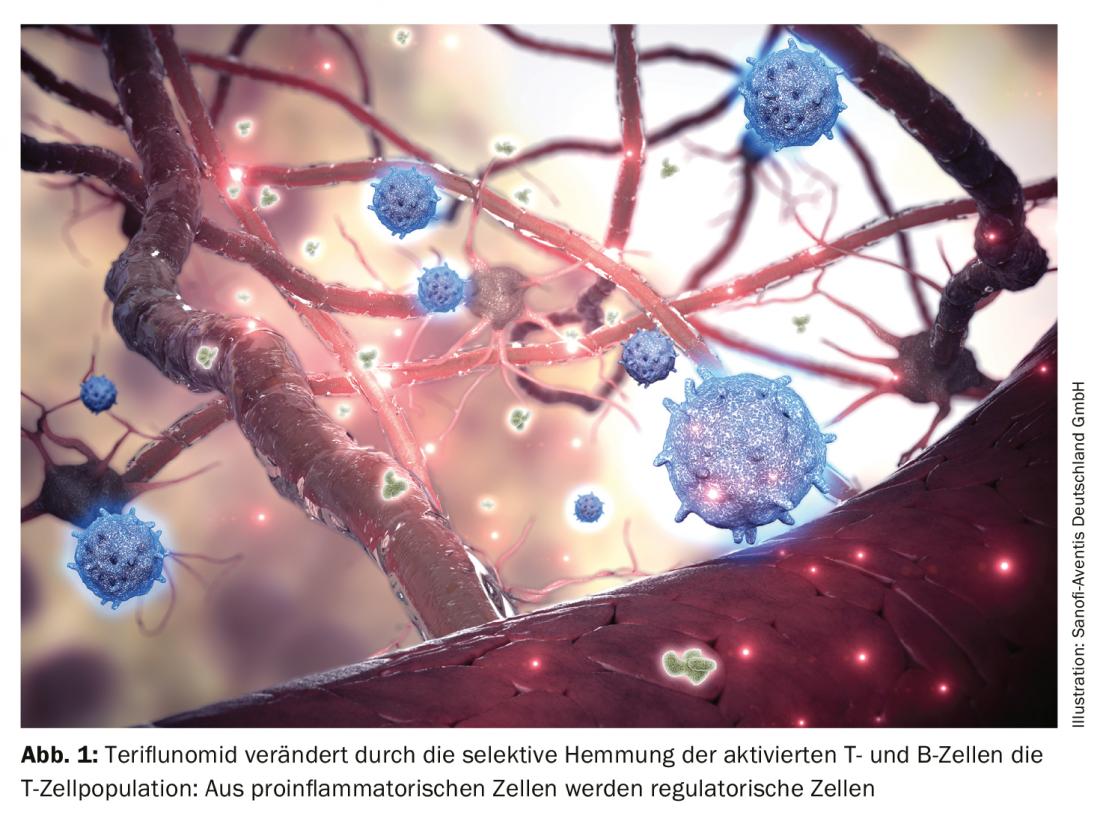
Immunomodulatory drugs such as teriflunomide (Aubagio®) have played a key role in the positive development of disease control in relapsing-remitting MS (RRMS). The drug selectively and reversibly inhibits the enzyme dihydroorotate dehydrogenase (DHODH) in mitochondria, thereby preventing the de novo synthesis of pyrimidine in activated lymphocytes. As a result, especially the activated CD4+ and CD8+ T cells relevant in the pathogenesis of MS are eliminated, as Prof. Dr. med. Sven Meuth, Münster, explained (Fig. 1). Results from real-world studies now demonstrate an efficacy of the immunomodulator comparable to that of dimethylflumarate (DMF) with regard to the mean relapse rate and the risk of progression. “However, significantly fewer adverse events occurred in the teriflunomide group,” the expert reported. Furthermore, when patients switched from prior therapy to teriflunomide, treatment satisfaction also increased significantly.


The humanized IgG1k monoclonal antibody alemtuzumab (Lemtrada®) has proven to be similarly effective. Current 8-year data demonstrate a low mean annual relapse rate and improvement in mental and physical well-being in pretreated patients. “In addition, at least 70% of patients had a stable or improved EDSS score each year compared with baseline,” Meuth said. An interim evaluation after six years also showed that only a proportion of 3.7% met the criteria for SPMS (secondary progressive MS) – in contrast to the comparison group of the MSBase registry, where it was 18%. Possible side effects, such as infusion-related reactions, mild to moderate infections or secondary autoimmune events, are detected at an early stage by a time-limited monitoring program and can be treated accordingly.

Source: Press workshop “5th MS Special(ists)”, June 25, 2019, Hamburg (D). Organizer: Sanofi


InFo NEUROLOGY & PSYCHIATRY 2019; 17(5): 34.
Publikation
  • InFo NEUROLOGIE & PSYCHIATRIE
Related Topics
  • Aubagio
  • Immunotherapy
  • Lemtrada
  • MS
  • Multiple sclerosis
Previous Article
  • Chronic inflammatory skin diseases

Positive long-term effects in moderate to severe psoriasis

  • Dermatology and venereology
  • Market & Medicine
  • RX
  • Studies
View Post
Next Article
  • Gynecological oncology

The treatment of breast carcinoma over time

  • Education
  • Gynecology
  • Oncology
  • RX
View Post
You May Also Like
View Post
  • 3 min
  • Genetic Kidney Disease: DOUBLE PROTECT Alport

The SGLT-2 inhibitor dapagliflozin as an add-on to RAS blockade

    • RX
    • Education
    • General Internal Medicine
    • Genetics
    • Nephrology
    • Studies
View Post
  • 4 min
  • Case Study: Cystic Fibrosis in Adults

Recurrent Pneumonia as a Manifestation of Cystic Fibrosis

    • RX
    • Education
    • Infectiology
    • Pneumology
View Post
  • 5 min
  • Long COVID/Fatigue Clinic

An Innovative Approach: Neuroplasticity and Predictive Processing

    • RX
    • Congress Reports
    • General Internal Medicine
    • Infectiology
    • Neurology
    • Physical medicine and rehabilitation
    • Pneumology
    • Psychiatry and psychotherapy
View Post
  • 6 min
  • T-cell lymphomas

Diagnostic Challenges and New Treatment Options

    • RX
    • Education
    • Hematology
    • Oncology
    • Studies
View Post
  • 6 min
  • Interbrain Synchrony

Two Brains, One Thought

    • RX
    • Education
    • Neurology
    • Psychiatry and psychotherapy
    • Studies
View Post
  • 8 min
  • Atopic Dermatitis in Children and Adults

Topically Applied “Small Molecules”: Janus Kinases or PDE-4 as Targets?

    • RX
    • Allergology and clinical immunology
    • Dermatology and venereology
    • Education
    • Pharmacology and toxicology
    • Studies
View Post
  • 4 min
  • Dermatomyositis

Glucocorticoids for more than one year

    • RX
    • Dermatology and venereology
    • Education
    • General Internal Medicine
    • Pneumology
    • Rheumatology
    • Studies
View Post
  • 13 min
  • Diabetic Polyneuropathy

Clinical Presentation, Diagnosis, and Treatment of DSPN

    • RX
    • CME continuing education
    • Endocrinology and Diabetology
    • Neurology
    • Prevention and health care
    • Studies
  • IBD matters

    Zum Thema
Top CME content
  • 1
    Clinical Presentation, Diagnosis, and Treatment of DSPN
  • 2
    Why is it so hard to lose weight?
  • 3
    Four-Legged Medical Assistants – Therapy Dogs in Clinical Settings
  • 4
    Functional limb preservation between infection control, vascular medicine and resurfacing
  • 5
    Update on Idiopathic Pulmonary Fibrosis

Newsletter

Sign up and stay up to date

Subscribe
Medizinonline Medizinonline
  • Contact
  • General terms and conditions
  • Imprint

Input your search keywords and press Enter.