Medizinonline Medizinonline
  • News
    • News
    • Market & Medicine
  • Patients
    • Disease patterns
    • Diagnostics
    • Therapy
  • Partner Content
    • Diabetes
      • Dia-Month Club – Type 2 Diabetes
      • Diabetes in Motion
      • Diabetes Podcasts
    • Gastroenterology
      • IBD matters
    • Oncology
      • Swiss Oncology in motion
    • Orthopedics
      • Osteoporosis in motion
  • Departments
    • Allergology and clinical immunology
    • General Internal Medicine
    • Anesthesiology
    • Angiology
    • Surgery
    • Dermatology and venereology
    • Endocrinology and Diabetology
    • Nutrition
    • Gastroenterology and Hepatology
    • Genetics
    • Geriatrics
    • Gynecology
    • Hematology
    • Infectiology
    • Cardiology
    • Nephrology
    • Neurology
    • Emergency and intensive care medicine
    • Nuclear Medicine
    • Oncology
    • Ophthalmology
    • ORL
    • Orthopedics
    • Pediatrics
    • Pharmacology and toxicology
    • Pharmaceutical medicine
    • Phlebology
    • Physical medicine and rehabilitation
    • Pneumology
    • Prevention and health care
    • Psychiatry and psychotherapy
    • Radiology
    • Forensic Medicine
    • Rheumatology
    • Sports Medicine
    • Traumatology and trauma surgery
    • Tropical and travel medicine
    • Urology
    • Dentistry
  • CME & Congresses
    • CME continuing education
    • Congress Reports
    • Congress calendar
  • Practice
    • Noctimed
    • Practice Management
    • Jobs
    • Interviews
  • Log In
  • Register
  • My account
  • Contact
  • Publications
  • Contact
  • Deutsch
  • English
  • Français
  • Italiano
  • Português
  • Español
Subscribe
Medizinonline Medizinonline
  • News
    • News
    • Market & Medicine
  • Patienten
    • Krankheitsbilder
    • Diagnostik
    • Therapie
  • Partner Content
    • Diabetes
      • Dia-Month Club – Type 2 Diabetes
      • Diabetes in Motion
      • Diabetes Podcasts
    • Gastroenterology
      • IBD matters
    • Oncology
      • Swiss Oncology in motion
    • Orthopedics
      • Osteoporosis in motion
    • Phytotherapie
    • Rheumatology
  • Departments
    • Fachbereiche 1-13
      • Allergology and clinical immunology
      • General Internal Medicine
      • Anesthesiology
      • Angiology
      • Surgery
      • Dermatology and venereology
      • Endocrinology and Diabetology
      • Nutrition
      • Gastroenterology and Hepatology
      • Genetics
      • Geriatrics
      • Gynecology
      • Hematology
    • Fachbereiche 14-26
      • Infectiology
      • Cardiology
      • Nephrology
      • Neurology
      • Emergency and intensive care medicine
      • Nuclear Medicine
      • Oncology
      • Ophthalmology
      • ORL
      • Orthopedics
      • Pediatrics
      • Pharmacology and toxicology
      • Pharmaceutical medicine
    • Fachbereiche 26-38
      • Phlebology
      • Physical medicine and rehabilitation
      • Phytotherapy
      • Pneumology
      • Prevention and health care
      • Psychiatry and psychotherapy
      • Radiology
      • Forensic Medicine
      • Rheumatology
      • Sports Medicine
      • Traumatology and trauma surgery
      • Tropical and travel medicine
      • Urology
      • Dentistry
  • CME & Congresses
    • CME continuing education
    • Congress Reports
    • Congress calendar
  • Practice
    • Noctimed
    • Practice Management
    • Jobs
    • Interviews
Login

Sie haben noch keinen Account? Registrieren

  • Diet for diabetes

Estimating carbohydrates is good, weighing them is even better

    • Congress Reports
    • Endocrinology and Diabetology
    • Nutrition
    • RX
  • 4 minute read

The diagnosis of diabetes mellitus almost always means that patients have to change their diet. Mieke Jacobs, Bc Dietetics, nutritionist at the University Hospital Zurich, provided information on the most important nutrition principles in a lecture at the “Diabetes Update Refresher”. Patients should know which foods contain how many carbohydrates. Therefore, weighing food – at least for a certain period of time – is still useful to train the patient’s eye.

A healthy diet adapted to the disease is an important part of the necessary lifestyle adjustments for diabetics. To learn proper nutrition principles, patients usually go to nutrition counseling. This pursues various goals. Promote and support healthy eating to improve overall health. In particular, the focus is on ensuring that patients achieve and maintain individual blood glucose, blood pressure and lipid targets, as well as target weight, so that late complications can be avoided wherever possible. It is important that the nutritionist takes individual nutritional needs into account as much as possible and gives practical advice that is suitable for everyday use. Patients should keep the joy of eating – and, for example, also plan to enjoy sweets in moderation – and only restrict themselves where it is really necessary.

Special diet is not necessary

The American Diabetes Association’s guidelines provide recommendations on various subsets of nutrition [1,2]. Type 2 diabetics who are overweight are recommended to reduce their weight; this improves not only blood glucose levels, but also blood pressure and lipid levels, especially at the onset of diabetes.

“There is no such thing as an ideal nutrient ratio between carbohydrates, proteins and fats,” the speaker said. Therefore, no recommendations are made as to how the distribution of these macronutrients should be in the diet. With fat, for example, it is not the quantity but the quality that is decisive. Increasing the intake of omega-3 fatty acids makes sense.

Acceptable diets for diabetes management include the Mediterranean diet, DASH (Dietary Approaches to Stop Hypertension), low-fat, and low-carb. A diet that pays attention to the glycemic index can moderately improve glucose metabolism.

Weigh and estimate carbohydrates

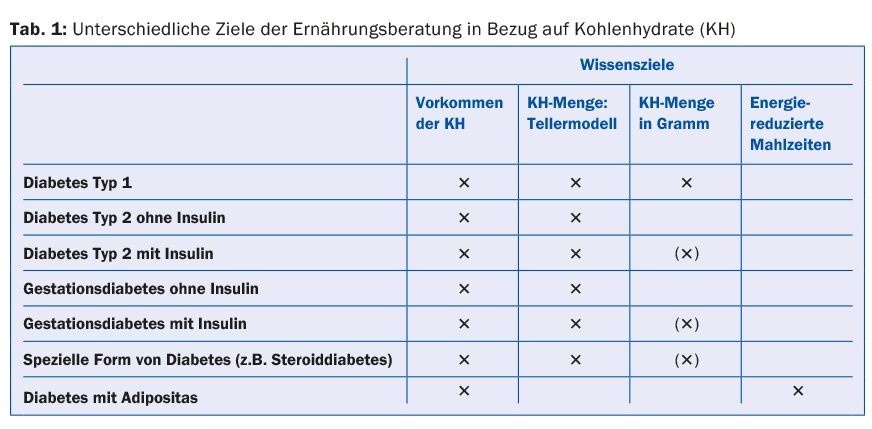
The most important dietary components for diabetics are carbohydrates, as they cause the postprandial blood glucose level to rise the most. An ideal value for how many carbohydrates a diabetic should consume cannot be quantified, but it is important for diabetics to be able to estimate the carbohydrates contained in a meal. Mieke Jacobs advocated that individuals newly diagnosed with type 1 diabetes weigh carbohydrates for at least a period of time to train the eye and get a feel for “normal” portions (Table 1).
 

Diabetics should know which foods contain how many carbohydrates and how quickly they are digested. To train this knowledge, Jacobs works with different methods (plate model, carbohydrate exchange tables, diet plans, etc.). For example, sugar cubes can be used to visualize how many carbohydrates individual foods contain (three sugar cubes correspond to 10 g of carbohydrates). When the speaker showed the corresponding picture, the audience was also amazed: a banana is equivalent to six sugar cubes, an apple is equivalent to five and a roll made of white flour is even equivalent to nine sugar cubes.

Sucrose (household sugar) does not increase blood sugar more than other carbohydrates, but because of its caloric density, sucrose consumption should be limited. More and more diabetics are also using apps that help them estimate the carbohydrates and calorie content of a meal (e.g. “Carbs and Cals” or “Mysugr”).

Artificial sweeteners and light products help to reduce the intake of sugar and calories. A whole range of sweeteners are approved in Switzerland, but not all of them are used as table-top sweeteners.

Glycemic index

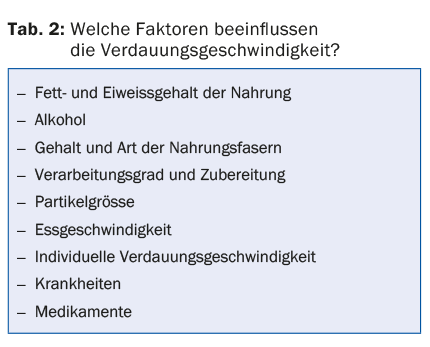
The glycemic index indicates in numbers which blood sugar-increasing effect a food has. The reference value (100) is the value of glucose. A food is tested in each case in the amount that contains 100 g of carbohydrates. For example, blood glucose levels rise rapidly after eating fruit juices, sorbets, cornflakes, white bread or mashed potatoes, and slowly after eating fondue, pizza or pasta. From the glycemic index, when the carbohydrate content of a food is taken into account, the glycemic load is obtained. However, both values are imprecise and subject to strong inter- and intraindividual variations. The rate of digestion, which in turn is influenced by numerous factors (Tab. 2), also plays an important role.
Using patient examples, the speaker explained how nutritional counseling is done in practice. This showed that both the amount of carbohydrate-containing foods and insulin requirements varied widely among patients.

Source: Diabetes Update Refresher, December 4, 2015, Zurich


Literature:

  1. American Diabetes Association: Foundations of Care: Education, Nutrition, Physical Activity, Smoking Cessation, Psychosocial Care, and Immunization. Diabetes Care 2015; 38: Supplement 1 S20-S30. doi: 10.2337/dc15-S007
  2. Evert AB, et al: Nutrition Therapy Recommendations for the Management of Adults With Diabetes. Diabetes Care 2014; 37: Supplement 1 S120-S143. doi: 10.2337/dc14-S120

HAUSARZT PRAXIS 2016; 11(3): 53-55

Autoren
  • Dr. med. Eva Ebnöther
Publikation
  • HAUSARZT PRAXIS
Related Topics
  • bold
  • Carbohydrates
  • Diabetes
  • Nutrition
  • Omega-3
  • Protein
  • Sugar
Previous Article
  • "Therapy-resistant" hypertension

What are the reasons?

  • Cardiology
  • Education
  • General Internal Medicine
  • RX
View Post
Next Article
  • Meta-analysis on endometrial cancer

Long-term protection through the use of oral contraceptives

  • Gynecology
  • News
  • Oncology
  • RX
  • Studies
View Post
You May Also Like
View Post
  • 8 min
  • Psychooncology

Communication as the key to therapy adherence

    • RX
    • CME continuing education
    • General Internal Medicine
    • Practice Management
View Post
  • 9 min
  • Cardiology

Minimally invasive – the quiet triumph of modern heart surgery

    • RX
    • Cardiology
    • CME continuing education
    • Studies
    • Surgery
View Post
  • 6 min
  • Schizophrenia in the early-onset stage

Which antipsychotic should be used for treatment-naive patients?

    • RX
    • Education
    • Pharmacology and toxicology
    • Psychiatry and psychotherapy
    • Studies
View Post
  • 4 min
  • Diarrhea in children

The problem of parental expectations

    • RX
    • Education
    • Gastroenterology and Hepatology
    • General Internal Medicine
    • Infectiology
    • Pediatrics
    • Studies
View Post
  • 4 min
  • From symptom to diagnosis

Multilocular cystic renal cell carcinoma (MCRCC)

    • RX
    • Cases
    • Education
    • Nephrology
    • Oncology
    • Radiology
    • Studies
    • Surgery
View Post
  • 3 min
  • Shaping the Future with LLM & Co.

AI in Everyday Clinical Practice: Friend or Foe?

    • RX
    • General Internal Medicine
    • Practice Management
    • Prevention and health care
View Post
  • 5 min
  • Ulcerative colitis: current evidence on anti-inflammatory therapies

Remission induction and maintenance with biologics and JAK-i

    • RX
    • Congress Reports
    • Gastroenterology and Hepatology
    • General Internal Medicine
    • Studies
View Post
  • 4 min
  • Bronchiectasis

New strategies against neutrophilic inflammation

    • RX
    • Congress Reports
    • General Internal Medicine
    • Infectiology
    • Pneumology
    • Studies
  • IBD matters

    Zum Thema
Top CME content
  • 1
    Current State of Knowledge and New Therapeutic Approaches
  • 2
    Why is it so hard to lose weight?
  • 3
    Functional limb preservation between infection control, vascular medicine and resurfacing
  • 4
    Algorithms, avatars and the unburdened mind
  • 5
    Communication as the key to therapy adherence

Newsletter

Sign up and stay up to date

Subscribe
Medizinonline Medizinonline
  • Contact
  • General terms and conditions
  • Imprint

Input your search keywords and press Enter.