Medizinonline Medizinonline
  • News
    • News
    • Market & Medicine
  • Patients
    • Disease patterns
    • Diagnostics
    • Therapy
  • Partner Content
    • Diabetes
      • Dia-Month Club – Type 2 Diabetes
      • Diabetes in Motion
      • Diabetes Podcasts
    • Gastroenterology
      • IBD matters
    • Oncology
      • Swiss Oncology in motion
    • Orthopedics
      • Osteoporosis in motion
  • Departments
    • Allergology and clinical immunology
    • General Internal Medicine
    • Anesthesiology
    • Angiology
    • Surgery
    • Dermatology and venereology
    • Endocrinology and Diabetology
    • Nutrition
    • Gastroenterology and Hepatology
    • Genetics
    • Geriatrics
    • Gynecology
    • Hematology
    • Infectiology
    • Cardiology
    • Nephrology
    • Neurology
    • Emergency and intensive care medicine
    • Nuclear Medicine
    • Oncology
    • Ophthalmology
    • ORL
    • Orthopedics
    • Pediatrics
    • Pharmacology and toxicology
    • Pharmaceutical medicine
    • Phlebology
    • Physical medicine and rehabilitation
    • Pneumology
    • Prevention and health care
    • Psychiatry and psychotherapy
    • Radiology
    • Forensic Medicine
    • Rheumatology
    • Sports Medicine
    • Traumatology and trauma surgery
    • Tropical and travel medicine
    • Urology
    • Dentistry
  • CME & Congresses
    • CME continuing education
    • Congress Reports
    • Congress calendar
  • Practice
    • Noctimed
    • Practice Management
    • Jobs
    • Interviews
  • Log In
  • Register
  • My account
  • Contact
  • Publications
  • Contact
  • Deutsch
  • English
  • Français
  • Italiano
  • Português
  • Español
Subscribe
Medizinonline Medizinonline
  • News
    • News
    • Market & Medicine
  • Patienten
    • Krankheitsbilder
    • Diagnostik
    • Therapie
  • Partner Content
    • Diabetes
      • Dia-Month Club – Type 2 Diabetes
      • Diabetes in Motion
      • Diabetes Podcasts
    • Gastroenterology
      • IBD matters
    • Oncology
      • Swiss Oncology in motion
    • Orthopedics
      • Osteoporosis in motion
    • Phytotherapie
    • Rheumatology
  • Departments
    • Fachbereiche 1-13
      • Allergology and clinical immunology
      • General Internal Medicine
      • Anesthesiology
      • Angiology
      • Surgery
      • Dermatology and venereology
      • Endocrinology and Diabetology
      • Nutrition
      • Gastroenterology and Hepatology
      • Genetics
      • Geriatrics
      • Gynecology
      • Hematology
    • Fachbereiche 14-26
      • Infectiology
      • Cardiology
      • Nephrology
      • Neurology
      • Emergency and intensive care medicine
      • Nuclear Medicine
      • Oncology
      • Ophthalmology
      • ORL
      • Orthopedics
      • Pediatrics
      • Pharmacology and toxicology
      • Pharmaceutical medicine
    • Fachbereiche 26-38
      • Phlebology
      • Physical medicine and rehabilitation
      • Phytotherapy
      • Pneumology
      • Prevention and health care
      • Psychiatry and psychotherapy
      • Radiology
      • Forensic Medicine
      • Rheumatology
      • Sports Medicine
      • Traumatology and trauma surgery
      • Tropical and travel medicine
      • Urology
      • Dentistry
  • CME & Congresses
    • CME continuing education
    • Congress Reports
    • Congress calendar
  • Practice
    • Noctimed
    • Practice Management
    • Jobs
    • Interviews
Login

Sie haben noch keinen Account? Registrieren

  • Reflux

Also of interest to the pulmonologist

    • Congress Reports
    • Education
    • Gastroenterology and Hepatology
    • General Internal Medicine
    • Pneumology
    • RX
  • 3 minute read

In Western countries, GERD (gastroesophageal reflux disease) affects approximately 20% of the population. Normally, the route leads to the gastroenterologist, but because the food pathway and the airway cross at the level of the larynx, reflux may also be of interest to pulmonologists.

There are different degrees of severity and effects of gastroesophageal reflux disease (GERD) and also different views regarding diagnosis and therapy, not least depending on where exactly the reflux occurs. The consequences of disease are classically reflux esophagitis or non-erosive reflux disease, reminded Dr. Macé Schuurmans from the Department of Pneumology at the University Hospital Zurich [1].

Symptomatically, there are esophageal syndromes and extra-esophageal syndromes. Esophageal syndromes are further subdivided into symptomatic syndromes (typical reflux syndromes, reflux chest pain syndromes) and syndromes with esophageal injury (reflux esophagitis, reflux stricture, Barrett’s esophagus, adenocarcinoma). The extraesophageal syndromes can be divided into established associations (reflux cough, laryngitis, asthma, and dental erosions) and suspected associations (sinusitis, pulmonary fibrosis, pharyngitis, recurrent otitis media).


Reflux symptoms among others.

  • Heartburn/burning behind the breastbone (approx. 75%)
  • Regurgitation
  • Air burst
  • Epigastric pain
  • Dysphagia
  • Cough
  • Hoarseness


PPI as standard therapy

Reflux may be caused by insufficiency of the lower esophageal sphincter, primarily congenital, or by inhibitory influences on the sphincter such as caffeine, alcohol, or fatty foods. Autonomic dysregulation, gastroparesis, or diabetes can also promote reflux. In addition, there are physical aspects such as obesity, constricting clothing or a tight belt. Last but not least, there are patients who are anatomically susceptible due to, for example, a hiatal hernia or systemic sclerosis.

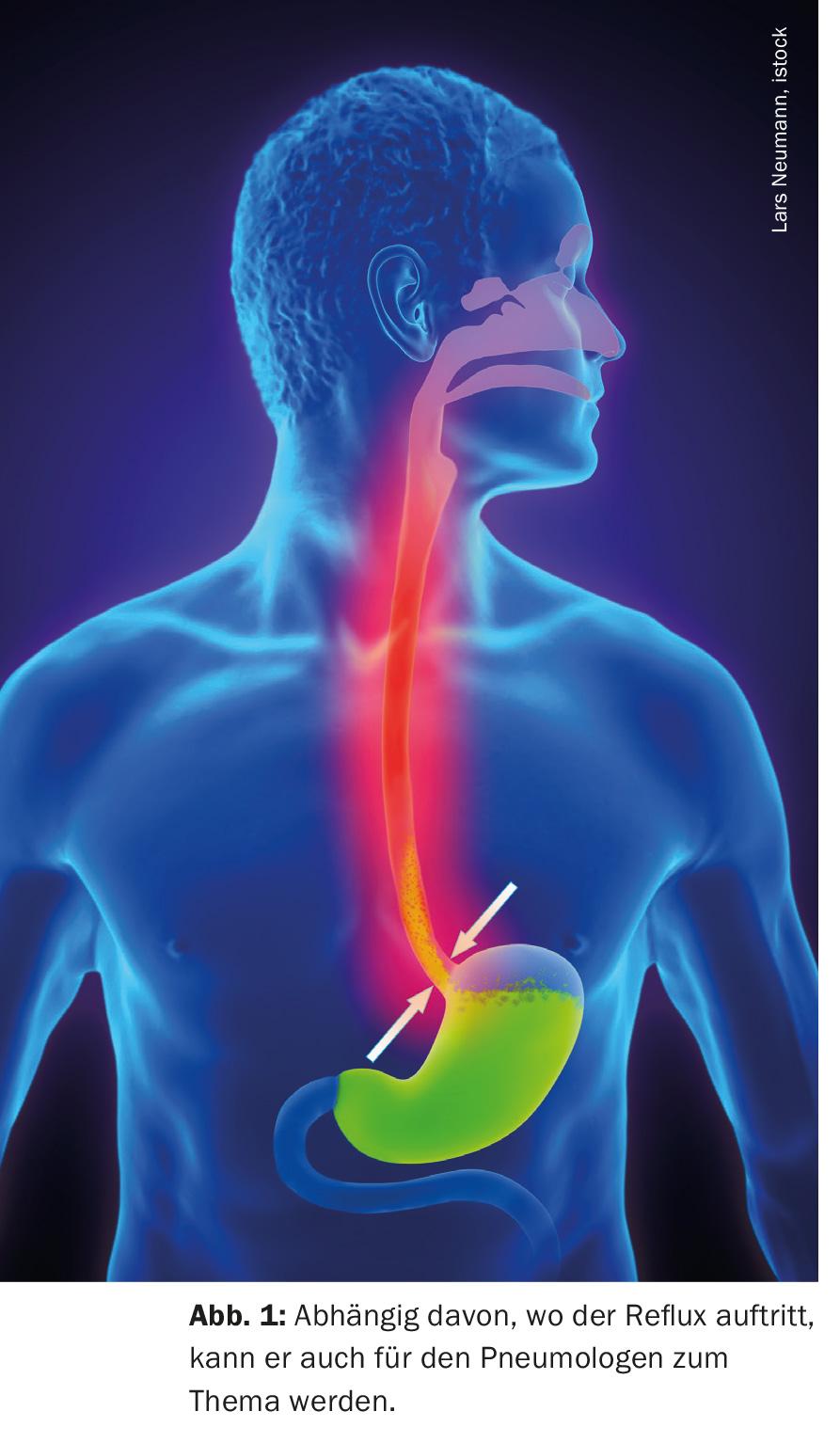
Gastroenterologists’ reflux diagnostics are esophageal manometry, esophageal pH metry, or sometimes catheter-free capsule-based pH metry. The colleagues then speak primarily of gastroesophageal reflux, whereas the phoniatrists and pulmonologists sometimes speak of laryngo-pharyngeal reflux, “because it comes up to a higher floor” (Fig. 1). Accordingly, the diagnosis is also made differently, namely with pharyngeal pH-metry.


Reflux therapy is well known, the use of proton pump inhibitors (PPI) is considered standard: pantoprazole, omeprazole, esomeprazole and others, typically taken half an hour before meals, for a sufficiently long period of time. This means that if a patient does not respond after 4 weeks, an extension to 8 weeks is quite advisable. If there is still no response, you can think about changing the product or do a course pH-metry to see if the PPI you are using also has a favorable effect on the pH. Dr. Schuurmans did not want to leave unmentioned the Nissen fundoplicatio as a surgical option for reflux treatment.

Non-specific antireflux measures

A recommended non-medicinal measure to combat reflux is to raise the bed at the head end: For a bed 2 meters long, the head end should be at least 15 cm higher than the foot end. Most people think of it as tipping up only the headboard. However, this leads to a kink in the body, possibly associated with breathing problems and back pain, for example when lying on the stomach. According to Dr. Schuurmans, however, it is more advisable to place a block of wood under the feet of the bed at the head end, for example, or alternatively between the slatted frame and its support surface. As further measures the expert mentioned:

  • Eat-lie interval of at least 2 hours (so that the stomach is not too full and regurgitation does not occur then).
  • No caffeinated beverages after 6 p.m. (including, for example, energy drinks or iced tea)
  • Avoiding fatty foods late at night
  • Weight loss (a lot of weight presses on the stomach!)

In addition to the classic, sufficiently long acid inhibition, Dr. Schuurmans recommended that the influencing factors also be taken into account, especially the aforementioned non-specific antireflux measures. However, it is not clear which of these non-drug interventions has the greatest impact because they are often either combined or not used at all in studies.


Source:

  1. FomF WebUp Pneumology, 7/12/2020.


InFo PNEUMOLOGY & ALLERGOLOGY 2021; 3(1): 33.

Autoren
  • Jens Dehn
Publikation
  • InFo PNEUMOLOGIE & ALLERGOLOGIE
Previous Article
  • Insomnia

When counting sheep doesn’t help: comprehensive therapy for sleep disorders

  • Congress Reports
  • General Internal Medicine
  • Neurology
  • Pharmacology and toxicology
  • Psychiatry and psychotherapy
  • RX
View Post
Next Article
  • Heart failure

SGLT-2 inhibitors – great therapeutic potential in HFrEF patients.

  • Cardiology
  • Education
  • Endocrinology and Diabetology
  • General Internal Medicine
  • RX
  • Studies
View Post
You May Also Like
View Post
  • 18 min
  • From Risk Identification to Anti-Inflammatory Intervention

Inflammation as a Treatment Goal in Its Own Right

    • RX
    • Angiology
    • Cardiology
    • CME continuing education
    • Endocrinology and Diabetology
    • General Internal Medicine
    • Nutrition
    • Studies
View Post
  • 3 min
  • Psoriasis Research: What's in the Pipeline?

Highly selective oral TYK inhibitors in Phase III

    • RX
    • Allergology and clinical immunology
    • Congress Reports
    • Dermatology and venereology
    • Pharmacology and toxicology
    • Rheumatology
    • Studies
View Post
  • 11 min
  • Cardiometabolism

Retatrutid and the TRIUMPH Program: The Triple Agonist on the Horizon

    • RX
    • Cardiology
    • Education
    • Endocrinology and Diabetology
    • General Internal Medicine
    • Nutrition
    • Prevention and health care
    • Studies
View Post
  • 7 min
  • Pediatric Retinoblastoma

The Tumor Microenvironment and Modern Eye-Sparing Therapies

    • RX
    • Education
    • Oncology
    • Ophthalmology
    • Pediatrics
View Post
  • 3 min
  • Adherence and management in asthma and COPD

Better to listen to the pharmacist

    • RX
    • Education
    • General Internal Medicine
    • Pharmacology and toxicology
    • Pneumology
    • Studies
View Post
  • 14 min
  • Focus Update 2026

Echocardiography in Cardio-Oncology

    • RX
    • Cardiology
    • Education
    • Oncology
    • Radiology
    • Studies
View Post
  • 4 min
  • Physical activity with IBD

Sport is not murder, but it doesn’t help either

    • RX
    • Education
    • Gastroenterology and Hepatology
    • General Internal Medicine
    • Sports Medicine
    • Studies
View Post
  • 3 min
  • White and Black Skin Cancer

Biology and Modern Therapeutic Approaches

    • RX
    • Dermatology and venereology
    • Education
    • Oncology
    • Prevention and health care
    • Studies
    • Surgery
  • IBD matters

    Zum Thema
Top CME content
  • 1
    Update on Anti-Rheumatic Medications
  • 2
    Psychiatry versus Neuro-Oncology: Diagnostic Pitfalls
  • 3
    Focus on preventive care options
  • 4
    Inflammation as a Treatment Goal in Its Own Right
  • 5
    Personalized Treatment Before a Planned Pregnancy

Newsletter

Sign up and stay up to date

Subscribe
Medizinonline Medizinonline
  • Contact
  • General terms and conditions
  • Imprint

Input your search keywords and press Enter.