Medizinonline Medizinonline
  • News
    • News
    • Market & Medicine
  • Patients
    • Disease patterns
    • Diagnostics
    • Therapy
  • Partner Content
    • Diabetes
      • Dia-Month Club – Type 2 Diabetes
      • Diabetes in Motion
      • Diabetes Podcasts
    • Gastroenterology
      • IBD matters
    • Oncology
      • Swiss Oncology in motion
    • Orthopedics
      • Osteoporosis in motion
  • Departments
    • Allergology and clinical immunology
    • General Internal Medicine
    • Anesthesiology
    • Angiology
    • Surgery
    • Dermatology and venereology
    • Endocrinology and Diabetology
    • Nutrition
    • Gastroenterology and Hepatology
    • Genetics
    • Geriatrics
    • Gynecology
    • Hematology
    • Infectiology
    • Cardiology
    • Nephrology
    • Neurology
    • Emergency and intensive care medicine
    • Nuclear Medicine
    • Oncology
    • Ophthalmology
    • ORL
    • Orthopedics
    • Pediatrics
    • Pharmacology and toxicology
    • Pharmaceutical medicine
    • Phlebology
    • Physical medicine and rehabilitation
    • Pneumology
    • Prevention and health care
    • Psychiatry and psychotherapy
    • Radiology
    • Forensic Medicine
    • Rheumatology
    • Sports Medicine
    • Traumatology and trauma surgery
    • Tropical and travel medicine
    • Urology
    • Dentistry
  • CME & Congresses
    • CME continuing education
    • Congress Reports
    • Congress calendar
  • Practice
    • Noctimed
    • Practice Management
    • Jobs
    • Interviews
  • Log In
  • Register
  • My account
  • Contact
  • Publications
  • Contact
  • Deutsch
  • English
  • Français
  • Italiano
  • Português
  • Español
Subscribe
Medizinonline Medizinonline
  • News
    • News
    • Market & Medicine
  • Patienten
    • Krankheitsbilder
    • Diagnostik
    • Therapie
  • Partner Content
    • Diabetes
      • Dia-Month Club – Type 2 Diabetes
      • Diabetes in Motion
      • Diabetes Podcasts
    • Gastroenterology
      • IBD matters
    • Oncology
      • Swiss Oncology in motion
    • Orthopedics
      • Osteoporosis in motion
    • Phytotherapie
    • Rheumatology
  • Departments
    • Fachbereiche 1-13
      • Allergology and clinical immunology
      • General Internal Medicine
      • Anesthesiology
      • Angiology
      • Surgery
      • Dermatology and venereology
      • Endocrinology and Diabetology
      • Nutrition
      • Gastroenterology and Hepatology
      • Genetics
      • Geriatrics
      • Gynecology
      • Hematology
    • Fachbereiche 14-26
      • Infectiology
      • Cardiology
      • Nephrology
      • Neurology
      • Emergency and intensive care medicine
      • Nuclear Medicine
      • Oncology
      • Ophthalmology
      • ORL
      • Orthopedics
      • Pediatrics
      • Pharmacology and toxicology
      • Pharmaceutical medicine
    • Fachbereiche 26-38
      • Phlebology
      • Physical medicine and rehabilitation
      • Phytotherapy
      • Pneumology
      • Prevention and health care
      • Psychiatry and psychotherapy
      • Radiology
      • Forensic Medicine
      • Rheumatology
      • Sports Medicine
      • Traumatology and trauma surgery
      • Tropical and travel medicine
      • Urology
      • Dentistry
  • CME & Congresses
    • CME continuing education
    • Congress Reports
    • Congress calendar
  • Practice
    • Noctimed
    • Practice Management
    • Jobs
    • Interviews
Login

Sie haben noch keinen Account? Registrieren

  • Spinal muscular atrophy

Clinical experience speaks for individual therapy management

    • Congress Reports
    • Neurology
    • Pediatrics
    • RX
    • Studies
  • 3 minute read

Spinal muscular atrophy is a rare genetic disorder characterized by the loss of motor neurons in the spinal cord and lower brainstem. In the meantime, experts agree that therapy management must be geared to the individual needs and subjective goals of the person concerned, especially with increasing age. Because these have a great influence on the quality of life.

One in about 10,000 newborns has a gene defect that disrupts impulse conduction in motor neurons. Spinal muscular atrophy (SMA) is a rare, predominantly autosomal recessive muscle disease in which motor anterior horn cells and motor cranial nerve nuclei degenerate. It is the most common hereditary disease resulting in death in infancy and is often diagnosed at a very early age – although not exclusively [1,2]. SMA may also not become apparent until adulthood [3]. This heterogeneity therefore requires individualized therapy that takes into account the disease activity and needs of the patient.

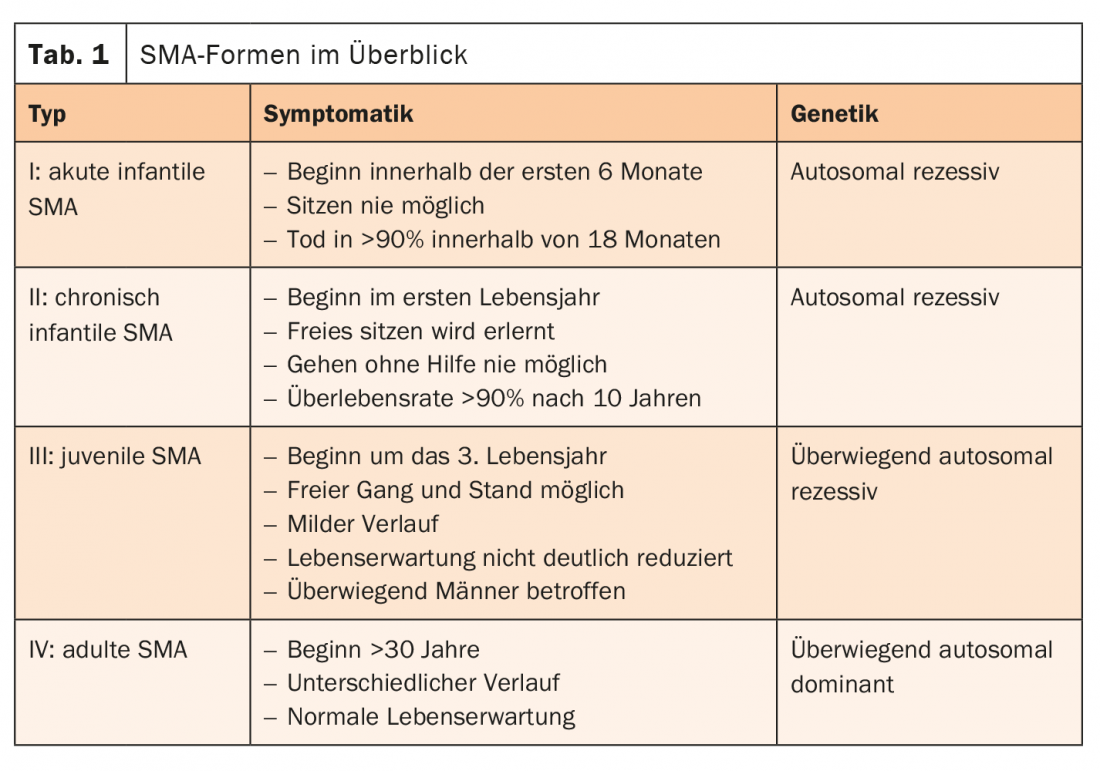
The cause of SMA is usually a defect in the SMN1 gene. Together with the SMN2 gene, it forms the survival of motor neuron (SMN) protein. This plays a central role in the transmission of impulses from the nerve cells to the muscles. If the SMN1 gene fails, the important protein can only be produced by the remaining SMN2 gene. Therefore, the more SMN2 copies are present, the later the onset of SMA and the more favorable the course. Patients with late-onset SMA (types II-IV) often have a normal life expectancy. The SMA forms are differentiated according to distribution pattern, onset of disease, severity and inheritance pattern (Tab. 1) [4].


Screen newborns if possible

A definite diagnosis regarding SMA can only be made by genetic testing. However, because type 1 SMA, if untreated, leads to death or requires permanent mechanical ventilation in 90% of cases by the time the patient reaches two years of age, early identification of the disease with initiation of treatment as soon as possible is indicated. Therapy management is complex and includes acute care as well as measures regarding rehabilitation, orthopedics, respiratory support, physical therapy, and drug interventions.

Therapy successes also with adolescents and adults

The first drug that not only acts symptomatically but also addresses the causes of the disease by correcting the underlying gene defect was approved in 2017 with nusinersen. The antisense oligonucleotide (ASO) is a specific splicing modulator that leaves the genome as it is and enhances the natural function of the SMN2 protein. This allows larger amounts of complete and functional SMN protein to be formed. Now, initial data from a multicenter cohort study have been presented. The main objective of this non-interventional observational study is to investigate the treatment goals and expectations of adult 5q-SMA patients and the subjective treatment satisfaction of patients [5].

The preliminary results show that individual treatment goals are of particular importance. Within the different 5q-SMA types, the goals of therapy vary significantly. Thus, preservation of arm function is one of the most common treatment goals, with a predominance in type 1 and type 2 patients. In patients with SMA type-3, preservation and improvement of leg function is more often prioritized. ASO therapy seems to be suitable for this purpose. Further study results also demonstrate that various motor abilities can stabilize or even clinically relevant motor improvements are possible in adults with 5q-SMA [6-8].

Congress: DGM 2021


Literature:

  1. Bowerman M, et al: Therapeutic strategies for spinal muscular atrophy: SMN and beyond. Dis Model Mech 2017; 10: 943-954.
  2. Borasio G, et al: Diagnostics of spinal muscular atrophies. Neurology 2001; 20:113-118.
  3. www.sma-schweiz.ch/spinale-muskelatrophie/typen-der-proximalen-sma (last accessed on 05.04.2021)
  4. www.muskelgesellschaft.ch/diagnosen/spinale-muskelatrophien-sma (last accessed on 05.04.2021)
  5. Meyer, et al: DGN Congress 2020, P333.
  6. Hagenacker T, et al: Lancet Neurol 2020; 19(4): 317-325.
  7. Walter MC, et al: J Neuromuscul Dis 2019; 6: 453-465.
  8. Maggi L, et al: JNNP. 2020, Nov;91(11): 1166-1174.


InFo NEUROLOGY & PSYCHIATRY 2021; 19(3): 41 (published 5.6.21, ahead of print).
HAUSARZT PRAXIS 2021; 16(8): 45
Autoren
  • Leoni Burggraf
Publikation
  • InFo NEUROLOGIE & PSYCHIATRIE
Related Topics
  • Motoneurons
  • SMA
  • Spinal muscular atrophy
Previous Article
  • Granulomatous diseases - an update

News and interesting facts about pathomechanisms and treatment

  • Congress Reports
  • Dermatology and venereology
  • Genetics
  • RX
  • Studies
View Post
Next Article
  • Management of dyslipidemia

Lipid-lowering agents for secondary prophylaxis also effective in elderly patients

  • Cardiology
  • Congress Reports
  • Endocrinology and Diabetology
  • General Internal Medicine
  • Geriatrics
  • RX
  • Studies
View Post
You May Also Like
View Post
  • 3 min
  • From symptom to diagnosis

Gynecomastia and Adipomastia

    • RX
    • Cases
    • Education
    • Endocrinology and Diabetology
    • General Internal Medicine
    • Gynecology
    • Radiology
    • Surgery
View Post
  • 7 min
  • Plastic surgery and reconstructive microsurgery for DFS

Functional limb preservation between infection control, vascular medicine and resurfacing

    • RX
    • Angiology
    • CME continuing education
    • Dermatology and venereology
    • Endocrinology and Diabetology
    • General Internal Medicine
    • Geriatrics
    • Physical medicine and rehabilitation
    • Surgery
View Post
  • 12 min
  • SURPASS-CVOT

Tirzepatide versus Dulaglutide in T2D with ASCVD

    • RX
    • Cardiology
    • Education
    • Endocrinology and Diabetology
    • General Internal Medicine
    • Pharmacology and toxicology
    • Studies
View Post
  • 6 min
  • Secondary prevention after ACS: individually optimized lipid management

Trend towards early combination therapy and new strategies for lowering Lp(a)

    • RX
    • Cardiology
    • Congress Reports
    • General Internal Medicine
    • Studies
View Post
  • 27 min
  • Pediatric Brain Tumors

Psychiatry versus Neuro-Oncology: Diagnostic Pitfalls

    • RX
    • CME continuing education
    • Neurology
    • Oncology
    • Pediatrics
    • Psychiatry and psychotherapy
    • Studies
View Post
  • 13 min
  • What the latest studies on the entire EF spectrum mean for clinical practice

Heart Failure – The 2026 Evidence Update

    • RX
    • Cardiology
    • Education
    • Endocrinology and Diabetology
    • Studies
View Post
  • 5 min
  • Acute ischemic stroke

Alteplase and Tenecteplase Are on the Same Level

    • RX
    • Education
    • Emergency and intensive care medicine
    • Neurology
    • Pharmacology and toxicology
    • Studies
View Post
  • 5 min
  • CKD in People with Type 2 Diabetes: Evidence-Based, Optimized Treatment

SGLT-2 inhibitors and GLP-1 receptor agonists: significant improvement in renal outcomes

    • RX
    • Education
    • Endocrinology and Diabetology
    • General Internal Medicine
    • Nephrology
    • Studies
Landingpage Fachinfo Landingpage Button
  • IBD matters

    Zum Thema
Top CME content
  • 1
    Update on Anti-Rheumatic Medications
  • 2
    Psychiatry versus Neuro-Oncology: Diagnostic Pitfalls
  • 3
    Focus on preventive care options
  • 4
    Inflammation as a Treatment Goal in Its Own Right
  • 5
    Personalized Treatment Before a Planned Pregnancy

Newsletter

Sign up and stay up to date

Subscribe
Medizinonline Medizinonline
  • Contact
  • General terms and conditions
  • Imprint

Input your search keywords and press Enter.